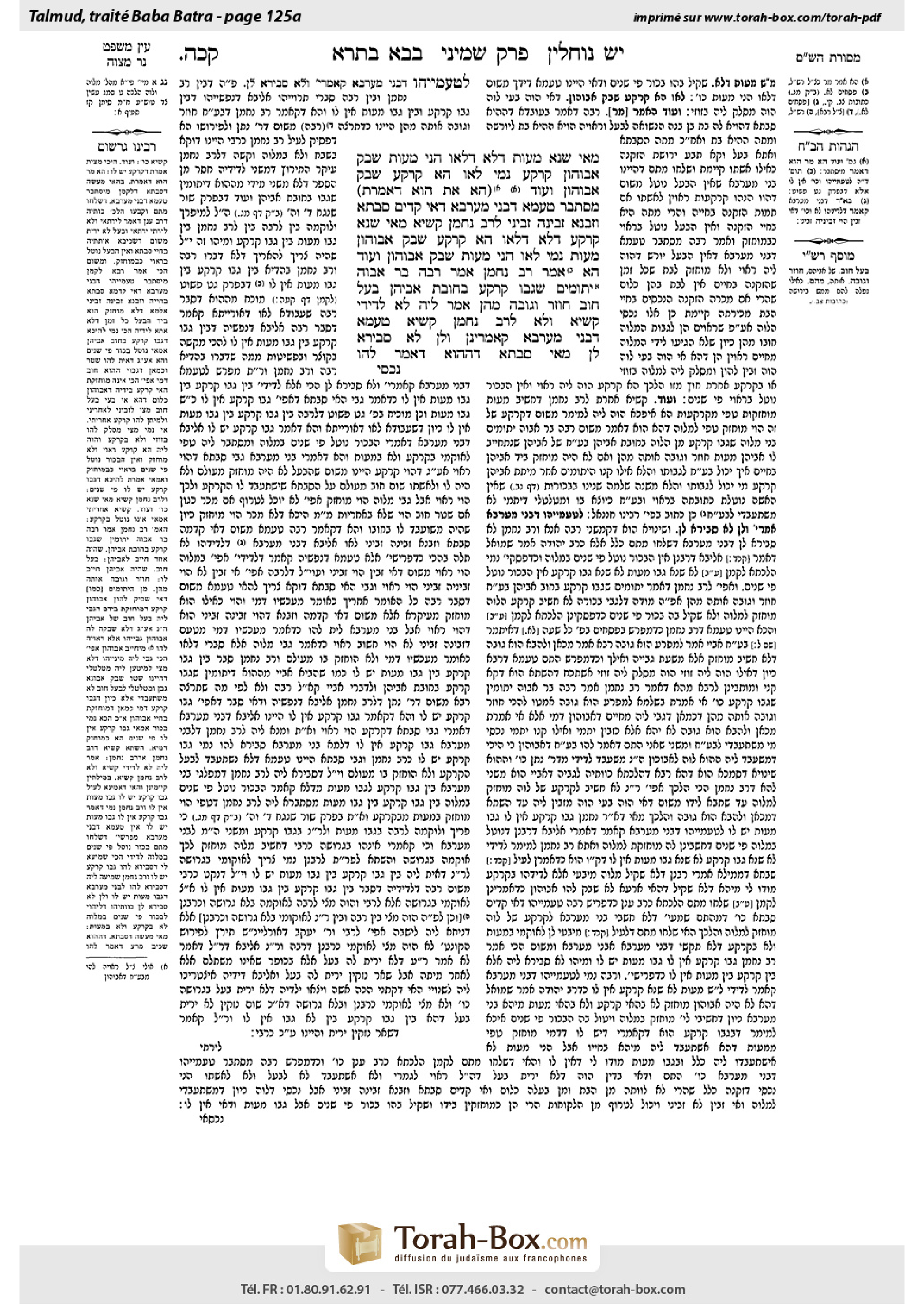
Bava Batra 125a: Talmud study for Daf Yomi
Study the Talmud for Daf Yomi with scanned pages, Hebrew text, English translations from Sefaria and AI-generated French translations.
Passage selection and English or AI-generated French translation are available where the scan has annotations. Daf Study is independent of Torah-Box and Sefaria.
Browse Bava Batra · בבא בתרא · All tractatesBava Batra 125a text and translations
This page of Bava Batra includes the Aramaic text, an English translation and an AI-generated French translation, alongside the scan above.
בבא בתרא קכ״ה א · Aramaic and Hebrew text
מַאי שְׁנָא מָעוֹת דְּלָא – דְּלָאו הָנֵי מָעוֹת שְׁבַק אֲבוּהוֹן; קַרְקַע נָמֵי – לָאו הָא קַרְקַע שְׁבַק אֲבוּהוֹן!
וְעוֹד, הָא אַתְּ הוּא דְּאָמְרַתְּ: מִסְתַּבֵּר טַעְמָא דִּבְנֵי מַעְרְבָא, דְּאִי קְדֵים סָבְתָּא וְזַבְּנָא – זְבִינַהּ זְבִינֵי!
לְרַב נַחְמָן קַשְׁיָא, מַאי שְׁנָא קַרְקַע דְּלָא – דְּלָאו הָא קַרְקַע שְׁבַק אֲבוּהוֹן; מָעוֹת נָמֵי – לָאו הָנֵי מָעוֹת שְׁבַק אֲבוּהוֹן!
וְעוֹד, הָא אָמַר רַב נַחְמָן אָמַר רַבָּה בַּר אֲבוּהּ: יְתוֹמִים שֶׁגָּבוּ קַרְקַע בְּחוֹבַת אֲבִיהֶן – בַּעַל חוֹב חוֹזֵר וְגוֹבָהּ מֵהֶן!
אֲמַר לֵיהּ: לָא לְדִידִי קַשְׁיָא, וְלָא לְרַב נַחְמָן קַשְׁיָא; טַעְמָא דִּבְנֵי מַעְרְבָא קָאָמְרִינַן, וְלַן לָא סְבִירָא לַן.
מַאי סָבְתָּא? דְּהַהוּא דַּאֲמַר לְהוּ:
Bava Batra 125a · English translation
because what is different about money, resulting in the halakha that the firstborn is not entitled to a double portion of it, is that their father did not leave them this specific money that was collected. With regard to land as well, their father did not leave them this specific parcel of land when he died, as the debtor could have repaid them with a different parcel of land, or with money.
And furthermore, aren’t you the one who said that the explanation of the people of the West, Eretz Yisrael, is reasonable? In a case where a married woman had been fit to inherit from her great-grandmother but then predeceased her great-grandmother, who then died, and her widower claims the inheritance in his late wife’s stead, the Sages of Eretz Yisrael ruled that he is not entitled to the inheritance, as it is merely property due to his wife, and a husband does not inherit property due to be inherited by his late wife. Rabba agreed that the inheritance is considered property due to the wife, and not property possessed by her, as if the great-grandmother would have sold it before she died, her sale would have been a valid sale. Here, too, the land should be considered property due to the father, of which a firstborn is not entitled to a double portion, since the debtor could have sold it. Therefore, Rabba’s opinion is difficult.
Abaya continues: According to the opinion of Rav Naḥman it is difficult; what is different about land, resulting in the halakha that the firstborn is not entitled to a double portion of it, is that their father did not leave them this specific parcel of land. With regard to money as well, their father did not leave them this specific money when he died.
And furthermore, doesn’t Rav Naḥman say that Rabba bar Avuh says: With regard to orphans who collected land for a debt owed to their father, their father’s creditor can come and seize this land from them, as any land owned by the father is liened against his debts. Evidently, Rav Naḥman holds that land liened against a debt has the legal status of land that is in the possession of the creditor. If so, why does Rav Naḥman hold that a firstborn is not entitled to a double portion of land that is collected as payment of a debt?
Rabba said to Abaye: According to my opinion it is not difficult, and according to the opinion of Rav Naḥman it is not difficult. We were merely saying, i.e., explaining, the reason for the opinion of the people of the West, Eretz Yisrael, introduced with the phrase: They sent the following ruling from there, that a firstborn is entitled to a double portion of the payment of a debt. But we ourselves do not hold in accordance with that opinion. Therefore, one cannot raise a contradiction from our opinions stated elsewhere to what we said in explanation of the Sages of Eretz Yisrael.
Having mentioned in passing the case of the great-grandmother, the Gemara discusses that case in depth. What is the case of the great-grandmother that was mentioned by Abaye? The Gemara explains: There was a certain moribund person who said to those present:
Bava Batra 125a · Traduction française (IA)
car ce qui diffère dans l'argent, ce qui conduit à la halakha selon laquelle le premier-né n'a pas droit à une double part de celui-ci, c'est que leur père n'a pas laissé à ses enfants cet argent spécifique qui a été recueilli. En ce qui concerne la terre également, leur père n'a pas laissé à ses enfants cette parcelle spécifique de terre lorsqu'il est décédé, car le débiteur aurait pu les rembourser avec une autre parcelle de terre ou avec de l'argent.
Et de plus, n'es-tu pas celui qui a dit que l'explication des gens du West, Eretz Yisrael, est raisonnable ? Dans un cas où une femme mariée avait été digne d'hériter de sa grand-mère paternelle, mais avait ensuite décédé avant elle, et celle-ci est décédée, et son veuf réclame l'héritage au nom de sa femme défunte, les Sages d'Eretz Yisrael ont rendu un jugement selon lequel il n'a pas droit à l'héritage, car il s'agit simplement de biens dus à sa femme, et un mari n'hérite pas de biens dus à son épouse décédée. Rabba a accepté que l'héritage soit considéré comme des biens dus à la femme, et non comme des biens possédés par elle, car si la grand-mère paternelle aurait vendu ces biens avant sa mort, cette vente aurait été valide. Ici aussi, la terre devrait être considérée comme des biens dus au père, dont le premier-né n'a pas droit à une double part, car le débiteur aurait pu la vendre. Ainsi, l'opinion de Rabba est difficile.
Abaya continue : Selon l'opinion de Rav Naḥman, cela est difficile ; ce qui diffère dans la terre, ce qui conduit à la halakha selon laquelle le premier-né n'a pas droit à une double part de celle-ci, c'est que leur père n'a pas laissé à ses enfants cette parcelle spécifique de terre. En ce qui concerne l'argent également, leur père n'a pas laissé à ses enfants cet argent spécifique lorsqu'il est décédé.
Et de plus, n'est-ce pas Rav Naḥman qui dit que Rabba bar Avuh a dit : En ce qui concerne les orphelins qui ont recueilli une terre en paiement d'une dette envers leur père, le créancier du père peut venir et saisir cette terre auprès d'eux, car toute terre appartenant au père est liée à ses dettes. Évidemment, Rav Naḥman considère que la terre liée à une dette a le statut juridique de la terre possédée par le créancier. Si c'est ainsi, pourquoi Rav Naḥman considère-t-il que le premier-né n'a pas droit à une double part de la terre recueillie en paiement d'une dette ?
Rabba a dit à Abaye : Selon mon opinion, cela n'est pas difficile, et selon l'opinion de Rav Naḥman, cela n'est pas difficile non plus. Nous étions simplement en train d'expliquer, c'est-à-dire de présenter, la raison de l'opinion des gens du West, Eretz Yisrael, introduite avec la phrase : Ils ont rendu le suivant jugement d'où ils viennent, que le premier-né a droit à une double part du paiement d'une dette. Mais nous-mêmes, nous ne suivons pas cette opinion. Ainsi, on ne peut pas établir une contradiction entre nos opinions exprimées ailleurs et ce que nous avons dit dans l'explication des Sages d'Eretz Yisrael.
Ayant mentionné à l'occasion le cas de la grand-mère paternelle, la Guemara discute en détail ce cas. Quel est le cas de la grand-mère paternelle mentionné par Abaye ? La Guemara explique : Il y avait un certain malade qui a dit à ceux qui étaient présents :
Traduction française générée par IA à partir de l’édition anglaise de Sefaria. Vérifie toujours un passage avec le texte source.
Text from Sefaria: William Davidson Edition - Vocalized Aramaic (CC BY NC); William Davidson Edition - English (CC BY NC).