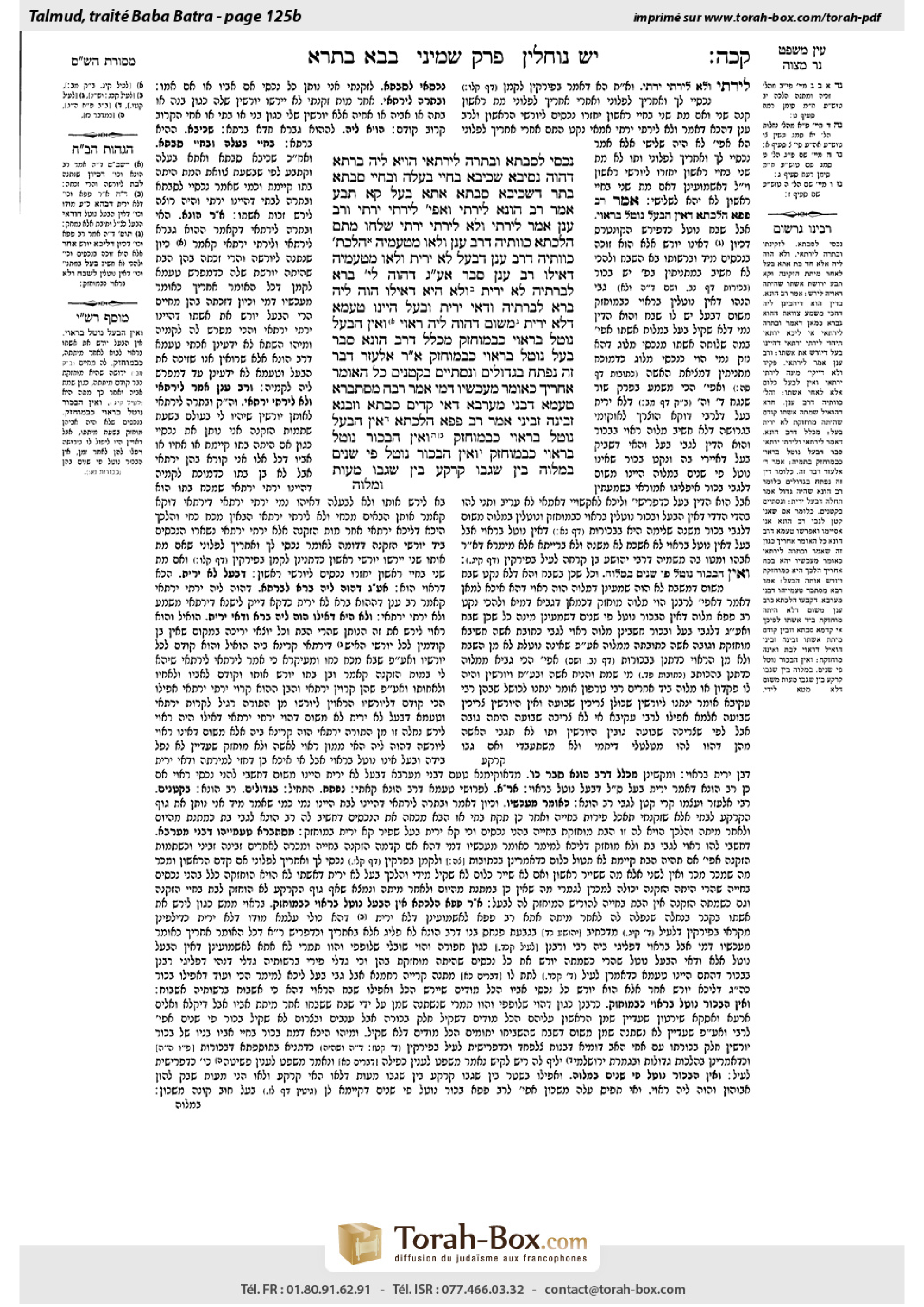
Bava Batra 125b: Talmud study for Daf Yomi
Study the Talmud for Daf Yomi with scanned pages, Hebrew text, English translations from Sefaria and AI-generated French translations.
Passage selection and English or AI-generated French translation are available where the scan has annotations. Daf Study is independent of Torah-Box and Sefaria.
Browse Bava Batra · בבא בתרא · All tractatesBava Batra 125b text and translations
This page of Bava Batra includes the Aramaic text, an English translation and an AI-generated French translation, alongside the scan above.
בבא בתרא קכ״ה ב · Aramaic and Hebrew text
״נִכְסַי לְסָבְתָּא, וּבָתְרַהּ לְיָרְתַאי״. הַוְיָא לֵיהּ בְּרַתָּא דַּהֲוָה נְסִיבָא, שְׁכִיבָא בְּחַיֵּי בַּעְלַהּ וּבְחַיֵּי סָבְתָּא. בָּתַר דִּשְׁכִיבָא סָבְתָּא, אֲתָא בַּעַל קָא תָּבַע.
אָמַר רַב הוּנָא: ״לְיָרְתַי״ – וַאֲפִילּוּ לְיָרְתֵי יָרְתַי. וְרַב עָנָן אָמַר: ״לְיָרְתַי״ – וְלָא לְיָרְתֵי יָרְתַי.
שְׁלַחוּ מִתָּם: הִלְכְתָא כְּווֹתֵיהּ דְּרַב עָנָן, וְלָאו מִטַּעְמֵיהּ. הִלְכְתָא כְּווֹתֵיהּ דְּרַב עָנָן – דְּבַעַל לָא יָרֵית, וְלָאו מִטַּעְמֵיהּ; דְּאִילּוּ רַב עָנָן סָבַר: אַף עַל גַּב דַּהֲוָה לֵיהּ בְּרָא לִבְרַתֵּיהּ, לָא יָרֵית; וְלָא הִיא, דְּאִילּוּ הֲוָה לֵיהּ בְּרָא לִבְרַתֵּיהּ, וַדַּאי יָרֵית; וּבַעַל הַיְינוּ טַעְמָא דְּלָא יָרֵית – מִשּׁוּם דַּהֲוָה לֵיהּ רָאוּי, וְאֵין הַבַּעַל נוֹטֵל בָּרָאוּי כִּבְמוּחְזָק.
מִכְּלָל דְּרַב הוּנָא סָבַר: בַּעַל נוֹטֵל בָּרָאוּי כִּבְמוּחְזָק?!
אָמַר רַבִּי אֶלְעָזָר: דָּבָר זֶה נִפְתַּח בִּגְדוֹלִים וְנִסְתַּיֵּים בִּקְטַנִּים, כׇּל הָאוֹמֵר: ״אַחֲרֶיךָ״, כְּאוֹמֵר ״מֵעַכְשָׁיו״ דָּמֵי.
אָמַר רַבָּה: מִסְתַּבְּרָא טַעְמָא דִּבְנֵי מַעְרְבָא, דְּאִי קְדֵים סָבְתָּא וְזַבִּנָא – זְבִינַהּ זְבִינֵי.
אָמַר רַב פָּפָּא, הִלְכְתָא: אֵין הַבַּעַל נוֹטֵל בָּרָאוּי כִּבְמוּחְזָק, וְאֵין הַבְּכוֹר נוֹטֵל בָּרָאוּי כִּבְמוּחְזָק. וְאֵין הַבְּכוֹר נוֹטֵל פִּי שְׁנַיִם בַּמִּלְוָה – בֵּין שֶׁגָּבוּ קַרְקַע, בֵּין שֶׁגָּבוּ מָעוֹת.
Bava Batra 125b · English translation
All my property is given to my grandmother, and after she dies, it is given to my heirs, not inherited by her heirs. He then died. He had a married daughter, who died during the lifetime of her husband and during the lifetime of her father’s grandmother. After her father’s grandmother died, her husband came and claimed the inheritance, as his wife was the heir of her father, and he is his wife’s heir.
Rav Huna said: When her father said that his property is given: To my heirs, he meant: And even to the heirs of my heirs. Therefore, since his daughter’s husband is the heir of his heir, he is entitled to the inheritance. And Rav Anan said that he meant: To my heirs, but not to the heirs of my heirs. Therefore, the husband is not entitled to the property.
The Gemara relates: They sent a ruling from there, Eretz Yisrael: The halakha is in accordance with the opinion of Rav Anan, but not due to his reasoning. The Gemara explains: The halakha is in accordance with the opinion of Rav Anan that the husband does not inherit the property. But not due to his reasoning, as Rav Anan holds that even if his daughter had a son to inherit from her, he would not inherit the property, as her father bequeathed it only to his heirs, not to the heirs of his heirs. And that is not so, as if his daughter had a son, he would certainly inherit; and this is the reason the husband does not inherit: Because the inheritance is considered property due to the daughter, as she did not own it during her lifetime, and a husband does not take in inheritance property due to his wife as he does the property she possessed.
The Gemara asks: By inference, does Rav Huna, who ruled that the husband is entitled to the inheritance, hold that a husband takes in inheritance property due to his wife as he does the property she possessed?
Rabbi Elazar says: This matter was introduced by great Sages, namely Rav Huna, and concluded by lesser Sages, i.e., by me. Rabbi Elazar, humbly referring to himself as a lesser Sage, will now explain Rav Huna’s statement. Anyone who says to another upon granting him an inheritance or a gift: After you die it is given to so-and-so, is considered like one who says: It is given to so-and-so from now. The first recipient merely has the right to use the property during his lifetime but did not actually become the owner. Accordingly, the inheritance was owned by the daughter in her lifetime, and the great-grandmother merely had usage rights. Therefore, it is inherited by the husband.
Rabba said: The explanation of the people of the West, that the inheritance is considered property due to the daughter and not property possessed by her, is reasonable, as if the grandmother would have sold it before she died, her sale would have been a valid sale, and the daughter would not have received it at all.
In conclusion, Rav Pappa said that the halakha is that the husband does not take in inheritance property due to his wife as he does the property she possessed; and a firstborn does not take a double portion of property due to his father as he does the property his father possessed; and a firstborn does not take a double portion of payment for a loan, whether the brothers collected land or whether they collected money.
Bava Batra 125b · Traduction française (IA)
Tous mes biens sont donnés à ma grand-mère, et après sa mort, ils sont donnés à mes héritiers, et non aux héritiers de ma grand-mère. Il mourut ensuite. Il avait une fille mariée, qui mourut pendant la vie de son mari et pendant la vie de sa grand-mère paternelle. Après la mort de sa grand-mère paternelle, son mari vint réclamer l'héritage, car sa femme était l'héritière de son père, et il était l'héritier de sa femme.
Rav Huna dit : Lorsque son père disait que ses biens sont donnés : À mes héritiers, il voulait dire : Même aux héritiers de mes héritiers. Ainsi, puisque le mari de sa fille est l'héritier de l'héritier, il a le droit à l'héritage. Et Rav Anan dit que cela signifiait : À mes héritiers, mais pas aux héritiers de mes héritiers. Ainsi, le mari n'a pas le droit à la propriété.
La Guemara rapporte : Ils envoyèrent un avis depuis là-bas, Eretz Yisrael : La halakha suit l'opinion de Rav Anan, mais pas en raison de sa raison. La Guemara explique : La halakha suit l'opinion de Rav Anan selon laquelle le mari ne hérite pas de la propriété. Mais pas en raison de sa raison, car Rav Anan considère que même si sa fille avait un fils pour hériter d'elle, il ne l'hériterait pas de la propriété, car son père avait donné la propriété uniquement à ses héritiers, pas aux héritiers de ses héritiers. Et cela n'est pas vrai, car si sa fille avait un fils, il hériterait certainement. Et c'est la raison pour laquelle le mari n'hérite pas : Parce que l'héritage est considéré comme la propriété de la fille, car elle ne l'avait pas possédée pendant sa vie, et un mari ne prend pas en héritage la propriété due à sa femme, car il ne prend pas la propriété qu'elle possédait.
La Guemara pose la question : Par déduction, Rav Huna, qui a décidé que le mari est dû à l'héritage, considère-t-il que le mari prend en héritage la propriété due à sa femme comme il le fait pour la propriété qu'elle possédait ?
Rabbi Elazar dit : Cette affaire a été introduite par des grands Sages, à savoir Rav Huna, et conclue par des Sages moindres, c'est-à-dire par moi. Rabbi Elazar, humblement se désignant comme un Sage moindre, expliquera maintenant l'affirmation de Rav Huna. Quiconque dit à un autre, lorsqu'il lui donne un héritage ou un don : Après que tu meures, il est donné à tel ou tel, est considéré comme celui qui dit : Il est donné à tel ou tel dès maintenant. Le premier récepteur a seulement le droit d'utiliser la propriété pendant sa vie, mais n'a pas réellement devenu propriétaire. Ainsi, l'héritage appartenait à la fille pendant sa vie, et la grand-mère n'avait que des droits d'usage. Par conséquent, il est hérité par le mari.
Rabba dit : L'explication des gens de l'Ouest, que l'héritage est considéré comme la propriété de la fille et non comme la propriété qu'elle possédait, est raisonnable, car si la grand-mère avait vendu cela avant sa mort, sa vente aurait été une vente valide, et la fille n'aurait pas reçu cela du tout.
En conclusion, Rav Pappa dit que la halakha est que le mari ne prend pas en héritage la propriété due à sa femme comme il le fait pour la propriété qu'elle possédait ; et le premier-né ne prend pas une double part de la propriété due à son père comme il le fait pour la propriété que son père possédait ; et le premier-né ne prend pas une double part de paiement pour un prêt, que les frères aient collecté des terres ou de l'argent.
Traduction française générée par IA à partir de l’édition anglaise de Sefaria. Vérifie toujours un passage avec le texte source.
Text from Sefaria: William Davidson Edition - Vocalized Aramaic (CC BY NC); William Davidson Edition - English (CC BY NC).