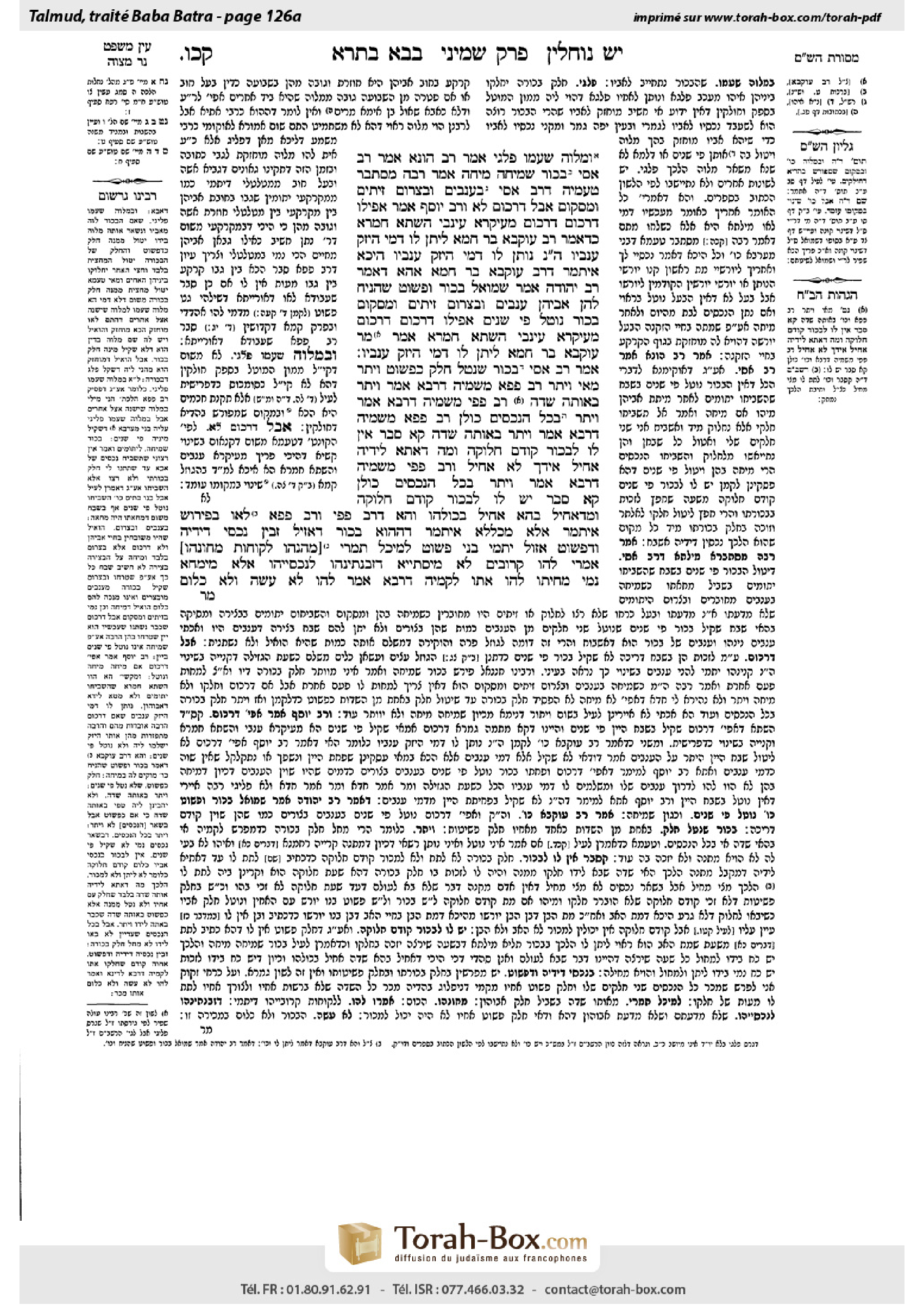
Bava Batra 126a: Talmud study for Daf Yomi
Study the Talmud for Daf Yomi with scanned pages, Hebrew text, English translations from Sefaria and AI-generated French translations.
Passage selection and English or AI-generated French translation are available where the scan has annotations. Daf Study is independent of Torah-Box and Sefaria.
Browse Bava Batra · בבא בתרא · All tractatesBava Batra 126a text and translations
This page of Bava Batra includes the Aramaic text, an English translation and an AI-generated French translation, alongside the scan above.
בבא בתרא קכ״ו א · Aramaic and Hebrew text
וּמִלְוָה שֶׁעִמּוֹ, פָּלְגִי.
אָמַר רַב הוּנָא אָמַר רַב אַסִּי: בְּכוֹר שֶׁמִּיחָה – מִיחָה.
אָמַר רַבָּה: מִסְתַּבֵּר טַעְמֵיהּ דְּרַב אַסִּי בַּעֲנָבִים – וּבְצָרוּם, זֵיתִים – וּמְסָקוּם; אֲבָל דְּרָכוּם – לָא. וְרַב יוֹסֵף אָמַר: אֲפִילּוּ דְּרָכוּם.
דְּרָכוּם?! מֵעִיקָּרָא עִינְבֵי, הַשְׁתָּא חַמְרָא!
כִּדְאָמַר רַב עוּקְבָא בַּר חָמָא: לִיתֵּן לוֹ דְּמֵי הֶיזֵּק עֲנָבָיו; הָכָא נָמֵי – נוֹתֵן לוֹ דְּמֵי הֶיזֵּק עֲנָבָיו.
הֵיכָא אִיתְּמַר דְּרַב עוּקְבָא בַּר חָמָא? אַהָא – דְּאָמַר רַב יְהוּדָה אָמַר שְׁמוּאֵל: בְּכוֹר וּפָשׁוּט שֶׁהִנִּיחַ לָהֶן אֲבִיהֶן עֲנָבִים, וּבְצָרוּם; זֵיתִים, וּמְסָקוּם – בְּכוֹר נוֹטֵל פִּי שְׁנַיִם, אֲפִילּוּ דְּרָכוּם. דְּרָכוּם?! מֵעִיקָּרָא עִינְבֵי, הַשְׁתָּא חַמְרָא! אָמַר מָר עוּקְבָא בַּר חָמָא: לִיתֵּן לוֹ דְּמֵי הֶיזֵּק עֲנָבָיו.
אָמַר רַב אַסִּי: בְּכוֹר שֶׁנָּטַל חֵלֶק כְּפָשׁוּט – וִיתֵּר. מַאי ״וִיתֵּר״? רַב פָּפָּא מִשְּׁמֵיהּ דְּרָבָא אָמַר: וִיתֵּר בְּאוֹתָהּ שָׂדֶה. רַב פַּפִּי מִשְּׁמֵיהּ דְּרָבָא אָמַר: וִיתֵּר בְּכׇל הַנְּכָסִים כּוּלָּן.
רַב פָּפָּא מִשְּׁמֵיהּ דְּרָבָא אָמַר: וִיתֵּר בְּאוֹתָהּ שָׂדֶה – קָא סָבַר: אֵין לוֹ לַבְּכוֹר קוֹדֶם חֲלוּקָּה; וּמָה דַּאֲתָא לִידֵיהּ – אַחֵיל, אִידַּךְ לָא אַחֵיל.
וְרַב פַּפֵּי מִשְּׁמֵיהּ דְּרָבָא אָמַר: וִיתֵּר בְּכׇל הַנְּכָסִים כּוּלָּן – קָא סָבַר: יֵשׁ לוֹ לִבְכוֹר קוֹדֶם חֲלוּקָּה; וּמִדְּאַחֵיל בְּהָא – אַחֵיל בְּכוּלְּהוּ.
וְהָא דְּרַב פַּפֵּי וְרַב פָּפָּא – לָאו בְּפֵירוּשׁ אִיתְּמַר, אֶלָּא מִכְּלָלָא אִיתְּמַר – דְּהָהוּא בְּכוֹר דַּאֲזַל זַבֵּין נִכְסֵי דִּידֵיהּ וּדְפָשׁוּט. אֲזוּל יַתְמֵי בְּנֵי פָּשׁוּט לְמֵיכַל תַּמְרֵי מֵהָנְהוּ לָקוֹחוֹת, מְחוֹנְהוּ. אָמְרִי לְהוּ קְרוֹבִים: לָא מִיסָּתְיָיא דִּזְבַנְתִּינְהוּ לְנִכְסַיְיהוּ, אֶלָּא מִימְחֵא נָמֵי מָחִיתוּ לְהוּ? אֲתוֹ לְקַמֵּיהּ דְּרָבָא, אֲמַר לְהוּ: לֹא עָשָׂה וְלֹא כְלוּם.
Bava Batra 126a · English translation
And as for a loan that is with the firstborn, i.e., he had borrowed money from his father, then his father died, it is uncertain whether the payment should be considered property due to the father or property possessed by him. Therefore, the firstborn and his brothers divide the additional portion.
§ With regard to the halakha that the firstborn is not entitled to a double portion of the enhancement of the property resulting from the actions of the heirs, Rav Huna says that Rav Asi says: A firstborn who protested the efforts of enhancing the property before it is divided has protested, and if the brothers use resources from the estate to enhance it against his will, he is entitled to a double portion of the enhanced value.
Rabba said: Rav Asi’s opinion is reasonable in a case where they inherited grapes on a grapevine and the brothers harvested them against the will of the firstborn, or if they inherited olives on olive trees and the brothers harvested them, as in these cases, the produce itself did not change. But if they treaded on them, converting them into wine or oil, even if the firstborn protested their doing so, he is not entitled to a double portion. And Rav Yosef said: Even if they treaded on them, the firstborn is entitled to a double portion.
The Gemara asks: Why is he entitled to a double portion, according to Rav Yosef, even if they treaded on them? Since the brothers transformed the produce, as initially it was in the form of grapes and now it is wine, they have acquired it in the same manner that a thief acquires an item he stole. Therefore, the firstborn should have no share of the enhancement.
The Gemara answers: Rav Yosef did not mean that the firstborn is entitled to a double portion of the enhanced value of the wine. Rather, his intention was the same as that which Rav Ukva bar Ḥama says in a different context, that the ruling is referring to a case where the wine spoiled, its value decreasing to below the initial value of the grapes, in which case the brothers must give the firstborn payment for the damage to his additional portion of the grapes. Here, too, Rav Yosef meant that the brothers must give the firstborn payment for the damage to his grapes.
The Gemara explains: Where, i.e., in what context, was the statement of Rav Ukva bar Ḥama stated? It was in reference to that which Rav Yehuda says that Shmuel says: With regard to a firstborn and an ordinary son whose father left them grapes and they harvested them, or if he left them olives and they harvested them, the firstborn takes a double portion. This is the halakha even if they treaded on them. The Gemara asks: Why is he entitled to a double portion if they treaded on them; initially they were grapes, and now it is wine? Mar Ukva bar Ḥama says: Shmuel did not mean that he is entitled to a double portion of the wine; rather, the reference is to a case where the wine spoiled, its value decreasing to below the initial value of the grapes, in which case the ordinary brother must give the firstborn payment for the damage to his grapes.
§ Rav Asi says: A firstborn who took a portion of the property like that of an ordinary heir has relinquished his right to an additional portion. The Gemara asks: What does it mean that he has relinquished his additional portion? Rav Pappa says in the name of Rava that he has relinquished his additional portion only with regard to that field that was divided, since he did not exercise his right to an additional portion, but he has not relinquished his right to receive an additional portion of the rest of the estate. Rav Pappi says in the name of Rava that he has relinquished his additional portion with regard to all of the property.
The Gemara explains: Rav Pappa says in the name of Rava that he has relinquished his additional portion only with regard to that field that was divided, because he holds that a firstborn does not have a right to his additional portion before the division of the property. And therefore, he has waived his additional portion of what has already reached his possession, namely, the field that was divided, but he has not waived his portion of the other fields of the estate.
And Rav Pappi says in the name of Rava that he has relinquished his additional portion with regard to all of the property, as he holds that a firstborn has a right to his additional portion before the division of the property. And therefore, since he waived his additional portion in this field, he has waived his portion of all of the property.
The Gemara notes: And this dispute of Rav Pappi and Rav Pappa was not stated explicitly; rather, it was stated by inference. As there was a certain firstborn who went and sold his property and the property of his deceased ordinary brother, i.e., their respective portions of their father’s property, before the property was divided. The orphan sons of the ordinary brother went to eat dates from the field that was now in the possession of those purchasers, due to their father’s share in the field. The purchasers hit them, as though they were thieves. The relatives of the orphans said to the purchasers: Not only did you purchase their property illegally, but you now hit them as well? They came before Rava, who said to them: The firstborn has done nothing. His sale was not valid.
Bava Batra 126a · Traduction française (IA)
Et quant à un prêt qui est lié au premier-né, c'est-à-dire qu'il avait emprunté de l'argent à son père, puis que son père est décédé, il est incertain si le paiement doit être considéré comme une propriété due au père ou comme une propriété possédée par lui. Ainsi, le premier-né et ses frères divisent la part supplémentaire.
§ En ce qui concerne la halakha selon laquelle le premier-né n'a pas droit à une double portion de l'augmentation de la propriété résultant des actions des héritiers, Rav Huna dit que Rav Asi dit : Un premier-né qui a protesté contre les efforts d'amélioration de la propriété avant qu'elle ne soit divisée a protesté, et si les frères utilisent des ressources de l'État pour l'améliorer contre sa volonté, il a droit à une double portion de la valeur améliorée.
Rabba dit : L'opinion de Rav Asi est raisonnable dans le cas où ils ont hérité de raisins sur une vigne et les frères les ont récoltés contre la volonté du premier-né, ou si ils ont hérité d'olives sur des arbres à olives et les frères les ont récoltés, comme dans ces cas, la production elle-même n'a pas changé. Mais si ils ont foulé les raisins, les transformant en vin ou en huile, même si le premier-né a protesté contre cela, il n'a pas droit à une double portion. Et Rav Yosef dit : Même s'ils ont foulé les raisins, le premier-né a droit à une double portion.
La Guemara pose la question : Pourquoi a-t-il droit à une double portion, selon Rav Yosef, même s'ils ont foulé les raisins ? Parce que les frères ont transformé la production, puisqu'initialement elle était sous forme de raisins et maintenant elle est du vin, ils l'ont acquis de la même manière qu'un voleur acquiert un objet volé. Ainsi, le premier-né ne devrait pas avoir sa part de l'amélioration.
La Guemara répond : Rav Yosef n'entendait pas que le premier-né ait droit à une double portion de la valeur améliorée du vin. Plutôt, son intention était la même que celle de Rav Ukva bar Ḥama dans un contexte différent, à savoir que la décision concerne un cas où le vin s'est gâté, sa valeur diminuant en dessous de la valeur initiale des raisins, dans ce cas les frères doivent payer au premier-né pour le préjudice causé à sa double portion des raisins. Ici aussi, Rav Yosef entendait que les frères doivent payer au premier-né pour le préjudice causé à ses raisins.
La Guemara explique : Dans quel contexte a-t-on dit la déclaration de Rav Ukva bar Ḥama ? C'était en référence à ce que Rav Yehuda dit que Shmuel dit : En ce qui concerne un premier-né et un fils ordinaire dont le père leur a laissé des raisins et ils les ont récoltés, ou s'il leur a laissé des olives et ils les ont récoltés, le premier-né prend une double portion. C'est la halakha même s'ils ont foulé les raisins. La Guemara pose la question : Pourquoi a-t-il droit à une double portion s'ils ont foulé les raisins ; initialement ils étaient des raisins, et maintenant c'est du vin ? Mar Ukva bar Ḥama dit : Shmuel n'entendait pas qu'il ait droit à une double portion du vin ; plutôt, la référence est à un cas où le vin s'est gâté, sa valeur diminuant en dessous de la valeur initiale des raisins, dans ce cas le frère ordinaire doit payer au premier-né pour le préjudice causé à sa double portion des raisins.
§ Rav Asi dit : Un premier-né qui a pris une part de la propriété comme un héritier ordinaire a renoncé à son droit à une part supplémentaire. La Guemara pose la question : De quoi est-ce que cela signifie qu'il a renoncé à sa part supplémentaire ? Rav Pappa dit en nom de Rava qu'il a renoncé à sa part supplémentaire uniquement concernant le champ qui a été divisé, puisqu'il n'a pas exercé son droit à une part supplémentaire, mais il n'a pas renoncé à son droit de recevoir une part supplémentaire des autres biens de l'État. Rav Pappi dit en nom de Rava qu'il a renoncé à sa part supplémentaire concernant toute la propriété.
La Guemara explique : Rav Pappa dit en nom de Rava qu'il a renoncé à sa part supplémentaire uniquement concernant le champ qui a été divisé, car il considère que le premier-né n'a pas le droit à sa part supplémentaire avant la division de la propriété. Ainsi, il a renoncé à sa part de ce qui est déjà en sa possession, à savoir le champ divisé, mais il n'a pas renoncé à sa part des autres champs de l'État.
Et Rav Pappi dit en nom de Rava qu'il a renoncé à sa part supplémentaire concernant toute la propriété, car il considère que le premier-né a le droit à sa part supplémentaire avant la division de la propriété. Ainsi, puisqu'il a renoncé à sa part supplémentaire dans ce champ, il a renoncé à sa part de toute la propriété.
La Guemara note : Et ce débat entre Rav Pappi et Rav Pappa n'a pas été exprimé explicitement ; il a été déduit. Car il y avait un premier-né qui est allé vendre sa propriété ainsi que la propriété de son frère ordinaire décédé, c'est-à-dire leurs parts dans la propriété de leur père, avant que la propriété ne soit divisée. Les fils orphelins du frère ordinaire sont allés manger des dattes du champ qui était désormais en possession de ces acheteurs, en raison de leur part dans le champ. Les acheteurs les ont frappés, comme s'ils étaient des voleurs. Les parents des orphelins ont dit aux acheteurs : Non seulement avez-vous acheté illégalement leurs biens, mais vous frappez aussi maintenant ? Ils sont allés devant Rava, qui a dit à ceux-ci : Le premier-né a fait rien. Sa vente n'était pas valide.
Traduction française générée par IA à partir de l’édition anglaise de Sefaria. Vérifie toujours un passage avec le texte source.
Text from Sefaria: William Davidson Edition - Vocalized Aramaic (CC BY NC); William Davidson Edition - English (CC BY NC).