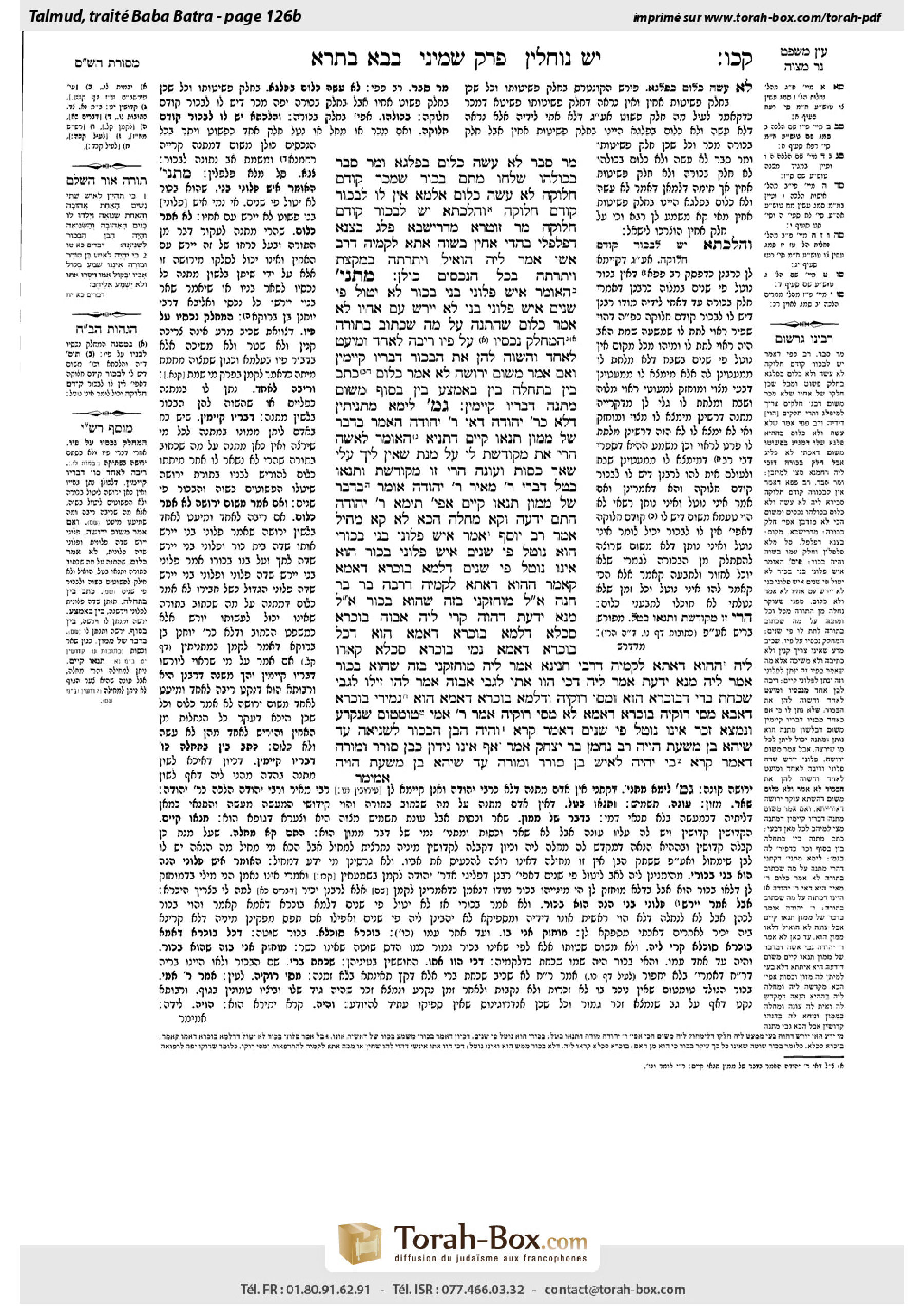
Bava Batra 126b: Talmud study for Daf Yomi
Study the Talmud for Daf Yomi with scanned pages, Hebrew text, English translations from Sefaria and AI-generated French translations.
Passage selection and English or AI-generated French translation are available where the scan has annotations. Daf Study is independent of Torah-Box and Sefaria.
Browse Bava Batra · בבא בתרא · All tractatesBava Batra 126b text and translations
This page of Bava Batra includes the Aramaic text, an English translation and an AI-generated French translation, alongside the scan above.
בבא בתרא קכ״ו ב · Aramaic and Hebrew text
מָר סָבַר: לֹא עָשָׂה כְּלוּם – בְּפַלְגָא. וּמָר סָבַר: בְּכוּלְּהוּ.
שְׁלַחוּ מִתָּם: בְּכוֹר שֶׁמָּכַר קוֹדֶם חֲלוּקָּה – לֹא עָשָׂה כְּלוּם. אַלְמָא אֵין לוֹ לַבְּכוֹר קוֹדֶם חֲלוּקָּה. וְהִלְכְתָא: יֵשׁ לַבְּכוֹר קוֹדֶם חֲלוּקָּה.
מָר זוּטְרָא מִדְּרִישְׁבָּא פְּלַג בְּצַנָּא דְפִלְפְּלֵי בַּהֲדֵי אַחִין, בְּשָׁוֶה. אֲתָא לְקַמֵּיהּ דְּרַב אָשֵׁי, אֲמַר לֵיהּ: הוֹאִיל וִיתַּרְתָּה בְּמִקְצָת – וִיתַּרְתָּה בְּכׇל הַנְּכָסִים כּוּלָּן.
מַתְנִי׳ הָאוֹמֵר: ״אִישׁ פְּלוֹנִי בְּנִי בְּכוֹר לֹא יִטּוֹל פִּי שְׁנַיִם״; ״אִישׁ פְּלוֹנִי בְּנִי לֹא יִירַשׁ עִם אֶחָיו״ – לֹא אָמַר כְּלוּם, שֶׁהִתְנָה עַל מַה שֶּׁכָּתוּב בַּתּוֹרָה.
הַמְחַלֵּק נְכָסָיו עַל פִּיו; רִיבָּה לְאֶחָד וּמִיעֵט לְאֶחָד, וְהִשְׁוָה לָהֶן אֶת הַבְּכוֹר – דְּבָרָיו קַיָּימִין. וְאִם אָמַר מִשּׁוּם יְרוּשָּׁה – לֹא אָמַר כְּלוּם. כָּתַב בֵּין בַּתְּחִלָּה בֵּין בָּאֶמְצַע בֵּין בַּסּוֹף – מִשּׁוּם מַתָּנָה, דְּבָרָיו קַיָּימִין.
גְּמָ׳ לֵימָא מַתְנִיתִין דְּלָא כְּרַבִּי יְהוּדָה? דְּאִי רַבִּי יְהוּדָה, הָאָמַר: בְּדָבָר שֶׁל מָמוֹן תְּנָאוֹ קַיָּים!
דְּתַנְיָא, הָאוֹמֵר לְאִשָּׁה: ״הֲרֵי אַתְּ מְקוּדֶּשֶׁת לִי, עַל מְנָת שֶׁאֵין לִיךְ עָלַי שְׁאֵר כְּסוּת וְעוֹנָה״ – הֲרֵי זוֹ מְקוּדֶּשֶׁת, וּתְנָאוֹ בָּטֵל; דִּבְרֵי רַבִּי מֵאִיר. רַבִּי יְהוּדָה אוֹמֵר: בְּדָבָר שֶׁל מָמוֹן – תְּנָאוֹ קַיָּים!
אֲפִילּוּ תֵּימָא רַבִּי יְהוּדָה: הָתָם יָדְעָה וְקָא מָחֲלָה, הָכָא לָא קָא מָחֵיל.
אָמַר רַב יוֹסֵף, אָמַר: ״אִישׁ פְּלוֹנִי בְּנִי, בְּכוֹרִי הוּא״ – נוֹטֵל פִּי שְׁנַיִם. ״אִישׁ פְּלוֹנִי בְּכוֹר הוּא״ – אֵינוֹ נוֹטֵל פִּי שְׁנַיִם, דִּלְמָא בּוּכְרָא דְאִמָּא קָאָמַר.
הָהוּא דַּאֲתָא לְקַמֵּיהּ דְּרַבָּה בַּר בַּר חָנָה, אֲמַר לֵיהּ: מוּחְזְקַנִי בָּזֶה שֶׁהוּא בְּכוֹר. אֲמַר לֵיהּ: מְנָא יָדְעַתְּ? דַּהֲוָה קָרֵי לֵיהּ אֲבוּהּ ״בּוּכְרָא סַכְלָא״. דִּלְמָא בּוּכְרָא דְאִמָּא הוּא, דְּכׇל בּוּכְרָא דְאִמָּא נָמֵי ״בּוּכְרָא סַכְלָא״ קָארוּ לֵיהּ.
הָהוּא דַּאֲתָא לְקַמֵּיהּ דְּרַבִּי חֲנִינָא, אֲמַר לֵיהּ: מוּחְזְקַנִי בָּזֶה שֶׁהוּא בְּכוֹר. אֲמַר לֵיהּ: מְנָא יָדְעַתְּ? אֲמַר לֵיהּ: דְּכִי הֲווֹ אָתוּ לְגַבֵּי אֲבוּהּ, אֲמַר לְהוּ: זִילוּ לְגַבֵּי שִׁכְחַת בְּרִי, דְּבוּכְרָא הוּא וּמַסֵּי רוּקֵּיהּ.
וְדִלְמָא בּוּכְרָא דְאִמָּא הוּא! גְּמִירִי: בּוּכְרָא דְאַבָּא – מַסֵּי רוּקֵּיהּ, בּוּכְרָא דְאִמָּא – לָא מַסֵּי רוּקֵּיהּ.
אָמַר רַבִּי אַמֵּי: טוּמְטוּם שֶׁנִּקְרַע וְנִמְצָא זָכָר, אֵינוֹ נוֹטֵל פִּי שְׁנַיִם; דְּאָמַר קְרָא: ״וְהָיָה הַבֵּן הַבְּכוֹר לַשְּׂנִיאָה״ – עַד שֶׁיְּהֵא בֵּן מִשְּׁעַת הֲוָיָה.
רַב נַחְמָן בַּר יִצְחָק אָמַר: אַף אֵינוֹ נִידּוֹן כְּבֵן סוֹרֵר וּמוֹרֶה, דְּאָמַר קְרָא: ״כִּי יִהְיֶה לְאִישׁ בֵּן סוֹרֵר וּמוֹרֶה״ – עַד שֶׁיְּהֵא בֵּן מִשְּׁעַת הֲוָיָה.
Bava Batra 126b · English translation
Rav Pappi and Rav Pappa disagree with regard to Rava’s intention. One Sage, Rav Pappi, holds that he has done nothing with regard to his brother’s portion, as he had no right to sell it; with regard to his own additional portion, the sale was valid, as it was in his possession even before the division of the property. And one Sage, Rav Pappa, holds that he has done nothing with regard to all of the property, as he does not possess the additional portion before the property is divided between the brothers.
The Gemara notes that they sent a ruling from there, Eretz Yisrael: A firstborn who sold his additional portion before the division of the property has done nothing. Apparently, the Sages of Eretz Yisrael hold that a firstborn does not have a right to his additional portion before the division. But the halakha is that a firstborn has a right to his additional portion before the division.
The Gemara relates: Mar Zutra of the house of Rishba, who was a firstborn, divided a basket of peppers from the estate of his father with his brothers equally. He came before Rav Ashi to claim a double portion of the rest of the estate. Rav Ashi said to him: Since you relinquished your additional portion with regard to some of the estate, you have relinquished your additional portion with regard to all of the property, as a firstborn has a right to his additional portion before the division.
MISHNA: In a case of one who says: So-and-so, my firstborn son, will not take a double portion of my estate; or one who says: So-and-so, my son, will not inherit my estate among his brothers, he has said nothing, as he has stipulated counter to that which is written in the Torah.
With regard to one on his deathbed who apportions his property orally, granting it to his sons as a gift, and he increased the portion given to one of his sons and reduced the portion given to one son, or equated the portion of the firstborn to the portions of the other sons, his statement stands. But if he said that they will receive the property not as a gift but as inheritance, he has said nothing. If he wrote in his will, whether at the beginning, or in the middle, or at the end, that he is granting them the property as a gift, his statement stands.
GEMARA: The Gemara suggests: Let us say that the mishna is not in accordance with the opinion of Rabbi Yehuda, as if it is in accordance with the opinion of Rabbi Yehuda, doesn’t he say elsewhere that if one stipulates counter to that which is written in the Torah with regard to monetary matters, his stipulation stands?
As it is taught in a baraita (Tosefta, Kiddushin 3:7): If one says to a woman: You are hereby betrothed to me on the condition that you have no ability to claim from me food, clothing, and conjugal rights, she is betrothed and his stipulation is void; this is the statement of Rabbi Meir. Rabbi Yehuda says: With regard to monetary matters, such as food and clothing, his stipulation stands, despite being counter to that which is written in the Torah. According to the opinion of Rabbi Yehuda, one should be able to stipulate that his firstborn son not receive a double portion, or that one of his sons not inherit from him at all, as inheritance is a monetary matter.
The Gemara rejects this suggestion: Even if you say that the mishna is in accordance with the opinion of Rabbi Yehuda, there, the woman knew of his stipulation and waived her rights. Therefore, the stipulation stands. Here, the son whose portion was reduced did not waive his portion. Therefore the stipulation is not valid.
§ Rav Yosef says that if a man says: So-and-so is my firstborn son, the son takes a double portion of his inheritance based on this testimony. If he says: So-and-so is a firstborn, the son does not take a double portion, as perhaps the man was saying that the son is his mother’s firstborn but not his own firstborn.
The Gemara relates: There was a certain man who came before Rabba bar bar Ḥana and said to him: I know that this man is a firstborn. Rabba bar bar Ḥana said to him: From where do you know? He answered: Because his father would call him a foolish firstborn. Rabba bar bar Ḥana replied: Perhaps he is his mother’s firstborn, as any firstborn of a mother is also called a foolish firstborn.
The Gemara relates: There was a certain man who came before Rabbi Ḥanina and said to him: I know that this man is a firstborn. Rabbi Ḥanina said to him: From where do you know? He said to Rabbi Ḥanina: Because when people would come before his father to obtain a cure for their ailing eyes, he would say to them: Go to my son Shikhḥat, as he is a firstborn and his saliva heals this ailment.
The Gemara asks: But perhaps he is his mother’s firstborn? The Gemara answers: It is learned as a tradition that the saliva of a father’s firstborn heals this ailment but the saliva of a mother’s firstborn does not heal this ailment.
§ Rabbi Ami says: In the case of one whose sexual organs are indeterminate [tumtum] and whose skin became perforated so that his genitals were exposed and he was found to be a male, he does not take a double portion of his father’s estate. As the verse states: “And if the firstborn son was [vehaya] hers that was hated” (Deuteronomy 21:15), which is interpreted to mean that he is not considered a firstborn unless he is recognized as a son, i.e., male, from the moment of his coming into being [havaya], i.e., his birth.
Rav Naḥman bar Yitzḥak says: A tumtum who was found to be male is also not judged as a stubborn and rebellious son, as the verse states: “If there will be [yihyeh] to a man a stubborn and rebellious son” (Deuteronomy 21:18), which is interpreted to mean that one is not judged in this manner unless he is recognized as a son from the moment of his coming into being.
Bava Batra 126b · Traduction française (IA)
Rav Pappi et Rav Pappa sont d'avis divergents concernant l'intention de Rava. Un Sage, Rav Pappi, considère qu'il n'a rien fait concernant la part de son frère, car il n'avait pas le droit de la vendre ; concernant sa propre part supplémentaire, la vente est valide, car il la possédait même avant la division des biens. Un autre Sage, Rav Pappa, considère qu'il n'a rien fait concernant tous les biens, car il ne possède pas la part supplémentaire avant la division des biens entre les frères.
La Guemara note qu'ils ont envoyé un avis depuis Eretz Yisrael : un premier-né qui a vendu sa part supplémentaire avant la division des biens n'a rien fait. Apparemment, les Sages d'Eretz Yisrael considèrent qu'un premier-né n'a pas le droit à sa part supplémentaire avant la division. Cependant, la halakha est que le premier-né a le droit à sa part supplémentaire avant la division.
La Guemara rapporte : Mar Zutra de la maison de Rishba, qui était un premier-né, a divisé une corbeille de piments de l'immobilier de son père avec ses frères de manière égale. Il est venu devant Rav Ashi pour revendiquer une double part du reste de l'immobilier. Rav Ashi a dit à lui : Puisque vous avez renoncé à votre part supplémentaire concernant une partie de l'immobilier, vous avez renoncé à votre part supplémentaire concernant tous les biens, car un premier-né a le droit à sa part supplémentaire avant la division.
MICHNA : Dans le cas d'une personne qui dit : tel, mon premier-né, ne prendra pas une double part de mon patrimoine ; ou qui dit : tel, mon fils, ne héritera pas de mon patrimoine auprès de ses frères, il a dit rien, car il a stipulé contraire à ce qui est écrit dans la Torah.
Concernant une personne sur son lit de mort qui distribue oralement ses biens, les donnant à ses fils en tant que cadeau, et qui a augmenté la part donnée à l'un de ses fils et réduit celle donnée à un autre fils, ou égalisé la part du premier-né à celle des autres fils, son déclaration est valable. Mais si il a dit qu'ils recevront la propriété non comme cadeau mais comme héritage, il a dit rien. Si il a écrit dans son testament, qu'au début, ou au milieu, ou à la fin, qu'il leur donne la propriété en tant que cadeau, sa déclaration est valable.
GUEMARA : La Guemara suggère : disons que la mishna n'est pas en conformité avec l'opinion de Rabbi Yehuda, car si elle l'est, ne dit-il pas ailleurs que si l'on stipule contraire à ce qui est écrit dans la Torah concernant les affaires monétaires, sa stipulation est valable ?
Comme il est enseigné dans une baraïta (Tosefta, Kiddushin 3:7) : Si l'on dit à une femme : Tu es betroché à moi sous la condition que tu n'as pas le droit de prétendre à mes aliments, vêtements et droits conjugaux, elle est betroché et sa stipulation est nulle ; c'est l'opinion de Rabbi Meir. Rabbi Yehuda dit : Concernant les affaires monétaires, comme les aliments et les vêtements, sa stipulation est valable, malgré être contraire à ce qui est écrit dans la Torah. Selon l'opinion de Rabbi Yehuda, on devrait pouvoir stipuler que son premier-né ne reçoit pas une double part, ou que l'un de ses fils ne hérite pas du tout, car l'héritage est une affaire monétaire.
La Guemara rejette cette suggestion : Même si vous dites que la Michna est en conformité avec l'opinion de Rabbi Yehuda, là, la femme savait de sa stipulation et a renoncé à ses droits. Par conséquent, la stipulation est valable. Ici, le fils dont la part a été réduite n'a pas renoncé à sa part. Par conséquent, la stipulation n'est pas valable.
§ Rav Yosef dit que si un homme dit : tel est mon premier-né, le fils reçoit une double part de son héritage en vertu de ce témoignage. Si il dit : tel est un premier-né, le fils ne reçoit pas une double part, car peut-être l'homme disait que le fils est le premier-né de sa mère mais pas le sien.
La Guemara rapporte : Il y avait un certain homme qui vint devant Rabba bar bar Ḥana et lui dit : Je sais que cette personne est un premier-né. Rabba bar bar Ḥana lui répondit : D'où sais-tu cela ? Il répondit : Parce que son père l'appelait un premier-né stupide. Rabba bar bar Ḥana dit : Peut-être qu'il est le premier-né de sa mère, car tout premier-né de mère est aussi appelé un premier-né stupide.
La Guemara rapporte : Il y avait un certain homme qui vint devant Rabbi Ḥanina et lui dit : Je sais que cette personne est un premier-né. Rabbi Ḥanina lui répondit : D'où sais-tu cela ? Il dit à Rabbi Ḥanina : Parce que quand les gens venaient devant son père pour obtenir un remède pour leurs yeux malades, il disait à eux : Allez chez mon fils Shikhḥat, car il est un premier-né et son salive guérit cette maladie.
La Guemara demande : Mais peut-être qu'il est le premier-né de sa mère ? La Guemara répond : On apprend comme une tradition que la salive du premier-né du père guérit cette maladie, mais la salive du premier-né de la mère ne guérit pas cette maladie.
§ Rabbi Ami dit : Dans le cas d'une personne dont les organes sexuels sont indéterminés [tumtum] et dont la peau s'est percée de sorte que ses organes génitaux étaient exposés et qu'il a été trouvé être un homme, il ne prend pas une double part de l'héritage de son père. Comme le verset dit : « Et si le premier-né fils était [vehaya] hers qui était haïe » (Deutéronome 21:15), qui est interprété pour signifier qu'il n'est pas considéré comme un premier-né à moins qu'il soit reconnu comme un fils, c'est-à-dire un homme, dès le moment de sa naissance [havaya], c'est-à-dire sa naissance.
Rav Naḥman bar Yitzḥak dit : Un tumtum qui a été trouvé être un homme n'est pas non plus jugé comme un fils rebelle et obstiné, comme le verset dit : « Si il y aura [yihyeh] à un homme un fils obstiné et rebelle » (Deutéronome 21:18), qui est interprété pour signifier qu'on ne juge pas ainsi à moins qu'il soit reconnu comme un fils dès le moment de sa naissance.
Traduction française générée par IA à partir de l’édition anglaise de Sefaria. Vérifie toujours un passage avec le texte source.
Text from Sefaria: William Davidson Edition - Vocalized Aramaic (CC BY NC); William Davidson Edition - English (CC BY NC).