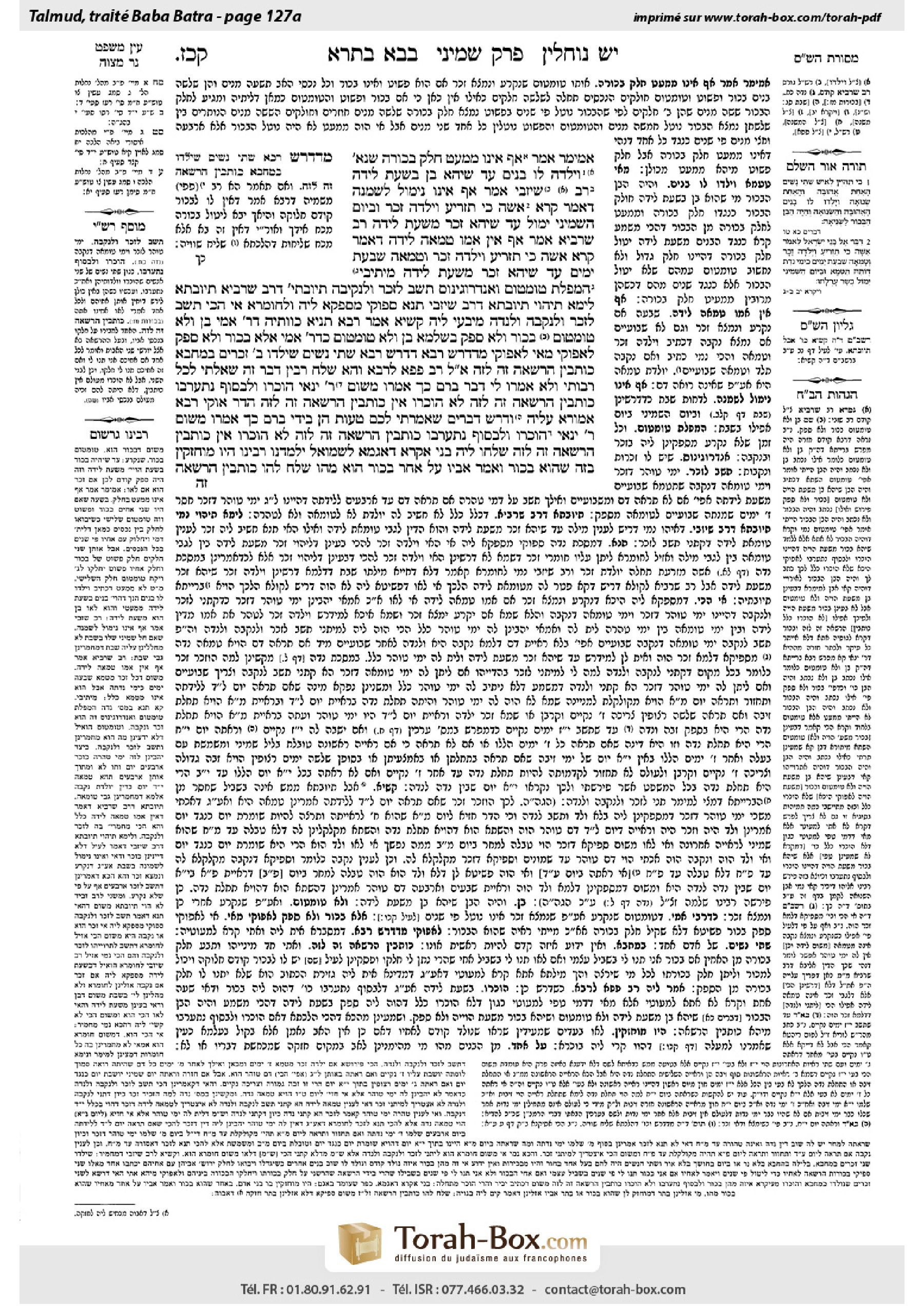
Bava Batra 127a: Talmud study for Daf Yomi
Study the Talmud for Daf Yomi with scanned pages, Hebrew text, English translations from Sefaria and AI-generated French translations.
Passage selection and English or AI-generated French translation are available where the scan has annotations. Daf Study is independent of Torah-Box and Sefaria.
Browse Bava Batra · בבא בתרא · All tractatesBava Batra 127a text and translations
This page of Bava Batra includes the Aramaic text, an English translation and an AI-generated French translation, alongside the scan above.
בבא בתרא קכ״ז א · Aramaic and Hebrew text
אַמֵּימָר אָמַר: אַף אֵינוֹ מְמַעֵט חֵלֶק בְּכוֹרָה, שֶׁנֶּאֱמַר: ״וְיָלְדָה לוֹ בָּנִים״ – עַד שֶׁיְּהֵא בֵּן בִּשְׁעַת לֵידָה.
רַב שֵׁיזְבִי אָמַר: אַף אֵינוֹ נִימּוֹל לִשְׁמֹנָה, דְּאָמַר קְרָא: ״אִשָּׁה כִּי תַזְרִיעַ וְיָלְדָה זָכָר״, ״וּבַיּוֹם הַשְּׁמִינִי יִמּוֹל״ – עַד שֶׁיְּהֵא זָכָר מִשְּׁעַת לֵידָה.
רַב שֵׁרֵבְיָא אָמַר: אַף אֵין אִמּוֹ טְמֵאָה לֵידָה, דְּאָמַר קְרָא: ״אִשָּׁה כִּי תַזְרִיעַ וְיָלְדָה זָכָר וְטָמְאָה שִׁבְעַת יָמִים״ – עַד שֶׁיְּהֵא זָכָר מִשְּׁעַת לֵידָה.
מֵיתִיבִי: הַמַּפֶּלֶת טוּמְטוּם וְאַנְדְּרוֹגִינוֹס – תֵּשֵׁב לְזָכָר וְלִנְקֵיבָה. תְּיוּבְתֵּיהּ דְּרַב שֵׁרֵבְיָא! תְּיוּבְתָּא.
לֵימָא תֶּיהְוֵי תְּיוּבְתָּא דְּרַב שֵׁיזְבִי?
תַּנָּא סַפּוֹקֵי מְסַפְּקָא לֵיהּ, וּלְחוּמְרָא.
אִי הָכִי, ״תֵּשֵׁב לְזָכָר וְלִנְקֵבָה וּלְנִדָּה״ מִיבְּעֵי לֵיהּ! קַשְׁיָא.
אָמַר רָבָא, תַּנְיָא כְּווֹתֵיהּ דְּרַבִּי אַמֵּי: ״בֵּן״ – וְלֹא טוּמְטוּם, ״בְּכוֹר״ – וְלֹא סָפֵק.
בִּשְׁלָמָא ״בֵּן״ וְלֹא טוּמְטוּם – כִּדְרַבִּי אַמֵּי. אֶלָּא ״בְּכוֹר״ וְלֹא סָפֵק – לְאַפּוֹקֵי מַאי?
לְאַפּוֹקֵי מִדְּדָרֵשׁ רָבָא, דְּדָרֵשׁ רָבָא: שְׁתֵּי נָשִׁים שֶׁיָּלְדוּ שְׁנֵי זְכָרִים בְּמַחֲבֵא, כּוֹתְבִין הַרְשָׁאָה זֶה לָזֶה.
אֲמַר לֵיהּ רַב פָּפָּא לְרָבָא, וְהָא שְׁלַח רָבִין: דָּבָר זֶה שָׁאַלְתִּי לְכׇל רַבּוֹתַי וְלֹא אָמְרוּ לִי דָּבָר, בְּרַם כָּךְ אָמְרוּ מִשּׁוּם רַבִּי יַנַּאי: הוּכְּרוּ, וּלְבַסּוֹף נִתְעָרְבוּ – כּוֹתְבִין הַרְשָׁאָה זֶה לָזֶה. לֹא הוּכְּרוּ – אֵין כּוֹתְבִין הַרְשָׁאָה זֶה לָזֶה!
הֲדַר אוֹקִי רָבָא אָמוֹרָא עֲלֵיהּ, וּדְרַשׁ: דְּבָרִים שֶׁאָמַרְתִּי לָכֶם – טָעוּת הֵן בְּיָדִי, בְּרַם כָּךְ אָמְרוּ מִשּׁוּם רַבִּי יַנַּאי: הוּכְּרוּ וּלְבַסּוֹף נִתְעָרְבוּ – כּוֹתְבִין הַרְשָׁאָה זֶה לְזֶה, לֹא הוּכְּרוּ – אֵין כּוֹתְבִין הַרְשָׁאָה זֶה לָזֶה.
שְׁלַחוּ לֵיהּ בְּנֵי אַקְרָא דְאַגְמָא לִשְׁמוּאֵל, יְלַמְּדֵנוּ רַבֵּינוּ: הָיוּ מוּחְזָקִין בָּזֶה – שֶׁהוּא בְּכוֹר, וְאָמַר אָבִיו עַל אַחֵר ״בְּכוֹר הוּא״, מַהוּ? שְׁלַח לְהוּ: כּוֹתְבִין הַרְשָׁאָה
Bava Batra 127a · English translation
Ameimar says: A tumtum who was found to be male also does not reduce the additional portion of the firstborn. His portion is not taken into account in the calculation of the firstborn’s additional portion. For example, if there are three brothers: A firstborn, an ordinary brother, and a tumtum, the firstborn receives one-third of the property as his additional portion, as he would if he and the ordinary brother were the only heirs, and the remaining two-thirds are divided among all three brothers. This is because it is stated with regard to the portion of the firstborn: “And they have borne him sons” (Deuteronomy 21:15), which is interpreted to mean that the brother of a firstborn does not affect his additional portion unless he is recognized as a son at the moment of his birth.
Rav Sheizevi says: A tumtum who was found to be male is also not circumcised on the eighth day, if his eighth day occurs on Shabbat, although the mitzva of circumcision on the eighth day generally overrides Shabbat prohibtions. As the verse states: “If a woman bears seed and gives birth to a male then she shall be unclean seven days; as in the days of the impurity of her sickness shall she be unclean. And on the eighth day the flesh of his foreskin shall be circumcised” (Leviticus 12:2–3), which is interpreted to mean that he is not circumcised on the eighth day, in the event that it occurs on Shabbat, unless he is recognized as a male from the moment of his birth.
Rav Sherevya says: His mother is also not rendered ritually impure due to his birth, as the verse states: “If a woman bears seed and gives birth to a male, then she shall be unclean seven days,” which is interpreted to mean that she is not rendered impure unless he is recognized as a male from the moment of his birth.
The Gemara raises an objection from a mishna (Nidda 28a): A woman who miscarries a tumtum or a hermaphrodite [ve’androginos] observes the strictures of a woman who gave birth to a male and to a female. Since it is uncertain whether the fetus is male or female, the woman must observe the halakhot of ritual impurity according to both possibilities. This appears to be a conclusive refutation of the statement of Rav Sherevya that a woman who gives birth to a tumtum is not rendered impure at all. The Gemara affirms: This is a conclusive refutation.
The Gemara asks: Shall we say it is also a conclusive refutation of the statement of Rav Sheizevi with regard to circumcision, as the halakha of circumsicion is stated together with the halakha of ritual impurity?
The Gemara answers: The tanna of the mishna in tractate Nidda is uncertain whether the birth discussed in the verse includes that of a tumtum, and therefore he rules stringently, that she should observe the halakhot of ritual impurity for both possibilities. Rav Sheizevi’s ruling can follow the same logic: The infant should not be circumcised on Shabbat, as it is uncertain whether the mitzva of his circumcision overrides the prohibitions of Shabbat.
The Gemara asks: If so, that the tanna of the mishna in tractate Nidda is uncertain whether the birth discussed in the verse includes that of a tumtum, the mishna should have stated that the woman observes the strictures of a woman who gave birth to both a male and to a female, and also as a menstruating woman. If it is uncertain whether the halakhot of ritual purity after birth pertain to a woman who gives birth to a tumtum at all, she should observe the halakhot of ritual impurity for any blood that emerges in the time period following the birth, as it should have the status of the blood of a menstruating woman. The Gemara concludes: This poses a difficulty.
Rava says that it is taught in a baraita in accordance with the opinion of Rabbi Ami that a tumtum firstborn does not receive a double portion of the inheritance. The baraita states: From the phrase “the firstborn son” (Deuteronomy 21:15) it is derived that only a son receives a double portion, but not a tumtum, and only a definite firstborn receives a double portion, but not one about whom it is uncertain if he is a firstborn.
The Gemara asks: Granted, the halakha that a son receives a double portion but a tumtum does not is understandable, as it is in accordance with the statement of Rabbi Ami, but what case does the halakha that only a definite firstborn receives a double portion but not one about whom it is uncertain if he is a firstborn serve to exclude? Why would one about whom it is uncertain if he is a firstborn receive a double portion?
The Gemara answers: It serves to exclude that which Rava taught, as Rava taught that if two wives of the same husband gave birth to two males in hiding, so that it is unknown which son was born first, and the husband subsequently had other sons, each of the two possible firstborns writes an authorization to the other. Since their brothers can claim against each of them individually that he is not the firstborn and does not deserve a double portion, each writes the other an authorization to collect his portion, so that they can jointly claim the additional portion in any event.
Rav Pappa subsequently said to Rava: But didn’t Ravin send a letter from Eretz Yisrael to Babylonia, stating: I asked all my teachers about this matter and they did not tell me anything; but this is what they said in the name of Rabbi Yannai: If the two sons were initially recognized, i.e., it was known which one of them was the firstborn, and they were ultimately mixed, and now the firstborn cannot be identified, each writes an authorization to the other. If they were not initially recognized, each does not write an authorization to the other.
Rava then established an amora to repeat his lesson to the masses aloud and taught: The statements that I said to you are a mistake on my part. But this is what they said in the name of Rabbi Yannai: If the two sons were initially recognized and were ultimately mixed, each writes an authorization to the other. If they were not initially recognized, each does not write an authorization to the other.
§ The residents of Akra De’Agma sent the following inquiry to Shmuel: Teach us, our master: If the court had a presumption concerning this son, that he is a firstborn, and his father says concerning another son of his: He is his firstborn, what is the halakha? Shmuel sent to them in response: Both of these sons write an authorization,
Bava Batra 127a · Traduction française (IA)
Ameimar dit : Un tumtum qui a été reconnu comme masculin ne réduit pas non plus la part supplémentaire du premier-né. Sa part n'est pas prise en compte dans le calcul de la part supplémentaire du premier-né. Par exemple, s'il y a trois frères : un premier-né, un frère ordinaire et un tumtum, le premier-né reçoit un tiers de la propriété comme part supplémentaire, comme s'il était seul avec le frère ordinaire, et les deux tiers restants sont divisés entre les trois frères. Cela est dû au fait que le texte dit concernant la part du premier-né : « Et ils ont engendré pour lui des fils » (Deutéronome 21:15), ce qui signifie que le frère du premier-né ne l'affecte pas dans sa part supplémentaire à moins qu'il ne soit reconnu comme fils au moment de sa naissance.
Rav Sheizevi dit : Un tumtum qui a été reconnu comme masculin n'est pas circoncis le huitième jour, même si ce huitième jour tombe un sabbat, bien que la mitsva de la circoncision le huitième jour l'emporte généralement sur les prohibitions du sabbat. Comme le texte dit : « Si une femme enfante un semence et donne naissance à un mâle, elle sera impure sept jours ; comme les jours de sa maladie impure, elle sera impure. Et le huitième jour, la chair de son prépuce sera circoncis » (Lévitique 12:2–3), ce qui signifie qu'il n'est pas circoncis le huitième jour, en cas où ce jour tombe un sabbat, à moins qu'il ne soit reconnu comme un mâle dès sa naissance.
Rav Sherevya dit : Sa mère n'est pas non plus rendue impure rituellement à cause de sa naissance, comme le texte dit : « Si une femme enfante un semence et donne naissance à un mâle, elle sera impure sept jours », ce qui signifie qu'elle n'est pas rendue impure à moins qu'il ne soit reconnu comme un mâle dès sa naissance.
Le Guemara soulève une objection contre une mitsna (Nidda 28a) : Une femme qui a eu un avortement d'un tumtum ou d'un hermaphrodite [ve’androginos] observe les restrictions d'une femme qui a donné naissance à un mâle et à une femelle. Puisque la nature du fœtus est incertaine, la femme doit observer les halakhot de la pureté rituelle selon les deux possibilités. Cela semble être une réfutation définitive de l'affirmation de Rav Sherevya selon laquelle une femme qui donne naissance à un tumtum n'est pas rendue impure du tout. Le Guemara affirme : C'est une réfutation définitive.
Le Guemara demande : Devons-nous dire que c'est aussi une réfutation définitive de l'affirmation de Rav Sheizevi concernant la circoncision, comme la halakha de la circoncision est mentionnée ensemble avec celle de la pureté rituelle ?
Le Guemara répond : Le tanna de la mitsna dans le traité Nidda est incertain quant à la naissance discutée dans le texte, et donc il règle strictement, en disant qu'elle doit observer les halakhot de la pureté rituelle pour les deux possibilités. La décision de Rav Sheizevi peut suivre la même logique : L'enfant ne doit pas être circoncis le sabbat, car il est incertain si la mitsva de sa circoncision l'emporte sur les prohibitions du sabbat.
Le Guemara demande : Si tel est le cas, que le tanna de la mitsna dans le traité Nidda est incertain quant à la naissance évoquée dans le texte, la mitsna aurait dû indiquer que la femme observe les restrictions d'une femme qui a donné naissance à un mâle et à une femelle, ainsi que celles d'une femme menstruante. Si l'on est incertain quant à l'applicabilité des halakhot de la pureté après la naissance à une femme qui a donné naissance à un tumtum, elle devrait observer les halakhot de la pureté rituelle pour tout sang qui s'écoule durant la période suivant la naissance, comme s'il avait le statut du sang d'une femme menstruante. Le Guemara conclut : Cela pose une difficulté.
Rava dit que cela est enseigné dans une baraïta selon l'opinion de Rabbi Ami : un premier-né tumtum ne reçoit pas une double portion de l'héritage. La baraïta dit : De la phrase « le premier-né fils » (Deutéronome 21:15), on déduit que seul un fils reçoit une double portion, mais pas un tumtum, et seul un premier-né déterminé reçoit une double portion, mais pas un premier-né dont on est incertain.
Le Guemara demande : Cela est compréhensible, la halakha que seul un fils reçoit une double portion mais pas un tumtum, selon l'affirmation de Rabbi Ami, mais quelle situation la halakha que seul un premier-né déterminé reçoit une double portion mais pas un premier-né dont on est incertain sert à exclure ? Pourquoi un premier-né dont on est incertain recevrait-il une double portion ?
Le Guemara répond : Cela sert à exclure ce que Rava a enseigné, à savoir que si deux épouses du même mari ont donné naissance à deux mâles en secret, de sorte qu'on ne sait pas quel fils est né en premier, et que le mari a ensuite eu d'autres fils, chacun des deux possibles premiers-nés écrit une autorisation à l'autre. Puisque leurs frères peuvent réclamer contre l'un d'eux individuellement qu'il n'est pas le premier-né et ne mérite pas une double portion, chacun écrit à l'autre une autorisation pour réclamer sa part, de sorte qu'ils puissent réclamer ensemble la part supplémentaire dans tous les cas.
Rav Pappa a ensuite dit à Rava : Mais n'a-t-il pas envoyé une lettre de la Terre d'Israël à Babylone, disant : J'ai demandé à tous mes maîtres sur cette question et ils ne m'ont rien dit ; mais c'est ce que disent en nom de Rabbi Yannai : Si les deux fils étaient initialement reconnus, c'est-à-dire qu'on savait quel était le premier-né, et qu'ils ont été mélangés, et maintenant le premier-né ne peut être identifié, chacun écrit une autorisation à l'autre. Si ils n'étaient pas initialement reconnus, aucun ne écrit une autorisation à l'autre.
Rava a alors institué un amora pour répéter sa leçon aux masses à haute voix et enseigna : Les déclarations que je vous ai faites sont une erreur de ma part. Mais c'est ce que disait en nom de Rabbi Yannai : Si les deux fils étaient initialement reconnus et finalement mélangés, chacun écrit une autorisation à l'autre. Si ils n'étaient pas initialement reconnus, chacun ne doit pas écrire d'autorisation à l'autre.
§ Les habitants d'Akra De’Agma envoyèrent à Shmuel la question suivante : Enseigne-nous, notre maître : Si la cour avait une présomption concernant ce fils, qu'il est le premier-né, et que son père dit concernant un autre fils de lui : Il est son premier-né, quelle est la halakha ? Shmuel envoya en réponse à eux : Les deux fils écrivent une autorisation.
Traduction française générée par IA à partir de l’édition anglaise de Sefaria. Vérifie toujours un passage avec le texte source.
Text from Sefaria: William Davidson Edition - Vocalized Aramaic (CC BY NC); William Davidson Edition - English (CC BY NC).