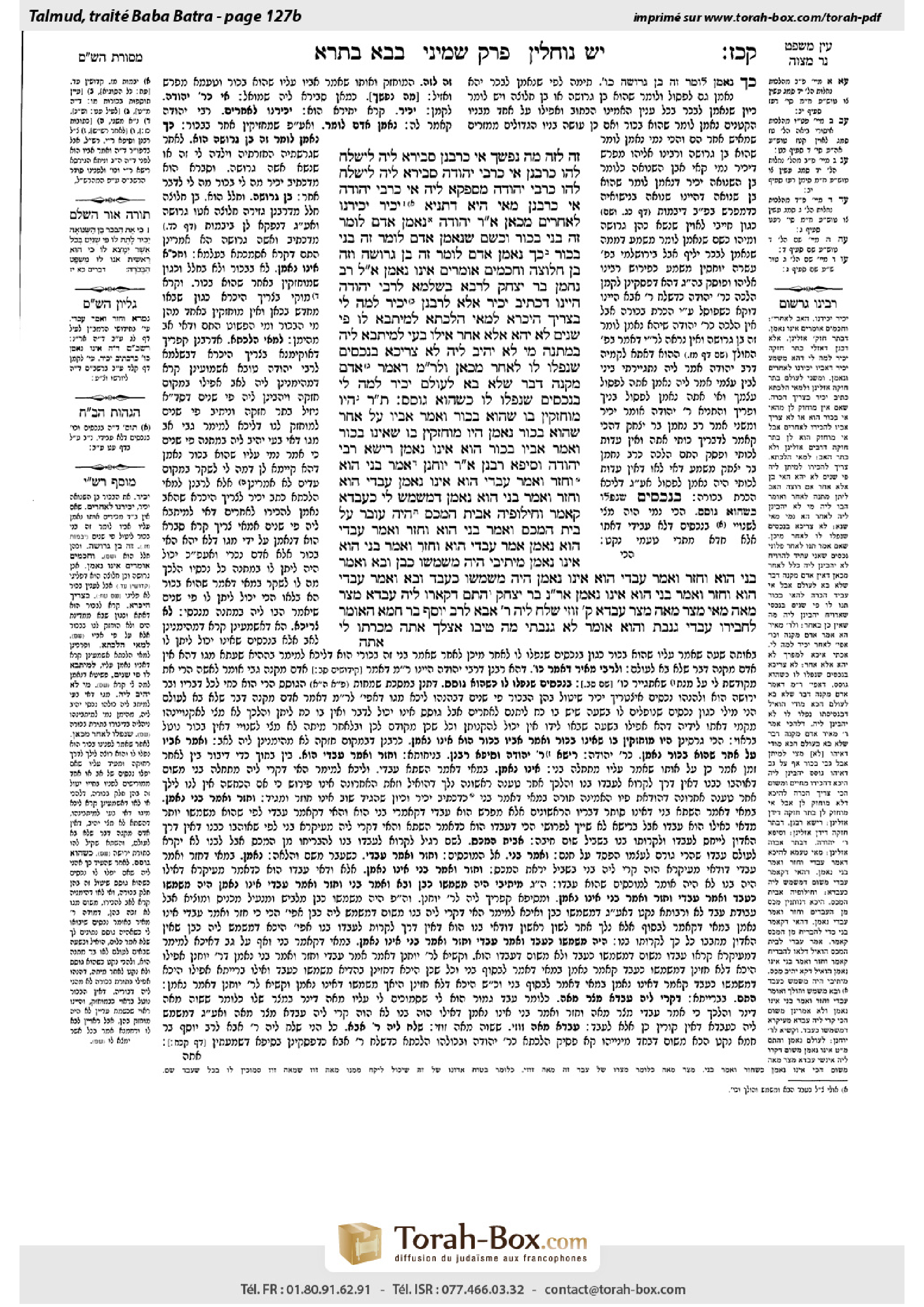
Bava Batra 127b: Talmud study for Daf Yomi
Study the Talmud for Daf Yomi with scanned pages, Hebrew text, English translations from Sefaria and AI-generated French translations.
Passage selection and English or AI-generated French translation are available where the scan has annotations. Daf Study is independent of Torah-Box and Sefaria.
Browse Bava Batra · בבא בתרא · All tractatesBava Batra 127b text and translations
This page of Bava Batra includes the Aramaic text, an English translation and an AI-generated French translation, alongside the scan above.
בבא בתרא קכ״ז ב · Aramaic and Hebrew text
זֶה לָזֶה.
מָה נַפְשָׁךְ? אִי כְּרַבָּנַן סְבִירָא לֵיהּ, לִישְׁלַח לְהוּ כְּרַבָּנַן; אִי כְּרַבִּי יְהוּדָה סְבִירָא לֵיהּ, לִישְׁלַח לְהוּ כְּרַבִּי יְהוּדָה!
מְסַפְּקָא לֵיהּ אִי כְּרַבִּי יְהוּדָה אִי כְּרַבָּנַן.
מַאי הִיא? דְּתַנְיָא: ״יַכִּיר״, יַכִּירֶנּוּ לַאֲחֵרִים.
מִכָּאן אָמַר רַבִּי יְהוּדָה: נֶאֱמָן אָדָם לוֹמַר: ״זֶה בְּנִי בְּכוֹר״. וּכְשֵׁם שֶׁנֶּאֱמָן אָדָם לוֹמַר ״זֶה בְּנִי בְּכוֹר״, כָּךְ נֶאֱמָן אָדָם לוֹמַר ״זֶה בֶּן גְּרוּשָׁה״ וְ״זֶה בֶּן חֲלוּצָה״. וַחֲכָמִים אוֹמְרִים: אֵינוֹ נֶאֱמָן.
אֲמַר לֵיהּ רַב נַחְמָן בַּר יִצְחָק לְרָבָא: בִּשְׁלָמָא לְרַבִּי יְהוּדָה – הַיְינוּ דִּכְתִיב: ״יַכִּיר״. אֶלָּא לְרַבָּנַן, ״יַכִּיר״ לְמָה לִי?
בִּצְרִיךְ הֶיכֵּרָא.
לְמַאי הִלְכְתָא, לְמִיתְּבָא לוֹ פִּי שְׁנַיִם? לֹא יְהֵא אֶלָּא אַחֵר – אִילּוּ בָּעֵי לְמִיתְּבָא לֵיהּ בְּמַתָּנָה, מִי לָא יָהֵיב לֵיהּ?!
לָא צְרִיכָא, בִּנְכָסִים שֶׁנָּפְלוּ לוֹ לְאַחַר מִכָּאן.
וּלְרַבִּי מֵאִיר, דְּאָמַר: אָדָם מַקְנֶה דָּבָר שֶׁלֹּא בָּא לָעוֹלָם, ״יַכִּיר״ לְמָה לִי?
בִּנְכָסִים שֶׁנָּפְלוּ לוֹ כְּשֶׁהוּא גּוֹסֵס.
תָּנוּ רַבָּנַן: הָיוּ מוּחְזָקִין בּוֹ שֶׁהוּא בְּכוֹר, וְאָמַר אָבִיו עַל אַחֵר שֶׁהוּא בְּכוֹר – נֶאֱמָן. הָיוּ מוּחְזָקִין בּוֹ שֶׁאֵינוֹ בְּכוֹר, וְאָמַר אָבִיו: בְּכוֹר הוּא – אֵינוֹ נֶאֱמָן.
רֵישָׁא רַבִּי יְהוּדָה, וְסֵיפָא רַבָּנַן.
אָמַר רַבִּי יוֹחָנָן: אָמַר ״בְּנִי הוּא״, וְחָזַר וְאָמַר ״עַבְדִּי הוּא״ – אֵינוֹ נֶאֱמָן. ״עַבְדִּי הוּא״, וְחָזַר וְאָמַר ״בְּנִי הוּא״ – נֶאֱמָן, דִּמְשַׁמֵּשׁ לִי כְּעַבְדָּא קָאָמַר.
וְחִילּוּפֵיהּ אַבֵּית הַמֶּכֶס – הָיָה עוֹבֵר עַל בֵּית הַמֶּכֶס וְאָמַר ״בְּנִי הוּא״, וְחָזַר וְאָמַר ״עַבְדִּי הוּא״ – נֶאֱמָן. אָמַר ״עַבְדִּי הוּא״, וְחָזַר וְאָמַר ״בְּנִי הוּא״ – אֵינוֹ נֶאֱמָן.
מֵיתִיבִי: הָיָה מְשַׁמְּשׁוֹ כְּבֵן, וּבָא וְאָמַר ״בְּנִי הוּא״, וְחָזַר וְאָמַר ״עַבְדִּי הוּא״ – אֵינוֹ נֶאֱמָן. הָיָה מְשַׁמְּשׁוֹ כְּעֶבֶד, וּבָא וְאָמַר ״עַבְדִּי הוּא״, וְחָזַר וְאָמַר ״בְּנִי הוּא״ – אֵינוֹ נֶאֱמָן.
אָמַר רַב נַחְמָן בַּר יִצְחָק: הָתָם, דְּקָארוּ לֵיהּ: ״עַבְדָּא מְצַר מְאָה״. מַאי ״מְצַר מְאָה״? מְצַר עַבְדָּא מְאָה זוּזֵי.
שְׁלַח לֵיהּ רַבִּי אַבָּא לְרַב יוֹסֵף בַּר חָמָא, הָאוֹמֵר לַחֲבֵירוֹ: ״עַבְדִּי גָּנַבְתָּ״, וְהוּא אוֹמֵר: ״לֹא גָּנַבְתִּי״. ״מָה טִיבוֹ אֶצְלְךָ?״ ״אַתָּה מְכַרְתּוֹ לִי;
Bava Batra 127b · English translation
each to the other.
The Gemara questions this ruling: Whichever way you look at it, Shmuel’s opinion is difficult. If he holds in accordance with the opinion of the Rabbis with regard to this issue, he should have sent them a response in accordance with the opinion of the Rabbis, and if he holds in accordance with the opinion of Rabbi Yehuda, he should have sent them a response in accordance with the opinion of Rabbi Yehuda. Shmuel’s response is not in accordance with either tannaitic opinion.
The Gemara answers: He is uncertain whether the halakha is in accordance with the opinion of Rabbi Yehuda or in accordance with the opinion of the Rabbis. Therefore he sent them a response that incorporates both opinions.
The Gemara explains: What is the dispute between Rabbi Yehuda and the Rabbis? As it is taught in a baraita: Expounding the verse: “He shall acknowledge the firstborn” (Deuteronomy 21:17), the Sages said: He shall acknowledge him to others. In other words, a father is deemed credible to tell others that this is his firstborn.
From here, Rabbi Yehuda says that a man is deemed credible to say: This is my firstborn son, even if he has sons presumed to be older. And just as a man is deemed credible to say: This is my firstborn son, so too, a man who is a priest is deemed credible to say about his son: This is a son of a divorced woman, or: This is a son of a yevama who has performed ḥalitza [ḥalutza], in which cases he is disqualified from the priesthood due to his flawed lineage [ḥalal]. And the Rabbis say: He is not deemed credible.
Rav Naḥman bar Yitzḥak said to Rava: Granted, according to Rabbi Yehuda, this is the reason that it is written: “He shall acknowledge;” he derives from these words that a father is deemed credible to attest to the identity of his sons. But according to the Rabbis, why do I need the term “he shall acknowledge”?
The Gemara answers: It is necessary for a case when he requires identification, i.e., when there is no presumption as to the identity of the firstborn. In such a situation the verse teaches that the father is deemed credible. The Rabbis disagree with Rabbi Yehuda’s opinion only in a case where another son is presumed to be the firstborn.
The Gemara asks: According to the Rabbis, with regard to what halakha is it necessary for the verse to teach that a father’s identification of his firstborn is deemed credible? If it is with regard to giving him a double portion, it is superfluous. Let the son be only like another person, i.e., one who is not an heir; if the father wants to give him a double portion of his estate as a gift, can he not give it to him? Since the father can give a double portion to the firstborn without having to testify that he is his firstborn, it cannot be that the verse is teaching us that he is deemed credible with regard to the halakha that a firstborn receives a double portion.
The Gemara answers: No, it is necessary with regard to property that came into the father’s possession afterward, after he testified that his son is his firstborn. He could not have given him this property as a gift, as at the time of his testimony, the property did not yet belong to him, and one cannot transfer ownership of an item that one does not own. Therefore, it is necessary for the verse to teach that the father’s testimony is deemed credible so that the son can receive a double portion of the father’s future property as well.
The Gemara asks: And according to Rabbi Meir, who says that a person can transfer an entity that has not yet come into the world, which would mean that one can give away his property even before it enters his possession, why do I need the term “he shall acknowledge”?
The Gemara answers: The term is necessary for a case where property came into the father’s possession when he was moribund, at which point he cannot transfer ownership of any of his property to others. It is with regard to such property that the verse states: “He shall acknowledge,” to teach that the son who the father states is the firstborn will receive a double portion even of that property.
The Sages taught in a baraita (Tosefta 7:3): If the court had a presumption concerning a son that he is a firstborn, and his father said concerning another son of his that he is his firstborn, the father’s statement is deemed credible. If the court had a presumption concerning a son that he is not a firstborn, and his father said that he is his firstborn, the father’s statement is not deemed credible.
The Gemara asserts that as the two halakhot of the baraita seem to contradict each other, it must be that the first clause represents the opinion of Rabbi Yehuda, and the latter clause represents the opinion of the Rabbis.
§ Rabbi Yoḥanan says that if one says about another: He is my son, and then says: He is my slave, his latter statement is not deemed credible. It cannot disqualify him from marrying a Jewish woman or exclude him from his inheritance. Conversely, if he first says: He is my slave, and then says: He is my son, his latter statement is deemed credible, as in his first statement he presumably was saying: He serves me as a slave does.
And the opposite halakha applies to one at the tax house: If one is passing the customs house and says about a certain person: He is my son, and then later says: He is my slave, his latter statement is deemed credible, as he presumably says that the other is his son only to evade paying a tax for possessing a slave. Conversely, if he says at the customs house: He is my slave, and then later says: He is my son, his latter statement is not deemed credible, as one would not unnecessarily render himself liable to pay a tax.
The Gemara raises an objection from a baraita: If one was serving another person like a son serves his father, and the person being served came and said: He is my son, and then said: He is my slave, his latter statement is not deemed credible. Additionally, if one was serving another person like a slave serves his master, and the one being served came and said: He is my slave, and then said: He is my son, his latter statement is not deemed credible. This contradicts Rabbi Yoḥanan’s statement that if he first says that he is his slave and then says that he is his son, his latter statement is deemed credible.
Rav Naḥman bar Yitzḥak said: There, in Rabbi Yoḥanan’s statement, it is a case where he is presumed to be a slave because everyone calls him: A slave on whose border [metzar] are one hundred. Since everyone is referring to him in this manner, the person he served cannot call into question his status as a slave by saying that he is his son. The Gemara asks: What does it mean that on his border [metzar] are one hundred? The Gemara answers: One hundred dinars are adjacent to [metzar] this slave. In other words, he is worth one hundred dinars.
§ Rabbi Abba sent several rulings from Eretz Yisrael to Rav Yosef bar Ḥama, including the following: In the case of one who says to another: You stole my slave, and he says in response: I did not steal him, and when the first inquires: If so, what is the nature of his presence in your possession, the latter responds: You sold him to me,
Bava Batra 127b · Traduction française (IA)
chacun à l’autre.
La Guemara questionne cette décision : Quel que soit le point de vue, l’opinion de Shmuel est difficile. Si il adopte l’opinion des Rabbins concernant cette question, il aurait dû envoyer une réponse conformément à l’opinion des Rabbins, et si il adopte l’opinion de Rabbi Yéhuda, il aurait dû envoyer une réponse conformément à l’opinion de Rabbi Yéhuda. La réponse de Shmuel ne correspond à aucune opinion tannaitique.
La Guemara répond : Il est incertain si la halakha suit l’opinion de Rabbi Yéhuda ou celle des Rabbins. Par conséquent, il a envoyé une réponse qui intègre les deux opinions.
La Guemara explique : Quel est le désaccord entre Rabbi Yéhuda et les Rabbins ? Comme il est enseigné dans une baraïta : En expliquant la parole : « Il reconnaîtra le premier-né » (Deutéronome 21:17), les Sages disent : Il reconnaîtra lui à d’autres. Autrement dit, un père est considéré comme crédible pour dire à d’autres que c’est son premier-né.
D’où Rabbi Yéhuda dit que l’homme est considéré comme crédible pour dire : C’est mon premier-né, même s’il a des fils supposés plus âgés. Et comme un homme est considéré comme crédible pour dire : C’est mon premier-né, de même un homme qui est un prêtre est considéré comme crédible pour dire à propos de son fils : C’est un fils d’une femme divorcée, ou : C’est un fils d’une yévama qui a accompli la ḥalitza [ḥalutza], dans lesquels cas il est disqualifié du sacerdoce en raison de sa lignée défectueuse [ḥalal]. Et les Rabbins disent : Il n’est pas considéré comme crédible.
Rav Naḥman bar Yitzḥak a dit à Rava : D’accord, selon Rabbi Yéhuda, c’est la raison pour laquelle il est écrit : « Il reconnaîtra » ; il en déduit que le père est considéré comme crédible pour attester l’identité de ses fils. Mais selon les Rabbins, pourquoi ai-je besoin du terme « il reconnaîtra » ?
La Guemara répond : Il est nécessaire dans un cas où l'identification est requise, c'est-à-dire lorsque l'identité du premier-né n'est pas présumée. Dans ce cas précis, la parole enseigne que le père est considéré comme crédible. Les Rabbins ne s'opposent pas à l'opinion de Rabbi Yéhuda qu'en un cas où un autre fils est présumé être le premier-né.
La Guemara pose la question : Selon les Rabbins, à quel halakha est-il nécessaire que la parole enseigne que le témoignage du père sur son premier-né est considéré comme crédible ? Si c'est concernant la répartition du double portion, c'est superflu. Laissons le fils être comme un autre, c'est-à-dire un héritier non désigné ; si le père veut lui donner une double portion de ses biens en cadeau, ne peut-il pas le lui donner ? Puisque le père peut donner une double portion au premier-né sans avoir à témoigner qu'il est son premier-né, il ne peut pas être que la parole enseigne que le père est considéré comme crédible concernant la halakha selon laquelle le premier-né reçoit une double portion.
La Guemara répond : Non, il est nécessaire concernant les biens qui sont entrés en possession du père après qu'il ait témoigné que son fils est son premier-né. Il ne pouvait pas lui donner ces biens en cadeau, car à l'époque de son témoignage, ces biens n'avaient pas encore appartenu à lui, et on ne peut transférer la propriété d'un objet que l'on ne possède pas. Par conséquent, il est nécessaire que la parole enseigne que le témoignage du père est considéré comme crédible afin que le fils puisse recevoir une double portion des biens futurs du père.
La Guemara pose la question : Et selon Rabbi Méir, qui affirme qu'une personne peut transférer un être qui n'a pas encore été créé, ce qui signifierait qu'on peut donner ses biens même avant qu'ils n'entrent en possession, pourquoi a-t-on besoin du terme « il reconnaîtra » ?
La Guemara répond : Le terme est nécessaire dans le cas où les biens sont entrés en possession du père alors qu'il était mourant, à ce moment-là il ne peut pas transférer la propriété de ses biens à d'autres. C'est à propos de ces biens que la parole dit : « Il reconnaîtra », afin d'enseigner que le fils que le père déclare être le premier-né recevra une double portion même de ces biens.
Les Sages ont enseigné dans une baraïta (Tosefta 7:3) : Si la cour avait une présomption concernant un fils qu'il est un premier-né, et que son père déclare qu'un autre fils est son premier-né, le témoignage du père est considéré comme crédible. Si la cour avait une présomption concernant un fils qu'il n'est pas un premier-né, et que son père déclare qu'il est son premier-né, le témoignage du père n'est pas considéré comme crédible.
La Guemara affirme que comme les deux halakhot de la baraïta semblent s’opposer l’une à l’autre, il faut que la première clause représente l’opinion de Rabbi Yéhuda, et la seconde clause celle des Rabbins.
§ Rabbi Yoḥanan dit que si l’on dit à propos d’un autre : Il est mon fils, et ensuite dit : Il est mon esclave, sa dernière déclaration n’est pas considérée comme crédible. Elle ne peut pas le disqualifier de se marier avec une femme juive ni l’exclure de son héritage. À l’inverse, si l’on dit d’abord : Il est mon esclave, et ensuite : Il est mon fils, sa dernière déclaration est considérée comme crédible, car dans sa première déclaration il présumait probablement dire : Il sert de l’esclave que je possède.
Et l’halakha opposée s’applique à celui qui est à la maison des impôts : Si l’on traverse la maison des douanes et dit à propos d’une personne : Il est mon fils, et ensuite dit : Il est mon esclave, sa dernière déclaration est considérée comme crédible, car il présumait probablement dire que l’autre est son fils uniquement pour éviter de payer un impôt pour posséder un esclave. À l’inverse, si l’on dit à la maison des douanes : Il est mon esclave, et ensuite dit : Il est mon fils, sa dernière déclaration n’est pas considérée comme crédible, car on ne rendrait pas inutilement responsable de payer un impôt.
La Guemara soulève un objet tiré d'une baraïta : Si l'on servait une autre personne comme un fils sert son père, et la personne servie vient et dit : Il est mon fils, puis dit : Il est mon esclave, sa dernière déclaration n'est pas considérée comme crédible. De même, si l'on servait une autre personne comme un esclave sert son maître, et la personne servie vient et dit : Il est mon esclave, puis dit : Il est mon fils, sa dernière déclaration n'est pas considérée comme crédible. Cela contredit l'affirmation du Rabbi Yoḥanan selon laquelle si l'on dit d'abord qu'il est son esclave et ensuite qu'il est son fils, sa dernière déclaration est considérée comme crédible.
Rav Naḥman bar Yitzḥak dit : Là, dans l'affirmation du Rabbi Yoḥanan, il s'agit d'un cas où l'on suppose qu'il est un esclave, car tout le monde l'appelle : Un esclave dont la valeur est de cent dinars. Puisque tout le monde le désigne ainsi, la personne qu'il servait ne peut pas contester son statut d'esclave en disant qu'il est son fils. La Guemara demande : De quoi est-ce que l'on dit qu'il a une valeur de cent dinars ? La Guemara répond : Cent dinars sont adjacents à cet esclave. En d'autres termes, il vaut cent dinars.
§ Le Rabbi Abba a envoyé plusieurs décisions provenant d'Eretz Yisrael à Rav Yosef bar Ḥama, dont la suivante : Dans le cas d'une personne qui dit à une autre : Tu as volé mon esclave, et celle-ci répond : Je ne l'ai pas volé, et lorsque le premier demande : Si c'est ainsi, quelle est la nature de sa présence chez toi, celle-ci répond : Tu l'as vendu à moi,
Traduction française générée par IA à partir de l’édition anglaise de Sefaria. Vérifie toujours un passage avec le texte source.
Text from Sefaria: William Davidson Edition - Vocalized Aramaic (CC BY NC); William Davidson Edition - English (CC BY NC).