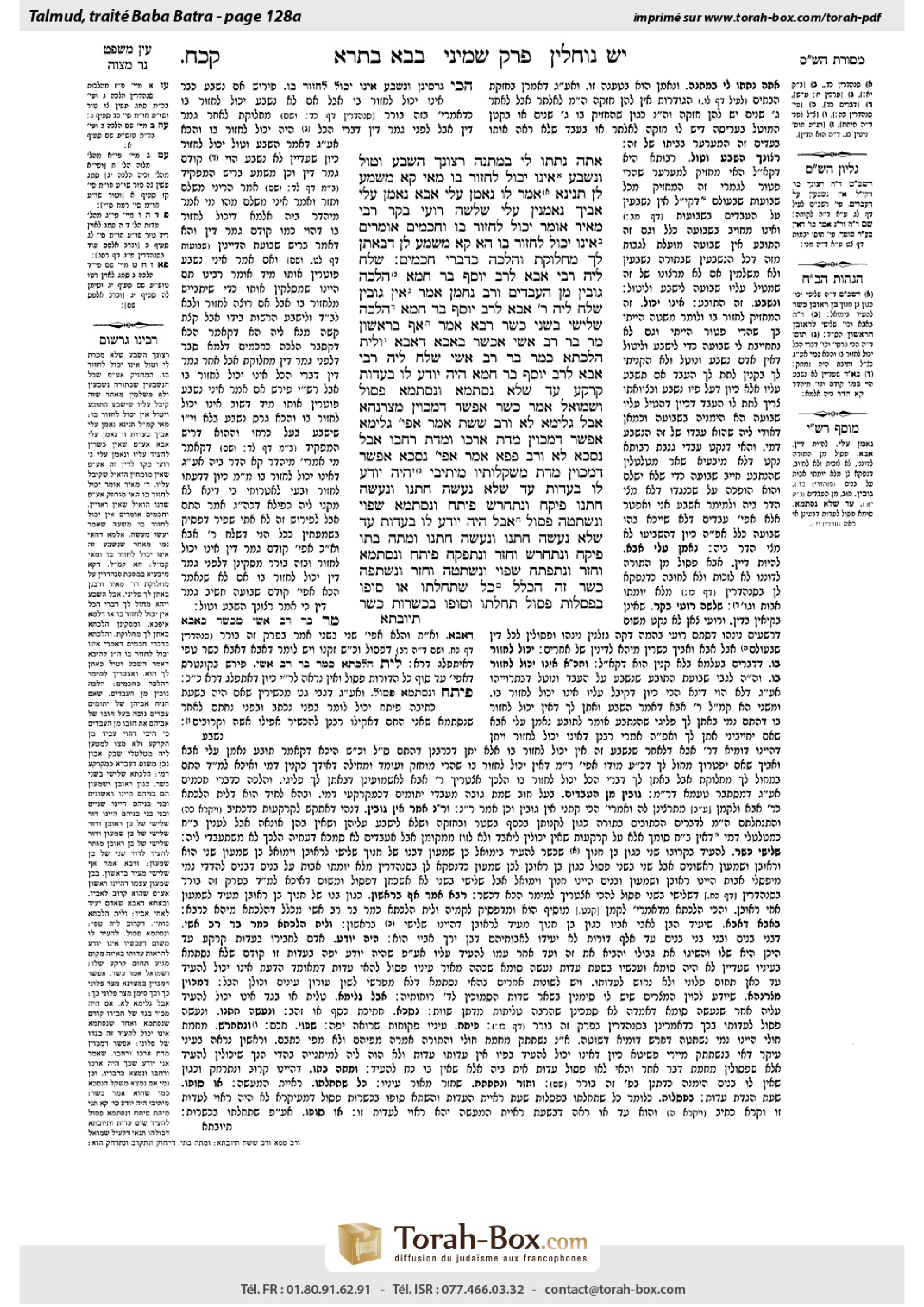
Bava Batra 128a: Talmud study for Daf Yomi
Study the Talmud for Daf Yomi with scanned pages, Hebrew text, English translations from Sefaria and AI-generated French translations.
Passage selection and English or AI-generated French translation are available where the scan has annotations. Daf Study is independent of Torah-Box and Sefaria.
Browse Bava Batra · בבא בתרא · All tractatesBava Batra 128a text and translations
This page of Bava Batra includes the Aramaic text, an English translation and an AI-generated French translation, alongside the scan above.
בבא בתרא קכ״ח א · Aramaic and Hebrew text
אַתָּה נְתַתּוֹ לִי בְּמַתָּנָה. רְצוֹנְךָ הִשָּׁבַע וְטוֹל?״ וְנִשְׁבַּע – אֵינוֹ יָכוֹל לַחְזוֹר בּוֹ.
מַאי קָא מַשְׁמַע לַן? תְּנֵינָא, אָמַר לוֹ: ״נֶאֱמָן עָלַי אַבָּא״; ״נֶאֱמָן עָלַי אָבִיךָ״; ״נֶאֱמָנִין עָלַי שְׁלֹשָׁה רוֹעֵי בָקָר״ – רַבִּי מֵאִיר אוֹמֵר: יָכוֹל לַחֲזוֹר בּוֹ, וַחֲכָמִים אוֹמְרִים: אֵינוֹ יָכוֹל לַחֲזוֹר בּוֹ!
הָא קָא מַשְׁמַע לַן – דִּבְ״אֶתֵּן לָךְ״ מַחְלוֹקֶת, וַהֲלָכָה כְּדִבְרֵי חֲכָמִים.
שְׁלַח לֵיהּ רַבִּי אַבָּא לְרַב יוֹסֵף בַּר חָמָא, הֲלָכָה: גּוֹבִין מִן הָעֲבָדִים. וְרַב נַחְמָן אָמַר: אֵין גּוֹבִין.
שְׁלַח לֵיהּ רַבִּי אַבָּא לְרַב יוֹסֵף בַּר חָמָא, הֲלָכָה: שְׁלִישִׁי בְּשֵׁנִי – כָּשֵׁר. רָבָא אָמַר: אַף בְּרִאשׁוֹן.
מָר בַּר רַב אָשֵׁי אַכְשַׁר בְּאַבָּא דְאַבָּא; וְלֵית הִלְכְתָא כְּמָר בַּר רַב אָשֵׁי.
שְׁלַח לֵיהּ רַבִּי אַבָּא לְרַב יוֹסֵף בַּר חָמָא: הָיָה יוֹדֵעַ לוֹ בְּעֵדוּת קַרְקַע עַד שֶׁלֹּא נִסְתַּמֵּא, וְנִסְתַּמֵּא – פָּסוּל.
וּשְׁמוּאֵל אָמַר: כָּשֵׁר, אֶפְשָׁר דִּמְכַוֵּין מִצְרָנַהָא. אֲבָל גְּלִימָא – לָא. וְרַב שֵׁשֶׁת אָמַר: אֲפִילּוּ גְּלִימָא, אֶפְשָׁר דִּמְכַוֵּין מִדַּת אׇרְכּוֹ וּמִדַּת רׇחְבּוֹ. אֲבָל נְסָכָא – לָא. וְרַב פָּפָּא אָמַר: אֲפִילּוּ נְסָכָא, אֶפְשָׁר דִּמְכַוֵּין מִדַּת מִשְׁקְלוֹתָיו.
מֵיתִיבִי: הָיָה יוֹדֵעַ לוֹ בְּעֵדוּת עַד שֶׁלֹּא נַעֲשָׂה חֲתָנוֹ, וְנַעֲשָׂה חֲתָנוֹ; פִּיקֵּחַ, וְנִתְחָרֵשׁ; פִּיתֵּחַ, וְנִסְתַּמֵּא; שָׁפוּי, וְנִשְׁתַּטָּה – פָּסוּל.
אֲבָל הָיָה יוֹדֵעַ לוֹ בְּעֵדוּת עַד שֶׁלֹּא נַעֲשָׂה חֲתָנוֹ, וְנַעֲשָׂה חֲתָנוֹ וּמֵתָה בִּתּוֹ; פִּיקֵּחַ וְנִתְחָרֵשׁ וְחָזַר וְנִתְפַּקֵּחַ; פִּיתֵּחַ וְנִסְתַּמֵּא וְחָזַר וְנִתְפַּתֵּחַ; שָׁפוּי וְנִשְׁתַּטָּה וְחָזַר וְנִשְׁתַּפָּה – כָּשֵׁר.
זֶה הַכְּלָל: כׇּל שֶׁתְּחִלָּתוֹ אוֹ סוֹפוֹ בְּפַסְלוּת – פָּסוּל, תְּחִלָּתוֹ וְסוֹפוֹ בְּכַשְׁרוּת – כָּשֵׁר.
Bava Batra 128a · English translation
or: You gave him to me as a gift, if he then adds: Although I owe you nothing, as the slave is mine, if it is your desire, take an oath that he is yours and take him; and the claimant takes an oath that the slave is his, the one in possession of the slave cannot retract his offer, although he was not obligated to make the offer.
The Gemara asks: What is Rabbi Abba teaching us? We already learned in a mishna (Sanhedrin 24a) that if one of the litigants said to the other: My father is trusted to adjudicate for me, or: Your father is trusted to adjudicate for me, or: These three cattle herders who are not experts in halakha are trusted to adjudicate for me, and all of the individuals this litigant mentioned are legally disqualified from serving as judges, Rabbi Meir says that the one who stated this can retract his statement, and the Rabbis say that he cannot retract it, and he is obligated to have them serve as judges if the other litigant so desires. Since this halakha is already stated in the mishna, what novel halakha did Rabbi Abba teach?
The Gemara in tractate Sanhedrin records a dispute between amora’im as to the circumstances of the case of that mishna, with one amora holding that the dispute pertains only to a case where the one accepting the disqualified judge will need to forgive a debt if the judge rules in accordance with his opponent, while another amora holds that the dispute pertains even to a case where he will need to pay the other litigant if the judge rules in accordance with his opponent. By stating his ruling in a case where the litigant will have to give the slave to the other, Rabbi Abba teaches us this, that the dispute between Rabbi Meir and the Rabbis is even in a case where the litigant said: I will give you what you claim if that is the ruling of these judges, and the Rabbis hold that if he subsequently wishes to retract his suggestion, he cannot do so. And Rabbi Abba also teaches that the halakha is in accordance with the statement of the Rabbis.
§ Rabbi Abba also sent a ruling to Rav Yosef bar Ḥama that the halakha is that the creditors of one who died collect the debts from the Canaanite slaves the deceased left his heirs, i.e., they take the slaves, as slaves have the same status as land in this regard. And Rav Naḥman says that they do not collect the debt by taking the slaves.
§ Rabbi Abba also sent a ruling to Rav Yosef bar Ḥama that with regard to people with a common ancestor, the halakha is that the testimony of members of the third generation with regard to members of the second generation whose closest familial connection is through that ancestor is valid. For example, one can testify about his first cousin once removed, and is not disqualified as a relative. Rava says: Even the testimony of members of the third generation with regard to members of the first generation is valid; e.g., one can testify about his great-uncle.
Mar bar Rav Ashi deemed one’s testimony with regard to his father’s father valid, as he considered it a case of testimony of a member of the third generation with regard to a member of the first generation, which Rava deemed valid. But the halakha is not in accordance with the opinion of Mar bar Rav Ashi.
§ Rabbi Abba also sent a ruling to Rav Yosef bar Ḥama concerning testimony: If one knew information that could serve as testimony about the boundary of another’s land before he became blind, and then he became blind, he is disqualified from bearing witness in a dispute as to the boundaries of that person’s properties.
And Shmuel said: He is fit to bear witness, as it is possible for him to determine the boundaries of the fields despite his blindness. But he is not fit to identify a movable item, e.g., a cloak, as he cannot see it. And Rav Sheshet said: He can identify even a cloak, as it is possible for him to determine its length and its width. But he is not fit to identify a piece of silver. And Rav Pappa said: He can identify even a piece of silver, as it is possible for him to determine its weight.
The Gemara raises an objection from a baraita (Tosefta, Sanhedrin 3:5): If one knew information that could serve as testimony about another before he became his son-in-law, and then he became his son-in-law, thereby becoming a relative who is disqualified from bearing witness concerning him; or if he was able to hear at the time he witnessed an incident and then he became deaf; or if he was able to see at the time he witnessed an incident and then became blind; or if he was halakhically competent and then became insane, in all these cases, he is disqualified from bearing witness.
The baraita continues: But if he knew information about him that could serve as testimony before he became his son-in-law, and then he became his son-in-law, and then his daughter died, so that they are no longer related; or if he was able to hear, and then became deaf, and then again became able to hear; or if he was able to see, and then became blind, and then again became able to see; or if he was halakhically competent, and then became insane, and then again became halakhically competent, in all these cases, he is fit to bear witness.
The baraita concludes: This is the principle: Anyone whose initial state or his ultimate state, i.e., his state at the time of the incident or at the time of his testimony in court, is one of disqualification for bearing witness is disqualified from bearing witness. But anyone whose initial state and his ultimate state is one of fitness to bear witness is fit to bear witness, even if he was disqualified in the interim. This baraita clearly states that one who is blind is disqualified from bearing witness.
Bava Batra 128a · Traduction française (IA)
ou : Tu m'as donné cet esclave en cadeau, si ensuite il ajoute : Bien que je ne te doive rien, car l'esclave m'appartient, si c'est ton désir, prends un serment qu'il t'appartient et prends-le ; et le demandeur prend un serment que l'esclave lui appartient, celui qui possède l'esclave ne peut pas rétracter son offre, même s'il n'était pas tenu de l'offrir.
La Guemara demande : Quel enseignement Rabbi Abba nous apporte-t-il ? Nous avons déjà appris dans une mitsna (Sanhédrin 24a) que si l'un des parties dit à l'autre : Mon père est digne de juger pour moi, ou : Votre père est digne de juger pour moi, ou : Ces trois bergers qui ne sont pas experts en halakha sont digne de juger pour moi, et tous les individus mentionnés par cette partie sont juridiquement inéligibles à être juges, Rabbi Meïr dit que celui qui a dit cela peut rétracter son déclaration, et les Rabbins disent qu'il ne peut pas rétracter, et qu'il est tenu de les faire servir de juges si la partie adverse le désire. Puisque cette halakha est déjà établie dans la mitsna, quelle halakha nouvelle Rabbi Abba a-t-il enseignée ?
La Guemara dans le traité Sanhédrin rapporte un débat entre des amoraïm concernant les circonstances du cas de cette mitsna, l'un des amoraïm considérant que le débat concerne uniquement un cas où la partie acceptant le juge inéligible devra rembourser une dette si le juge rend un verdict en faveur de son adversaire, tandis que l'autre amoraïm considère que le débat concerne même un cas où il devra payer l'autre partie si le juge rend un verdict en faveur de son adversaire. En énonçant son jugement dans un cas où la partie devra donner l'esclave à l'autre, Rabbi Abba nous enseigne cela, que le débat entre Rabbi Meïr et les Rabbins est même dans un cas où la partie dit : Je te donnerai ce que tu revendiques si c'est le verdict de ces juges, et les Rabbins considèrent que s'il souhaite ensuite rétracter son suggestion, il ne peut pas le faire. Rabbi Abba enseigne également que la halakha suit l'opinion des Rabbins.
§ Rabbi Abba a également envoyé un jugement à Rav Yosef bar Ḥama que la halakha est que les créanciers d'une personne décédée récoltent ses dettes auprès des esclaves cananéens laissés à ses héritiers, c'est-à-dire qu'ils prennent les esclaves, car les esclaves ont le même statut que la terre à cet égard. Et Rav Naḥman dit qu'ils ne récoltent pas la dette en prenant les esclaves.
§ Rabbi Abba a également envoyé un jugement à Rav Yosef bar Ḥama que concernant les personnes ayant un ancêtre commun, la halakha est que le témoignage des membres de la troisième génération concernant les membres de la deuxième génération dont le lien familial le plus proche est via cet ancêtre est valide. Par exemple, l'un peut témoigner sur son cousin germain une fois éloigné, et n'est pas disqualifié comme parent. Rava dit : Même le témoignage des membres de la troisième génération concernant les membres de la première génération est valide ; par exemple, l'un peut témoigner sur son oncle maternel.
Mar bar Rav Ashi considérait que le témoignage concernant son père et son grand-père était valide, car il le considérait comme un cas de témoignage d'un membre de la troisième génération concernant un membre de la première génération, que Rava considérait comme valide. Mais la halakha ne suit pas l'opinion de Mar bar Rav Ashi.
§ Rabbi Abba a également envoyé un jugement à Rav Yosef bar Ḥama concernant le témoignage : Si l'on connaissait une information pouvant servir de témoignage concernant la limite d'une autre propriété avant qu'il ne devienne aveugle, et ensuite il devint aveugle, il est disqualifié de témoigner dans un litige concernant les limites de cette propriété.
Et Shmuel dit : Il est digne de témoigner, car il est possible qu'il détermine les limites des champs malgré son aveuglement. Mais il n'est pas digne d'identifier un objet mobile, par exemple une cape, car il ne peut pas la voir. Et Rav Sheshet dit : Il peut identifier même une cape, car il est possible qu'il détermine sa longueur et sa largeur. Mais il n'est pas digne d'identifier une pièce d'argent. Et Rav Pappa dit : Il peut identifier même une pièce d'argent, car il est possible qu'il détermine son poids.
La Guemara soulève une objection tirée d'une baraïta (Tosefta, Sanhédrin 3:5) : Si l'on connaissait une information pouvant servir de témoignage concernant un autre avant qu'il ne devienne son gendre, et ensuite il devint son gendre, devenant ainsi un parent disqualifié à témoigner concernant lui ; ou si l'on avait pu entendre à l'époque où l'on avait témoin d'un incident et ensuite l'on devint sourd ; ou si l'on avait pu voir à l'époque où l'on avait témoin d'un incident et ensuite l'on devint aveugle ; ou si l'on était halakhiquement compétent et ensuite devint fou, dans tous ces cas, il est disqualifié de témoigner.
La baraïta continue : Mais si l'on connaissait une information concernant lui pouvant servir de témoignage avant qu'il ne devienne son gendre, et ensuite il devint son gendre, et ensuite sa fille mourut, de sorte qu'ils ne sont plus liés ; ou si l'on avait pu entendre, et ensuite devint sourd, et ensuite à nouveau pouvait entendre ; ou si l'on avait pu voir, et ensuite devint aveugle, et ensuite à nouveau pouvait voir ; ou si l'on était halakhiquement compétent, et ensuite devint fou, et ensuite à nouveau halakhiquement compétent, dans tous ces cas, il est digne de témoigner.
La baraïta conclut : Ce principe est le suivant : Quiconque dont l'état initial ou son état final, c'est-à-dire son état à l'époque de l'incident ou à l'époque de son témoignage en cour, est celui de disqualification pour témoigner est disqualifié de témoigner. Mais quiconque dont l'état initial et son état final est celui de fitness à témoigner est digne de témoigner, même s'il a été disqualifié temporairement. Cette baraïta établit clairement que celui qui est aveugle est disqualifié de témoigner.
Traduction française générée par IA à partir de l’édition anglaise de Sefaria. Vérifie toujours un passage avec le texte source.
Text from Sefaria: William Davidson Edition - Vocalized Aramaic (CC BY NC); William Davidson Edition - English (CC BY NC).