Bava Batra 128b: Talmud study for Daf Yomi
Study the Talmud for Daf Yomi with scanned pages, Hebrew text, English translations from Sefaria and AI-generated French translations.
Passage selection and English or AI-generated French translation are available where the scan has annotations. Daf Study is independent of Torah-Box and Sefaria.
Browse Bava Batra · בבא בתרא · All tractatesBava Batra 128b text and translations
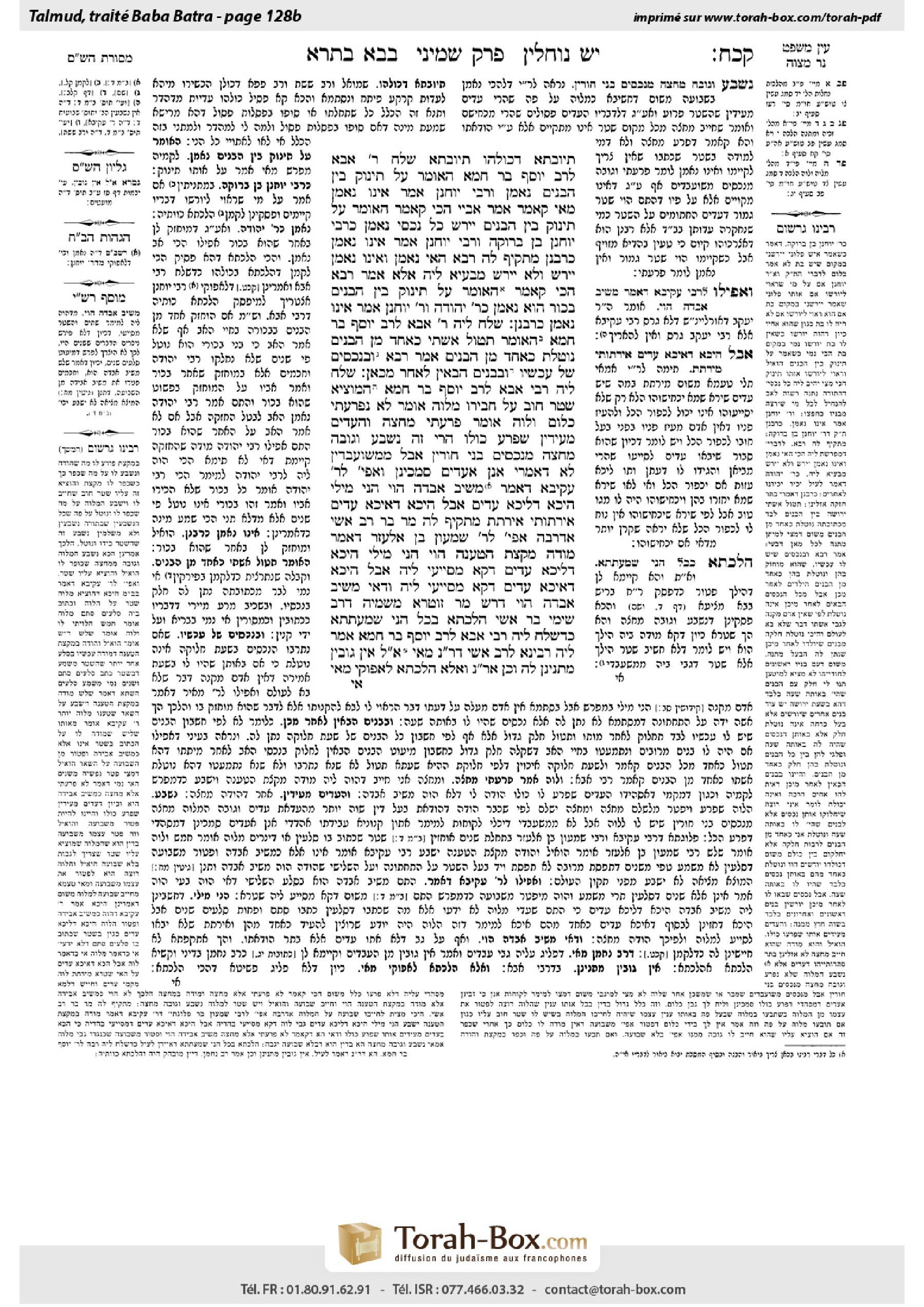
This page of Bava Batra includes the Aramaic text, an English translation and an AI-generated French translation, alongside the scan above.
בבא בתרא קכ״ח ב · Aramaic and Hebrew text
תְּיוּבְתָּא דְכוּלְּהוּ! תְּיוּבְתָּא.
שְׁלַח רַבִּי אַבָּא לְרַב יוֹסֵף בַּר חָמָא: הָאוֹמֵר עַל תִּינוֹק בֵּין הַבָּנִים – נֶאֱמָן. וְרַבִּי יוֹחָנָן אָמַר: אֵינוֹ נֶאֱמָן.
מַאי קָאָמַר? אָמַר אַבָּיֵי: הָכִי קָאָמַר, הָאוֹמֵר עַל תִּינוֹק בֵּין הַבָּנִים: ״יִירַשׁ כׇּל נְכָסַי״ – נֶאֱמָן, כְּרַבִּי יוֹחָנָן בֶּן בְּרוֹקָה. וְרַבִּי יוֹחָנָן אָמַר: אֵינוֹ נֶאֱמָן, כְּרַבָּנַן.
מַתְקֵיף לַהּ רָבָא: הַאי ״נֶאֱמָן״ וְ״אֵינוֹ נֶאֱמָן״?! ״יִירַשׁ״ וְ״לֹא יִירַשׁ״ מִבַּעְיָא לֵיהּ!
אֶלָּא אָמַר רָבָא: הָכִי קָאָמַר, הָאוֹמֵר עַל תִּינוֹק בֵּין הַבָּנִים: ״בְּכוֹר הוּא״ – נֶאֱמָן, כְּרַבִּי יְהוּדָה. וְרַבִּי יוֹחָנָן אָמַר: אֵינוֹ נֶאֱמָן, כְּרַבָּנַן.
שְׁלַח לֵיהּ רַבִּי אַבָּא לְרַב יוֹסֵף בַּר חָמָא: הָאוֹמֵר ״תִּטּוֹל אִשְׁתִּי כְּאֶחָד מִן הַבָּנִים״ – נוֹטֶלֶת כְּאֶחָד מִן הַבָּנִים. אָמַר רָבָא: וּבִנְכָסִים שֶׁל עַכְשָׁיו, וּבְבָנִים הַבָּאִין לְאַחַר מִכָּאן.
שְׁלַח לֵיהּ רַבִּי אַבָּא לְרַב יוֹסֵף בַּר חָמָא: הַמּוֹצִיא שְׁטַר חוֹב עַל חֲבֵירוֹ; מַלְוֶה אוֹמֵר: לֹא נִפְרַעְתִּי כְּלוּם, וְלֹוֶה אוֹמֵר: פָּרַעְתִּי מֶחֱצָה, וְהָעֵדִים מְעִידִין שֶׁפָּרַע כּוּלּוֹ – הֲרֵי זֶה נִשְׁבָּע, וְגוֹבֶה מֶחֱצָה מִנְּכָסִים בְּנֵי חוֹרִין; אֲבָל מִמְּשׁוּעְבָּדִין לָא, דְּאָמְרִי: אֲנַן אַעֵדִים סָמְכִינַן.
וַאֲפִילּוּ לְרַבִּי עֲקִיבָא, דְּאָמַר: מֵשִׁיב אֲבֵדָה הָוֵי – הָנֵי מִילֵּי הֵיכָא דְּלֵיכָּא עֵדִים, אֲבָל הֵיכָא דְּאִיכָּא עֵדִים – אִירְתוֹתֵי אִירְתַת.
מַתְקֵיף לַהּ מָר בַּר רַב אָשֵׁי: אַדְּרַבָּה, אֲפִילּוּ לְרַבִּי שִׁמְעוֹן בֶּן אֶלְעָזָר דְּאָמַר: מוֹדֶה מִקְצָת הַטַּעֲנָה הָוֵי – הָנֵי מִילֵּי הֵיכָא דְּלֵיכָּא עֵדִים דְּקָא מְסַיְּיעִי לֵיהּ, אֲבָל הֵיכָא דְּאִיכָּא עֵדִים דְּקָא מְסַיְּיעִי לֵיהּ – וַדַּאי מֵשִׁיב אֲבֵדָה הָוֵי.
דָּרֵשׁ מָר זוּטְרָא מִשְּׁמֵיהּ דְּרַב שִׁימִי בַּר אָשֵׁי: הִלְכְתָא בְּכׇל הָנֵי שְׁמַעְתָּתָא, כְּדִשְׁלַח לֵיהּ רַבִּי אַבָּא לְרַב יוֹסֵף בַּר חָמָא. אֲמַר לֵיהּ רָבִינָא לְרַב אָשֵׁי: דְּרַב נַחְמָן, מַאי? אֲמַר לֵיהּ: ״אֵין גּוֹבִין״ מַתְנֵינַן לַהּ, וְכֵן אָמַר רַב נַחְמָן.
וְאֶלָּא הִלְכְתָא – לְאַפּוֹקֵי מַאי?
Bava Batra 128b · English translation
The Gemara concludes: The refutation of the opinions of all the amora’im who held that a person who became blind after witnessing a matter can, in certain cases, testify about it, is indeed a conclusive refutation.
§ Rabbi Abba sent another ruling to Rav Yosef bar Ḥama: One who says something concerning one child among his sons is deemed credible, and Rabbi Yoḥanan says that he is not deemed credible.
The Gemara asks: What is Rabbi Abba saying? Abaye said that this is what Rabbi Abba is saying: One who says concerning one child among his sons: He shall inherit all my property, is deemed credible, in accordance with the opinion of Rabbi Yoḥanan ben Beroka, who holds that one can bequeath all his property to one of his heirs (130a). And Rabbi Yoḥanan says that he is not deemed credible, in accordance with the opinion of the Rabbis, who disagree with Rabbi Yoḥanan ben Beroka.
Rava objects to this explanation: According to Abaye’s explanation, this wording: Is deemed credible, and: He is not deemed credible, is not precise; he should have employed the terms: Shall inherit, and: Shall not inherit, as the issue is the ability of the father to specify who will inherit from him, not his credibility.
Rather, Rava said that this is what Rabbi Abba is saying: One who says about one child among his sons that he is his firstborn is deemed credible, in accordance with the opinion of Rabbi Yehuda (127b); and Rabbi Yoḥanan says that he is not deemed credible, in accordance with the opinion of the Rabbis, who disagree with Rabbi Yehuda.
§ Rabbi Abba sent another ruling to Rav Yosef bar Ḥama: In a case of one who says: My wife will take a portion of my estate like one of the sons, she takes a portion like one of the sons, as it is considered a gift. Rava says: And this ruling is only with regard to the husband’s current property, which he can give her as a gift. The husband cannot give her a portion of his future property. And furthermore, the calculation of her portion must take into account not only the number of sons the husband has at the time of his statement, but also the sons who come, i.e., who will be born, afterward.
§ Rabbi Abba sent another ruling to Rav Yosef bar Ḥama: In the case of one who produces a promissory note against another, and the creditor says: I was not repaid anything, and the debtor says: I repaid half the debt, and the witnesses testify that the debtor repaid the entire debt, then this debtor takes an oath that he repaid half, as is the halakha with regard to one who admits to a part of a claim, and he is exempt from paying that half. And the creditor collects the second half from unsold property; but not from liened property that was sold after the loan, as the buyers can say: We rely on the witnesses that the debt was repaid in its entirety.
The Gemara compares this halakha to the case of a promissory note that states that the debtor owes the creditor: Sela coins, without stating how many. The creditor claims that he lent the debtor five sela and the debtor claims that he borrowed only three. Rabbi Akiva holds that since the wording of the promissory note indicates a minimum debt of two sela, and the creditor could not have collected the third sela without the debtor’s admission, the latter’s admission to a part of the claim cannot render him liable to take an oath. The Gemara states: And even according to Rabbi Akiva, who says that the debtor is not liable to take an oath, as with regard to the third sela his legal status is similar to that of one who returns a lost item, this statement applies only in a case where there are no witnesses to the loan. But where there are witnesses, as is the case in Rabbi Abba’s ruling, the debtor fears denying the entire debt. Therefore he is liable to take an oath that he repaid half, as one who admits to a part of the claim.
Mar bar Rav Ashi objects to this: On the contrary; even according to Rabbi Shimon ben Elazar, who disagrees with Rabbi Akiva and says that the debtor is considered one who admits to a part of the claim, this statement applies only in a case where there are no witnesses who support him. But here in the case of Rabbi Abba, where there are witnesses who support him, testifying that he repaid the entire debt, his legal status is certainly that of one who returns a lost item, and he does not need to take an oath that he repaid half.
§ Mar Zutra taught in the name of Rav Shimi bar Ashi: The halakha in all these halakhot is as Rabbi Abba sent to Rav Yosef bar Ḥama. Ravina said to Rav Ashi: What about the statement with which Rav Naḥman disagreed, i.e., that a debt can be collected by taking the slaves the debtor left his heirs? Is the halakha in accordance with this ruling of Rabbi Abba as well, despite the principle that in monetary matters the halakha is in accordance with Rav Naḥman’s opinion? Rav Ashi said to him: We teach a different tradition, that Rabbi Abba’s statement rules that a creditor does not collect the debt from the slaves the debtor left his heirs, and that Rav Naḥman said the same.
The Gemara asks: But then what possibility does Mar Zutra exclude in ruling that the halakha is in accordance with Rabbi Abba’s statement?
Bava Batra 128b · Traduction française (IA)
La Guemara conclut : La réfutation des opinions de tous les amora’im qui pensaient qu'une personne devenue aveugle après avoir été témoin d'un fait peut, dans certains cas, témoigner à son sujet est effectivement une réfutation concluante.
§ Rabbi Abba envoya un autre avis à Rav Yosef bar Ḥama : Celui qui dit quelque chose concernant un fils parmi ses fils est considéré comme crédible, et Rabbi Yoḥanan dit qu'il n'est pas considéré comme crédible.
La Guemara pose la question : De quoi Rabbi Abba parle-t-il ? Abaye dit que c'est ce que Rabbi Abba dit : Celui qui dit concernant un fils parmi ses fils : Il héritera toute ma propriété, est considéré comme crédible, conformément à l'opinion de Rabbi Yoḥanan ben Beroka, qui considère que l'on peut léguer toute sa propriété à l'un de ses héritiers (130a). Et Rabbi Yoḥanan dit qu'il n'est pas considéré comme crédible, conformément à l'opinion des Rabbins, qui s'opposent à Rabbi Yoḥanan ben Beroka.
Rava s’oppose à cette explication : Selon l’explication d’Abaye, cette formulation : Il est considéré comme crédible, et : Il n’est pas considéré comme crédible, n’est pas précise ; il aurait dû employer les termes : Il héritera, et : Il ne héritera pas, car la question porte sur la capacité du père à spécifier qui héritera de lui, pas sur sa crédibilité.
En réalité, Rava dit que c’est ce que Rabbi Abba dit : Celui qui dit concernant un fils parmi ses fils qu’il est son premier-né est considéré comme crédible, conformément à l’opinion de Rabbi Yéhuda (127b) ; et Rabbi Yoḥanan dit qu’il n’est pas considéré comme crédible, conformément à l’opinion des Rabbins, qui s’opposent à Rabbi Yéhuda.
§ Rabbi Abba envoya un autre avis à Rav Yosef bar Ḥama : Dans le cas où l’on dit : Ma femme prendra une part de ma succession comme l’un de mes fils, elle prend une part comme l’un de mes fils, car cela est considéré comme un don. Rava dit : Et cet avis s’applique uniquement à la propriété actuelle du mari, qu’il peut lui donner en don. Le mari ne peut pas lui donner une part de sa propriété future. De plus, le calcul de sa part doit prendre en compte non seulement le nombre de fils que le mari a au moment de son déclaration, mais aussi les fils qui naîtront par la suite.
§ Rabbi Abba envoya un autre avis à Rav Yosef bar Ḥama : Dans le cas où l’on produit un billet de change contre un autre, et le créancier dit : Je n’ai pas été remboursé du tout, et le débiteur dit : J’ai remboursé la moitié de la dette, et les témoins témoignent que le débiteur a remboursé toute la dette, alors ce débiteur prend un serment qu’il a remboursé la moitié, conformément à la halakha concernant celui qui admet une partie d’une réclamation, et il est exempt de payer cette moitié. Et le créancier récupère la seconde moitié à partir de biens non vendus ; mais pas à partir de biens hypothéqués vendus après le prêt, car les acheteurs peuvent dire : Nous nous appuyons sur les témoins que la dette a été remboursée en totalité.
La Guemara compare cette halakha au cas d’un billet de change qui stipule que le débiteur doit au créancier : des sela, sans préciser combien. Le créancier affirme qu’il a prêté au débiteur cinq sela et le débiteur affirme qu’il a emprunté seulement trois. Rabbi Akiva considère que puisque la formulation du billet de change indique une dette minimale de deux sela, et que le créancier ne pouvait pas récupérer le troisième sela sans l’admission du débiteur, l’admission du débiteur à une partie de la réclamation ne peut pas le rendre responsable de prendre un serment. La Guemara dit : Et même selon Rabbi Akiva, qui dit que le débiteur n’est pas responsable de prendre un serment, car concernant le troisième sela son statut juridique est similaire à celui de celui qui rend un objet perdu, cette déclaration s’applique uniquement dans un cas où il n’y a pas de témoins à l’origine du prêt. Mais dans le cas où il y a des témoins, comme c’est le cas dans l’avis de Rabbi Abba, le débiteur craint de nier toute la dette. Il est donc responsable de prendre un serment qu’il a remboursé la moitié, comme celui qui admet une partie de la réclamation.
Mar bar Rav Ashi s’oppose à cela : Au contraire ; même selon Rabbi Shimon ben Elazar, qui s’oppose à Rabbi Akiva et affirme que le débiteur est considéré comme celui qui admet une partie de la réclamation, cette déclaration s’applique uniquement dans un cas où il n’y a pas de témoins qui soutiennent le débiteur. Mais ici, dans le cas de Rabbi Abba, où il y a des témoins qui soutiennent le débiteur, témoignant qu’il a remboursé toute la dette, son statut juridique est certainement celui de celui qui rend un objet perdu, et il n’a pas besoin de prendre un serment qu’il a remboursé la moitié.
§ Mar Zutra enseigna en nom de Rav Shimi bar Ashi : La halakha dans tous ces cas est comme l’avis que Rabbi Abba envoya à Rav Yosef bar Ḥama. Ravina dit à Rav Ashi : Et que devons-nous penser de l’affirmation avec laquelle Rav Naḥman s’est désaccordé, c’est-à-dire que la dette peut être récupérée en prenant les esclaves laissés par le débiteur à ses héritiers ? La halakha s’applique-t-elle également à cet avis de Rabbi Abba, malgré le principe selon lequel, dans les affaires monétaires, la halakha suit l’opinion de Rav Naḥman ? Rav Ashi dit à lui : Nous enseignons une tradition différente, que l’avis de Rabbi Abba établit que le créancier ne récupère pas la dette des esclaves laissés par le débiteur à ses héritiers, et que Rav Naḥman a dit la même chose.
La Guemara pose la question : Mais alors, quelle possibilité Mar Zutra exclut-il en déclarant que la halakha suit l’avis de Rabbi Abba ?
Traduction française générée par IA à partir de l’édition anglaise de Sefaria. Vérifie toujours un passage avec le texte source.
Text from Sefaria: William Davidson Edition - Vocalized Aramaic (CC BY NC); William Davidson Edition - English (CC BY NC).