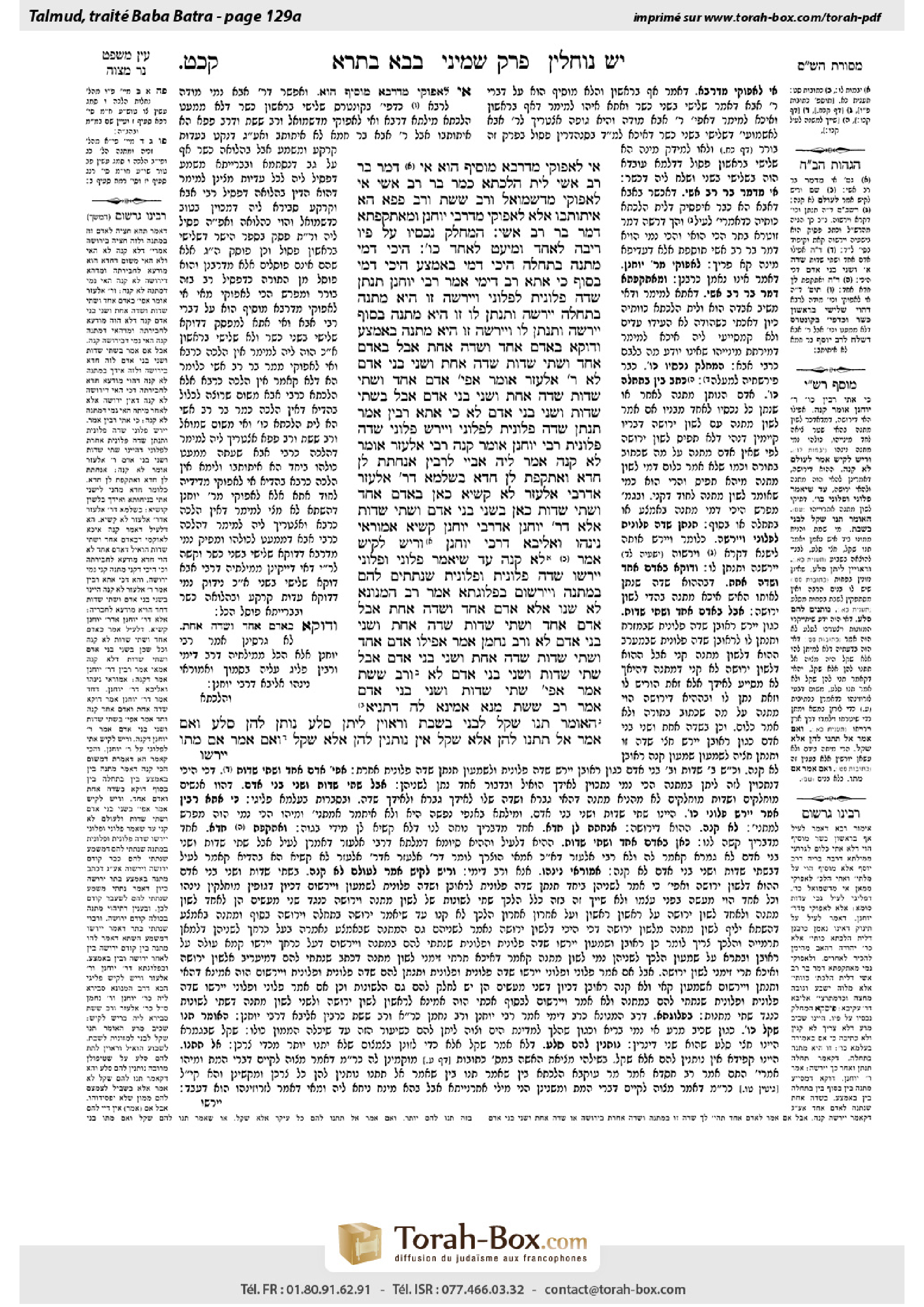
Bava Batra 129a: Talmud study for Daf Yomi
Study the Talmud for Daf Yomi with scanned pages, Hebrew text, English translations from Sefaria and AI-generated French translations.
Passage selection and English or AI-generated French translation are available where the scan has annotations. Daf Study is independent of Torah-Box and Sefaria.
Browse Bava Batra · בבא בתרא · All tractatesBava Batra 129a text and translations
This page of Bava Batra includes the Aramaic text, an English translation and an AI-generated French translation, alongside the scan above.
בבא בתרא קכ״ט א · Aramaic and Hebrew text
אִי לְאַפּוֹקֵי מִדְּרָבָא – מוֹסִיף הוּא! אִי דְּמָר בַּר רַב אָשֵׁי – לֵית הִלְכְתָא כְּמָר בַּר רַב אָשֵׁי! אִי לְאַפּוֹקֵי מִדִּשְׁמוּאֵל וְרַב שֵׁשֶׁת וְרַב פָּפָּא – הָא אִיתּוֹתְבוּ!
אֶלָּא לְאַפּוֹקֵי מִדְּרַבִּי יוֹחָנָן, וּמֵאַתְקָפְתָּא דְּמָר בַּר רַב אָשֵׁי.
הַמְחַלֵּק נְכָסָיו עַל פִּיו, רִיבָּה לְאֶחָד וּמִיעֵט לְאֶחָד כּוּ׳. הֵיכִי דָּמֵי מַתָּנָה בַּתְּחִלָּה, הֵיכִי דָּמֵי בָּאֶמְצַע, הֵיכִי דָּמֵי בַּסּוֹף?
כִּי אֲתָא רַב דִּימִי אָמַר רַבִּי יוֹחָנָן: ״תִּנָּתֵן שָׂדֶה פְּלוֹנִית לִפְלוֹנִי, וְיִירָשֶׁהָ״ – זוֹ הִיא מַתָּנָה בַּתְּחִלָּה. ״וְיִירָשֶׁהָ וְתִנָּתֵן לוֹ״ – זוֹ הִיא מַתָּנָה בַּסּוֹף. ״יִירָשֶׁהָ וְתִנָּתֵן לוֹ וְיִירָשֶׁהָ״ – זוֹ הִיא מַתָּנָה בָּאֶמְצַע.
וְדַוְקָא בְּאָדָם אֶחָד וְשָׂדֶה אַחַת; אֲבָל בְּאָדָם אֶחָד וּשְׁתֵּי שָׂדוֹת, שָׂדֶה אַחַת וּשְׁנֵי בְּנֵי אָדָם – לֹא.
רַבִּי אֶלְעָזָר אוֹמֵר: אֲפִילּוּ אָדָם אֶחָד וּשְׁתֵּי שָׂדוֹת, שָׂדֶה אַחַת וּשְׁנֵי בְּנֵי אָדָם; אֲבָל בִּשְׁתֵּי שָׂדוֹת וּשְׁנֵי בְּנֵי אָדָם – לֹא.
כִּי אֲתָא רָבִין, אָמַר: ״תִּנָּתֵן שָׂדֶה פְּלוֹנִית לִפְלוֹנִי, וְיִירַשׁ פְּלוֹנִי שָׂדֶה פְּלוֹנִית״ – רַבִּי יוֹחָנָן אוֹמֵר: קָנָה, רַבִּי אֶלְעָזָר אוֹמֵר: לֹא קָנָה.
אֲמַר לֵיהּ אַבָּיֵי לְרָבִין: אַנְחֵתְתְּ לַן חֲדָא, וְאַתְקֵפְתְּ לַן חֲדָא! בִּשְׁלָמָא דְּרַבִּי אֶלְעָזָר אַדְּרַבִּי אֶלְעָזָר לָא קַשְׁיָא – כָּאן בְּאָדָם אֶחָד וּשְׁתֵּי שָׂדוֹת, כָּאן בִּשְׁנֵי בְּנֵי אָדָם וּשְׁתֵּי שָׂדוֹת;
אֶלָּא דְּרַבִּי יוֹחָנָן אַדְּרַבִּי יוֹחָנָן – קַשְׁיָא!
אָמוֹרָאֵי נִינְהוּ וְאַלִּיבָּא דְּרַבִּי יוֹחָנָן.
וְרֵישׁ לָקִישׁ אָמַר, לֹא קָנָה עַד שֶׁיֹּאמַר: ״פְּלוֹנִי וּפְלוֹנִי יִירְשׁוּ שָׂדֶה פְּלוֹנִית וּפְלוֹנִית שֶׁנְּתַתִּים לָהֶם בְּמַתָּנָה, וְיִירָשׁוּם״.
בִּפְלוּגְתָּא – אָמַר רַב הַמְנוּנָא: לֹא שָׁנוּ אֶלָּא אָדָם אֶחָד וְשָׂדֶה אַחַת; אֲבָל אָדָם אֶחָד וּשְׁתֵּי שָׂדוֹת, שָׂדֶה אַחַת וּשְׁנֵי בְּנֵי אָדָם – לֹא. וְרַב נַחְמָן אָמַר: אֲפִילּוּ אָדָם אֶחָד וּשְׁתֵּי שָׂדוֹת, שָׂדֶה אַחַת וּשְׁנֵי בְּנֵי אָדָם; אֲבָל שְׁתֵּי שָׂדוֹת וּשְׁנֵי בְּנֵי אָדָם – לֹא. וְרַב שֵׁשֶׁת אָמַר: אֲפִילּוּ שְׁתֵּי שָׂדוֹת וּשְׁנֵי בְּנֵי אָדָם.
אָמַר רַב שֵׁשֶׁת: מְנָא אָמֵינָא לַהּ? דְּתַנְיָא, הָאוֹמֵר: ״תְּנוּ שֶׁקֶל לְבָנַי בְּשַׁבָּת״, וּרְאוּיִן לִיתֵּן סֶלַע – נוֹתֵן לָהֶן סֶלַע. וְאִם אָמַר: ״אַל תִּתְּנוּ לָהֶן אֶלָּא שֶׁקֶל״ – אֵין נוֹתְנִין לָהֶן אֶלָּא שֶׁקֶל. וְאִם אָמַר: ״אִם מֵתוּ,
Bava Batra 129a · English translation
If his statement is said to exclude the statement of Rava that the testimony of members of the third generation concerning members of the first generation is valid, this is difficult, as Rava’s statement is not in conflict with Rabbi Abba’s statement that the testimony of members of the third generation with regard to members of the second generation is valid; it merely adds to it. If it is said to exclude the opinion of Mar bar Rav Ashi that a grandfather can testify concerning his grandchild, this is also difficult, as it has already been established that the halakha is not in accordance with the opinion of Mar bar Rav Ashi. If it is said to exclude the rulings of Shmuel and Rav Sheshet and Rav Pappa, that a person who became blind can testify about what he saw beforehand, this too is difficult, as their rulings were refuted based on a baraita.
The Gemara explains: Rather, Mar Zutra’s statement is said to exclude the statement of Rabbi Yoḥanan that one cannot testify that a specific one of his sons is his firstborn, and to exclude the strong objection of Mar bar Rav Ashi to the statement of Rabbi Abba with regard to a case where a debtor admitted to part of a claim and witnesses testified that he repaid the entire debt. Despite Mar bar Rav Ashi’s objection, the halakha is that the debtor is not liable to take an oath.
§ The mishna teaches: With regard to one on his deathbed who apportions his property orally, granting it to his sons as a gift, and he increased the portion given to one of his sons and reduced the portion given to one other son, or equated the portion of the firstborn to the portions of the other sons, his statement stands. But if he said that they will receive the property not as a gift but as an inheritance, he has said nothing. If he wrote in his will, whether at the beginning, or in the middle, or at the end, that he is granting them the property as a gift, his statement stands. The Gemara asks: What are the circumstances where it is phrased as a gift at the beginning? What are the circumstances where it is phrased as a gift in the middle? What are the circumstances where it is phrased as a gift at the end?
When Rav Dimi came from Eretz Yisrael to Babylonia, he said that Rabbi Yoḥanan says that where one on his deathbed instructed: Such and such a field will be given to so-and-so and he will inherit it, this is a case where it is phrased as a gift at the beginning. Where he instructed: And he will inherit it and it will be given to him, this is a case where it is phrased as a gift at the end. Where he instructed: He will inherit it and it will be given to him and he will inherit it, this is a case where it is phrased as a gift in the middle.
And the halakha that his statement is valid pertains specifically to a case where the two terms, giving and inheritance, are employed with regard to one person and one field. But if they are employed with regard to one person and two fields, e.g., if he says: Reuven will inherit this field and will be given that field, or one field and two people, e.g., Reuven will inherit half of this field and Shimon will be given the other half, the part that was phrased as inheritance does not take effect. Only the part that is phrased as a gift takes effect.
Rabbi Elazar says: Even in a case where the two terms are employed with regard to one person and two fields, or one field and two people, his instruction takes effect, as both terms were employed with regard to the same person or the same field. But with regard to two fields and two people, it does not take effect, as the two instructions are not connected to one another.
When Ravin came from Eretz Yisrael to Babylonia, he said that if one on his deathbed said: Such and such a field will be given to so-and-so, and so-and-so, i.e., another person, will inherit such and such a field, i.e., another field, Rabbi Yoḥanan says that even the latter person, who was designated to inherit his field, has acquired it. Rabbi Elazar says: He has not acquired it.
Abaye said to Ravin: You have lightened our burden with one statement that you cited, but you have made it difficult for us with the other one. Granted, the contradiction between this statement of Rabbi Elazar that you cited and the previously cited statement of Rabbi Elazar is not difficult. There, in the previously cited statement, Rabbi Elazar said that the directive takes effect with regard to a case of one person and two fields, and here he said that the directive does not take effect with regard to a case of two people and two fields.
But the apparent contradiction between one statement of Rabbi Yoḥanan and the other statement of Rabbi Yoḥanan is difficult, as Rav Dimi cited in Rabbi Yoḥanan’s name that his directive takes effect only in a case of one person and one field, and according to your citation in the name of Rabbi Yoḥanan it takes effect even in a case of two people and two fields.
Ravin answered him: Rav Dimi and I are amora’im, and we each have a different tradition with regard to the opinion of Rabbi Yoḥanan.
Ravin continued: And Reish Lakish says that one has not acquired the field in the case of two people and two fields unless the giver says: So-and-so and so-and-so will inherit such and such a field and such and such a field that I have given them as a gift, and they will inherit it.
This dispute between the amora’im of Eretz Yisrael is also the subject of a dispute between the amora’im of Babylonia. Rav Hamnuna says: The mishna taught that when both giving and inheritance are mentioned one can increase the portion of one of his sons only with regard to a case of one person and one field, but with regard to one person and two fields, or one field and two people, it is not effective. And Rav Naḥman says: Even in a case of one person and two fields, or one field and two people, it is effective, but in a case of two fields and two people, it is not. And Rav Sheshet says: Even in a case of two fields and two people, it is effective.
Rav Sheshet said: From where do I say this? As it is taught in a baraita (Tosefta, Ketubot 6:10): If a person on his deathbed, or one who is going overseas, says to his children’s steward: Give a shekel to my children every week for their needs, and this is a situation where, based on their needs, they are fit for the steward to give them a sela, i.e., double the amount, he gives them a sela. When the father mentioned a shekel, he presumably meant that the children should be given a sum in accordance with their actual requirements, not that specific amount. But if he said: Give them only a shekel, the steward gives them only a shekel, and no more. And if he said: If my children die,
Bava Batra 129a · Traduction française (IA)
Si son affirmation exclut celle de Rava selon laquelle le témoignage des membres de la troisième génération concernant les membres de la première génération est valide, cela est difficile, car l'affirmation de Rava ne contredit pas celle de Rabbi Abba selon laquelle le témoignage des membres de la troisième génération concernant les membres de la deuxième génération est valide ; elle n'ajoute qu'à celle-ci. Si on dit qu'elle exclut l'opinion de Mar bar Rav Ashi selon laquelle un grand-père peut témoigner concernant son petit-fils, cela est également difficile, car il a déjà été établi que la halakha ne suit pas l'opinion de Mar bar Rav Ashi. Si on dit qu'elle exclut les décisions de Shmuel et de Rav Sheshet et de Rav Pappa selon lesquelles une personne devenue aveugle peut témoigner sur ce qu'elle a vu auparavant, cela est également difficile, car ces décisions ont été réfutées sur la base d'une baraïta.
La Guemara explique : En réalité, l'affirmation de Mar Zutra est dite pour exclure celle de Rabbi Yoḥanan selon laquelle on ne peut témoigner que l'un des fils d'une personne est son premier-né, et pour exclure l'objection forte de Mar bar Rav Ashi à l'affirmation de Rabbi Abba concernant un cas où un débiteur a admis une partie d'une réclamation et des témoins ont témoigné qu'il avait remboursé la dette entière. Malgré l'objection de Mar bar Rav Ashi, la halakha est que le débiteur n'est pas tenu de prendre un serment.
§ La mitsna enseigne : Concernant une personne sur son lit de mort qui distribue oralement ses biens, les donnant à ses fils en tant que don, et qui accroît la part donnée à l'un de ses fils et réduit celle donnée à un autre, ou égale la part du premier-né à celle des autres fils, son déclaration est valable. Mais si il dit qu'ils recevront la propriété non en tant que don mais en tant qu'héritage, il n'a rien dit. Si il écrit dans son testament, que ce soit au début, au milieu ou à la fin, qu'il leur donne la propriété en tant que don, sa déclaration est valable. La Guemara pose la question : Quels sont les cas où il est formulé comme un don au début ? Quels sont les cas où il est formulé comme un don au milieu ? Quels sont les cas où il est formulé comme un don à la fin ?
Quand Rav Dimi est venu de la Terre d'Israël vers Babylone, il a dit que Rabbi Yoḥanan dit que lorsqu'une personne sur son lit de mort ordonne : Ce champ-là sera donné à tel et il héritera de lui, c'est un cas où il est formulé comme un don au début. Lorsqu'il ordonne : Et il héritera de lui et il sera donné à lui, c'est un cas où il est formulé comme un don à la fin. Lorsqu'il ordonne : Il héritera de lui et il sera donné à lui et il héritera de lui, c'est un cas où il est formulé comme un don au milieu.
Et la halakha selon laquelle sa déclaration est valide concerne spécifiquement un cas où les deux termes, donner et héritage, sont employés concernant une seule personne et un seul champ. Mais si ils sont employés concernant une seule personne et deux champs, par exemple, s'il dit : Reuven héritera de ce champ et recevra celui-ci, ou un champ et deux personnes, par exemple, Reuven héritera de la moitié de ce champ et Shimon recevra l'autre moitié, la partie formulée comme héritage ne prend effet. Seule la partie formulée comme don prend effet.
Rabbi Elazar dit : Même dans un cas où les deux termes sont employés concernant une seule personne et deux champs, ou un champ et deux personnes, son instruction prend effet, car les deux termes ont été employés concernant la même personne ou le même champ. Mais concernant deux champs et deux personnes, cela ne prend pas effet, car les deux instructions ne sont pas liées l'une à l'autre.
Quand Ravin est venu de la Terre d'Israël vers Babylone, il a dit que si une personne sur son lit de mort dit : Ce champ-là sera donné à tel et tel, c'est-à-dire une autre personne, héritera de ce champ, c'est-à-dire un autre champ, Rabbi Yoḥanan dit que même la personne désignée pour hériter de son champ a acquis ce champ. Rabbi Elazar dit : Il n'a pas acquis ce champ.
Abaye a dit à Ravin : Vous avez allégé notre fardeau avec l'affirmation que vous avez citée, mais vous avez rendu difficile notre tâche avec l'autre. En effet, la contradiction entre cette affirmation de Rabbi Elazar que vous avez citée et l'affirmation précédemment citée de Rabbi Elazar n'est pas difficile. Là, dans l'affirmation précédemment citée, Rabbi Elazar a dit que l'instruction prend effet dans le cas d'une seule personne et deux champs, et ici il dit que l'instruction ne prend pas effet dans le cas de deux personnes et deux champs.
Mais la contradiction apparente entre l'affirmation de Rabbi Yoḥanan et l'autre affirmation de Rabbi Yoḥanan est difficile, car Rav Dimi a cité en nom de Rabbi Yoḥanan que son instruction prend effet uniquement dans le cas d'une seule personne et d'un seul champ, et selon votre citation en nom de Rabbi Yoḥanan, elle prend effet même dans le cas de deux personnes et deux champs.
Ravin a répondu à lui : Rav Dimi et moi sommes des amoraïm, et nous avons chacun une tradition différente concernant l'opinion de Rabbi Yoḥanan.
Ravin a poursuivi : Et Reish Lakish dit que l'on n'a pas acquis le champ dans le cas de deux personnes et deux champs, sauf si le donneur dit : Tel et tel hériteront de ce champ et de ce champ que je leur ai donné en don, et ils hériteront de lui.
Ce débat entre les amoraïm de la Terre d'Israël est également l'objet d'un débat entre les amoraïm de Babylone. Rav Hamnuna dit : La mitsna a enseigné que lorsqu'on mentionne à la fois donner et héritage, on peut augmenter la part d'un des fils uniquement dans le cas d'une seule personne et d'un seul champ, mais dans le cas d'une seule personne et deux champs, ou d'un champ et deux personnes, cela n'est pas efficace. Et Rav Naḥman dit : Même dans le cas d'une seule personne et deux champs, ou d'un champ et deux personnes, cela est efficace, mais dans le cas de deux champs et deux personnes, cela n'est pas efficace. Et Rav Sheshet dit : Même dans le cas de deux champs et deux personnes, cela est efficace.
Rav Sheshet a dit : D'où dis-je cela ? Comme il est enseigné dans une baraïta (Tosefta, Ketubot 6:10) : Si une personne, sur son lit de mort, ou celui qui part à l'étranger, dit à son steward des enfants : Donne un sela à mes enfants chaque semaine pour leurs besoins, et c'est une situation où, selon leurs besoins, ils sont dûment éligibles pour que le steward leur donne un sela, c'est-à-dire double la somme, il leur donne un sela. Lorsque le père a mentionné un sela, il a probablement voulu dire que les enfants devaient recevoir une somme en fonction de leurs besoins réels, pas cette somme spécifique. Mais si il a dit : Donne-leur seulement un sela, le steward leur donne seulement un sela, et pas plus. Et si il a dit : Si mes enfants meurent,
Traduction française générée par IA à partir de l’édition anglaise de Sefaria. Vérifie toujours un passage avec le texte source.
Text from Sefaria: William Davidson Edition - Vocalized Aramaic (CC BY NC); William Davidson Edition - English (CC BY NC).