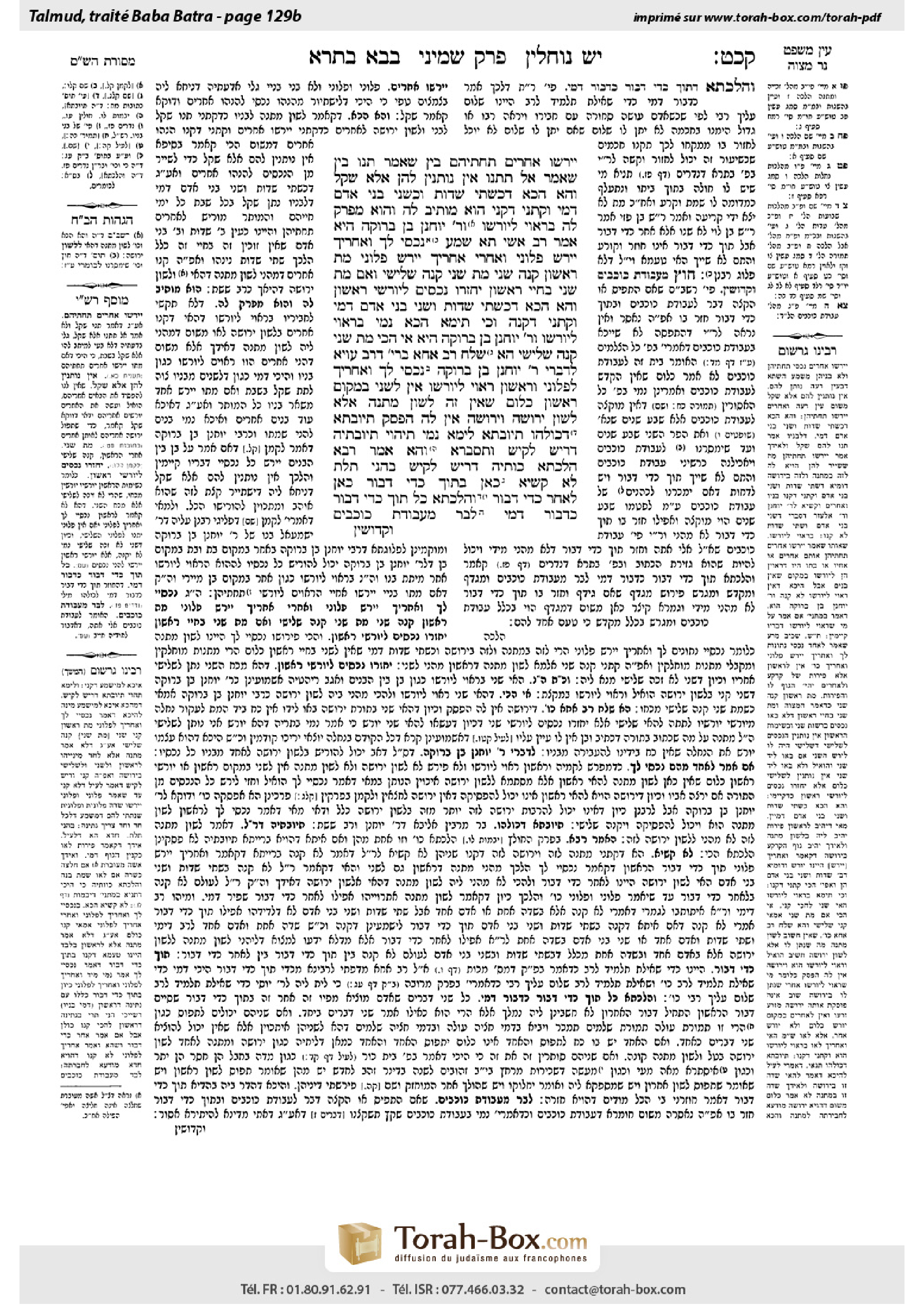
Bava Batra 129b: Talmud study for Daf Yomi
Study the Talmud for Daf Yomi with scanned pages, Hebrew text, English translations from Sefaria and AI-generated French translations.
Passage selection and English or AI-generated French translation are available where the scan has annotations. Daf Study is independent of Torah-Box and Sefaria.
Browse Bava Batra · בבא בתרא · All tractatesBava Batra 129b text and translations
This page of Bava Batra includes the Aramaic text, an English translation and an AI-generated French translation, alongside the scan above.
בבא בתרא קכ״ט ב · Aramaic and Hebrew text
יִירְשׁוּ אֲחֵרִים תַּחְתֵּיהֶם״ – בֵּין שֶׁאָמַר ״תְּנוּ״ בֵּין שֶׁאָמַר ״אַל תִּתְּנוּ״ – אֵין נוֹתְנִין לָהֶן אֶלָּא שֶׁקֶל.
וְהָא הָכָא, דְּכִשְׁתֵּי שָׂדוֹת וְכִשְׁנֵי בְנֵי אָדָם דָּמֵי, וְקָתָנֵי דְּקָנֵי!
הוּא מוֹתֵיב לַהּ וְהוּא מְפָרֵק לַהּ – בְּרָאוּי לְיוֹרְשׁוֹ, וְרַבִּי יוֹחָנָן בֶּן בְּרוֹקָה הִיא.
אָמַר רַב אָשֵׁי, תָּא שְׁמַע: ״נְכָסַי לְךָ, וְאַחֲרֶיךָ יִירַשׁ פְּלוֹנִי, וְאַחֲרֵי אַחֲרֶיךָ יִירַשׁ פְּלוֹנִי״ – מֵת רִאשׁוֹן, קָנָה שֵׁנִי; מֵת שֵׁנִי, קָנָה שְׁלִישִׁי. וְאִם מֵת שֵׁנִי בְּחַיֵּי רִאשׁוֹן – יַחְזְרוּ נְכָסִים לְיוֹרְשֵׁי רִאשׁוֹן.
וְהָא הָכָא, דְּכִשְׁתֵּי שָׂדוֹת וּשְׁנֵי בְּנֵי אָדָם דָּמֵי, וְקָתָנֵי דְּקָנָה!
וְכִי תֵּימָא: הָכָא נָמֵי בְּרָאוּי לְיוֹרְשׁוֹ, וְרַבִּי יוֹחָנָן בֶּן בְּרוֹקָה הִיא; אִי הָכִי, מֵת שֵׁנִי קָנָה שְׁלִישִׁי?!
הָא שְׁלַח רַב אַחָא בְּרֵיהּ דְּרַב עַוְיָא: לְדִבְרֵי רַבִּי יוֹחָנָן בֶּן בְּרוֹקָה, ״נְכָסַי לְךָ, וְאַחֲרֶיךָ לִפְלוֹנִי״, וְרִאשׁוֹן רָאוּי לְיוֹרְשׁוֹ – אֵין לַשֵּׁנִי בִּמְקוֹם רִאשׁוֹן כְּלוּם, שֶׁאֵין זֶה לְשׁוֹן מַתָּנָה אֶלָּא לְשׁוֹן יְרוּשָּׁה, וִירוּשָּׁה אֵין לָהּ הֶפְסֵק!
תְּיוּבְתָּא דְכוּלְּהוּ! תְּיוּבְתָּא.
לֵימָא נָמֵי תֶּיהְוֵי תְּיוּבְתֵּיהּ דְּרֵישׁ לָקִישׁ? וְתִסְבְּרָא?! וְהָא אָמַר רָבָא: הִלְכְתָא כְּוָתֵיהּ דְּרֵישׁ לָקִישׁ בְּהָנֵי תְּלָת!
לָא קַשְׁיָא; כָּאן בְּתוֹךְ כְּדֵי דִבּוּר, כָּאן לְאַחַר כְּדֵי דִבּוּר.
וְהִלְכְתָא: כׇּל תּוֹךְ כְּדֵי דִבּוּר כְּדִבּוּר דָּמֵי, לְבַר מֵעֲבוֹדָה זָרָה
Bava Batra 129b · English translation
others will inherit their portion in their stead, then regardless of whether he said: Give them a shekel, or whether he said: Do not give them more than a shekel, the court gives his children only a shekel per week, so as not to reduce the share of the others, as their father clearly stated that he wishes to give his children only a specific stipend, and that he intends to leave the bulk of his property to others.
Rav Sheshet concludes: And isn’t the case here like a case of two fields and two people, as the father gave part of his property to his sons as a gift, and the rest to others as an inheritance? But it is taught that the others acquire the property, although he employed only the terminology of inheritance concerning them.
Rav Sheshet raised the objection and he resolved it: The term others is referring to those who are fit to inherit from him; and the ruling of the baraita is in accordance with the opinion of Rabbi Yoḥanan ben Beroka, who holds that one can bequeath his property to anyone who is fit to inherit from him. Therefore it is unnecessary for the bequest to be phrased as a gift.
Rav Ashi said: Come and hear a proof for the opinion of Rav Sheshet from a baraita (Tosefta 8:4): If one states: My property will go to you after my death for your use during your lifetime, and after you die, so-and-so will inherit the property, and after the one who inherits after you dies, so-and-so will inherit the property, then in this case, when the first recipient dies, the second acquires it, and when the second dies, the third acquires it. And if the second dies during the lifetime of the first, the property returns after his death to the heirs of the first, and does not go to the third designated recipient, as his right was to inherit it from the second one, who never received it.
Rav Ashi states his proof: And here it is a case like that of two fields and two people, as the bequest to the first recipient was phrased as a gift, and to the second one it was phrased as inheritance; and yet the baraita teaches that the second recipient acquires the property after the death of the first.
And if you would say that here, too, the baraita is referring to a case where the recipient is fit to inherit from him, and it is in accordance with the opinion of Rabbi Yoḥanan ben Beroka, if so, why does it state that when the second dies, the third acquires it?
Rav Ashi explains his previous comment: Didn’t Rav Aḥa, son of Rav Avya, send the following ruling in accordance with the statement of Rabbi Yoḥanan ben Beroka? If a person on his deathbed said: My property is given to you, and after you to so-and-so, and the first recipient was fit to inherit from him, the second gets nothing in place of the first, i.e., he does not receive the property after the first one dies, as this formulation employed by the owner was not one of a gift; rather, it was a formulation of inheritance, and inheritance has no end, i.e., it cannot be stopped. Therefore, since the first recipient acquired it as inheritance, his heirs inherit it from him, and it cannot be taken by the second one. Therefore, the baraita is irreconcilable with the opinion of Rabbi Yoḥanan ben Beroka.
The Gemara affirms: The refutation of the opinions of all the Sages who disagree with the opinion of Rav Sheshet that even if one uses the two terms with regard to two fields and two people his gift to both people is effective, is a conclusive refutation.
The Gemara suggests: Let us say that it is also a conclusive refutation of the opinion of Reish Lakish, who maintains that giving must be mentioned with regard to both recipients and both fields. The Gemara asks: And how can you understand this? But didn’t Rava say that the halakha is in accordance with the opinion of Reish Lakish with regard to these three issues: Acquisition of land for the rights to its produce, ḥalitza of a pregnant woman, and the matter of bequeathal phrased both as a gift and as inheritance?
The Gemara answers: This is not difficult. Here, in the case where giving can be mentioned concerning one of the recipients and inheritance with regard to the other, it is a case where the two bequests were stated within the time required for speaking a short phrase, i.e., the time it takes to greet one’s teacher. According to the halakha, within this time a speaker can retract his statement. Therefore both bequests are considered to be part of one statement. There, in the case where Reish Lakish maintains that giving must be mentioned with regard to both people for it to take effect, it is a case where the final part of the statement, where he said: And they will inherit it, was after the time required for speaking a short phrase.
And the halakha is that the legal status of any statement interrupted or retracted within the time required for speaking a short phrase is like that of continuous speech. This is the halakha in all cases, apart from idol worship, as one who accepts an idol as his god is liable to receive court-imposed capital punishment even if he retracts his statement within the time required for speaking a short phrase,
Bava Batra 129b · Traduction française (IA)
d'autres héritent de leur part à leur place, et qu'il ait dit : Donnez-leur un shekel, ou qu'il ait dit : Ne leur donnez pas plus qu'un shekel, la cour donne à ses enfants seulement un shekel par semaine, afin de ne pas réduire la part des autres, car leur père a clairement indiqué qu'il souhaite donner à ses enfants un stipendium spécifique, et qu'il veut laisser la plus grande partie de ses biens aux autres.
Rav Sheshet conclut : Et n'est-ce pas un cas semblable à celui de deux champs et de deux personnes, comme le père a donné une partie de ses biens à ses fils en cadeau, et le reste à d'autres en héritage ? Mais il est enseigné que les autres acquièrent la propriété, bien qu'il ait utilisé uniquement le terme d'héritage à leur égard.
Rav Sheshet a soulevé l'objection et l'a résolue : Le terme « d'autres » fait référence à ceux qui sont dignes d'héritage ; et la décision de la baraïta s'inspire de l'opinion de Rabbi Yoḥanan ben Beroka, qui considère que l'on peut léguer ses biens à quiconque est digne d'héritage. Ainsi, il n'est pas nécessaire que le legs soit formulé comme un cadeau.
Rav Ashi dit : Viens entendre une preuve pour l'opinion de Rav Sheshet à partir d'une baraïta (Tosefta 8:4) : Si l'on dit : Mon bien ira à vous après ma mort pour votre usage pendant votre vie, et après que vous mourriez, tel et tel héritera du bien, et après que celui qui héritera après vous meure, tel et tel héritera du bien, alors dans ce cas, lorsque le premier destinataire meurt, le second acquiert le bien, et lorsque le second meurt, le troisième acquiert le bien. Et si le second meurt pendant la vie du premier, le bien retourne après sa mort aux héritiers du premier, et ne va pas au troisième destinataire désigné, car son droit était d'hériter du second, qui n'a jamais reçu le bien.
Rav Ashi expose sa preuve : Et ici, c'est un cas semblable à celui des deux champs et des deux personnes, car le legs au premier destinataire a été formulé comme un cadeau, et celui au second comme un héritage ; et pourtant, la baraïta enseigne que le second destinataire acquiert le bien après la mort du premier.
Et si l'on dit que, dans ce cas également, la baraïta fait référence à un cas où le destinataire est digne d'héritage, et qu'il s'inspire de l'opinion de Rabbi Yoḥanan ben Beroka, si c'est ainsi, pourquoi dit-on que lorsque le second meurt, le troisième acquiert le bien ?
Rav Ashi explique son commentaire précédent : N’a-t-il pas dit Rav Aḥa, fils de Rav Avya, une décision en conformité avec l’opinion de Rabbi Yoḥanan ben Beroka ? Si une personne, à son lit de mort, dit : Mon bien est donné à vous, et après vous à tel et tel, et que le premier destinataire était digne d’héritage, le second ne reçoit rien à la place du premier, c’est-à-dire qu’il ne reçoit pas le bien après la mort du premier, car cette formulation employée par le propriétaire n’était pas celle d’un cadeau ; plutôt, c’était une formulation d’héritage, et l’héritage n’a pas de fin, c’est-à-dire qu’il ne peut être interrompu. Ainsi, puisque le premier destinataire a acquis le bien en tant qu’héritage, ses héritiers héritent de lui, et il ne peut être pris par le second. Ainsi, la baraïta est incompatiblable avec l’opinion de Rabbi Yoḥanan ben Beroka.
La Guemara affirme : La réfutation des opinions de tous les Sages qui s’opposent à l’opinion de Rav Sheshet, selon laquelle même si l’on utilise les deux termes concernant deux champs et deux personnes, son cadeau aux deux personnes est efficace, est une réfutation concluante.
La Guemara suggère : Disons que c’est également une réfutation concluante de l’opinion de Reish Lakish, qui maintient que le don doit être mentionné concernant les deux destinataires et les deux champs. La Guemara demande : Et comment pouvez-vous comprendre cela ? Mais n’a-t-il pas dit Rava que la halakha suit l’opinion de Reish Lakish concernant ces trois questions : l’acquisition de terrain pour les droits sur ses produits, la ḥalitza de la femme enceinte, et la question du legs formulé à la fois comme don et comme héritage ?
La Guemara répond : Ce n'est pas difficile. Ici, dans le cas où le don peut être mentionné concernant l'un des destinataires et l'héritage concernant l'autre, il s'agit d'un cas où les deux legs ont été déclarés dans le temps requis pour prononcer une courte phrase, c'est-à-dire le temps nécessaire pour saluer son maître. Selon la halakha, dans ce délai, un locuteur peut rétracter son déclaration. Ainsi, les deux legs sont considérés comme faisant partie d'une seule déclaration. Là, dans le cas où Reish Lakish maintient que le don doit être mentionné concernant les deux personnes pour être efficace, il s'agit d'un cas où la fin de la déclaration, où il a dit : Et ils hériteront de cela, était après le temps requis pour prononcer une courte phrase.
Et la halakha est que le statut juridique de toute déclaration interrompue ou rétractée dans le temps requis pour prononcer une courte phrase est comme celui d'une parole continue. C'est la halakha dans tous les cas, à l'exception de l'idolâtrie, car celui qui accepte un idole comme son dieu est puni par la peine de mort imposée par la cour même s'il rétracte sa déclaration dans le temps requis pour prononcer une courte phrase.
Traduction française générée par IA à partir de l’édition anglaise de Sefaria. Vérifie toujours un passage avec le texte source.
Text from Sefaria: William Davidson Edition - Vocalized Aramaic (CC BY NC); William Davidson Edition - English (CC BY NC).