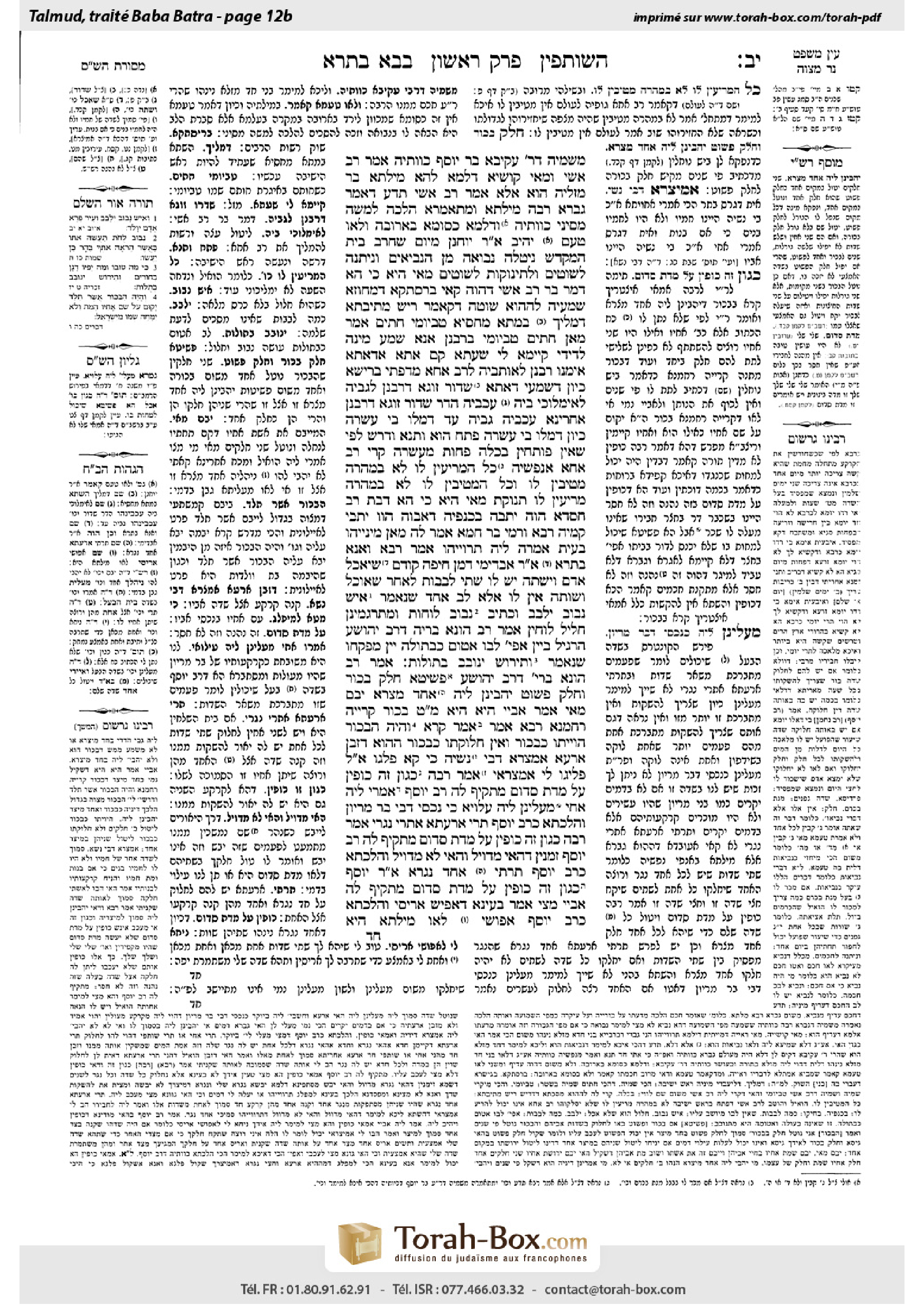
Bava Batra 12b: Talmud study for Daf Yomi
Study the Talmud for Daf Yomi with scanned pages, Hebrew text, English translations from Sefaria and AI-generated French translations.
Passage selection and English or AI-generated French translation are available where the scan has annotations. Daf Study is independent of Torah-Box and Sefaria.
Browse Bava Batra · בבא בתרא · All tractatesBava Batra 12b text and translations
This page of Bava Batra includes the Aramaic text, an English translation and an AI-generated French translation, alongside the scan above.
בבא בתרא י״ב ב · Aramaic and Hebrew text
מִשְּׁמֵיהּ דְּרַבִּי עֲקִיבָא בַּר יוֹסֵף כְּווֹתֵיהּ. אָמַר רַב אָשֵׁי: וּמַאי קוּשְׁיָא? דִּלְמָא לְהָא מִילְּתָא בַּר מַזָּלֵיהּ הוּא!
אֶלָּא אָמַר רַב אָשֵׁי: תִּדַּע, דְּאָמַר גַּבְרָא רַבָּה מִילְּתָא, וּמִתְאַמְרָא הֲלָכָה לְמֹשֶׁה מִסִּינַי כְּווֹתֵיהּ. וְדִלְמָא כְּסוֹמֵא בַּאֲרוּבָּה! וְלָאו טַעַם יְהֵיב?!
אָמַר רַבִּי יוֹחָנָן: מִיּוֹם שֶׁחָרַב בֵּית הַמִּקְדָּשׁ, נִיטְּלָה נְבוּאָה מִן הַנְּבִיאִים וְנִיתְּנָה לַשּׁוֹטִים וְלַתִּינוֹקוֹת. לַשּׁוֹטִים – מַאי הִיא? כִּי הָא דְּמָר בַּר רַב אָשֵׁי – דַּהֲוָה קָאֵי בְּרִסְתְּקָא דְמָחוֹזָא, שַׁמְעֵיהּ לְהָהוּא שׁוֹטֶה דְּקָאָמַר: רֵישׁ מְתִיבְתָּא דְּמָלֵיךְ בְּמָתָא מַחְסֵיָא – ״טַבְיוֹמֵי״ חָתֵים. אֲמַר: מַאן חָתֵים ״טַבְיוֹמֵי״ בְּרַבָּנַן – אֲנָא; שְׁמַע מִינַּהּ לְדִידִי קָיְימָא לִי שַׁעְתָּא. קָם אֲתָא. אַדַּאֲתָא אִימְּנוֹ רַבָּנַן לְאוֹתֹבֵיהּ לְרַב אַחָא מִדִּפְתִּי בְּרֵישָׁא.
כֵּיוָן דְּשָׁמְעִי דַּאֲתָא, שַׁדּוּר זוּגָא דְּרַבָּנַן לְגַבֵּיהּ לְאִימְּלוֹכֵי בֵּיהּ. עַכְּבֵיהּ. הֲדַר שַׁדּוּר זוּגָא דְּרַבָּנַן אַחֲרִינָא, עַכְּבֵיהּ גַּבֵּיהּ. עַד דִּמְלוֹ בֵּי עַשְׂרָה. כֵּיוָן דִּמְלוֹ בֵּי עַשְׂרָה, פְּתַח הוּא וּתְנָא וּדְרַשׁ. לְפִי שֶׁאֵין פּוֹתְחִין בְּכַלָּה פָּחוֹת מֵעֲשָׂרָה.
קָרֵי רַב אַחָא אַנַּפְשֵׁיהּ: כׇּל הַמְּרִיעִין לוֹ – לֹא בִּמְהֵרָה מְטִיבִין לוֹ, וְכׇל הַמְּטִיבִין לוֹ – לֹא בִּמְהֵרָה מְרִיעִין לוֹ.
תִּנוֹקֹת – מַאי הִיא? כִּי הָא דְּבַת רַב חִסְדָּא – הֲוָה יָתְבָה בְּכַנְפֵיהּ דַּאֲבוּהָ, הֲווֹ יָתְבִי קַמֵּיהּ רָבָא וְרָמֵי בַּר חָמָא. אֲמַר לַהּ: מַאן מִינַּיְיהוּ בָּעֵית? אֲמַרָה לֵיהּ: תַּרְוַיְיהוּ. אָמַר רָבָא: וַאֲנָא בָּתְרָא.
אָמַר רַבִּי אַבְדִּימִי דְּמִן חֵיפָה: קוֹדֶם שֶׁיֹּאכַל אָדָם וְיִשְׁתֶּה, יֵשׁ לוֹ שְׁתֵּי לְבָבוֹת; לְאַחַר שֶׁאוֹכֵל וְשׁוֹתֶה – אֵין לוֹ אֶלָּא לֵב אֶחָד. שֶׁנֶּאֱמַר: ״אִישׁ נָבוּב יִלָּבֵב״ – וּכְתִיב: ״נְבוּב לֻחֹת״, וּמְתַרְגְּמִינַן: חֲלִיל לוּחִין.
אָמַר רַב הוּנָא בְּרֵיהּ דְּרַב יְהוֹשֻׁעַ: הָרָגִיל בְּיַיִן, אֲפִילּוּ לִבּוֹ אָטוּם כִּבְתוּלָה – יַיִן מְפַקְּחוֹ, שֶׁנֶּאֱמַר: ״וְתִירוֹשׁ יְנוֹבֵב בְּתֻלוֹת״.
אָמַר רַב הוּנָא בְּרֵיהּ דְּרַב יְהוֹשֻׁעַ: פְּשִׁיטָא, חֵלֶק בְּכוֹר וְחֵלֶק פָּשׁוּט – יָהֲבִינַן לֵיהּ אַחַד מִצְרָא. יָבָם – מַאי?
אָמַר אַבָּיֵי: הִיא – הִיא; מַאי טַעְמָא? ״בְּכוֹר״ קַרְיֵיהּ רַחֲמָנָא. רָבָא אָמַר, אָמַר קְרָא: ״וְהָיָה הַבְּכוֹר״ – הֲוָיָיתוֹ כִּבְכוֹר, וְאֵין חֲלוּקָּתוֹ כִּבְכוֹר.
הָהוּא דִּזְבַן אַרְעָא אַמִּצְרָא דְּבֵי נְשֵׁיהּ. כִּי קָא פָּלְגוּ, אֲמַר לְהוּ: פְּלִיגוּ לִי אַמִּצְרַאי. אָמַר רַבָּה: כְּגוֹן זֶה – כּוֹפִין עַל מִדַּת סְדוֹם.
מַתְקֵיף לַהּ רַב יוֹסֵף: אָמְרִי לֵיהּ אֲחֵי, מְעַלִּינַן לֵיהּ עִלּוּיָא כִּי נִכְסֵי דְּבֵי בַּר מָרִיּוֹן! וְהִלְכְתָא כְּרַב יוֹסֵף.
תְּרֵי אַרְעָתָא אַתְּרֵי נִגְרֵי – אָמַר רַבָּה: כְּגוֹן זֶה – כּוֹפִין עַל מִדַּת סְדוֹם. מַתְקֵיף לַהּ רַב יוֹסֵף: זִמְנִין דְּהַאי מִדְּוִיל וְהַאי לָא מִדְּוִיל! וְהִלְכְתָא כְּרַב יוֹסֵף.
תַּרְתֵּי אַחַד נִגְרָא – אָמַר רַב יוֹסֵף: כְּגוֹן זֶה – כּוֹפִין עַל מִדַּת סְדוֹם. מַתְקֵיף לַהּ אַבָּיֵי, מָצֵי אָמַר: בָּעֵינָא דְּאַפֵּישׁ אֲרִיסֵי! וְהִלְכְתָא כְּרַב יוֹסֵף; אַפּוֹשֵׁי לָאו מִילְּתָא הִיא.
Bava Batra 12b · English translation
in the name of the well-known tanna Rabbi Akiva bar Yosef in accordance with his statement. It certainly cannot be maintained that the first Sage is similar in his nature to the illustrious Rabbi Akiva, so he must have arrived at his statement through prophecy. Rav Ashi said: And what is the difficulty with explaining this? Perhaps they were born under the same constellation, and with regard to this issue the first Sage has the same understanding as Rabbi Akiva.
Rather, Rav Ashi said: Know that this is so, as a great man makes a statement and the same statement is then cited as a halakha transmitted to Moses from Sinai in accordance with his statement. The Sage makes a statement that corresponds to words pronounced in Heaven, which, without prophecy, is beyond human capability. The Gemara states: But perhaps he arrived at this idea by chance, without the assistance of prophecy, like a blind man who makes his way through a skylight. A blind man cannot deliberately find a skylight; therefore, his finding it occurs by chance. The Gemara answers: But does the Sage not offer a reason for his statement? The fact that he demonstrates an understanding of the issue indicates that he does not arrive at his idea by chance, but rather by prophecy.
Rabbi Yoḥanan said: From the day that the Temple was destroyed, prophecy was taken from the prophets and given to imbeciles and children. The Gemara explains: In what way was prophecy given to imbeciles? It was like this incident involving Mar bar Rav Ashi, who was standing in the street [beristeka] of Meḥoza when he heard a certain imbecile say: The head of the yeshiva who will be appointed in Mata Meḥasya signs his name Tavyumei. Mar bar Rav Ashi said to himself: Who among the Sages signs his name Tavyumei? Nobody but me. Conclude from the statement by the imbecile that my hour has arrived, and I will reap success in this matter. He arose and went to Mata Meḥasya. By the time he arrived, the Sages had already decided to appoint Rav Aḥa of Difti as the head of the yeshiva.
As soon as the Sages heard that Mar bar Rav Ashi had arrived, they determined not to proceed with their appointment without the approval of an important figure such as him. They sent a pair of Sages to him to consult with him, and he detained them. They again sent a pair of Sages to him, and he detained them as well. This continued until they completed a quorum of ten Sages. Once they reached ten men, Mar bar Rav Ashi opened his lecture, taught, and expounded. He did not speak earlier because one should not open a lecture during kalla, the gatherings for Torah study during the months of Elul and Adar, when less than ten men are present. He was then appointed as head of the yeshiva.
Understanding that he had been passed over for the position, Rav Aḥa of Difti read about himself the rabbinic aphorism: Anyone who is treated poorly will not soon be treated well; and anyone who is treated well will not soon be treated poorly. Rav Aḥa understood that he had lost the chance to be appointed, whereas Mar bar Rav Ashi had the good fortune to be appointed, and would remain in his position.
And in what way was prophecy given to children? It was like this incident involving the daughter of Rav Ḥisda, who when she was a child was sitting on her father’s lap while he sat and learned. Rava and Rami bar Ḥama were sitting before him. Rav Ḥisda jokingly said to his daughter: Which of them would you want as a husband? She said: I want both of them. Rava said: And I will be last. And this is what happened; first she married Rami bar Ḥama, and when he died she married Rava.
Having already cited one statement of Rabbi Avdimi from Haifa, the Gemara cites another statement in his name: Rabbi Avdimi from Haifa says: Before a person eats and drinks he has two hearts, meaning his heart is unsettled because he is distracted by hunger. But after he eats and drinks he has only one heart, as it is stated: “A hollow [nevuv] man is two-hearted” (Job 11:12). How is it indicated that “nevuv” means hungry? As it is written concerning the altar: “Nevuv luḥot” (Exodus 27:8), which we translate into Aramaic as: Hollow with planks, meaning that a hollow person, i.e., one who has not yet eaten, is two-hearted.
The Gemara continues to discuss the meaning of nevuv, Rav Huna, son of Rav Yehoshua, says: With regard to one who is accustomed to wine, although his heart, i.e., his mind, is closed like a virgin, wine opens it, as it is stated: “And new wine opens [yenovev] the virgins” (Zechariah 9:17). The word yenovev is used here in the sense of clearing out a space: Even if one’s heart and mind are closed, wine will open them to understanding.
§ The Gemara resumes its discussion of the division of property. Rav Huna, son of Rav Yehoshua, says: It is obvious that if a person inherits a portion of his father’s estate because he is the firstborn, and he also inherits a portion of that estate as an ordinary son, like the rest of his brothers, he is given his two portions along one boundary, so that they are adjacent to one another and form a single property. The Gemara asks: What is the halakha with regard to a yavam, a man whose brother died without children, who is obligated by Torah law to marry his deceased brother’s widow or grant her ḥalitza? If he marries his brother’s widow, the halakha dictates that he receive his brother’s portion of their father’s estate in addition to his own. Does he too receive the two portions along one boundary?
Abaye said: This case is equal to that case. What is the reason for this? The Merciful One calls the yavam “firstborn” (see Yevamot 24a) and therefore he is treated like a firstborn in all regards. He receives the two portions of his father’s estate as a single parcel of land. But Rava said: The verse states: “And it shall be, the firstborn” (Deuteronomy 25:6). With regard to his being, i.e., his inheritance itself, he is like a firstborn; but as for the distribution of the estate, he is not like a firstborn, and the brothers are not obligated to give him two adjacent portions.
It is reported that a certain person bought land along the boundary of his father’s property. After some time the father died. When they came to divide the estate, this person said to his brothers: Give me my portion of the estate along my boundary. Rabba said: In a case such as this, the court compels people to refrain from conduct characteristic of Sodom. The court forces a person to waive his legal rights in order to prevent him from acting in a manner characteristic of the wicked city of Sodom. Since it makes no difference to the brothers which portion they receive since the parcels of land must be of equal value, whereas it matters to this brother that the area he receives should be adjacent to the land he already bought, the court forces the others to give this brother his portion along his boundary.
Rav Yosef objects to this, saying this is not a case involving conduct characteristic of Sodom, since the brothers can explain their refusal to grant the request. The brothers can say to him: We assess this field that you want for yourself as particularly valuable, like the property of the house of bar Maryon. The brothers can claim that the portion he wants is more desirable than the others, and for that reason they do not want to give it to him. The Gemara concludes: And the halakha is in accordance with the opinion of Rav Yosef, and the brothers can refuse the request.
If a father leaves his two sons two parcels of land next to two water channels [nigrei], and one brother requests the field that is next to a field that he already owns, Rabba says: In a case such as this, the court compels people to refrain from conduct characteristic of Sodom and allows that brother to receive the field adjoining his own. Rav Yosef objects to this, saying that if the other brother protests and wants that parcel of land, it is not a case involving conduct characteristic of Sodom because he may have a valid reason for objecting: Sometimes this water channel continues running well, while this second one does not continue running well; therefore, the second brother wants to receive land that adjoins a water channel on both sides. The Gemara concludes: And the halakha is in accordance with the opinion of Rav Yosef.
If a father leaves his two sons two parcels of land next to one channel and one of the brothers already owns a field next to one of those parcels of land, Rav Yosef said: In a case such as this, the court compels people to refrain from conduct characteristic of Sodom and allows that brother to receive the field adjoining his own. Abaye objects to this, saying that this is not a case involving conduct characteristic of Sodom because the other brother can say to him: I want the number of sharecroppers to increase. If my field is in the middle and you have fields on either side, you will need more sharecroppers to work them and my field will enjoy greater security. And the halakha is in accordance with the opinion of Rav Yosef because the increase of sharecroppers is considered as nothing, and this is therefore not a valid reason for objecting.
Bava Batra 12b · Traduction française (IA)
dans le nom du tanna bien connu Rabbi Akiva bar Yosef selon son propre déclaration. Il est certain qu'on ne peut pas affirmer que le premier Sage est semblable en nature au célèbre Rabbi Akiva, donc il doit avoir formulé sa déclaration par la prophétie. Rav Ashi dit : Et qu'est-ce qui est difficile à expliquer là-dedans ? Peut-être qu'ils sont nés sous la même constellation, et concernant cette question, le premier Sage a la même compréhension que Rabbi Akiva.
Plutôt, Rav Ashi dit : Sache que c'est ainsi, car un grand homme fait une déclaration et la même déclaration est ensuite citée comme une halakha transmise à Moïse depuis Sinaï selon sa déclaration. Le Sage fait une déclaration qui correspond à des paroles prononcées au Ciel, ce qui, sans prophétie, est au-delà de la capacité humaine. La Guemara dit : Mais peut-être qu'il a atteint cette idée par hasard, sans l'aide de la prophétie, comme un aveugle qui se dirige à travers une lucarne. Un aveugle ne peut pas délibérément trouver une lucarne ; donc, son trouver cette lucarne arrive par hasard. La Guemara répond : Mais le Sage ne donne-t-il pas une raison à sa déclaration ? Le fait qu'il démontre une compréhension de la question indique qu'il n'arrive pas à cette idée par hasard, mais plutôt par la prophétie.
Rabbi Yoḥanan dit : Depuis que le Temple a été détruit, la prophétie a été enlevée des prophètes et donnée aux imbéciles et aux enfants. La Guemara explique : De quelle manière la prophétie a-t-elle été donnée aux imbéciles ? C'était comme cet incident concernant Mar bar Rav Ashi, qui était debout dans la rue [beristeka] de Meḥoza lorsqu'il a entendu un certain imbécile dire : Le chef de la yeshiva qui sera désigné à Mata Meḥasya signe son nom Tavyumei. Mar bar Rav Ashi a dit à lui-même : Qui parmi les Sages signe son nom Tavyumei ? Personne d'autre que moi. Conclure de la déclaration de l'imbécile que mon heure est arrivée, et je vais réussir dans cette affaire. Il s'est levé et est allé à Mata Meḥasya. À l'arrivée, les Sages avaient déjà décidé de désigner Rav Aḥa de Difti comme chef de la yeshiva.
Dès que les Sages ont entendu que Mar bar Rav Ashi était arrivé, ils ont décidé de ne pas procéder à leur désignation sans l'approbation d'une figure importante comme lui. Ils ont envoyé un couple de Sages pour le consulter, et il les a retenus. Ils ont à nouveau envoyé un couple de Sages, et il les a retenus également. Cela a continué jusqu'à ce qu'ils aient atteint un nombre de dix Sages. Une fois qu'ils étaient dix hommes, Mar bar Rav Ashi a ouvert son discours, a enseigné et a développé. Il n'avait pas parlé plus tôt parce qu'on ne doit pas ouvrir un discours pendant kalla, les réunions d'étude de la Torah pendant les mois d'Elul et d'Adar, lorsque moins de dix hommes sont présents. Il a été ensuite désigné comme chef de la yeshiva.
En comprenant qu'il avait été passé outre pour le poste, Rav Aḥa de Difti a lu à son sujet l'aphorisme rabbinique : Celui qui est maltraité ne sera pas bientôt traité bien ; et celui qui est traité bien ne sera pas bientôt maltraité. Rav Aḥa a compris qu'il avait perdu l'occasion d'être désigné, tandis que Mar bar Rav Ashi avait la bonne fortune d'être désigné et resterait dans son poste.
Et de quelle manière la prophétie a-t-elle été donnée aux enfants ? C'était comme cet incident concernant la fille de Rav Ḥisda, qui, étant enfant, était assise sur les genoux de son père alors qu'il apprenait. Rava et Rami bar Ḥama étaient assis devant lui. Rav Ḥisda, en plaisantant, a dit à sa fille : Quel d'entre eux voudrais-tu comme mari ? Elle a dit : Je veux les deux. Rava a dit : Et je serai le dernier. Et c'est ce qui s'est produit ; d'abord elle a épousé Rami bar Ḥama, et quand il est mort, elle a épousé Rava.
Ayant déjà cité une déclaration de Rabbi Avdimi de Haifa, la Guemara cite une autre déclaration en son nom : Rabbi Avdimi de Haifa dit : Avant que la personne ne mange et ne boive, il a deux cœurs, c'est-à-dire son cœur est troublé parce qu'il est distrait par la faim. Mais après qu'il ait mangé et bu, il a un seul cœur, comme il est dit : « Un homme vide [nevuv] est deux-cœur » (Job 11:12). Comment sait-on que « nevuv » signifie faim ? Comme il est écrit concernant l'autel : « Névuv luḥot » (Exode 27:8), que nous traduisons en araméen comme : Vide avec des planches, ce qui signifie qu'un homme vide, c'est-à-dire celui qui n'a pas encore mangé, est deux-cœur.
La Guemara continue à discuter du sens de nevuv. Rav Huna, fils de Rav Yehoshua, dit : Concernant celui qui est habitué au vin, bien que son cœur, c'est-à-dire son esprit, soit fermé comme une vierge, le vin l'ouvre, comme il est dit : « Et le vin nouveau ouvre [yenovev] les vierges » (Zacharie 9:17). Le mot yenovev est utilisé ici dans le sens de dégager un espace : Même si le cœur et l'esprit sont fermés, le vin les ouvrira à la compréhension.
§ La Guemara reprend la discussion sur la division des biens. Rav Huna, fils de Rav Yehoshua, dit : Il est évident que si une personne hérite d'une part de l'héritage de son père parce qu'elle est le premier-né, et qu'elle hérite également d'une part de cet héritage comme un fils ordinaire, comme les autres frères, elle reçoit ses deux parts sur une seule limite, de sorte qu'elles sont adjacentes et forment une seule propriété. La Guemara demande : Quelle est la halakha concernant un yavam, un homme dont le frère est mort sans enfants, qui est tenu par la loi juive à épouser la veuve de son frère décédé ou à lui accorder la ḥalitza ? Si il épouse la veuve de son frère, la halakha déclare qu'il reçoit la part de son frère dans l'héritage de leur père en plus de la sienne. Reçoit-il aussi les deux parts sur une seule limite ?
Abaye dit : Ce cas est équivalent à ce cas. Quelle est la raison de cela ? L'Éternel Tout-Puissant appelle le yavam « premier-né » (voir Yevamot 24a) et donc il est traité comme un premier-né en toutes choses. Il reçoit les deux parts de l'héritage de son père comme une seule parcelle de terre. Mais Rava dit : La Parashah dit : « Et il sera, le premier-né » (Deutéronome 25:6). Concernant son être, c'est-à-dire son héritage lui-même, il est comme un premier-né ; mais concernant la distribution de l'héritage, il n'est pas comme un premier-né, et les frères ne sont pas tenus de lui donner deux parts adjacentes.
On rapporte qu'un certain homme acheta un terrain sur la limite de la propriété de son père. Après un certain temps, le père mourut. Lorsqu'ils vinrent diviser les biens, cet homme dit à ses frères : Donnez-moi ma part des biens selon ma limite. Rabba dit : Dans un cas tel que celui-ci, la cour force les gens à se tenir éloignés des comportements propres à Sodome. La cour force une personne à renoncer à ses droits légaux afin de l'empêcher de se comporter comme la vilaine ville de Sodome. Puisque cela n'a pas d'importance pour les frères quelle part ils reçoivent, puisque les parcelles de terre doivent être de valeur égale, alors que cela importe à ce frère que la portion qu'il reçoit soit adjacente à la terre qu'il a déjà achetée, la cour force les autres à donner à ce frère sa part selon sa limite.
Rav Yosef s'oppose à cela, en disant que ce n'est pas un cas impliquant des comportements propres à Sodome, puisque les frères peuvent expliquer leur refus de satisfaire la demande. Les frères peuvent dire à lui : Nous évaluons ce champ que vous voulez pour vous-même comme particulièrement précieux, comme la propriété de la maison de bar Maryon. Les frères peuvent affirmer que la portion qu'il veut est plus désirable que les autres, et pour cette raison ils ne veulent pas lui la donner. La Guemara conclut : Et la halakha suit l'opinion de Rav Yosef, et les frères peuvent refuser la demande.
Si un père laisse à ses deux fils deux parcelles de terre adjacentes à deux canaux [nigrei], et que l'un des frères demande la parcelle qui est adjacente à un terrain qu'il possède déjà, Rabba dit : Dans un cas tel que celui-ci, la cour force les gens à se tenir éloignés des comportements propres à Sodome et permet à ce frère de recevoir la parcelle adjacente à son propre terrain. Rav Yosef s'oppose à cela, en disant que si l'autre frère proteste et veut cette parcelle de terre, ce n'est pas un cas impliquant des comportements propres à Sodome, car il peut avoir une raison valable pour protester : Parfois ce canal continue à couler bien, tandis que ce second ne continue pas à couler bien ; donc, le second frère veut recevoir une terre adjacente à un canal des deux côtés. La Guemara conclut : Et la halakha suit l'opinion de Rav Yosef.
Si un père laisse à ses deux fils deux parcelles de terre adjacentes à un seul canal et que l'un des frères possède déjà un terrain adjacent à l'une de ces parcelles, Rav Yosef dit : Dans un cas tel que celui-ci, la cour force les gens à se tenir éloignés des comportements propres à Sodome et permet à ce frère de recevoir la parcelle adjacente à son propre terrain. Abaye s'oppose à cela, en disant que ce n'est pas un cas impliquant des comportements propres à Sodome, car l'autre frère peut lui dire : Je veux que le nombre de cultivateurs en contrat augmente. Si mon terrain est au milieu et que vous avez des terrains des deux côtés, vous aurez besoin de plus de cultivateurs pour les travailler et mon terrain bénéficiera d'une plus grande sécurité. Et la halakha suit l'opinion de Rav Yosef, car l'augmentation des cultivateurs est considérée comme rien, et cela n'est donc pas une raison valable pour protester.
Traduction française générée par IA à partir de l’édition anglaise de Sefaria. Vérifie toujours un passage avec le texte source.
Text from Sefaria: William Davidson Edition - Vocalized Aramaic (CC BY NC); William Davidson Edition - English (CC BY NC).