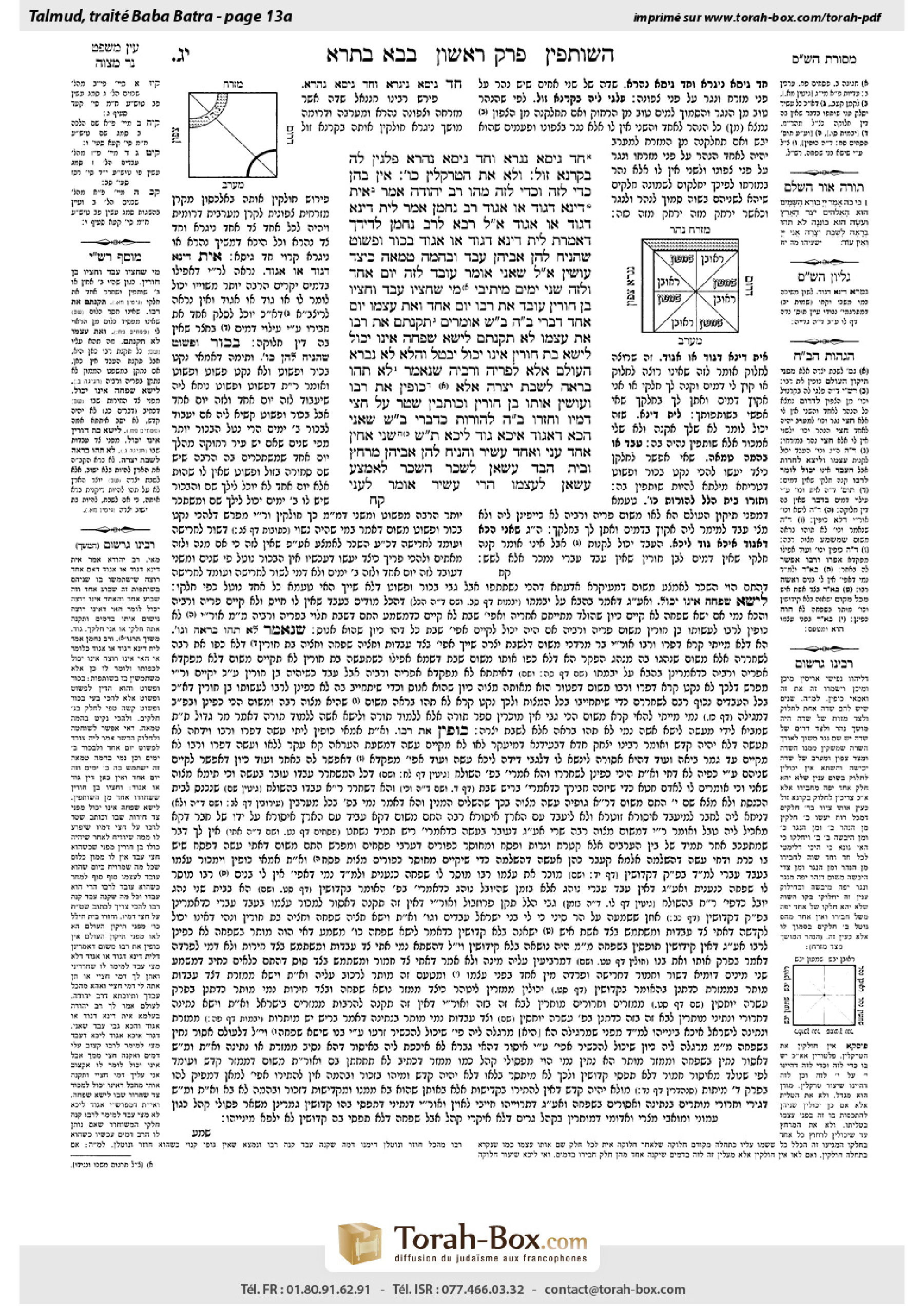
Bava Batra 13a: Talmud study for Daf Yomi
Study the Talmud for Daf Yomi with scanned pages, Hebrew text, English translations from Sefaria and AI-generated French translations.
Passage selection and English or AI-generated French translation are available where the scan has annotations. Daf Study is independent of Torah-Box and Sefaria.
Browse Bava Batra · בבא בתרא · All tractatesBava Batra 13a text and translations
This page of Bava Batra includes the Aramaic text, an English translation and an AI-generated French translation, alongside the scan above.
בבא בתרא י״ג א · Aramaic and Hebrew text
חַד גִּיסָא נִגְרָא וְחַד גִּיסָא נַהֲרָא – פָּלְגִין לַהּ בְּקַרְנָא זוֹל.
וְלֹא אֶת הַטְּרַקְלִין כּוּ׳. אֵין בָּהֶן כְּדַי לָזֶה וּכְדֵי לָזֶה, מַהוּ? רַב יְהוּדָה אָמַר: אִית דִּינָא דְּ״גוּד, אוֹ אֶגּוּד״. רַב נַחְמָן אָמַר: לֵית דִּינָא דְּ״גוּד, אוֹ אֶגּוּד״.
אֲמַר לֵיהּ רָבָא לְרַב נַחְמָן: לְדִידָךְ דְּאָמְרַתְּ לֵית דִּינָא דְּ״גוּד אוֹ אֶגּוּד״, בְּכוֹר וּפָשׁוּט שֶׁהִנִּיחַ לָהֶן אֲבִיהֶן עֶבֶד וּבְהֵמָה טְמֵאָה, כֵּיצַד עוֹשִׂין? אֲמַר לֵיהּ, שֶׁאֲנִי אוֹמֵר: עוֹבֵד לָזֶה יוֹם אֶחָד, וְלָזֶה שְׁנֵי יָמִים.
מֵיתִיבִי: מִי שֶׁחֶצְיוֹ עֶבֶד וְחֶצְיוֹ בֶּן חוֹרִין – עוֹבֵד אֶת רַבּוֹ יוֹם אֶחָד, וְאֶת עַצְמוֹ יוֹם אֶחָד; דִּבְרֵי בֵּית הִלֵּל. בֵּית שַׁמַּאי אוֹמְרִים: תִּקַּנְתֶּם אֶת רַבּוֹ; אֶת עַצְמוֹ לֹא תִּקַּנְתֶּם! לִישָּׂא שִׁפְחָה – אֵינוֹ יָכוֹל, לִישָּׂא בַּת חוֹרִין – אֵינוֹ יָכוֹל; יִבָּטֵל?! וַהֲלֹא לֹא נִבְרָא הָעוֹלָם אֶלָּא לִפְרִיָּה וּרְבִיָּה, שֶׁנֶּאֱמַר: ״לֹא תֹהוּ בְרָאָהּ, לָשֶׁבֶת יְצָרָהּ״!
אֶלָּא כּוֹפִין אֶת רַבּוֹ – וְעוֹשִׂין אוֹתוֹ בֶּן חוֹרִין, וְכוֹתְבִין שְׁטָר עַל חֲצִי דָּמָיו. וְחָזְרוּ בֵּית הִלֵּל לְהוֹרוֹת כְּדִבְרֵי בֵּית שַׁמַּאי!
שָׁאנֵי הָכָא, דְּ״אֶגּוּד״ אִיכָּא, ״גּוּד״ לֵיכָּא.
תָּא שְׁמַע: שְׁנֵי אַחִין – אֶחָד עָנִי וְאֶחָד עָשִׁיר, וְהִנִּיחַ לָהֶן אֲבִיהֶן מֶרְחָץ וּבֵית הַבַּד; עֲשָׂאָן לְשָׂכָר – הַשָּׂכָר לָאֶמְצַע; עֲשָׂאָן לְעַצְמוֹ – הֲרֵי עָשִׁיר אוֹמֵר לֶעָנִי:
Bava Batra 13a · English translation
If there is a water channel on one side of the field and a river on the other side, the field is divided diagonally [bekarna zol] between the two brothers, so that they each receive land adjoining both the river and the water channel.
§ The mishna teaches that a hall, a drawing room, and the like should not be divided unless the two parties will be able to use their respective portions in the same manner that they had previously used them. The Gemara asks: What is the halakha if there is not enough for this one and that one? What is to be done if one of the parties wishes to dissolve the partnership? Rav Yehuda said: There is a halakha of: Either you set a price or I will set a price. That is to say, one party can say to the other: Set a price you are willing to pay for my share, and I will sell my share to you or purchase your share from you at that price. Rav Naḥman said: There is no halakha of: Either you set a price or I will set a price; rather, the partnership continues.
Rava said to Rav Naḥman: According to you who say that there is no halakha of: Either you set a price or I will set a price, what should they do if there was a firstborn son and an ordinary brother whose father left them a slave and a non-kosher animal as an inheritance? How are they to be divided? Rav Naḥman said to him: I say that they work for this one, the ordinary brother, one day, and for the other one, the firstborn, two days.
The Gemara raises an objection to Rav Yehuda’s approach from what is taught in a mishna (Gittin 41a): One who is half-slave half-freeman, e.g., a slave who had been jointly owned by two people, one of whom emancipated him, serves his master one day and himself one day; this is the statement of Beit Hillel. Beit Shammai say: You have remedied the situation of his master, who benefits fully from all his rights to the slave, but you have not remedied his own situation. He cannot marry a maidservant, since half of him is free, and a free Jew may not marry a Canaanite maidservant. He is also not able to marry a free woman, since half of him is a slave, and a Jewish woman may not marry a Canaanite slave. And if you say he should be idle and not marry, but is it not true that the world was created only for procreation, as it is stated: “He did not create it to be a waste; He formed it to be inhabited” (Isaiah 45:18)?
Rather, the court forces his master to make him a freeman by emancipating the half that he owns, and the court writes a bill in which the slave accepts responsibility to pay half his value to his master. This was the original version of the mishna. The ultimate version of the mishna records the retraction of Beit Hillel: And Beit Hillel retracted its opinion and ruled in accordance with the statement of Beit Shammai. This indicates that it is only in this case, where there is the particular consideration of procreation, that the court compels one of the parties to forfeit his portion and dissolve the partnership. But in other cases there is no halakha of: Either you set a price or I will set a price.
The Gemara answers: It is different here, because the slave can say: I will set a price, but he is not able to say: You set a price. In other words, the slave cannot offer to sell himself, because his Jewish side precludes him from selling himself as a Canaanite slave. Therefore, the court would not be able force the master to sell his share, were it not for the consideration of procreation. By contrast, in a situation where either side can buy or sell, one partner can compel the other to either buy his portion or sell his portion to him.
The Gemara suggests: Come and hear a proof from what is taught in a mishna (172a): In a case where there are two brothers, one poor and one rich, and their father left them a bathhouse or an olive press as an inheritance, if the father had built these facilities for profit, i.e., to charge others for using them, the profit that accrues after the father’s death is shared equally by the two brothers. If the father had built them for himself and for the members of his household to use, the poor brother, who has little use for these amenities, cannot force the rich brother to convert the facilities to commercial use; rather, the rich brother can say to the poor brother:
Bava Batra 13a · Traduction française (IA)
Si un canal d'eau est situé d'un côté du champ et un fleuve de l'autre, le champ est divisé en diagonale [bekarna zol] entre les deux frères, de sorte qu'ils reçoivent chacun un terrain adjacent à la fois au fleuve et au canal d'eau.
§ La Michna enseigne que les salles de réception, les salles de séjour et les semblables ne devraient pas être divisées à moins que les deux parties puissent utiliser leurs portions respectives de la même manière qu'elles l'avaient fait auparavant. La Guemara pose la question : Quelle est la halakha si il n'y a pas assez pour l'un et pour l'autre ? Qu'est-ce qu'on doit faire si l'une des parties souhaite dissoudre le partage ? Rav Yehuda a dit : Il y a une halakha de : Soit tu fixes un prix, soit je fixe un prix. C'est-à-dire, une partie peut dire à l'autre : Fixe un prix que tu es prêt à payer pour ma part, et je vends ma part à toi ou je achète ta part de toi à ce prix. Rav Naḥman a dit : Il n'y a pas de halakha de : Soit tu fixes un prix, soit je fixe un prix ; plutôt, le partage continue.
Rava a dit à Rav Naḥman : Selon toi qui dis qu'il n'y a pas de halakha de : Soit tu fixes un prix, soit je fixe un prix, que devraient-ils faire si l'un d'entre eux était un fils aîné et l'autre un frère ordinaire, et que leur père les a laissé un esclave et un animal non-kosher en héritage ? Comment doivent-ils être divisés ? Rav Naḥman a dit à lui : Je dis qu'ils travaillent pour ce dernier, le frère ordinaire, un jour, et pour l'autre, le fils aîné, deux jours.
La Guemara soulève une objection contre l'approche de Rav Yehuda à partir de ce qui est enseigné dans une Michna (Gittin 41a) : Celui qui est moitié esclave et moitié libre, par exemple, un esclave qui avait été conjointement possédé par deux personnes, l'un desquels l'a emancipé, sert son maître un jour et lui-même un jour ; c'est l'opinion de Beit Hillel. Beit Shammai disent : Tu as réparé la situation de son maître, qui bénéficie pleinement de tous ses droits sur l'esclave, mais tu n'as pas réparé sa propre situation. Il ne peut pas épouser une servante, puisque la moitié de lui est libre, et un Juif libre ne peut pas épouser une servante cananéenne. Il ne peut pas non plus épouser une femme libre, puisque la moitié de lui est un esclave, et une femme juive ne peut pas épouser un esclave cananéen. Et si tu dis qu'il devrait être inactif et ne pas épouser, mais n'est-ce pas vrai que le monde a été créé uniquement pour la procréation, comme il est dit : « Il ne l'a pas créé pour être un gaspillage ; Il l'a fait pour être habité » (Yachout 45:18) ?
Plutôt, la cour force son maître à le rendre libre en l'émancipant, et la cour écrit un contrat dans lequel l'esclave assume la responsabilité de payer la moitié de sa valeur à son maître. C'était la version originale de la Michna. La version finale de la Michna enregistre la rétractation de Beit Hillel : Et Beit Hillel a rétracté son opinion et a décidé d'appliquer l'opinion de Beit Shammai. Cela indique que c'est seulement dans ce cas, où il y a la considération particulière de la procréation, que la cour force l'une des parties à renoncer à sa part et à dissoudre le partage. Mais dans d'autres cas, il n'y a pas de halakha de : Soit tu fixes un prix, soit je fixe un prix.
La Guemara répond : C'est différent ici, car l'esclave peut dire : Je fixe un prix, mais il ne peut pas dire : Tu fixes un prix. En d'autres termes, l'esclave ne peut pas offrir de vendre lui-même, car son côté juif l'empêche de vendre lui-même comme un esclave cananéen. Par conséquent, la cour ne pourrait pas forcer le maître à vendre sa part sans la considération de la procréation. À l'inverse, dans une situation où l'un des côtés peut acheter ou vendre, un partenaire peut obliger l'autre à acheter sa part ou à vendre sa part à lui.
La Guemara suggère : Viens écouter une preuve à partir de ce qui est enseigné dans une Michna (172a) : Dans un cas où il y a deux frères, l'un pauvre et l'autre riche, et leur père leur a laissé une salle de bain ou une presse d'olive en héritage, si le père avait construit ces installations à des fins commerciales, c'est-à-dire pour facturer les autres pour leur utilisation, le bénéfice qui s'accumule après la mort du père est partagé équitablement entre les deux frères. Si le père avait construit ces installations pour lui-même et pour les membres de sa famille à utiliser, le frère pauvre, qui a peu d'utilité pour ces commodités, ne peut pas obliger le frère riche à convertir les installations en usage commercial ; plutôt, le frère riche peut dire au frère pauvre :
Traduction française générée par IA à partir de l’édition anglaise de Sefaria. Vérifie toujours un passage avec le texte source.
Text from Sefaria: William Davidson Edition - Vocalized Aramaic (CC BY NC); William Davidson Edition - English (CC BY NC).