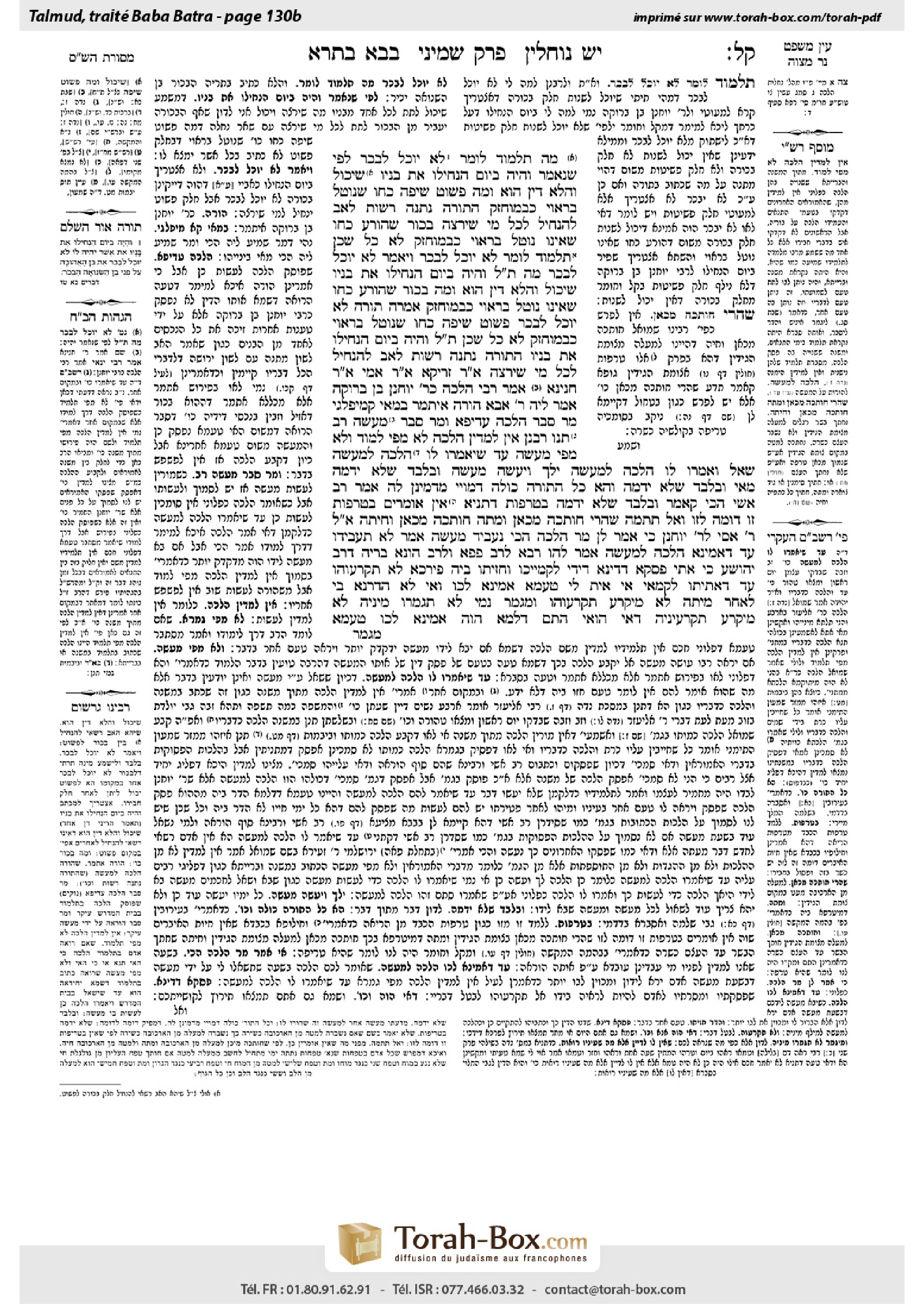
Bava Batra 130b: Talmud study for Daf Yomi
Study the Talmud for Daf Yomi with scanned pages, Hebrew text, English translations from Sefaria and AI-generated French translations.
Passage selection and English or AI-generated French translation are available where the scan has annotations. Daf Study is independent of Torah-Box and Sefaria.
Browse Bava Batra · בבא בתרא · All tractatesBava Batra 130b text and translations
This page of Bava Batra includes the Aramaic text, an English translation and an AI-generated French translation, alongside the scan above.
בבא בתרא ק״ל ב · Aramaic and Hebrew text
מָה תַּלְמוּד לוֹמַר: ״לֹא יוּכַל לְבַכֵּר״?
לְפִי שֶׁנֶּאֱמַר: ״וְהָיָה בְּיוֹם הַנְחִילוֹ אֶת בָּנָיו״. שֶׁיָּכוֹל וַהֲלֹא דִין הוּא – וּמָה פָּשׁוּט, שֶׁיִּפָּה כֹּחוֹ, שֶׁנּוֹטֵל בָּרָאוּי כִּבְמוּחְזָק – הַתּוֹרָה נָתְנָה רְשׁוּת לָאָב לְהַנְחִיל לְכׇל מִי שֶׁיִּרְצֶה; בְּכוֹר, שֶׁהוֹרַע כֹּחוֹ, שֶׁאֵינוֹ נוֹטֵל בָּרָאוּי כִּבְמוּחְזָק – לֹא כׇּל שֶׁכֵּן? תַּלְמוּד לוֹמַר: ״לֹא יוּכַל לְבַכֵּר״.
וְיֹאמַר ״לֹא יוּכַל לְבַכֵּר״; מָה תַּלְמוּד לוֹמַר: ״וְהָיָה בְּיוֹם הַנְחִילוֹ אֶת בָּנָיו״?
שֶׁיָּכוֹל וַהֲלֹא דִּין הוּא – וּמָה בְּכוֹר, שֶׁהוֹרַע כֹּחוֹ, שֶׁאֵינוֹ נוֹטֵל בָּרָאוּי כִּבְמוּחְזָק – אָמְרָה תּוֹרָה: ״לֹא יוּכַל לְבַכֵּר״; פָּשׁוּט, שֶׁיִּפָּה כֹּחוֹ, שֶׁנּוֹטֵל בָּרָאוּי כִּבְמוּחְזָק – לֹא כׇּל שֶׁכֵּן?!
תַּלְמוּד לוֹמַר: ״וְהָיָה בְּיוֹם הַנְחִילוֹ אֶת בָּנָיו״ – הַתּוֹרָה נָתְנָה רְשׁוּת לָאָב לְהַנְחִיל לְכׇל מִי שֶׁיִּרְצֶה.
אָמַר רַבִּי זְרִיקָא אָמַר רַבִּי אַמֵּי אָמַר רַבִּי חֲנִינָא אָמַר רַבִּי: הֲלָכָה כְּרַבִּי יוֹחָנָן בֶּן בְּרוֹקָה. אֲמַר לֵיהּ רַבִּי אַבָּא: ״הוֹרָה״ אִיתְּמַר.
בְּמַאי קָמִיפַּלְגִי? מָר סָבַר: הֲלָכָה עֲדִיפָא, וּמָר סָבַר: מַעֲשֶׂה רַב.
תָּנוּ רַבָּנַן: אֵין לְמֵדִין הֲלָכָה לֹא מִפִּי תַלְמוּד, וְלֹא מִפִּי מַעֲשֶׂה, עַד שֶׁיֹּאמְרוּ לוֹ הֲלָכָה לְמַעֲשֶׂה. שָׁאַל וְאָמְרוּ לוֹ הֲלָכָה לְמַעֲשֶׂה – יֵלֵךְ וְיַעֲשֶׂה מַעֲשֶׂה, וּבִלְבַד שֶׁלֹּא יְדַמֶּה.
מַאי ״וּבִלְבַד שֶׁלֹּא יְדַמֶּה״? וְהָא כׇּל הַתּוֹרָה כּוּלָּהּ דַּמּוֹיֵי מְדַמֵּינַן לַהּ!
אָמַר רַב אָשֵׁי, הָכִי קָאָמַר: וּבִלְבַד שֶׁלֹּא יְדַמֶּה בִּטְרֵפוֹת.
דְּתַנְיָא: אֵין אוֹמְרִים בִּטְרֵפוֹת זוֹ דּוֹמָה לָזוֹ. וְאַל תִּתְמַהּ, שֶׁהֲרֵי חוֹתְכָהּ מִכָּאן וּמֵתָה, חוֹתְכָהּ מִכָּאן וְחָיְתָה.
אֲמַר לֵיהּ רַבִּי אַסִּי לְרַבִּי יוֹחָנָן: כִּי אָמַר לַן מָר ״הֲלָכָה הָכִי״, נַעֲבֵיד מַעֲשֶׂה? אָמַר: לָא תַּעְבְּידוּ עַד דְּאָמֵינָא הֲלָכָה לְמַעֲשֶׂה.
אֲמַר לְהוּ רָבָא לְרַב פָּפָּא וּלְרַב הוּנָא בְּרֵיהּ דְּרַב יְהוֹשֻׁעַ: כִּי אָתֵי פִּסְקָא דְּדִינָא דִּידִי לְקַמַּיְיכוּ, וְחָזֵיתוּ בֵּיהּ פִּירְכָא – לָא תִּקְרְעוּהוּ עַד דְּאָתֵיתוּ לְקַמַּאי; אִי אִית לִי טַעְמָא – אָמֵינָא לְכוּ, וְאִי לָא – הָדַרְנָא בִּי. לְאַחַר מִיתָה, לָא מִיקְרָע תִּקְרְעוּהוּ, וּמִגְמָר נָמֵי לָא תִּגְמְרוּ מִינֵּיהּ. לָא מִיקְרָע תִּקְרְעוּנֵיהּ – דְּאִי הֲוַאי הָתָם דִּלְמָא הֲוָה אָמֵינָא לְכוּ טַעְמָא;
Bava Batra 130b · English translation
Why must the verse state: “He may not make the son of the beloved the firstborn” (Deuteronomy 21:16)?
Abba Ḥanan explains: It is necessary because it is stated previously in the verse: “Then it shall be, in the day that he causes his sons to inherit,” as one might have thought: Could this not be derived through an a fortiori inference, as follows: And if with regard to an ordinary son, one who is not a firstborn, whose power is enhanced in that he takes in inheritance the property due the deceased as he does the property the deceased possessed at the time he died, nevertheless, the Torah gave the father permission to bequeath his estate to whichever of his sons he wishes, depriving his other sons of their portions, then with regard to a firstborn, whose power is diminished in that he does not take a double portion of the property due his father as he takes of the property the deceased possessed at the time of his death, is it not clear all the more so that his father can deprive him of the double portion he receives as a firstborn? Therefore, the verse states: “He may not make the son of the beloved the firstborn.”
Abba Ḥanan continues: And let the verse state only the prohibition of: “He may not make the son of the beloved the firstborn.” Why must the verse state: “Then it shall be, in the day that he causes his sons to inherit”?
It is necessary because one might have thought: Could this not be derived through an a fortiori inference, as follows: And if with regard to a firstborn, whose power is diminished in that he does not take a double portion of the property due his father as he takes of the property the deceased possessed, nevertheless the Torah states: “He may not make the son of the beloved the firstborn,” i.e., the firstborn may not be deprived of his double portion, then with regard to an ordinary son, whose power is enhanced in that he takes in inheritance the property due the deceased as he does the property the deceased possessed, is it not clear all the more so that his father cannot deprive him of his portion of the inheritance?
Therefore, the verse states: “Then it shall be, in the day that he causes his sons to inherit,” indicating that the Torah gave the father permission to bequeath his estate to whichever of his sons he wishes. Consequently, the prohibition “he may not make the son of the beloved the firstborn” is not available to prove that one may bequeath his estate to whichever of his sons he wishes.
§ The Gemara resumes discussion of the halakhic ruling: Rabbi Zerika says that Rabbi Ami says that Rabbi Ḥanina says that Rabbi Yehuda HaNasi says: The halakha is in accordance with the opinion of Rabbi Yoḥanan ben Beroka. Rabbi Abba said to Rabbi Zerika: It was stated that Rabbi Yehuda HaNasi ruled in an actual case in accordance with the opinion of Rabbi Yoḥanan ben Beroka.
The Gemara asks: With regard to what principle do they disagree? Since both Rabbi Zerika and Rabbi Abba agree that the halakha is in accordance with the opinion of Rabbi Yoḥanan ben Beroka, why did Rabbi Abba state that Rabbi Yehuda HaNasi ruled as much in an actual case? The Gemara answers: One Sage, Rabbi Zerika, holds that a ruling in principle is a preferable source for a halakha, rather than a ruling from an incident; and one Sage, Rabbi Abba, holds that a specific incident ruled upon by a Sage is a preferable source.
The Gemara examines which source is preferable. The Sages taught in a baraita: One may derive the halakha neither from a statement nor from an incident where one saw a ruling issued in a certain manner, unless the Sages explicitly tell him that it is the practical halakha. If he asked the Sages and they told him the practical halakha, he may go and act upon the ruling in those circumstances, provided that he does not compare between cases and apply the ruling to other circumstances.
The Gemara asks: What is the meaning of the statement: Provided that he does not compare? But don’t we compare cases throughout the entire Torah? The main method of halakhic derivation is through comparing cases where the halakha was already established to cases where the halakha is unclear.
Rav Ashi said that this is what the baraita is saying: Provided that he does not compare between various cases of animals with wounds that will cause them to die within twelve months [tereifot], which are forbidden for consumption. In general, one may compare cases, but with regard to the definition of a tereifa, one may not compare.
This is as it is taught in a baraita: With regard to tereifot, one does not say: This wound is similar to that wound. Every type of wound has its own halakhot. And do not wonder about this principle, as there are organs with regard to which one cuts it from here, i.e., one side, and the animal dies within twelve months, but one cuts it from there, i.e., another side, and it lives.
Rabbi Asi said to Rabbi Yoḥanan: When the Master, i.e., Rabbi Yoḥanan, says to us: This is the halakha, should we act upon the ruling? Rabbi Yoḥanan said: Do not act upon the ruling unless I say that it is a practical halakha.
Rava said to Rav Pappa and to Rav Huna, son of Rav Yehoshua: When a legal ruling of mine comes before you and you perceive a refutation of it, do not tear it up until you come before me to discuss it. If I have a valid explanation, I will tell you, and if not, I will retract my ruling. If a ruling of mine comes before you after my death, when you can no longer discuss it with me, do not tear it up, but do not learn from it either, i.e., do not rule in accordance with it. Do not tear it up, as had I been there, perhaps I would have told you a valid explanation that you would have accepted;
Bava Batra 130b · Traduction française (IA)
Pourquoi la Bible précise-t-elle : « Il ne doit pas rendre le fils aimé premier fils » (Deutéronome 21:16) ?
Abba Ḥanan explique : Cela est nécessaire car la Bible avait déjà dit précédemment : « Il arrivera, le jour où il fera hériter ses fils », car on aurait pu penser que cela pouvait être déduit par une déduction a fortiori, comme suit : Et si, concernant un fils ordinaire, celui qui n'est pas premier fils, dont la puissance est renforcée dans la mesure où il hérite de la propriété due au défunt comme il hérite de la propriété que le défunt possédait au moment de sa mort, néanmoins la Torah permet au père de léguer son patrimoine à n'importe quel fils qu'il souhaite, en privant ses autres fils de leur part, alors concernant un premier fils, dont la puissance est diminuée dans la mesure où il ne prend pas une double part de la propriété due à son père comme il prend de la propriété que le défunt possédait au moment de sa mort, n'est-il pas clair à plus forte raison que son père peut lui enlever la double part qu'il reçoit en tant que premier fils ? C'est pourquoi la Bible dit : « Il ne doit pas rendre le fils aimé premier fils. »
Abba Ḥanan continue : Et pourquoi la Bible précise-t-elle : « Il arrivera, le jour où il fera hériter ses fils » ?
Cela est nécessaire car on aurait pu penser que cela pouvait être déduit par une déduction a fortiori, comme suit : Et si, concernant un premier fils, dont la puissance est diminuée dans la mesure où il ne prend pas une double part de la propriété due à son père comme il prend de la propriété que le défunt possédait, néanmoins la Torah dit : « Il ne doit pas rendre le fils aimé premier fils », c'est-à-dire que le premier fils ne doit pas être privé de sa double part, alors concernant un fils ordinaire, dont la puissance est renforcée dans la mesure où il hérite de la propriété due au défunt comme il hérite de la propriété que le défunt possédait, n'est-il pas clair à plus forte raison que son père ne peut pas lui enlever sa part de l'héritage ?
C'est pourquoi la Bible dit : « Il arrivera, le jour où il fera hériter ses fils », indiquant que la Torah a donné au père le droit de léguer son patrimoine à n'importe quel fils qu'il souhaite. Ainsi, l'interdiction « il ne doit pas rendre le fils aimé premier fils » ne peut pas être utilisée pour prouver que l'on peut léguer son patrimoine à n'importe quel fils qu'on souhaite.
§ La Guemara reprend la discussion sur la décision halakhique : Rabbi Zerika dit que Rabbi Ami dit que Rabbi Ḥanina dit que Rabbi Yehuda HaNasi dit : La halakha suit l'opinion de Rabbi Yoḥanan ben Beroka. Rabbi Abba dit à Rabbi Zerika : On a dit que Rabbi Yehuda HaNasi a rendu un jugement dans un cas concret selon l'opinion de Rabbi Yoḥanan ben Beroka.
La Guemara pose la question : Sur quel principe ces sages s'opposent-ils ? Puisque Rabbi Zerika et Rabbi Abba s'accordent sur le fait que la halakha suit l'opinion de Rabbi Yoḥanan ben Beroka, pourquoi Rabbi Abba a-t-il dit que Rabbi Yehuda HaNasi a rendu un jugement dans un cas concret ? La Guemara répond : Un sage, Rabbi Zerika, considère que la décision en principe est une source préférable pour la halakha plutôt qu'une décision issue d'un cas concret ; et un autre sage, Rabbi Abba, considère que le cas concret décidé par un sage est une source préférable.
La Guemara examine quelle source est préférable. Les sages ont enseigné dans une baraïta : On ne peut déduire la halakha ni d'une déclaration ni d'un cas où l'on a vu un jugement rendu d'une certaine manière, à moins que les sages ne disent explicitement que c'est la halakha pratique. Si l'on demande aux sages et qu'ils disent que c'est la halakha pratique, on peut agir selon ce jugement dans ces circonstances, à condition qu'on ne compare pas les cas et qu'on ne l'applique pas à d'autres circonstances.
La Guemara pose la question : Quelle est la signification de la déclaration : À condition qu'il ne compare pas ? Mais ne nous comparons-nous pas à travers tout le Torah ? La méthode principale de déduction halakhique est de comparer les cas où la halakha est déjà établie à des cas où la halakha est incertaine.
Rav Ashi dit que c'est ce que la baraïta enseigne : À condition qu'il ne compare pas entre divers cas d'animaux ayant des blessures qui les rendent mortels dans les douze mois [tereifot], qui sont interdits à la consommation. En général, on peut comparer les cas, mais concernant la définition d'un tereifa, on ne peut pas comparer.
C'est ce qui est enseigné dans une baraïta : Concernant les tereifot, on ne dit pas : Cette blessure est semblable à cette blessure. Chaque type de blessure a ses propres halakhot. Et ne vous étonnez pas de ce principe, car il y a des organes pour lesquels on les coupe d'ici, c'est-à-dire d'un côté, et l'animal meurt dans les douze mois, mais on les coupe d'ailleurs, c'est-à-dire de l'autre côté, et il vit.
Rabbi Asi dit à Rabbi Yoḥanan : Lorsque le Maître, c'est-à-dire Rabbi Yoḥanan, dit à nous : C'est la halakha, devons-nous agir selon ce jugement ? Rabbi Yoḥanan dit : Ne faites pas selon ce jugement à moins que je dise que c'est une halakha pratique.
Rava dit à Rav Pappa et à Rav Huna, fils de Rav Yehoshua : Lorsqu'un jugement légal de moi arrive devant vous et que vous percevez une réfutation de ce jugement, ne le déchirez pas avant de venir devant moi pour en discuter. Si j'ai une explication valide, je vous le dirai, et si non, je rétracterai mon jugement. Si un jugement de moi arrive devant vous après ma mort, lorsque vous ne pouvez plus en discuter avec moi, ne le déchirez pas, mais ne l'apprenez pas non plus, c'est-à-dire ne jugez pas selon lui. Ne le déchirez pas, car si j'étais là, peut-être j'aurais dit une explication valide que vous auriez acceptée ;
Traduction française générée par IA à partir de l’édition anglaise de Sefaria. Vérifie toujours un passage avec le texte source.
Text from Sefaria: William Davidson Edition - Vocalized Aramaic (CC BY NC); William Davidson Edition - English (CC BY NC).