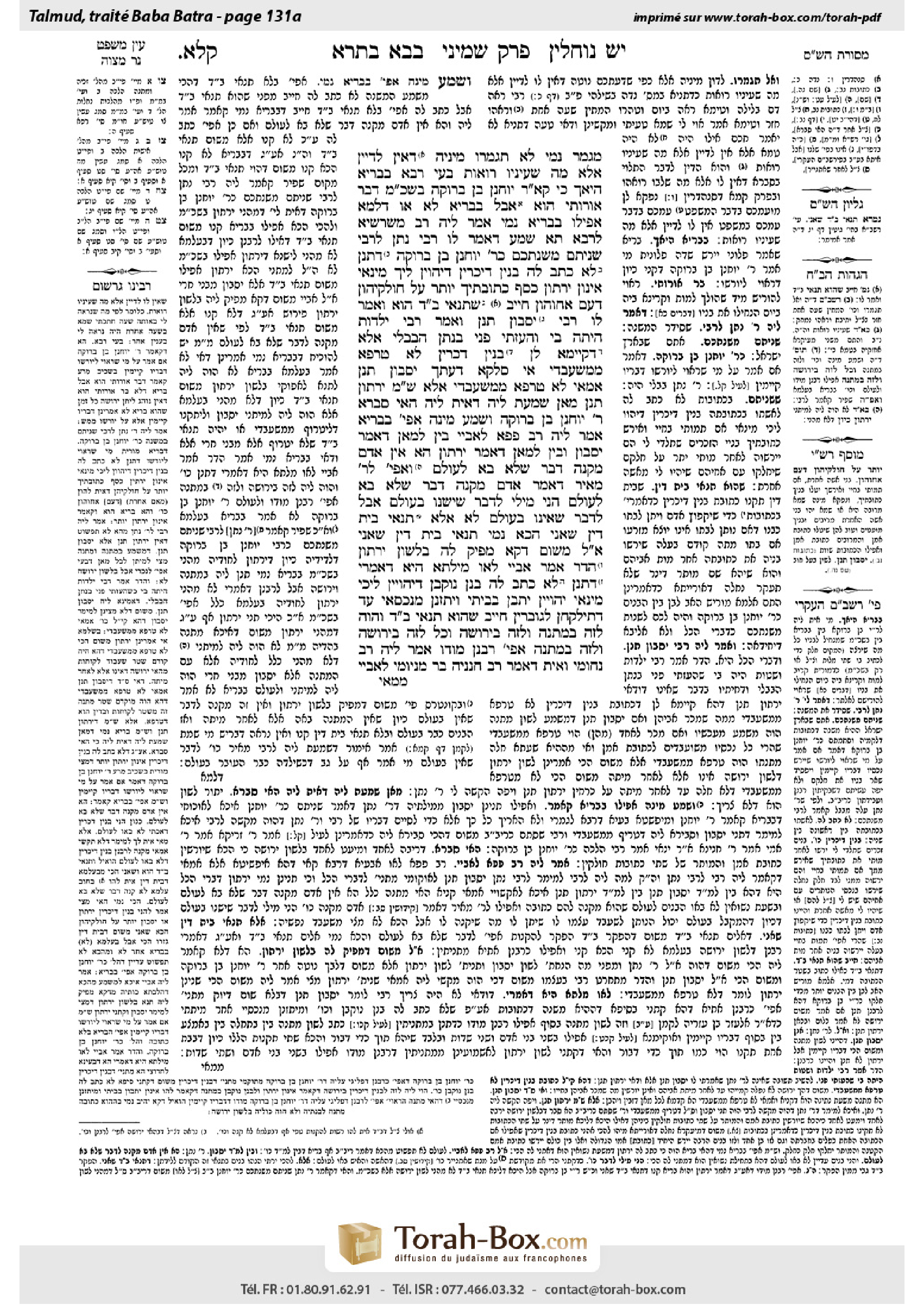
Bava Batra 131a: Talmud study for Daf Yomi
Study the Talmud for Daf Yomi with scanned pages, Hebrew text, English translations from Sefaria and AI-generated French translations.
Passage selection and English or AI-generated French translation are available where the scan has annotations. Daf Study is independent of Torah-Box and Sefaria.
Browse Bava Batra · בבא בתרא · All tractatesBava Batra 131a text and translations
This page of Bava Batra includes the Aramaic text, an English translation and an AI-generated French translation, alongside the scan above.
בבא בתרא קל״א א · Aramaic and Hebrew text
מִגְמָר נָמֵי לָא תִּגְמְרוּ מִינֵּיהּ – דְּאֵין לַדַּיָּין אֶלָּא מַה שֶּׁעֵינָיו רוֹאוֹת.
בָּעֵי רָבָא: בְּבָרִיא הֵיאַךְ? כִּי קָאָמַר רַבִּי יוֹחָנָן בֶּן בְּרוֹקָה – בִּשְׁכִיב מְרַע, דְּבַר אוֹרוֹתֵי הוּא; אֲבָל בְּבָרִיא – לָא; אוֹ דִלְמָא אֲפִילּוּ בְּבָרִיא נָמֵי?
אֲמַר לֵיהּ רַב מְשַׁרְשְׁיָא לְרָבָא: תָּא שְׁמַע, דְּאָמַר לוֹ רַבִּי נָתָן לְרַבִּי: שְׁנִיתֶם מִשְׁנַתְכֶם כְּרַבִּי יוֹחָנָן בֶּן בְּרוֹקָה! דִּתְנַן: לֹא כָּתַב לָהּ ״בְּנִין דִּיכְרִין דְּיִהְוֹין לִיךְ מִינַּאי, אִינּוּן יִרְתוּן כֶּסֶף כְּתוּבְּתִיךְ יוֹתֵר עַל חוּלַקְיהוֹן דְּעִם אֲחוּהוֹן״ – חַיָּיב, שֶׁתְּנַאי בֵּית דִּין הוּא.
וְאָמַר לוֹ רַבִּי: ״יִסְּבוּן״ תְּנַן.
וְאָמַר רַבִּי: יַלְדוּת הָיְתָה בִּי וְהֵעַזְתִּי פָּנַי בְּנָתָן הַבַּבְלִי – אֶלָּא דְּקַיְימָא לַן: בְּנִין דִּכְרִין לָא טָרְפָא מִמְּשַׁעְבְּדִי; אִי סָלְקָא דַּעְתָּךְ ״יִסְּבוּן״ תְּנַן, אַמַּאי לָא טָרְפָא מִמְּשַׁעְבְּדִי? אֶלָּא שְׁמַע מִינַּהּ: ״יִרְתוּן״ תְּנַן.
מַאן שָׁמְעַתְּ לֵיהּ דְּאִית לֵיהּ הַאי סְבָרָא – רַבִּי יוֹחָנָן בֶּן בְּרוֹקָה, וּשְׁמַע מִינַּהּ אֲפִילּוּ בְּבָרִיא.
אֲמַר לֵיהּ רַב פָּפָּא לְאַבָּיֵי: בֵּין לְמַאן דְּאָמַר ״יִסְּבוּן״, וּבֵין לְמַאן דְּאָמַר ״יִרְתוּן״, הָא אֵין אָדָם מַקְנֶה דָּבָר שֶׁלֹּא בָּא לָעוֹלָם!
וַאֲפִילּוּ לְרַבִּי מֵאִיר דְּאָמַר: אָדָם מַקְנֶה דָּבָר שֶׁלֹּא בָּא לָעוֹלָם, הָנֵי מִילֵּי לְדָבָר שֶׁיֶּשְׁנוֹ בָּעוֹלָם, אֲבָל לְדָבָר שֶׁאֵינוֹ בָּעוֹלָם – לֹא!
אֶלָּא תְּנַאי בֵּית דִּין שָׁאנֵי; הָכָא נָמֵי – תְּנַאי בֵּית דִּין שָׁאנֵי!
אֲמַר לֵיהּ: מִשּׁוּם דְּקָא מַפֵּיק לַהּ בִּלְשׁוֹן ״יִרְתוּן״.
הֲדַר אָמַר אַבָּיֵי: לָאו מִילְּתָא הִיא דַּאֲמַרִי, דִּתְנַן: לֹא כָּתַב לָהּ ״בְּנָן נוּקְבָן דְּיִהְוְיָין לִיכִי מִינַּאי, יִהְוְיָין יָתְבָן בְּבֵיתִי וְיִתַּזְנָן מִנִּכְסַאי עַד דְּתִילַּקְחָן לְגוּבְרִין״ – חַיָּיב, שֶׁהוּא תְּנַאי בֵּית דִּין.
וְהָוֵה לָזֶה בְּמַתָּנָה וְלָזֶה בִּירוּשָׁה, וְכֹל לָזֶה בִּירוּשָּׁה וְלָזֶה בְּמַתָּנָה – אֲפִילּוּ רַבָּנַן מוֹדוּ.
אֲמַר לֵיהּ רַב נְחוּמִי וְאִית דְּאָמַר רַב חֲנַנְיָה בַּר מִנְיוֹמֵי, לְאַבָּיֵי:
Bava Batra 131a · English translation
but do not learn from it either, as a judge has only what his eyes see as the basis for his ruling. One must rule according to his own understanding.
§ Rava raises a dilemma: In the case of a healthy person who bequeaths his estate to one of his sons, how should the court rule? Should it be reasoned that when Rabbi Yoḥanan ben Beroka says that the bequeathal is valid, he said so specifically with regard to the case of a person on his deathbed, since he is capable of bequeathal, as the verse: “In the day that he causes his sons to inherit” (Deuteronomy 21:16), from which the validity of this bequeathal is derived, is referring specifically to the time of one’s death; but in the case of a healthy person, he did not say his ruling? Or perhaps he stated his ruling even in the case of a healthy person.
Rav Mesharshiyya said to Rava: Come and hear a resolution of your dilemma from a baraita, as Rabbi Natan said to Rabbi Yehuda HaNasi: You taught in your Mishna in accordance with the opinion of Rabbi Yoḥanan ben Beroka, as we learned in a mishna (Ketubot 52b): If the husband did not write for her in her marriage contract: Any male children you will have from me will inherit the money of your marriage contract in addition to their portion of the inheritance that they receive together with their brothers, he is nevertheless obligated as though he had written it, as it is a stipulation of the court and consequently takes effect even if it is not explicitly stated. This mishna is in accordance with the opinion of Rabbi Yoḥanan ben Beroka that one may add to the share of some of his sons at the expense of the others.
And Rabbi Yehuda HaNasi said to him: We did not learn that the male children she has from him will inherit the money of the marriage contract; that version is not accurate. Rather, we learned that they will take the money of the marriage contract, as a gift. When a bequeathal is worded in this manner, it is valid in any event, as stated in the previous mishna (126b).
The baraita continues: And Rabbi Yehuda HaNasi later retracted his response, and said: My response was because of immaturity that I had in me, and I was insolent in the presence of Rabbi Natan the Babylonian by responding in a manner that is incorrect. It is incorrect for the following reason: But since we maintain that concerning an obligation detailed in a marriage document ensuring inheritance rights of a woman’s male children, the beneficiaries do not repossess liened property that has been sold, one can infer that they do not receive the money as a gift. As, if it enters your mind that we learned in the mishna that they will take the money as a gift, why don’t they repossess liened property? The gift was given to them before the property was sold to others. Rather, conclude from this claim that we learned in the mishna that they will inherit the money.
Rav Mesharshiyya concludes: Of whom have you heard that he holds this opinion that one can add to the inheritance of some of his sons at the expense of the others? It is the opinion of Rabbi Yoḥanan ben Beroka, and conclude from the mishna in Ketubot that his ruling applies even with regard to a healthy person, as one does not write a marriage contract on his deathbed. This resolves Rava’s dilemma.
Rav Pappa said to Abaye: How can one prove that the mishna in tractate Ketubot is in accordance with the opinion of Rabbi Yoḥanan ben Beroka? Whether according to the one who says that the correct version of the mishna is: They will take, and whether according to the one who says the correct version of the mishna is: They will inherit, the mishna is difficult, for the following reason: A person cannot transfer ownership of an entity that has not yet come into the world. How can the husband confer rights to his property to children that have yet to be born?
Rav Pappa explains: And even according to Rabbi Meir, who says that a person can transfer ownership of an entity that has not yet come into the world, this statement applies specifically in a case where he transfers the item to an entity, i.e., a person, that is in the world; but with regard to transferring ownership of an item to an entity that is not yet in the world, e.g., to his children that have yet to be born, this statement does not apply. Therefore, the ruling of the mishna is difficult according to all opinions.
Rav Pappa explains: Rather, evidently a stipulation of the court is different. Since this clause of the marriage contract was instituted by rabbinic ordinance, it is not subject to the standard halakhot of transferring property, and one can transfer ownership of an item to an entity that is not yet in the world. Accordingly, here too, with regard to the dispute between Rabbi Yoḥanan ben Beroka and the Rabbis, a stipulation of the court is different, and even according to the Rabbis, who disagree with the opinion of Rabbi Yoḥanan ben Beroka, one can bequeath the money of his wife’s marriage contract to the male children she will have from him in any manner he chooses. Consequently, there is no proof that the mishna is in accordance with the opinion of Rabbi Yoḥanan ben Beroka.
Abaye said to him: The assertion that the mishna is in accordance with the opinion of Rabbi Yoḥanan ben Beroka is due to the fact that it expresses this bequeathal with the wording: They will inherit, as opposed to: They will take. This indicates that a person can normally apportion his inheritance to his sons in any manner he wishes, in accordance with the opinion of Rabbi Yoḥanan ben Beroka.
Abaye then said: That which I said is not correct. The expression: They will inherit, is appropriate even according to the Rabbis, who disagree with Rabbi Yoḥanan ben Beroka, as we learned in the continuation of that mishna that even if the husband did not write for his wife: Any female children you will have from me will sit in my house and be sustained from my property until they are taken by men, i.e., until they are married, he is nevertheless obligated as though he had written it, as it too is a stipulation of the court.
And since these two clauses are written adjacent to each other in the marriage contract, it is effectively a case where one bequeaths his estate to two people: To this one, the daughters, as a gift, and to that one, the sons, as an inheritance. And in any case where one bequeaths his estate to this person as an inheritance and to that person as a gift, even the Rabbis concede that the bequest is valid even if it is to people who are not his heirs, as it is considered a gift with regard to both recipients.
Rav Naḥumi, and some say it was Rav Ḥananya bar Minyumi, said to Abaye:
Bava Batra 131a · Traduction française (IA)
mais ne tirez pas de conclusion à partir de cela, car un juge ne s'appuie que sur ce qu'il voit avec ses yeux pour rendre son verdict. Il faut rendre son verdict selon sa propre compréhension.
§ Rava soulève un dilemme : Dans le cas d'une personne en bonne santé qui léguerait son patrimoine à l'un de ses fils, comment la cour devrait-elle statuer ? Doit-on considérer que lorsque Rabbi Yoḥanan ben Beroka dit que le legs est valide, il le dit spécifiquement en référence au cas d'une personne sur son lit de mort, puisqu'il est capable de léguer, comme le dit la parole : « Le jour où il fera hériter ses fils » (Deutéronome 21:16), d'après laquelle la validité de ce legs est dérivée, se réfère spécifiquement au moment de la mort ; mais dans le cas d'une personne en bonne santé, il n'a pas dit son avis ? Ou peut-être a-t-il exprimé son avis même dans le cas d'une personne en bonne santé.
Rav Mesharshiyya dit à Rava : Viens écouter la résolution de ton dilemme d'une baraïta, comme Rabbi Natan dit à Rabbi Yehuda HaNasi : Tu as enseigné dans ta Michna selon l'opinion de Rabbi Yoḥanan ben Beroka, comme nous l'avons appris dans une Michna (Ketubot 52b) : Si le mari n'a pas écrit dans son contrat de mariage : Toute fille que tu auras de moi héritera de l'argent du contrat de mariage en plus de sa part de l'héritage qu'elle reçoit avec ses frères, il est tout de même tenu comme s'il avait écrit cela, car c'est une stipulation de la cour et donc elle prend effet même si elle n'est pas explicitement mentionnée. Cette Michna est selon l'opinion de Rabbi Yoḥanan ben Beroka qui dit qu'on peut ajouter à la part de certains de ses fils au détriment des autres.
Et Rabbi Yehuda HaNasi dit à lui : Nous n'avons pas appris que les fils masculins qu'elle aura de lui héritent de l'argent du contrat de mariage ; cette version n'est pas exacte. Plutôt, nous avons appris qu'ils prendront l'argent du contrat de mariage, en tant que cadeau. Lorsqu'un legs est formulé ainsi, il est valide en tout cas, comme indiqué dans la Michna précédente (126b).
La baraïta continue : Et Rabbi Yehuda HaNasi a plus tard rétracté sa réponse et a dit : Ma réponse était due à ma jeunesse et à mon insolence en présence de Rabbi Natan le Babylonien en répondant de manière incorrecte. Cela est incorrect pour la raison suivante : Mais puisque nous maintenons que concernant une obligation détaillée dans un contrat de mariage garantissant les droits d'héritage des fils masculins d'une femme, les bénéficiaires ne peuvent pas récupérer la propriété liée qui a été vendue, on peut en déduire qu'ils ne reçoivent pas l'argent en tant que cadeau. En effet, si cela vous vient à l'esprit que nous avons appris dans la Michna qu'ils prendront l'argent en tant que cadeau, pourquoi ne récupèrent-ils pas la propriété liée ? Le cadeau a été donné à eux avant que la propriété ne soit vendue à d'autres. Plutôt, concluez de cette affirmation que nous avons appris dans la Michna qu'ils héritent de l'argent.
Rav Mesharshiyya conclut : De qui avez-vous entendu qu'il maintient cette opinion qu'on peut ajouter à l'héritage de certains de ses fils au détriment des autres ? C'est l'opinion de Rabbi Yoḥanan ben Beroka, et concluez de la Michna dans Ketubot que son avis s'applique même en ce qui concerne une personne en bonne santé, car on ne rédige pas un contrat de mariage sur son lit de mort. Cela résout le dilemme de Rava.
Rav Pappa dit à Abaye : Comment peut-on prouver que la Michna dans le traité Ketubot est selon l'opinion de Rabbi Yoḥanan ben Beroka ? Qu'importe que l'on considère que la version correcte de la Michna est : Ils prendront, ou que l'on considère que la version correcte est : Ils hériteront, la Michna est difficile, pour la raison suivante : Une personne ne peut pas transférer la propriété d'une entité qui n'a pas encore vu le jour. Comment un mari peut-il conférer des droits sur sa propriété à des enfants qui n'ont pas encore été conçus ?
Rav Pappa explique : Et même selon Rabbi Meir, qui dit qu'une personne peut transférer la propriété d'une entité qui n'a pas encore vu le jour, cette déclaration s'applique spécifiquement dans un cas où il transfère l'objet à une entité, c'est-à-dire une personne, qui est dans le monde ; mais concernant le transfér de propriété d'un objet à une entité qui n'est pas encore dans le monde, par exemple à ses enfants qui n'ont pas encore été conçus, cette déclaration ne s'applique pas. Ainsi, le verdict de la Michna est difficile selon toutes les opinions.
Rav Pappa explique : Plutôt, il est évident que la stipulation de la cour est différente. Puisque cette clause du contrat de mariage a été instituée par ordonnance rabbinique, elle n'est pas soumise aux halakhot standards de transfert de propriété, et on peut transférer la propriété d'un objet à une entité qui n'est pas encore dans le monde. Ainsi, ici aussi, concernant le débat entre Rabbi Yoḥanan ben Beroka et les Rabbins, la stipulation de la cour est différente, et même selon les Rabbins, qui s'opposent à l'opinion de Rabbi Yoḥanan ben Beroka, on peut léguer l'argent du contrat de mariage de sa femme à ses fils masculins qu'elle aura de lui selon la manière qu'il choisit. Ainsi, il n'y a pas de preuve que la Michna est selon l'opinion de Rabbi Yoḥanan ben Beroka.
Abaye dit à lui : L'affirmation que la Michna est selon l'opinion de Rabbi Yoḥanan ben Beroka est due au fait qu'elle exprime ce legs avec la formulation : Ils hériteront, contrairement à : Ils prendront. Cela indique qu'une personne peut normalement répartir son héritage entre ses fils selon la manière qu'il souhaite, selon l'opinion de Rabbi Yoḥanan ben Beroka.
Abaye dit alors : Ce que j'ai dit n'est pas correct. La formulation : Ils hériteront, est appropriée même selon les Rabbins, qui s'opposent à l'opinion de Rabbi Yoḥanan ben Beroka, comme nous l'avons appris dans la continuation de cette Michna : même si le mari n'a pas écrit à sa femme : Toute fille que tu auras de moi siéra dans ma maison et sera nourrie de ma propriété jusqu'à ce qu'elle soit emmenée par des hommes, c'est-à-dire jusqu'à ce qu'elle soit mariée, il est tout de même tenu comme s'il avait écrit cela, car cela est aussi une stipulation de la cour.
Et puisque ces deux clauses sont écrites côte à côte dans le contrat de mariage, c'est effectivement un cas où l'on légue son patrimoine à deux personnes : à celle-ci, les filles en tant que don, et à celle-là, les fils en tant qu'héritage. Et dans tout cas où l'on légue son patrimoine à cette personne en tant qu'héritage et à celle-ci en tant que don, même les Rabbins reconnaissent que la légation est valide même si elle est faite à des personnes qui ne sont pas ses héritiers, car elle est considérée comme un don à l'égard des deux bénéficiaires.
Rav Naḥumi, et certains disent que c'était Rav Ḥananya bar Minyumi, dit à Abaye :
Traduction française générée par IA à partir de l’édition anglaise de Sefaria. Vérifie toujours un passage avec le texte source.
Text from Sefaria: William Davidson Edition - Vocalized Aramaic (CC BY NC); William Davidson Edition - English (CC BY NC).