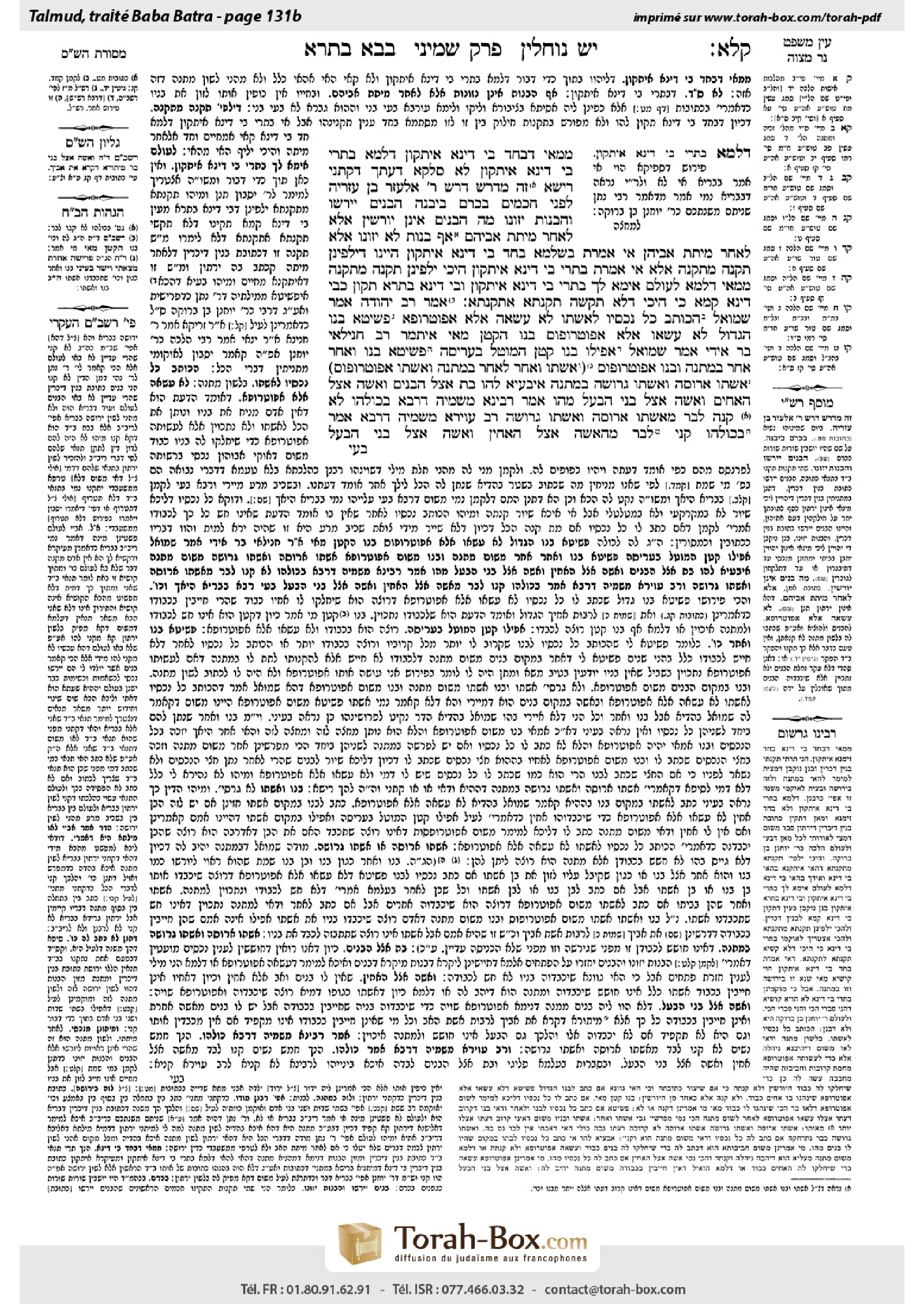
Bava Batra 131b: Talmud study for Daf Yomi
Study the Talmud for Daf Yomi with scanned pages, Hebrew text, English translations from Sefaria and AI-generated French translations.
Passage selection and English or AI-generated French translation are available where the scan has annotations. Daf Study is independent of Torah-Box and Sefaria.
Browse Bava Batra · בבא בתרא · All tractatesBava Batra 131b text and translations
This page of Bava Batra includes the Aramaic text, an English translation and an AI-generated French translation, alongside the scan above.
בבא בתרא קל״א ב · Aramaic and Hebrew text
מִמַּאי דִּבְחַד בֵּי דִינָא אִיתְּקוּן? דִּלְמָא בִּתְרֵי בֵּי דִינָא אִיתְּקוּן!
לָא סָלְקָא דַּעְתָּךְ, דְּקָתָנֵי רֵישָׁא: זֶה מִדְרָשׁ דָּרַשׁ רַבִּי אֶלְעָזָר בֶּן עֲזַרְיָה לִפְנֵי חֲכָמִים בַּכֶּרֶם בְּיַבְנֶה: הַבָּנִים יִירְשׁוּ וְהַבָּנוֹת יִזּוֹנוּ; מָה הַבָּנִים אֵינָן יוֹרְשִׁין אֶלָּא לְאַחַר מִיתַת אֲבִיהֶם, אַף בָּנוֹת לֹא יִזּוֹנוּ אֶלָּא לְאַחַר מִיתַת אֲבִיהֶן.
אִי אָמְרַתְּ בִּשְׁלָמָא בְּחַד בֵּי דִינָא אִיתְּקוּן, הַיְינוּ דְּיָלְפִינַן תַּקָּנָה מִתַּקָּנָה. אֶלָּא אִי אָמְרַתְּ בִּתְרֵי בֵּי דִינָא אִיתְּקוּן, הֵיכִי יָלְפִינַן תַּקָּנָה מִתַּקָּנָה?
מִמַּאי? דִּלְמָא לְעוֹלָם אֵימָא לָךְ בִּתְרֵי בֵּי דִינָא אִיתְּקוּן; וּבֵי דִינָא בָּתְרָא תַּקּוּן כְּבֵי דִינָא קַמָּא, כִּי הֵיכִי דְּלָא תִּקְשֵׁה תַּקַּנְתָּא אַתַּקַּנְתָּא.
אָמַר רַב יְהוּדָה אָמַר שְׁמוּאֵל: הַכּוֹתֵב כׇּל נְכָסָיו לְאִשְׁתּוֹ – לֹא עֲשָׂאָהּ אֶלָּא אַפּוֹטְרוֹפָּא.
פְּשִׁיטָא, בְּנוֹ הַגָּדוֹל – לֹא עֲשָׂאוֹ אֶלָּא אַפּוֹטְרוֹפּוֹס. בְּנוֹ הַקָּטָן מַאי?
אִיתְּמַר, רַב חֲנִילַאי בַּר אִידֵּי אָמַר שְׁמוּאֵל: אֲפִילּוּ בְּנוֹ קָטָן הַמּוּטָּל בַּעֲרִיסָה.
פְּשִׁיטָא, בְּנוֹ וְאַחֵר – אַחֵר בְּמַתָּנָה, וּבְנוֹ אַפּוֹטְרוֹפּוֹס. אִשְׁתּוֹ וְאַחֵר – לְאַחֵר בְּמַתָּנָה, וְאִשְׁתּוֹ אַפּוֹטְרוֹפּוֹס.
אִשְׁתּוֹ אֲרוּסָה וְאִשְׁתּוֹ גְּרוּשָׁה – בְּמַתָּנָה.
אִיבַּעְיָא לְהוּ: בַּת אֵצֶל הַבָּנִים, וְאִשָּׁה אֵצֶל הָאַחִים, וְאִשָּׁה אֵצֶל בְּנֵי הַבַּעַל, מַהוּ?
אָמַר רָבִינָא מִשְּׁמֵיהּ דְּרָבָא: בְּכוּלְּהוּ לֹא קָנָה, לְבַר מֵאִשְׁתּוֹ אֲרוּסָה וְאִשְׁתּוֹ גְּרוּשָׁה. רַב עַוִּירָא מִשְּׁמֵיהּ דְּרָבָא אָמַר: בְּכוּלְּהוּ קָנֵי, לְבַר מֵהָאִשָּׁה אֵצֶל הָאַחִין וְאִשָּׁה אֵצֶל בְּנֵי הַבַּעַל.
Bava Batra 131b · English translation
From where do you conclude that both clauses, the one for the benefit of the sons and the one for the benefit of the daughters, were instituted by one court and are therefore each read in light of the other? Perhaps they were instituted by two different courts and are unrelated to each other. Accordingly, the wording of the gift and the wording of the inheritance are not part of the same statement.
The Gemara answers: This possibility should not enter your mind, as the former clause of that mishna teaches (Ketubot 49a): A father is not obligated to provide his daughter’s sustenance. This interpretation was interpreted by Rabbi Elazar ben Azarya before the Sages of the vineyard in Yavne: Since the Sages instituted that after the father’s death, the sons inherit the sum of money specified in their mother’s marriage contract, and the daughters are sustained from their father’s estate, these two halakhot are equated: Just as the sons inherit only after their father’s death, not during his lifetime, so too, the daughters are sustained from their father’s property only after their father’s death.
The Gemara explains: Granted, if you say that the two clauses were instituted by one court, this is the reason that we derive the halakhot of one ordinance from the halakhot of the other ordinance, under the assumption that a court institutes ordinances in a consistent manner. But if you say that they were instituted by two distinct courts operating in different periods, how can we derive the halakhot of one ordinance from the halakhot of the other ordinance?
The Gemara rejects this explanation: From where is it assumed that they were instituted by one court? Actually, I will say to you that perhaps the two clauses were instituted by two separate courts, and nevertheless Rabbi Elazar ben Azarya derived the halakhot of one ordinance from the halakhot of the other ordinance, because the latter court presumably instituted its ordinance in accordance with the format of the former court, so that one should not ask about contradictions between one ordinance and the other ordinance. With regard to the halakhot of inheritance, there is no reason to read the two clauses in light of the other.
§ Rav Yehuda says that Shmuel says: A person on his deathbed who writes a document granting all his property to his wife has merely rendered her a steward. The assumption is that he did not intend to deprive his heirs of their entire inheritance. Rather, he intended to appoint her as a steward in charge of the property, so that the heirs will honor her.
The Gemara discusses similar cases: It is obvious that if one writes a document granting all his property to his adult son, he does not intend to give him the entire inheritance, but to have him distribute it among his brothers. Rather, he has merely rendered him a steward [apotropos]. If he writes it to his minor son, what is the halakha? Is it still assumed that his intention is to appoint him as a steward, or is that implausible since a minor boy is not yet capable of assuming this position and therefore the father apparently intended to bequeath to him the entire inheritance?
It was stated that Rav Ḥanilai bar Idi says that Shmuel says that even if one wrote a document granting all his property to his minor son who is lying in his crib, he does not receive the entire inheritance. Rather, the father presumably intended to appoint him as a steward when he reached adulthood, so that the other heirs would honor him.
The Gemara states: It is obvious that if one wrote a document granting all his property to his son and another person, he intended to give the other person half the property as a gift, and to appoint his son a steward to oversee the property of his brothers, with whom he shares the other half. Similarly, if he wrote a document granting all his property to his wife and another person, he intended to give the other person half the property as a gift, and to appoint his wife a steward to oversee the other half of the property for his sons.
Furthermore, it is obvious that if one wrote a document granting all his property to his betrothed wife, whom he did not yet wed, or to his former wife, whom he had divorced, he intended to give it to them as a gift, as he had no reason to have his heirs honor them.
A dilemma was raised before the Sages: If one wrote a document granting all his property to his daughter before his sons, in a case where he has sons who would inherit from him, or to his wife before his brothers, or to his wife before the husband’s sons who are not her sons, what is the halakha? Is it assumed that his intention was to appoint her as a steward or to give her the property as a gift?
Ravina said in the name of Rava that in all of these cases the recipient did not acquire the property. Rather, he or she was merely appointed a steward, except for the cases of his betrothed wife and his former wife whom he divorced. By contrast, Rav Avira said in the name of Rava that in all of these cases the recipient acquired the property, except for the cases of his wife before his brothers and his wife before the husband’s sons, where he clearly intended only to appoint her as a steward.
Bava Batra 131b · Traduction française (IA)
D'où concluez-vous que les deux clauses, celle en faveur des fils et celle en faveur des filles, ont été instituées par une même cour et sont donc lues l'une en lumière de l'autre ? Peut-être ont-elles été instituées par deux cours différentes et sont donc indépendantes l'une de l'autre. Ainsi, la formulation du don et la formulation de l'héritage ne font pas partie d'un même énoncé.
La Guemara répond : Cette possibilité ne doit pas entrer en considération, car la première clause de cette mitsva enseigne (Ketubot 49a) : Un père n'est pas tenu de fournir la subsistance à sa fille. Cette interprétation a été émise par Rabbi Elazar ben Azarya devant les Sages du vignoble à Yavne : Puisque les Sages ont institué que, après la mort du père, les fils héritent de la somme d'argent spécifiée dans le contrat de mariage de leur mère, et que les filles sont sustentées à partir du patrimoine du père, ces deux halakhot sont équivalentes : Tout comme les fils héritent seulement après la mort de leur père, pas pendant sa vie, de même les filles sont sustentées à partir du patrimoine de leur père seulement après la mort de ce dernier.
La Guemara explique : Bien sûr, si vous dites que les deux clauses ont été instituées par une même cour, c'est pour cela que nous dérivons les halakhot d'une ordonnance à partir des halakhot de l'autre ordonnance, sous l'hypothèse qu'une cour institue les ordonnances de manière cohérente. Mais si vous dites qu'elles ont été instituées par deux cours distinctes, opérant à des époques différentes, comment pouvons-nous dériver les halakhot d'une ordonnance à partir des halakhot de l'autre ordonnance ?
La Guemara rejette cette explication : D'où suppose-t-on qu'elles ont été instituées par une même cour ? En réalité, je vous dis que peut-être les deux clauses ont été instituées par deux cours distinctes, et pourtant Rabbi Elazar ben Azarya a dérivé les halakhot d'une ordonnance à partir des halakhot de l'autre ordonnance, car la cour suivante a probablement institué son ordonnance conformément au format de la première cour, de sorte qu'on ne devrait pas poser de questions sur les contradictions entre une ordonnance et une autre. En ce qui concerne les halakhot de l'héritage, il n'y a pas de raison de lire les deux clauses l'une en lumière de l'autre.
§ Rav Yehuda dit que Shmuel dit : Un homme sur son lit de mort qui écrit un document lui donnant toute sa propriété à sa femme n'a fait que lui confier la charge de steward. L'hypothèse est qu'il n'avait pas l'intention de dépriver ses héritiers de leur héritage entier. Plutôt, il voulait nommer sa femme steward afin qu'elle gère la propriété, de sorte que les héritiers la respectent.
La Guemara discute des cas similaires : Il est évident que si l'on écrit un document lui donnant toute sa propriété à son fils adulte, on ne suppose pas qu'il veut lui donner l'héritage entier, mais qu'il veut qu'il le distribue parmi ses frères. Plutôt, il a simplement rendu son fils steward. Si l'on écrit cela à son fils mineur, quelle est la halakha ? Est-ce que l'on suppose toujours qu'il voulait le nommer steward, ou cela est-il implausible, puisque le jeune garçon n'est pas encore capable d'assumer ce poste, et donc le père voulait probablement lui léguer l'héritage entier ?
Il a été dit que Rav Ḥanilai bar Idi dit que Shmuel dit que même si l'on écrit un document lui donnant toute sa propriété à son fils mineur qui est allongé dans son berceau, il ne reçoit pas l'héritage entier. Plutôt, le père a probablement voulu le nommer steward lorsqu'il serait adulte, de sorte que les autres héritiers le respectent.
La Guemara affirme : Il est évident que si l'on écrit un document lui donnant toute sa propriété à son fils et à une autre personne, l'intention était de donner à la personne l'autre moitié de la propriété en cadeau, et de nommer son fils steward pour gérer la propriété de ses frères, avec qui il partage l'autre moitié. De même, si l'on écrit un document lui donnant toute sa propriété à sa femme et à une autre personne, l'intention était de donner à la personne l'autre moitié de la propriété en cadeau, et de nommer sa femme steward pour gérer l'autre moitié de la propriété pour ses fils.
De plus, il est évident que si l'on écrit un document lui donnant toute sa propriété à sa fiancée, qu'il n'a pas encore épousée, ou à sa femme précédente, qu'il a divorcée, l'intention était de lui donner la propriété en cadeau, car il n'avait pas de raison de faire honorer ses héritiers par elle.
Un dilemme a été soulevé devant les Sages : Si l'on écrit un document lui donnant toute sa propriété à sa fille avant ses fils, dans un cas où il a des fils qui héritent de lui, ou à sa femme avant ses frères, ou à sa femme avant les fils du mari qui ne sont pas ses enfants, quelle est la halakha ? Est-ce qu'on suppose que son intention était de la nommer gestionnaire ou de lui donner la propriété en cadeau ?
Ravina a dit en nom de Rava que dans tous ces cas, le destinataire n'a pas acquis la propriété. Plutôt, il ou elle a été simplement nommé gestionnaire, sauf pour les cas de sa fiancée et de sa femme divorcée. À l'inverse, Rav Avira a dit en nom de Rava que dans tous ces cas, le destinataire a acquis la propriété, sauf pour les cas de sa femme avant ses frères et de sa femme avant les fils du mari, où il est clair qu'il voulait seulement la nommer gestionnaire.
Traduction française générée par IA à partir de l’édition anglaise de Sefaria. Vérifie toujours un passage avec le texte source.
Text from Sefaria: William Davidson Edition - Vocalized Aramaic (CC BY NC); William Davidson Edition - English (CC BY NC).