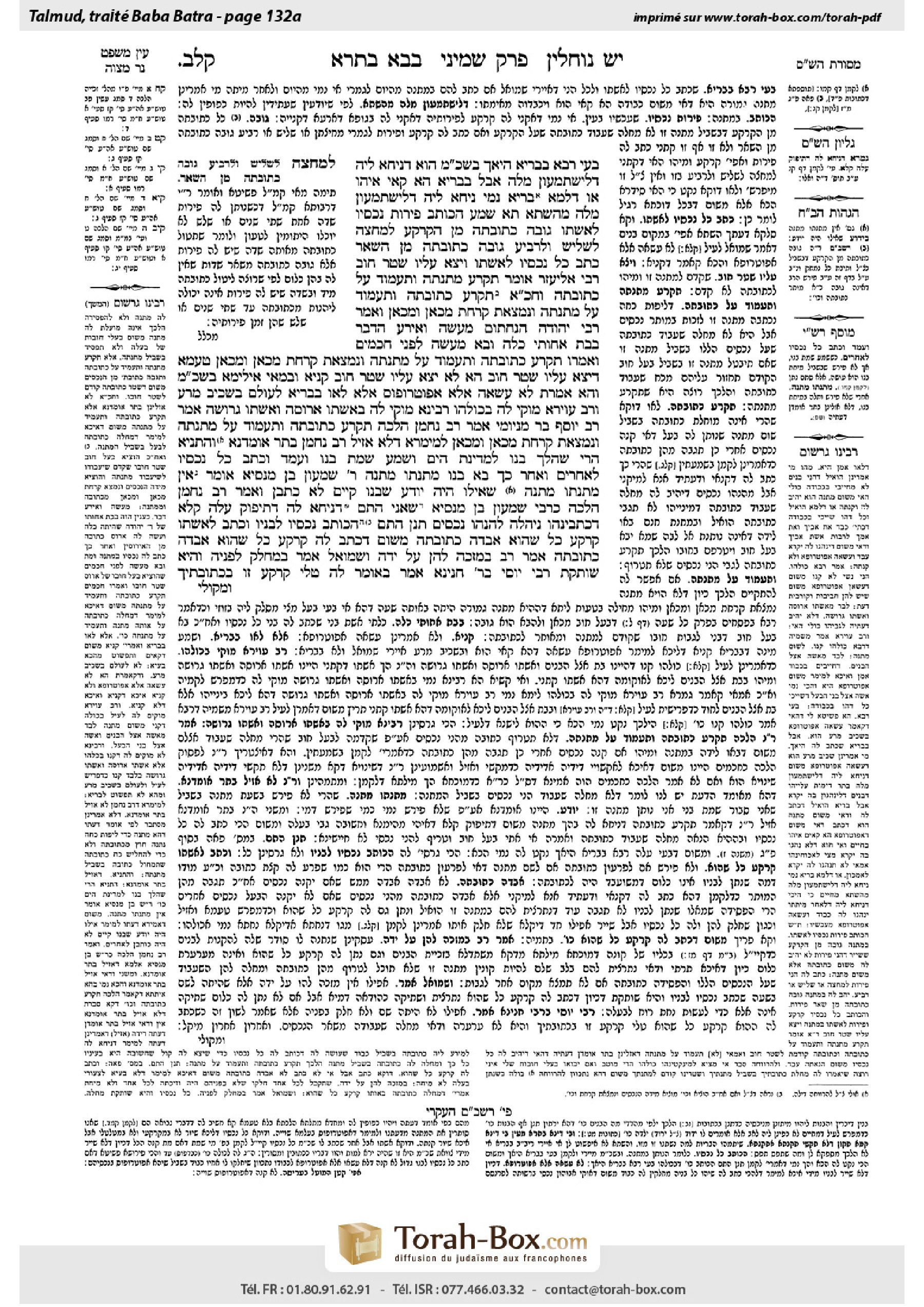
Bava Batra 132a: Talmud study for Daf Yomi
Study the Talmud for Daf Yomi with scanned pages, Hebrew text, English translations from Sefaria and AI-generated French translations.
Passage selection and English or AI-generated French translation are available where the scan has annotations. Daf Study is independent of Torah-Box and Sefaria.
Browse Bava Batra · בבא בתרא · All tractatesBava Batra 132a text and translations
This page of Bava Batra includes the Aramaic text, an English translation and an AI-generated French translation, alongside the scan above.
בבא בתרא קל״ב א · Aramaic and Hebrew text
בָּעֵי רָבָא: בְּבָרִיא הֵיאַךְ? בִּשְׁכִיב מְרַע הוּא דְּנִיחָא לֵיהּ – דְּלִישְׁתַּמְעוּן מִלֵּהּ, אֲבָל בְּבָרִיא – הָא קָאֵי אִיהוּ; אוֹ דִלְמָא בָּרִיא נָמֵי נִיחָא לֵיהּ, דְּלִישְׁתַּמְעוּן מִלֵּהּ מֵהַשְׁתָּא?
תָּא שְׁמַע: הַכּוֹתֵב פֵּירוֹת נְכָסָיו לְאִשְׁתּוֹ – גּוֹבָה כְּתוּבָּתָהּ מִן הַקַּרְקַע. לְמֶחֱצָה, לִשְׁלִישׁ וְלִרְבִיעַ – גּוֹבָה כְּתוּבָּתָהּ מִן הַשְּׁאָר.
כָּתַב כׇּל נְכָסָיו לְאִשְׁתּוֹ, וְיָצָא עָלָיו שְׁטַר חוֹב – רַבִּי אֱלִיעֶזֶר אוֹמֵר: תִּקָּרַע מַתְּנָתָהּ וְתַעֲמוֹד עַל כְּתוּבָּתָהּ. וַחֲכָמִים אוֹמְרִים: תִּקָּרַע כְּתוּבָּתָהּ וְתַעֲמוֹד עַל מַתְּנָתָהּ; וְנִמְצֵאת קֵרַחַת מִכָּאן וּמִכָּאן.
וְאָמַר רַבִּי יְהוּדָה הַנַּחְתּוֹם: מַעֲשֶׂה וְאֵירַע הַדָּבָר בְּבַת אֲחוֹתִי כַּלָּה, וּבָא מַעֲשֶׂה לִפְנֵי חֲכָמִים, וְאָמְרוּ: תִּקָּרַע כְּתוּבָּתָהּ וְתַעֲמוֹד עַל מַתְּנָתָהּ, וְנִמְצֵאת קֵרַחַת מִכָּאן וּמִכָּאן.
טַעְמָא דְּיָצָא עָלָיו שְׁטַר חוֹב, הָא לֹא יָצָא עָלָיו שְׁטַר חוֹב – קָנְיָא. וּבְמַאי? אִילֵּימָא בִּשְׁכִיב מְרַע – וְהָא אָמְרַתְּ לֹא עֲשָׂאָהּ אֶלָּא אַפּוֹטְרוֹפּוֹס! אֶלָּא לָאו בְּבָרִיא?
לְעוֹלָם בִּשְׁכִיב מְרַע; וְרַב עַוִּירָא מוֹקֵי לַהּ בְּכוּלְּהוּ, רָבִינָא מוֹקֵי לַהּ בְּאִשְׁתּוֹ אֲרוּסָה וְאִשְׁתּוֹ גְּרוּשָׁה.
אָמַר רַב יוֹסֵף בַּר מִנְיוֹמֵי אָמַר רַב נַחְמָן, הֲלָכָה: תִּקָּרַע כְּתוּבָּתָהּ וְתַעֲמוֹד עַל מַתְּנָתָהּ, וְנִמְצֵאת קֵרַחַת מִכָּאן וּמִכָּאן.
לְמֵימְרָא דְּלָא אָזֵיל רַב נַחְמָן בָּתַר אוּמְדָּנָא?!
וְהָתַנְיָא: הֲרֵי שֶׁהָלַךְ בְּנוֹ לִמְדִינַת הַיָּם, וְשָׁמַע שֶׁמֵּת בְּנוֹ, וְעָמַד וְכָתַב כׇּל נְכָסָיו לַאֲחֵרִים, וְאַחַר כָּךְ בָּא בְּנוֹ – מַתְּנָתוֹ מַתָּנָה. רַבִּי שִׁמְעוֹן בֶּן מְנַסְיָא אוֹמֵר: אֵין מַתְּנָתוֹ מַתָּנָה – שֶׁאִילּוּ הָיָה יוֹדֵעַ שֶׁבְּנוֹ קַיָּים, לֹא כְּתָבָן. וְאָמַר רַב נַחְמָן: הֲלָכָה כְּרַבִּי שִׁמְעוֹן בֶּן מְנַסְיָא.
שָׁאנֵי הָתָם, דְּנִיחָא לַהּ דְּתִיפּוֹק עֲלַהּ קָלָא דְּכַתְבִינְהוּ נִיהֲלַהּ לְהָנְהוּ נְכָסִים.
תְּנַן הָתָם: הַכּוֹתֵב נְכָסָיו לְבָנָיו, וְכָתַב לְאִשְׁתּוֹ קַרְקַע כׇּל שֶׁהוּא – אִבְּדָה כְּתוּבָּתָהּ. מִשּׁוּם דְּכָתַב לָהּ קַרְקַע כׇּל שֶׁהוּא – אִבְּדָה כְּתוּבָּתָהּ?!
אָמַר רַב: בִּמְזַכֶּה לָהֶן עַל יָדָהּ. וּשְׁמוּאֵל אָמַר: בִּמְחַלֵּק לְפָנֶיהָ וְהִיא שׁוֹתֶקֶת. רַבִּי יוֹסֵי בְּרַבִּי חֲנִינָא אֲמַר: בְּאוֹמֵר לָהּ: ״טְלִי קַרְקַע זוֹ בִּכְתוּבָּתִךְ״.
Bava Batra 132a · English translation
With regard to the halakha that a person on his deathbed who wrote a document granting all his property to his wife has appointed her as a steward, Rava raises a dilemma: In the case of a healthy person, what is the halakha? Should it be reasoned that specifically in the case of a person on his deathbed it is assumed that he intended to appoint his wife as a steward, as it is preferable for him that her word be heard and she is honored after his death, but in the case of a healthy person, he is still standing and can ensure that his wife is honored, so he apparently intended to actually give her all of his property? Or perhaps should it be reasoned that in the case of a healthy person as well, it is preferable that his wife’s word be heard and she be given honor from now?
The Gemara suggests: Come and hear a resolution of the dilemma from a baraita: If one writes a document that the profits of his property should go to his wife in the event that he dies or divorces her, she collects payment of her marriage contract, which he wrote her at the time of their marriage, from the land itself. The profits are hers as a result of his gift. Similarly, if he wrote a document granting her one-half, one-third, or one-quarter of his property, she collects payment of her marriage contract from the rest of his property, which he did not give her as a separate gift.
The baraita continues: If one wrote a document granting all his property to his wife, and subsequently a promissory note emerged against him for a loan he took while they were married but before he gave her this gift, Rabbi Eliezer says that she should tear up her deed of gift and remain with her marriage contract, so that the creditor will not be able to collect the property she received, as her marriage contract preceded the promissory note. And the Rabbis say: She must tear up her marriage contract and remain with her deed of gift, as by accepting the gift of all her husband’s property she waived her right to receive payment of her marriage contract. Since the promissory note preceded the deed of gift, the creditor receives the property, and the wife is found to be bald from here and from there, i.e., she receives neither her gift nor her marriage contract.
And Rabbi Yehuda the baker said: There was an incident where this matter occurred to my sister’s daughter who is my daughter-in-law [kalla], that my son wrote such a document to her, and the incident came before the Sages. And they said that she must tear up her marriage contract and remain with her deed of gift, and she is found to be bald from here and from there.
The Gemara infers: The reason she loses her gift is that a promissory note emerged against him, but if a promissory note did not emerge against him, she acquires the gift of his property. And with regard to what case is this stated? If we say it is with regard to a person on his deathbed, but didn’t you say previously that in such a case he merely rendered her a steward? Rather, is it not with regard to a healthy person? Accordingly, Rava’s dilemma is resolved: If a healthy person writes a document granting all his property to his wife, it is hers.
The Gemara rejects this proof: Actually, the halakha of the baraita is stated with regard to a person on his deathbed; and Rav Avira would interpret the baraita as referring to all of the cases mentioned above in which, in his opinion, the wife acquires the property and is not appointed as a steward. And Ravina would interpret it specifically in reference to a case where one wrote a document granting all his property to his betrothed wife or his former wife, whom he divorced, where he concedes that she acquires the property.
Rav Yosef bar Minyumi says that Rav Naḥman says: The halakha is in accordance with the opinion of the Rabbis. She must tear up her marriage contract and remain with her deed of gift, and she is found to be bald from here and from there.
The Gemara asks: Is this to say that Rav Naḥman does not follow the principle of assessing intention, meaning that even if one did not state something explicitly, the court assesses what his intention was and decides the halakha based on that assessment? Clearly, upon accepting the gift the wife did not intend to waive payment of her marriage contract and thereby be left with nothing in the event that her husband’s creditor produces a promissory note that predates her gift.
But isn’t it taught in a baraita (Tosefta, Ketubot 5:9): In a case where one’s son went overseas and he heard that his son died, and then he arose and wrote a document granting all his property to others, and then his son came back, his gift to the other people is a valid gift. Rabbi Shimon ben Menasya says: His gift is not a valid gift, as had he known that his son was alive he would not have written a document granting them his property. And Rav Naḥman says that the halakha is in accordance with the opinion of Rabbi Shimon ben Menasya. Apparently, Rav Naḥman follows the principle of assessing intention.
The Gemara answers: There, in the case of one who writes a document granting all his property to his wife, it is different, as it is beneficial to her that it be publicized that he wrote a document granting her all of that property, and she was willing to risk not receiving payment of her marriage contract to gain this benefit.
§ We learned in a mishna there (Pe’a 3:7): If a man writes a document granting his property to his sons, and he wrote a document granting any amount of land to his wife, she has lost her right to receive payment of her marriage contract. The Gemara questions this: Because he wrote a document granting her any amount of land, she has lost her right to receive payment of her marriage contract? Why should this be?
Rav says: This mishna is referring to a case where the husband transfers ownership of his property to his sons through his wife’s participation in a formal act of acquisition. Not only did she not protest the transfer of property to the sons, but she facilitated the transaction. Clearly, she agreed to waive payment of her marriage contract. And Shmuel says: It is referring not only to a case where she actually participates in the act of acquisition, but also to a case where he distributes the property to his sons in her presence, and she is silent and does not ask about her marriage contract. Rabbi Yosei, son of Rabbi Ḥanina, says: It is referring to a case where he says to her: Take only this parcel of land for your marriage contract.
Bava Batra 132a · Traduction française (IA)
Concernant la halakha qui stipule qu'un homme sur son lit de mort, ayant écrit un document lui donnant toute sa propriété à sa femme, a désigné celle-ci comme administratrice, Rava soulève un dilemme : Dans le cas d'un homme en bonne santé, quelle est la halakha ? Doit-on raisonner que spécifiquement dans le cas d'un homme sur son lit de mort, on suppose qu'il a l'intention de désigner sa femme comme administratrice, car il est préférable qu'on écoute sa parole et qu'elle soit honorée après sa mort, mais dans le cas d'un homme en bonne santé, il est encore debout et peut s'assurer qu'on honorera sa femme, donc il a visiblement l'intention de lui donner toute sa propriété ? Ou peut-être doit-on raisonner que dans le cas d'un homme en bonne santé également, il est préférable que sa femme ait sa parole écoutée et qu'on l'honore dès maintenant ?
La Guemara suggère : Viens écouter la résolution de ce dilemme tirée d'une baraïta : Si l'on écrit un document selon lequel les profits de sa propriété doivent aller à sa femme en cas de son décès ou de son divorce, elle récupère le paiement de son contrat de mariage, que l'on a écrit à l'époque de leur mariage, directement de la terre elle-même. Les profits sont à elle en raison de son don. De même, si l'on écrit un document lui donnant la moitié, le tiers ou le quart de sa propriété, elle récupère le paiement de son contrat de mariage à partir de la reste de sa propriété, que l'on n'a pas donné à elle comme don distinct.
Le baraïta continue : Si l'on écrit un document donnant toute sa propriété à sa femme, et ensuite un billet de créance apparaît contre lui pour un prêt qu'il a pris pendant qu'ils étaient mariés mais avant qu'il ne lui donne ce don, Rabbi Eliezer dit qu'elle doit déchirer son don et rester avec son contrat de mariage, afin que le créancier ne puisse pas récupérer la propriété qu'elle a reçue, car son contrat de mariage a précédé le billet de créance. Et les Rabbins disent : Elle doit déchirer son contrat de mariage et rester avec son don, car en acceptant le don de toute la propriété de son mari, elle a renoncé à son droit de recevoir le paiement de son contrat de mariage. Puisque le billet de créance a précédé le don, le créancier récupère la propriété, et la femme est trouvée nue de ce côté et de l'autre, c'est-à-dire qu'elle reçoit ni son don ni son contrat de mariage.
Et Rabbi Yehuda le boulanger dit : Il y a eu un cas où cela s'est produit pour ma nièce, qui est ma fille au mariage, que mon fils a écrit un tel document à elle, et l'incident s'est produit devant les Sages. Et ils ont dit qu'elle devait déchirer son contrat de mariage et rester avec son don, et elle est trouvée nue de ce côté et de l'autre.
La Guemara déduit : La raison pour laquelle elle perd son don est que le billet de créance est apparu contre lui, mais si un billet de créance n'est pas apparu contre lui, elle acquiert le don de sa propriété. Et concernant quel cas est-ce dit ? Si nous disons qu'il s'agit d'un homme sur son lit de mort, mais n'avez-vous pas dit précédemment que dans ce cas il a simplement rendu sa femme administratrice ? Plutôt, n'est-ce pas concernant un homme en bonne santé ? Ainsi, le dilemme de Rava est résolu : Si un homme en bonne santé écrit un document donnant toute sa propriété à sa femme, c'est à elle.
La Guemara rejette cette preuve : En réalité, la halakha du baraïta est énoncée concernant une personne sur son lit de mort ; et Rav Avira interpréterait le baraïta comme se référant à tous les cas mentionnés ci-dessus où, selon son avis, la femme acquiert la propriété et n'est pas désignée comme administratrice. Et Ravina interpréterait spécifiquement le cas où l'on écrit un document donnant toute sa propriété à sa fiancée ou à sa femme divorcée, à qui il a divorcé, où il reconnaît qu'elle acquiert la propriété.
Rav Yosef bar Minyumi dit que Rav Naḥman dit : La halakha suit l'opinion des Rabbins. Elle doit déchirer son contrat de mariage et rester avec son don, et elle est trouvée nue de ce côté et de l'autre.
La Guemara demande : Est-ce que cela signifie que Rav Naḥman ne suit pas le principe d'évaluation de l'intention, c'est-à-dire que même si l'on n'a pas dit quelque chose explicitement, la cour évalue ce que l'on avait l'intention de faire et décide la halakha en fonction de cette évaluation ? Évidemment, en acceptant le don, la femme n'avait pas l'intention de renoncer au paiement de son contrat de mariage et ainsi être laissée sans rien en cas où le créancier de son mari produit un billet de créance qui précède son don.
Mais n'est-ce pas enseigné dans une baraïta (Tosefta, Ketubot 5:9) : Dans le cas où un fils est parti en voyage et qu'on a appris qu'il était mort, et ensuite il a écrit un document donnant toute sa propriété à d'autres personnes, et ensuite son fils est revenu, son don aux autres personnes est un don valide. Rabbi Shimon ben Menasya dit : Son don n'est pas valide, car s'il avait su que son fils était vivant, il n'aurait pas écrit un document donnant leur propriété. Et Rav Naḥman dit que la halakha suit l'opinion de Rabbi Shimon ben Menasya. Apparemment, Rav Naḥman suit le principe d'évaluation de l'intention.
La Guemara répond : Là, dans le cas où l'on écrit un document donnant toute sa propriété à sa femme, c'est différent, car il est bénéfique pour elle que cela soit rendu public qu'il a écrit un document donnant toute cette propriété à elle, et elle a été prête à risquer de ne pas recevoir le paiement de son contrat de mariage pour obtenir ce bénéfice.
§ Nous avons appris dans une mishna là (Pe’a 3:7) : Si un homme écrit un document donnant sa propriété à ses fils, et s'il a écrit un document donnant une quantité quelconque de terre à sa femme, elle a perdu son droit de recevoir le paiement de son contrat de mariage. La Guemara questionne cela : Parce qu'il a écrit un document donnant une quantité quelconque de terre à sa femme, elle a perdu son droit de recevoir le paiement de son contrat de mariage ? Pourquoi cela ?
Rav dit : Cette mitsna fait référence à un cas où le mari transfère la propriété de son bien à ses fils grâce à la participation de sa femme dans un acte formel d'acquisition. Non seulement elle n'a pas protesté contre le transfert de la propriété aux fils, mais elle a facilité la transaction. Évidemment, elle a accepté de renoncer au paiement de son contrat de mariage. Et Shmuel dit : Elle fait référence non seulement à un cas où elle participe effectivement à l'acte d'acquisition, mais aussi à un cas où il distribue la propriété à ses fils en sa présence, et elle reste muette sans demander rien concernant son contrat de mariage. Rabbi Yosei, fils de Rabbi Ḥanina, dit : Elle fait référence à un cas où il dit à elle : Prends seulement cette parcelle de terre pour ton contrat de mariage.
Traduction française générée par IA à partir de l’édition anglaise de Sefaria. Vérifie toujours un passage avec le texte source.
Text from Sefaria: William Davidson Edition - Vocalized Aramaic (CC BY NC); William Davidson Edition - English (CC BY NC).