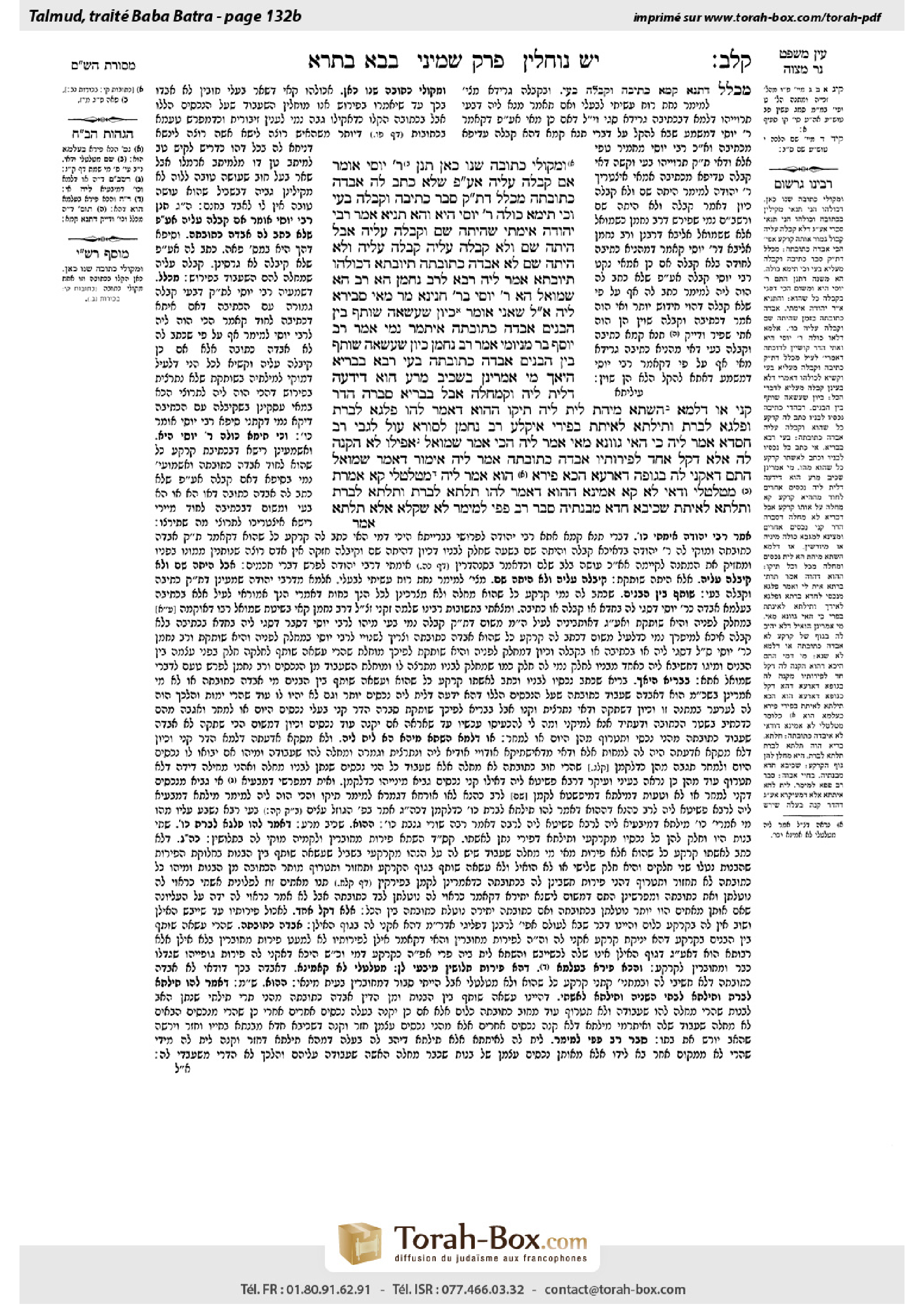
Bava Batra 132b: Talmud study for Daf Yomi
Study the Talmud for Daf Yomi with scanned pages, Hebrew text, English translations from Sefaria and AI-generated French translations.
Passage selection and English or AI-generated French translation are available where the scan has annotations. Daf Study is independent of Torah-Box and Sefaria.
Browse Bava Batra · בבא בתרא · All tractatesBava Batra 132b text and translations
This page of Bava Batra includes the Aramaic text, an English translation and an AI-generated French translation, alongside the scan above.
בבא בתרא קל״ב ב · Aramaic and Hebrew text
וּמִקּוּלֵּי כְתוּבָּה שָׁנוּ כָּאן.
תְּנַן, רַבִּי יוֹסֵי אוֹמֵר: אִם קִבְּלָה עָלֶיהָ, אַף עַל פִּי שֶׁלֹּא כָּתַב לָהּ – אִבְּדָה כְּתוּבָּתָהּ. מִכְּלָל דְּתַנָּא קַמָּא סָבַר: כְּתִיבָה וְקַבָּלָה בָּעֵי!
וְכִי תֵּימָא: כּוּלַּהּ רַבִּי יוֹסֵי הִיא; וְהָא תַנְיָא, אָמַר רַבִּי יְהוּדָה: אֵימָתַי – שֶׁהָיְתָה שָׁם וְקִבְּלָה עָלֶיהָ; אֲבָל הָיְתָה שָׁם וְלֹא קִבְּלָה עָלֶיהָ, קִבְּלָה עָלֶיהָ וְלֹא הָיְתָה שָׁם – לֹא אִבְּדָה כְּתוּבָּתָהּ! תְּיוּבְתָּא דְכוּלְּהוּ! תְּיוּבְתָּא.
אֲמַר לֵיהּ רָבָא לְרַב נַחְמָן: הָא רַב, הָא שְׁמוּאֵל, הָא רַבִּי יוֹסֵי בְּרַבִּי חֲנִינָא. מָר – מַאי סְבִירָא לֵיהּ? אֲמַר לֵיהּ, שֶׁאֲנִי אוֹמֵר: כֵּיוָן שֶׁעֲשָׂאָהּ שׁוּתָּף בֵּין הַבָּנִים – אִבְּדָה כְּתוּבָּתָהּ.
אִיתְּמַר נָמֵי, אָמַר רַב יוֹסֵף בַּר מִנְיוֹמֵי אָמַר רַב נַחְמָן: כֵּיוָן שֶׁעֲשָׂאָהּ שׁוּתָּף בֵּין הַבָּנִים – אִבְּדָה כְּתוּבָּתָהּ.
בָּעֵי רָבָא: בְּבָרִיא הֵיאַךְ? מִי אָמְרִינַן: בִּשְׁכִיב מְרַע הוּא דְּיָדְעָה דְּלֵית לֵיהּ – וְקָמָחֲלָה, אֲבָל בְּבָרִיא – סָבְרָה הָדַר קָנֵי; אוֹ דִלְמָא, הַשְׁתָּא מִיהַת לֵית לֵיהּ? תֵּיקוּ.
הַהוּא דַּאֲמַר לְהוּ: ״פַּלְגָא לִבְרַת, וּפַלְגָא לִבְרַת, וְתִילְתָּא לְאִיתַּת בְּפֵירֵי״. אִיקְּלַע רַב נַחְמָן לְסוּרָא, עוּל לְגַבֵּי רַב חִסְדָּא, אֲמַר לֵיהּ: כִּי הַאי גַוְונָא מַאי? אֲמַר לֵיהּ, הָכִי אָמַר שְׁמוּאֵל: אֲפִילּוּ לֹא הִקְנָה לָהּ אֶלָּא דֶּקֶל אֶחָד לְפֵירוֹתָיו – אִבְּדָה כְּתוּבָּתָהּ.
אֲמַר לֵיהּ: אֵימוֹר דְּאָמַר שְׁמוּאֵל הָתָם – דְּאַקְנִי לַהּ בְּגוּפַהּ דְּאַרְעָא; הָכָא – פֵּירָא הוּא! אֲמַר לֵיהּ: מִטַּלְטְלִי קָא אָמְרַתְּ? מִטַּלְטְלִי וַדַּאי לָא קָא אָמֵינָא.
הַהוּא דַּאֲמַר לְהוּ: ״תִּלְתָּא לִבְרַת, וְתִלְתָּא לִבְרַת, וְתִלְתָּא לְאִיתַּת״. שְׁכִיבָא חֲדָא מִבְּנָתֵיהּ. סְבַר רַב פַּפֵּי לְמֵימַר: לָא שָׁקְלָא אֶלָּא תְּלָתָא.
Bava Batra 132b · English translation
And the Sages taught here one of the leniencies that apply to a marriage contract. This manner in which the wife loses her right to receive payment of her marriage contract is a leniency for the husband, as an ordinary creditor does not lose money he is owed in this fashion.
The Gemara questions this statement: We learned in the same mishna that Rabbi Yosei says that if she accepted the distribution upon herself, even if he did not write a document granting her any amount of land, she has lost her right to receive payment of her marriage contract. By inference, it can be stated that the first tanna holds that both his writing a document granting her a piece of land and her acceptance of the distribution are necessary for her to lose her right, contrary to the interpretation of all three amora’im, i.e., Rav, Shmuel, and Rabbi Yosei, son of Rabbi Ḥanina, all of whom assumed that she need not affirmatively accept the distribution and that her silence is sufficient.
And if you would say that the entire mishna is the opinion of Rabbi Yosei, who holds that either the husband’s writing a deed of gift or the wife’s acceptance of the distribution is sufficient, but isn’t it taught in a baraita that Rabbi Yehuda said: According to the first tanna, when does she lose her right to receive payment of her marriage contract? In a case where she was there at the time of the distribution and accepted it; but if she was there but did not accept it, or accepted it but was not there, she has not lost her right to receive payment of her marriage contract, as she can claim that her acquiescence was only to please her husband and was not sincere. The Gemara concludes: The refutation of the opinions of all the interpretations of the amora’im is indeed a conclusive refutation.
Rava said to Rav Naḥman: This is the opinion of Rav; this is the opinion of Shmuel; and this is the opinion of Rabbi Yosei, son of Rabbi Ḥanina. What does the Master hold in this matter? Rav Naḥman said to him: As I say, that once he rendered her a partner in the property among the sons, she lost her right to receive payment of her marriage contract.
Rav Naḥman’s opinion was also stated as a halakhic ruling: Rav Yosef bar Minyumi says that Rav Naḥman says that once he rendered her a partner in the property among the sons, she lost her right to receive payment of her marriage contract.
Rava raises a dilemma: In the case of a healthy person, what is the halakha? Do we say that the wife loses her right to receive payment of her marriage contract only in the case of a person on his deathbed, as she knew that he had no other property and nevertheless waived payment of the marriage contract, but in the case of a healthy person, she might have reasoned that he will then acquire other property from which she will be able to collect payment of her marriage contract, and that is why she accepted the distribution of the property? If so, she did not waive her right to receive payment of her marriage contract. Or perhaps, should it be reasoned that since in any event, now he has no other property, her acceptance should be interpreted as waiving her right? The Gemara concludes: The dilemma shall stand unresolved.
§ There was a certain man on his deathbed who said to the people surrounding him: Give one-half of my estate to my daughter, and one-half to my other daughter, and one-third of the produce to my wife. Rav Naḥman happened to come to Sura. He entered the study hall to see Rav Ḥisda, who said to him: In a case like this, what is the halakha? Rav Naḥman said to him that this is what Shmuel says: Even if he transferred to her ownership only one palm tree for its produce, she has lost her right to receive payment of her marriage contract.
Rav Ḥisda said to him: Say that Shmuel said his statement that she loses her right there, in a case where he gave her a palm tree for its produce, because he transferred rights in the land itself to her ownership, as the palm tree is connected to the ground. But here, in this case, it is only produce that he gave her, without any share in the land itself. Perhaps she does not lose payment of her marriage contract. Rav Naḥman said to him: You say that he gave her only movable property? I certainly did not mean to say that she loses her right even if he gave her only movable property such as produce. Rather, she receives payment of her marriage contract.
There was a certain man on his deathbed who said to the people surrounding him: Give one-third of my property to my daughter, and one-third to my other daughter, and one-third to my wife. One of his daughters died before he did, and her portion consequently returned to his possession. Rav Pappi thought to say that the wife takes only one-third. She cannot receive payment of her marriage contract from the two-thirds bequeathed to the daughters, as by entering a partnership with the daughters in ownership of the property, she waived payment of her marriage contract.
Bava Batra 132b · Traduction française (IA)
Et les Sages enseignèrent ici l'une des facilités applicables à un contrat de mariage. La manière dont la femme perd le droit de recevoir le paiement de son contrat de mariage est une facilité pour l'époux, car un créancier ordinaire ne perd pas l'argent qu'il est dû de cette manière.
La Guemara questionne cette déclaration : Nous avons appris dans la même mitsva que Rabbi Yosei dit que si elle a accepté la distribution à son sujet, même si l'époux n'a pas rédigé un document lui octroyant une parcelle de terre, elle a perdu le droit de recevoir le paiement de son contrat de mariage. Par conséquent, on peut affirmer que le premier tanna considère que tant l'écriture d'un document octroyant une parcelle de terre par l'époux que l'acceptation de la distribution par la femme sont nécessaires pour qu'elle perde le droit, contrairement à l'interprétation de tous les trois amoraïm, c'est-à-dire Rav, Shmuel et Rabbi Yosei, fils de Rabbi Ḥanina, qui tous supposaient qu'elle n'avait pas besoin d'accepter activement la distribution et que son silence suffisait.
Et si l'on disait que toute la mitsva est l'opinion de Rabbi Yosei, qui considère que soit l'écriture d'un don par l'époux, soit l'acceptation de la distribution par la femme suffit, mais n'est-il pas enseigné dans une baraïta que Rabbi Yéhuda dit : Selon le premier tanna, quand la femme perd le droit de recevoir le paiement de son contrat de mariage ? Dans le cas où elle était présente lors de la distribution et l'avait acceptée ; mais si elle était présente mais n'avait pas accepté, ou si elle avait accepté mais n'était pas présente, elle n'a pas perdu le droit de recevoir le paiement de son contrat de mariage, car elle pouvait affirmer que son acquiescement était uniquement pour plaire à son époux et n'était pas sincère. La Guemara conclut : La réfutation des opinions de toutes les interprétations des amoraïm est effectivement une réfutation concluante.
Rava dit à Rav Naḥman : C'est l'opinion de Rav ; c'est l'opinion de Shmuel ; et c'est l'opinion de Rabbi Yosei, fils de Rabbi Ḥanina. Quelle est l'opinion du Maître sur cette question ? Rav Naḥman dit à lui : Comme je le dis, une fois qu'il a rendu sa fille partenaire dans la propriété parmi les fils, elle a perdu le droit de recevoir le paiement de son contrat de mariage.
L'opinion de Rav Naḥman a également été formulée comme un jugement halakhique : Rav Yosef bar Minyumi dit que Rav Naḥman dit que lorsqu'il a rendu sa fille partenaire dans la propriété parmi les fils, elle a perdu le droit de recevoir le paiement de son contrat de mariage.
Rava soulève un dilemme : Dans le cas d'une personne en bonne santé, quelle est la halakha ? Disons-nous que la femme perd le droit de recevoir le paiement de son contrat de mariage uniquement dans le cas d'une personne sur son lit de mort, car elle savait qu'il n'avait plus d'autres biens et a néanmoins renoncé au paiement du contrat de mariage, mais dans le cas d'une personne en bonne santé, elle pourrait avoir raisonné qu'il acquerrait d'autres biens d'où elle pourrait récupérer le paiement de son contrat de mariage, et c'est pourquoi elle a accepté la distribution des biens ? Si c'est le cas, elle n'a pas renoncé à son droit. Ou peut-être devons-nous raisonner que puisque, de toute façon, il n'a plus d'autres biens, son acceptation devrait être interprétée comme un renoncement ? La Guemara conclut : Ce dilemme restera sans solution.
§ Il y avait un certain homme sur son lit de mort qui dit aux personnes autour de lui : Donnez la moitié de mon patrimoine à ma fille, et la moitié à ma fille aînée, et un tiers des récoltes à ma femme. Rav Naḥman était à Sura. Il entra dans la salle de study pour voir Rav Ḥisda, qui lui dit : Dans un cas comme celui-ci, quelle est la halakha ? Rav Naḥman dit à lui que c'est ce que Shmuel dit : Même si il a transféré à elle la propriété d'un seul palmier pour ses récoltes, elle a perdu le droit de recevoir le paiement de son contrat de mariage.
Rav Ḥisda dit à lui : Dis que Shmuel a dit son affirmation que elle perd le droit là, dans le cas où il lui a donné un palmier pour ses récoltes, car il a transféré les droits sur la terre elle-même à sa propriété, car le palmier est lié au sol. Mais ici, dans ce cas, il a seulement donné des récoltes, sans aucune part dans la terre elle-même. Peut-être qu'elle n'a pas perdu le droit de recevoir le paiement de son contrat de mariage. Rav Naḥman dit à lui : Tu dis qu'il lui a donné seulement des biens mobiliers ? Je n'ai certainement pas voulu dire qu'elle perde le droit même s'il lui avait donné seulement des biens mobiliers tels que des récoltes. Plutôt, elle reçoit le paiement de son contrat de mariage.
Il y avait un certain homme sur son lit de mort qui dit aux personnes autour de lui : Donnez un tiers de mon patrimoine à ma fille, et un tiers à ma fille aînée, et un tiers à ma femme. Une de ses filles est décédée avant lui, et sa part est donc revenue à sa possession. Rav Pappi voulait dire que la femme ne prend que un tiers. Elle ne peut pas recevoir le paiement de son contrat de mariage des deux tiers légués aux filles, car en entrant en partenariat avec les filles dans la propriété, elle a renoncé au paiement de son contrat de mariage.
Traduction française générée par IA à partir de l’édition anglaise de Sefaria. Vérifie toujours un passage avec le texte source.
Text from Sefaria: William Davidson Edition - Vocalized Aramaic (CC BY NC); William Davidson Edition - English (CC BY NC).