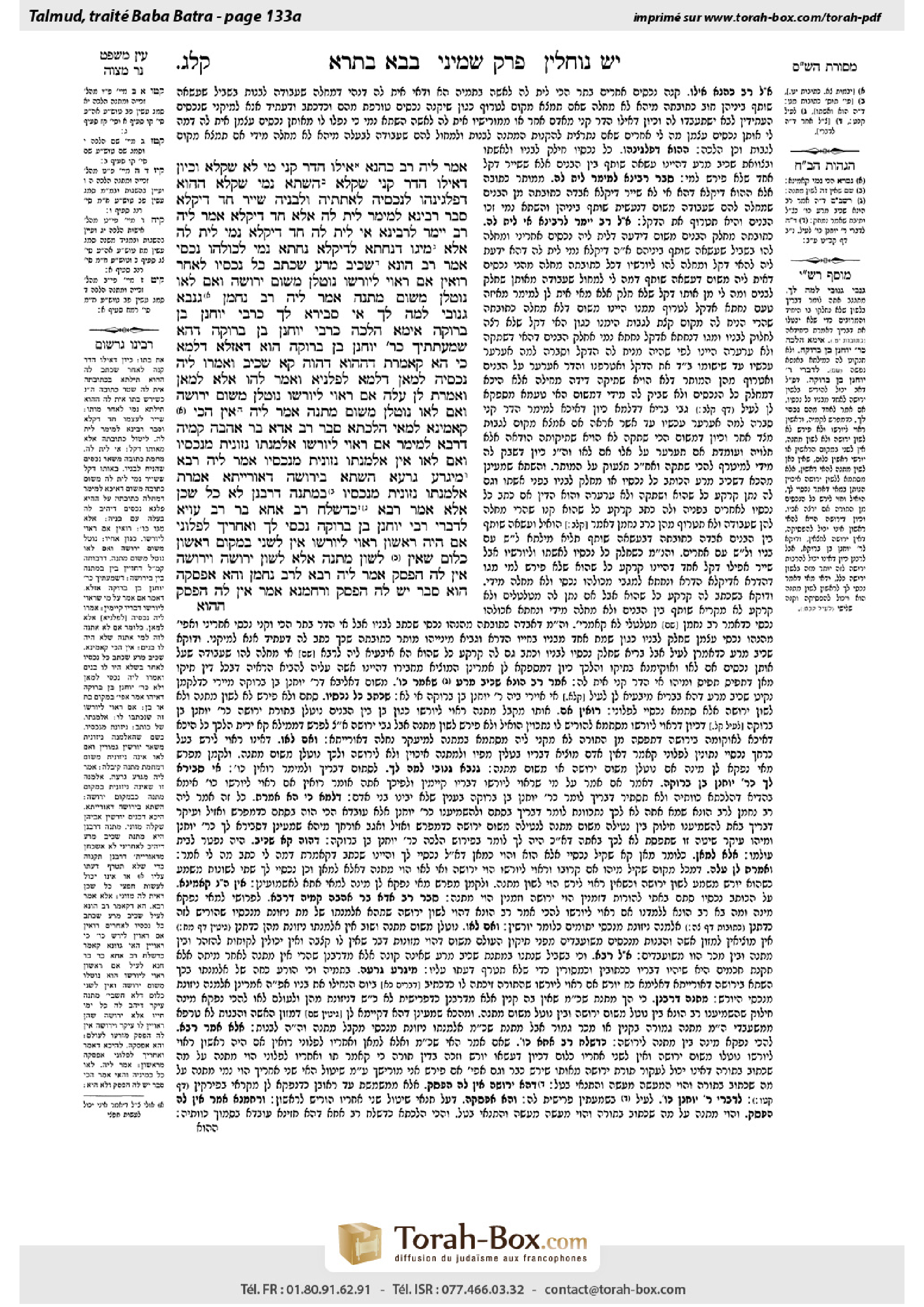
Bava Batra 133a: Talmud study for Daf Yomi
Study the Talmud for Daf Yomi with scanned pages, Hebrew text, English translations from Sefaria and AI-generated French translations.
Passage selection and English or AI-generated French translation are available where the scan has annotations. Daf Study is independent of Torah-Box and Sefaria.
Browse Bava Batra · בבא בתרא · All tractatesBava Batra 133a text and translations
This page of Bava Batra includes the Aramaic text, an English translation and an AI-generated French translation, alongside the scan above.
בבא בתרא קל״ג א · Aramaic and Hebrew text
אֲמַר לֵיהּ רַב כָּהֲנָא: אִילּוּ הָדַר קָנֵי, מִי לָא שָׁקְלָא? וְכֵיוָן דְּאִילּוּ הָדַר קָנֵי – שָׁקְלָא, הַשְׁתָּא נָמֵי שָׁקְלָא.
הַהוּא דְּפַלְגִינְהוּ לְנִכְסֵיהּ לְאִתְּתֵיהּ וְלִבְנֵיהּ, שַׁיַּיר חַד דִּיקְלָא. סְבַר רָבִינָא לְמֵימַר: לֵית לַהּ אֶלָּא חַד דִּיקְלָא. אֲמַר לֵיהּ רַב יֵימַר לְרָבִינָא: אִי לֵית לַהּ, חַד דִּיקְלָא נָמֵי לֵית לַהּ! אֶלָּא מִיגּוֹ דְּנָחֲתָא לְדִיקְלָא, נָחֲתָא נָמֵי לְכוּלְּהוּ נִכְסֵי.
אָמַר רַב הוּנָא: שְׁכִיב מְרַע שֶׁכָּתַב כׇּל נְכָסָיו לְאַחֵר – רוֹאִין; אִם רָאוּי לְיוֹרְשׁוֹ – נוֹטְלָן מִשּׁוּם יְרוּשָּׁה, וְאִם לָאו – נוֹטְלָן מִשּׁוּם מַתָּנָה.
אֲמַר לֵיהּ רַב נַחְמָן: גַּנָּבָא גַּנּוֹבֵי לְמָה לָךְ? אִי סְבִירָא לָךְ כְּרַבִּי יוֹחָנָן בֶּן בְּרוֹקָה, אֵימָא: ״הֲלָכָה כְּרַבִּי יוֹחָנָן בֶּן בְּרוֹקָה״ – דְּהָא שְׁמַעְתְּתָיךְ כְּרַבִּי יוֹחָנָן בֶּן בְּרוֹקָה הוּא דְּאָזְלָא!
דִּלְמָא כִּי הָא קָאָמְרַתְּ – דְּהָהוּא דַּהֲוָה קָא שָׁכֵיב, וַאֲמַרוּ לֵיהּ: נִכְסֵיהּ לְמַאן, דִּלְמָא לִפְלָנְיָא? וַאֲמַר לְהוּ: אֶלָּא לְמַאן? וַאֲמַרְתְּ לַן עֲלַהּ: אִם רָאוּי לְיוֹרְשׁוֹ – נוֹטְלָן מִשּׁוּם יְרוּשָּׁה, וְאִם לָאו – נוֹטְלָן מִשּׁוּם מַתָּנָה. אָמַר לֵיהּ: אִין, הָכִי קָאָמֵינָא.
לְמַאי הִלְכְתָא? סָבַר רַב אַדָּא בַּר אַהֲבָה קַמֵּיהּ דְּרָבָא לְמֵימַר: אִם רָאוּי לְיוֹרְשׁוֹ – אַלְמְנָתוֹ נִזּוֹנֶית מִנְּכָסָיו, וְאִם לָאו – אֵין אַלְמְנָתוֹ נִזּוֹנֶית מִנְּכָסָיו.
אֲמַר לֵיהּ רָבָא: מִיגְרָע גָּרְעָא?! הַשְׁתָּא בִּירוּשָׁה – דְּאוֹרָיְיתָא, אָמְרַתְּ אַלְמְנָתוֹ נִזּוֹנֶית מִנְּכָסָיו; בְּמַתָּנָה – דְּרַבָּנַן, לֹא כׇּל שֶׁכֵּן?!
אֶלָּא אָמַר רָבָא, כְּדִשְׁלַח רַב אַחָא בַּר רַב עַוְיָא: לְדִבְרֵי רַבִּי יוֹחָנָן בֶּן בְּרוֹקָה, ״נְכָסַי לְךָ, וְאַחֲרֶיךָ לִפְלוֹנִי״, אִם הָיָה רִאשׁוֹן רָאוּי לְיוֹרְשׁוֹ – אֵין לַשֵּׁנִי בִּמְקוֹם רִאשׁוֹן כְּלוּם; שֶׁאֵין לְשׁוֹן מַתָּנָה אֶלָּא לְשׁוֹן יְרוּשָּׁה, וִירוּשָּׁה אֵין לָהּ הֶפְסֵק.
אֲמַר לֵיהּ רָבָא לְרַב נַחְמָן: וְהָא אַפְסְקַהּ! הוּא סָבַר – יֵשׁ לָהּ הֶפְסֵק, וְרַחֲמָנָא אָמַר: אֵין לָהּ הֶפְסֵק.
Bava Batra 133a · English translation
Rav Kahana said to him: If the husband had then acquired other property, would she not have taken it as payment of her marriage contract? And since if he would have then acquired other property she would have taken it as payment of her marriage contract, now she also takes the deceased daughter’s share as payment of her marriage contract.
There was a certain person who divided his property between his wife and his son, leaving out a single palm tree. Ravina thought to say that the wife has only the single palm tree as future payment of her marriage contract, which was presumably left out of the distribution for this reason. Rav Yeimar said to Ravina: If she does not have the right to collect payment of her marriage contract from all of his property, as she presumably waived that right when he gave her the gift of some of his property, she does not have the right to collect it from the single palm tree either and it belongs to the heirs. Rav Yeimar presents a different ruling: Rather, since the halakha is that she does descend to collect the palm tree, she therefore descends to collect all of the property as well, i.e., she receives payment of her marriage contract from all the property.
§ Rav Huna says: With regard to a person on his deathbed who wrote a document granting all his property to another, the court investigates the legal status of the recipient: If he is fit to inherit from him, e.g., if he is one of his sons, he takes the property as an inheritance, and if not, he takes it as a gift.
Rav Naḥman said to him: Why should you steal this halakha and not attribute it to its source? If you hold in accordance with the opinion of Rabbi Yoḥanan ben Beroka, say explicitly that the halakha is in accordance with the opinion of Rabbi Yoḥanan ben Beroka, as your halakhic statement follows the opinion of Rabbi Yoḥanan ben Beroka that a person can bequeath his property to any of his heirs.
Perhaps this is what you meant to say: There was a certain childless person who was dying, and those around him said to him: To whom should his, i.e., your, property be given? Perhaps it should be given to so-and-so? And he said to them: Rather, to whom if not him? And you, Rav Huna, meant to say to us: If that person is fit to inherit from him, he takes it as an inheritance, and if not, he takes it as a gift. Rav Huna said to him: Yes, that is what I was saying.
The Gemara asks: With regard to what halakha is there a difference whether he receives it as an inheritance or as a gift? Rav Adda bar Ahava, who was in the presence of Rava, thought that it would be correct to say: If he is fit to inherit from him, the giver’s widow is sustained from his property, as she has the right to be sustained from the inheritance; and if not, and the property was given as a gift, his widow is not sustained from his property.
Rava said to him: Can the widow’s right be diminished by the gift? Now that you say with regard to inheritance, which is granted by Torah law, that his widow is sustained from his property, with regard to the gift of a person on his deathbed, which is effective without any formal act of acquisition by rabbinic law, all the more so is it not clear that the widow has sustenance rights?
Rather, Rava said that the difference whether it is inheritance or a gift is in accordance with the ruling that Rav Aḥa bar Rav Avya sent: According to the statement of Rabbi Yoḥanan ben Beroka, in the case of one who said: My property is given to you, and after you to so-and-so, and the first recipient was fit to inherit from him, the second gets nothing in place of the first, i.e., he does not receive the property after the first one dies, as this formulation employed by the owner was not one of a gift. Rather, it was a formulation of inheritance, and inheritance has no end, i.e., it cannot be stopped. Therefore, since the first recipient acquired it as an inheritance, his heirs inherit it from him, and it cannot be taken by the second.
Rava said to Rav Naḥman: But he ended it. The one who bequeathed it to him ended his inheritance in advance by stating that after the first dies, the property will be given to the second. The Gemara answers: He thought that inheritance has an end; but the Merciful One states that it has no end.
Bava Batra 133a · Traduction française (IA)
Rav Kahana dit à lui : Si l'époux avait alors acquis d'autres biens, ne l'aurait-elle pas pris comme paiement de son mariage ? Et puisque si l'époux avait alors acquis d'autres biens elle les aurait pris comme paiement de son mariage, elle prend maintenant la part de la fille décédée comme paiement de son mariage.
Il y avait un certain homme qui avait divisé ses biens entre sa femme et son fils, en omettant un seul palmier. Ravina pensait dire que la femme n'a que ce palmier comme paiement futur de son mariage, qui a probablement été omis de la distribution à cette fin. Rav Yeimar dit à Ravina : Si elle n'a pas le droit de réclamer le paiement de son mariage sur l'ensemble de ses biens, car elle a probablement renoncé à ce droit lorsqu'il lui a donné un cadeau de ses biens, elle n'a pas le droit de le réclamer non plus sur ce palmier et il appartient aux héritiers. Rav Yeimar présente une autre décision : plutôt, puisque la halakha est que la femme descend réclamer le palmier, elle descend donc aussi réclamer l'ensemble des biens, c'est-à-dire qu'elle reçoit le paiement de son mariage sur l'ensemble des biens.
§ Rav Huna dit : En ce qui concerne une personne sur son lit de mort qui a écrit un document lui donnant tous ses biens à un autre, la cour examine le statut légal du destinataire : s'il est digne d'hériter de lui, c'est-à-dire s'il est l'un de ses fils, il prend les biens comme héritage, et s'il n'en est pas ainsi, il les prend comme cadeau.
Rav Naḥman dit à lui : Pourquoi devrais-tu voler cette halakha et ne pas la créditer à sa source ? Si tu tiens compte de l'opinion de Rabbi Yoḥanan ben Beroka, dis explicitement que la halakha suit l'opinion de Rabbi Yoḥanan ben Beroka, car ton déclaration halakhique suit l'opinion de Rabbi Yoḥanan ben Beroka selon laquelle une personne peut léguer ses biens à n'importe l'un de ses héritiers.
Peut-être que c'est ce que tu voulais dire : Il y avait un certain homme sans enfants qui mourait, et ceux qui étaient autour de lui dirent à lui : À qui devrait être donné ses biens, c'est-à-dire tes biens ? Peut-être devraient-ils être donnés à tel ou tel ? Et il dit à eux : Plutôt, à qui, si ce n'est lui ? Et toi, Rav Huna, tu voulais dire à nous : Si cette personne est digne d'hériter de lui, il le prend comme héritage, et s'il n'en est pas ainsi, il le prend comme cadeau. Rav Huna dit à lui : Oui, c'est ce que je disais.
La Guemara pose la question : En ce qui concerne quelle halakha y a-t-il une différence entre le fait qu'il le reçoive comme héritage ou comme cadeau ? Rav Adda bar Ahava, qui était en présence de Rava, pensait que ce serait correct de dire : Si il est digne d'hériter de lui, la veuve du donneur est sustentée à partir de ses biens, car elle a le droit d'être sustentée à partir de l'héritage ; et si non, et que les biens ont été donnés comme cadeau, la veuve n'est pas sustentée à partir de ses biens.
Rava dit à lui : Le droit de la veuve peut-il être diminué par le cadeau ? Maintenant que tu dis en ce qui concerne l'héritage, qui est accordé par la loi divine, que la veuve est sustentée à partir des biens du défunt, en ce qui concerne le cadeau d'une personne sur son lit de mort, qui est efficace sans aucun acte formel d'acquisition par la loi rabbinique, n'est-ce pas encore plus clair que la veuve a des droits de sustentation ?
Plutôt, Rava dit que la différence entre héritage et cadeau est selon la décision que Rav Aḥa bar Rav Avya a envoyé : Selon la déclaration de Rabbi Yoḥanan ben Beroka, dans le cas d'une personne qui dit : Mes biens sont donnés à toi, et après toi à tel ou tel, et le premier destinataire était digne d'hériter de lui, le second ne reçoit rien à la place du du premier, c'est-à-dire qu'il ne reçoit pas les biens après la mort du premier, car cette formulation employée par le propriétaire n'était pas celle d'un cadeau. Plutôt, c'était une formulation d'héritage, et l'héritage n'a pas de fin, c'est-à-dire qu'il ne peut pas être interrompu. Ainsi, puisque le premier destinataire a acquis les biens comme héritage, ses héritiers héritent de lui, et ils ne peuvent pas être pris par le second.
Rava dit à Rav Naḥman : Mais il l'a terminé. Celui qui a légué les biens à lui a terminé son héritage à l'avance en disant que, après la mort du premier, les biens seront donnés au second. La Guemara répond : Il pensait que l'héritage a une fin ; mais l'Éternel dit qu'il n'en a pas.
Traduction française générée par IA à partir de l’édition anglaise de Sefaria. Vérifie toujours un passage avec le texte source.
Text from Sefaria: William Davidson Edition - Vocalized Aramaic (CC BY NC); William Davidson Edition - English (CC BY NC).