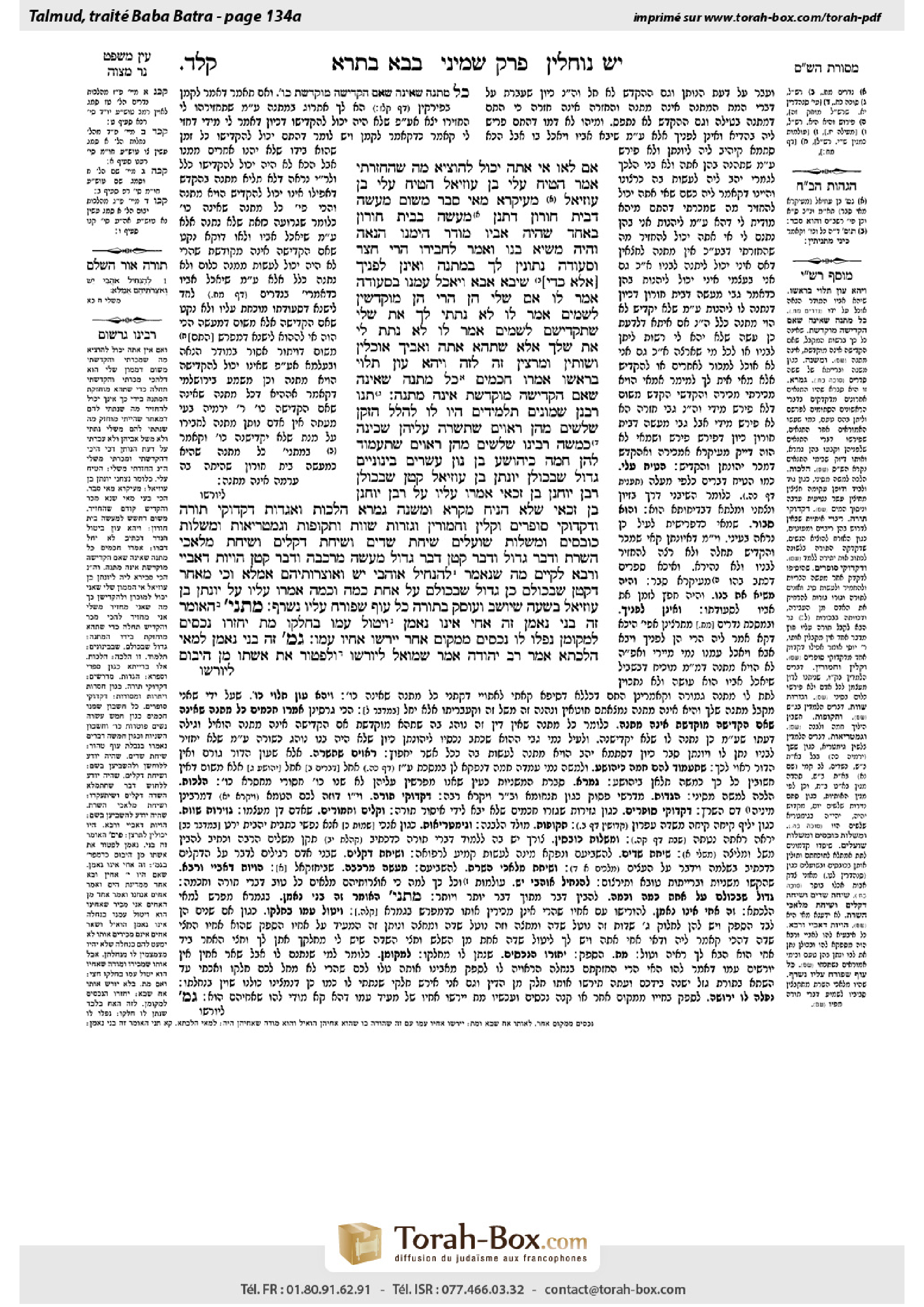
Bava Batra 134a: Talmud study for Daf Yomi
Study the Talmud for Daf Yomi with scanned pages, Hebrew text, English translations from Sefaria and AI-generated French translations.
Passage selection and English or AI-generated French translation are available where the scan has annotations. Daf Study is independent of Torah-Box and Sefaria.
Browse Bava Batra · בבא בתרא · All tractatesBava Batra 134a text and translations
This page of Bava Batra includes the Aramaic text, an English translation and an AI-generated French translation, alongside the scan above.
בבא בתרא קל״ד א · Aramaic and Hebrew text
אִם לָאו – אִי אַתָּה יָכוֹל לְהוֹצִיא מַה שֶּׁהֶחְזַרְתִּי. אָמַר: הֵטִיחַ עָלַי בֶּן עוּזִּיאֵל! הֵטִיחַ עָלַי בֶּן עוּזִּיאֵל!
מֵעִיקָּרָא מַאי סָבַר? מִשּׁוּם מַעֲשֶׂה דְּבֵית חוֹרוֹן.
דִּתְנַן: מַעֲשֶׂה בְּבֵית חוֹרוֹן, בְּאֶחָד שֶׁהָיָה אָבִיו מוּדָּר הֵימֶנּוּ הֲנָאָה, וְהָיָה מַשִּׂיא בְּנוֹ; וְאָמַר לַחֲבֵירוֹ: הֲרֵי חָצֵר וּסְעוּדָה נְתוּנִין לְךָ בְּמַתָּנָה, וְאֵינָן לְפָנֶיךָ אֶלָּא כְּדֵי שֶׁיָּבֹא אַבָּא וְיֹאכַל עִמָּנוּ בַּסְּעוּדָה.
אָמַר לוֹ: אִם שֶׁלִּי הֵן – הֲרֵי הֵן מוּקְדָּשִׁין לַשָּׁמַיִם! אָמַר לוֹ: לֹא נָתַתִּי לְךָ אֶת שֶׁלִּי שֶׁתַּקְדִּישֵׁם לַשָּׁמַיִם! אָמַר לוֹ: לֹא נָתַתָּ לִי אֶת שֶׁלְּךָ אֶלָּא שֶׁתְּהֵא אַתָּה וְאָבִיךְ אוֹכְלִין וְשׁוֹתִין וּמְרַצִּין זֶה לָזֶה, וִיהֵא עָוֹן תָּלוּי בְּרֹאשׁוֹ!
אָמְרוּ חֲכָמִים: כׇּל מַתָּנָה שֶׁאֵינָהּ שֶׁאִם הִקְדִּישָׁהּ מוּקְדֶּשֶׁת – אֵינָהּ מַתָּנָה.
תָּנוּ רַבָּנַן: שְׁמוֹנִים תַּלְמִידִים הָיוּ לוֹ לְהִלֵּל הַזָּקֵן; שְׁלֹשִׁים מֵהֶן רְאוּיִם שֶׁתִּשְׁרֶה עֲלֵיהֶן שְׁכִינָה כְּמֹשֶׁה רַבֵּינוּ, שְׁלֹשִׁים מֵהֶן רְאוּיִם שֶׁתַּעֲמוֹד לָהֶן חַמָּה כִּיהוֹשֻׁעַ בִּן נוּן, עֶשְׂרִים בֵּינוֹנִיִּים. גָּדוֹל שֶׁבְּכוּלָּן – יוֹנָתָן בֶּן עוּזִּיאֵל, קָטָן שֶׁבְּכוּלָּן – רַבָּן יוֹחָנָן בֶּן זַכַּאי.
אָמְרוּ עָלָיו עַל רַבָּן יוֹחָנָן בֶּן זַכַּאי, שֶׁלֹּא הִנִּיחַ מִקְרָא, וּמִשְׁנָה, תַּלְמוּד, הֲלָכוֹת, וְאַגָּדוֹת, דִּקְדּוּקֵי תוֹרָה, וְדִקְִדּוּקֵי סוֹפְרִים, וְקַלִּין וַחֲמוּרִין, וּגְזֵרוֹת שָׁווֹת, וּתְקוּפוֹת, וְגִמַטְרִיָּאוֹת, וּמִשְׁלוֹת כּוֹבְסִים, וּמִשְׁלוֹת שׁוּעָלִים, שִׂיחַת שֵׁדִים, וְשִׂיחַת דְּקָלִים, וְשִׂיחַת מַלְאֲכֵי הַשָּׁרֵת, וְדָבָר גָּדוֹל, וְדָבָר קָטָן.
״דָּבָר גָּדוֹל״ – מַעֲשֵׂה מֶרְכָּבָה, ״וְדָבָר קָטָן״ – הֲוָיוֹת דְּאַבָּיֵי וְרָבָא. לְקַיֵּים מַה שֶּׁנֶּאֱמַר: ״לְהַנְחִיל אוֹהֲבַי יֵשׁ, וְאֹצְרֹתֵיהֶם אֲמַלֵּא״.
וְכִי מֵאַחַר דְּקָטָן שֶׁבְּכוּלָּם כֵּן, גָּדוֹל שֶׁבְּכוּלָּם – עַל אַחַת כַּמָּה וְכַמָּה. אָמְרוּ עָלָיו עַל יוֹנָתָן בֶּן עוּזִּיאֵל, בְּשָׁעָה שֶׁיּוֹשֵׁב וְעוֹסֵק בַּתּוֹרָה – כׇּל עוֹף שֶׁפּוֹרֵחַ עָלָיו נִשְׂרָף.
מַתְנִי׳ הָאוֹמֵר ״זֶה בְּנִי״ – נֶאֱמָן, ״זֶה אָחִי״ – אֵינוֹ נֶאֱמָן, וְיִטּוֹל עִמּוֹ בְּחֶלְקוֹ.
מֵת – יַחְזְרוּ נְכָסִים לִמְקוֹמָן.
נָפְלוּ לוֹ נְכָסִים מִמָּקוֹם אַחֵר, יִירְשׁוּ אֶחָיו עִמּוֹ.
גְּמָ׳ ״זֶה בְּנִי״ – נֶאֱמָן. לְמַאי הִלְכְתָא? אָמַר רַב יְהוּדָה אָמַר שְׁמוּאֵל: לְיוֹרְשׁוֹ, וְלִפְטוֹר אֶת אִשְׁתּוֹ מִן הַיִּבּוּם.
Bava Batra 134a · English translation
but if not, as the property is mine and I have the right to do with it whatever I want, you cannot repossess what I returned to the man’s children either. Shammai then said: Ben Uzziel reprimanded me; ben Uzziel reprimanded me, and I have no response.
The Gemara asks: What did Shammai hold initially, causing him to protest Yonatan ben Uzziel’s behavior? The Gemara answers: He protested due to the incident that happened in the city of Beit Ḥoron.
As we learned in a mishna (Nedarim 48a): An incident occurred involving someone in the city of Beit Ḥoron whose father had vowed not to derive benefit from him, and the son was marrying off his own son and wanted his father to be able to participate in the wedding meal. And he therefore said to another: The courtyard where the wedding will take place and the wedding meal are hereby given to you as a gift, but they are given to you only so that my father will come and eat with us at the meal. The son wanted to circumvent the prohibition imposed by the vow and enable his father to participate in the meal, so he transferred ownership to someone else for that purpose.
The recipient said to him: If they are mine, they are all hereby consecrated to Heaven, i.e., the Temple, and are forbidden to everyone. The son said to him in anger: I did not give you my property so that you should consecrate them to Heaven. The recipient said to him: You gave me your property only so that you and your father would eat and drink and thereby appease each other, and the sin of transgressing the vow would be hung on his, i.e., my, head, as I enabled the transgression.
The mishna continues: In reference to this incident, the Sages said: Any gift that is not so absolute that if the recipient were to consecrate it, the gift would be consecrated, is not a gift. In other words, in order for it to be a gift the recipient must have the ability to consecrate it. Similarly, Shammai had initially reasoned that the gift to Yonatan ben Uzziel was not a valid gift, as its sole purpose was so that the property should not fall into the possession of the man’s children. Once he discovered that Yonatan ben Uzziel consecrated part of the gift, he realized that it was, in fact, a valid gift, with which the recipient could do whatever he pleased.
§ Apropos Yonatan ben Uzziel, the Gemara cites that the Sages taught: Hillel the Elder had eighty students. Thirty of them were sufficiently worthy that the Divine Presence should rest upon them as it did upon Moses our teacher, thirty of them were sufficiently worthy that the sun should stand still for them as it did for Joshua bin Nun, and twenty were on an intermediate level between the other two. The greatest of all the students was Yonatan ben Uzziel, and the least of them was Rabban Yoḥanan ben Zakkai.
The Sages said about Rabban Yoḥanan ben Zakkai that he did not neglect Bible and Mishna; Talmud; halakhot and aggadot; minutiae of the Torah and minutiae of the scribes; and the hermeneutical principles of the Torah with regard to a fortiori inferences; and verbal analogies; and the calculation of the calendric seasons; and numerical values of Hebrew letters [gimatriyot]; and parables of launderers, which are folktales that can be used to explain the Torah, and parables of foxes. In addition, he did not neglect esoteric matters, including the conversation of demons, and the conversation of palm trees, and the conversation of ministering angels, and more generally, a great matter and a small matter.
The Gemara elaborates: A great matter is referring to the secrets of the Design of the Divine Chariot (see Ezekiel, chapter 1), the conduct of the transcendent universe, and a small matter is, for example, halakhot that were ultimately formulated in the framework of the discussions of Abaye and Rava. He did not neglect any of these disciplines, so as to fulfill that which is stated: “That I may cause those that love me to inherit substance and that I may fill their treasuries” (Proverbs 8:21), as Rabban Yoḥanan was filled with the disciplines of Torah and wisdom.
The Gemara adds: And if the least of them was so prolific, the greatest of them was all the more so prolific. The Gemara relates that the Sages said of Yonatan ben Uzziel, the greatest of Hillel’s students, that when he would sit and engage in Torah study, the sanctity that he generated was so intense that any bird that would fly over him would be incinerated.
MISHNA: One who says: This is my son, is deemed credible. One who says: This is my brother, is not deemed credible with regard to his other brothers’ obligation to share the inheritance with the subject of his statement. When one claims that this man is his brother, this claim is accepted with regard to the speaker’s own portion, and the man in question takes a share of their father’s inheritance with him, i.e., from his portion.
If the man in question dies, the property he received from the father’s inheritance shall return to its place, i.e., to the possession of the brother who testified on his behalf, from whose portion he received a share.
If property came into the man in question’s possession from somewhere else, other than from the father, and the man in question died, all of the brothers of the one who testified shall inherit with the one who testified, as according to his claim they too are the heirs of the deceased.
GEMARA: The mishna teaches that one who says: This is my son, is deemed credible. With regard to what halakha is this stated? Rav Yehuda says that Shmuel says: It is stated with regard to inheriting from him, i.e., the son inherits from the speaker, and with regard to rendering his wife exempt from levirate marriage. Because he claims that the person in question is his son, his wife is not required to enter into levirate marriage after his death, as he has a child.
Bava Batra 134a · Traduction française (IA)
mais si ce n'est pas le cas, puisque la propriété m'appartient et que je peux en faire ce que je veux, vous ne pouvez pas reprendre ce que j'ai rendu aux enfants de l'homme. Shammai dit alors : Ben Uzziel m'a réprimandé ; Ben Uzziel m'a réprimandé, et je n'ai pas de réponse.
La Guemara demande : De quoi Shammai tenait-il au départ, ce qui l'a poussé à protester contre le comportement de Yonatan ben Uzziel ? La Guemara répond : Il protestait à cause de l'incident qui s'était produit dans la ville de Beit Ḥoron.
Comme nous l'avons appris dans une mitsna (Nedarim 48a) : un incident s'est produit dans la ville de Beit Ḥoron concernant un homme dont le père avait fait un vœu de ne pas tirer profit de lui, et le fils voulait marier son propre fils et souhaitait que son père puisse participer au repas de mariage. Il a donc dit à un autre : Le jardin où aura lieu le mariage et le repas sont donnés à vous en cadeau, mais ils sont donnés à vous uniquement afin que mon père vienne et mange avec nous au repas. Le fils voulait contourner l'interdiction imposée par le vœu et permettre à son père de participer au repas, et il a donc transféré la propriété à quelqu'un d'autre à cet effet.
Le destinataire lui a répondu : Si ce sont mes biens, ils sont tous consacrés à Dieu, c'est-à-dire au Temple, et interdits à tous. Le fils lui a répondu en colère : Je ne t'ai pas donné ma propriété pour que tu la consacreras à Dieu. Le destinataire lui a répondu : Tu m'as donné ta propriété uniquement afin que tu et ton père puissiez manger et boire et ainsi vous apaiser mutuellement, et le péché de transgression du vœu serait mis sur ton compte, c'est-à-dire sur mon compte, car j'ai permis la transgression.
La mitsva continue : En référence à cet incident, les Sages ont dit : Tout don qui n'est pas suffisamment absolu pour que, si le destinataire le consacrait, le don soit consacré, n'est pas un don. En d'autres termes, afin qu'il soit un don, le destinataire doit avoir la capacité de le consacrer. De même, Shammai avait initialement raisonné que le don à Yonatan ben Uzziel n'était pas un don valide, car son seul but était que la propriété ne tombe pas entre les mains des enfants de l'homme. Une fois qu'il a découvert que Yonatan ben Uzziel avait consacré une partie du don, il a réalisé qu'il s'agissait en réalité d'un don valide, avec lequel le destinataire pouvait faire ce qu'il voulait.
§ En ce qui concerne Yonatan ben Uzziel, la Guemara cite que les Sages ont enseigné : Hillel le Vieil avait soixante-dix élèves. Trente d'entre eux étaient suffisamment dignes pour que la Présence Divine repose sur eux comme sur Moïse notre maître, trente d'entre eux étaient suffisamment dignes pour que le soleil s'arrête pour eux comme pour Josué ben Nun, et vingt étaient à un niveau intermédiaire entre les deux autres. Le plus grand de tous les élèves était Yonatan ben Uzziel, et le moins grand d'entre eux était Rabban Yoḥanan ben Zakkai.
Les Sages ont dit à propos de Rabban Yoḥanan ben Zakkai qu'il n'avait pas négligé la Bible et la Michna ; le Talmud ; les halakhot et les aggadot ; les détails de la Torah et les détails des scribes ; et les principes exégétiques de la Torah concernant les raisonnements par analogie ; les analogies verbales ; et le calcul des saisons calendaires ; et les valeurs numériques des lettres hébraïques [gimatriyot] ; et les paraboles des lavandières, qui sont des contes populaires qui peuvent être utilisés pour expliquer la Torah, et les paraboles des renards. En outre, il n'avait pas négligé les choses ésotériques, y compris la conversation des démons, et la conversation des palmiers, et la conversation des anges ministres, et plus généralement, une grande chose et une petite chose.
La Guemara développe : Une grande chose fait référence aux secrets de la conception du Chariot divin (voir Lévitique, chapitre 1), à la conduite de l'univers transcendant, et une petite chose est, par exemple, les halakhot qui ont finalement été formulés dans le cadre des discussions d'Abaye et de Rava. Il n'avait négligé aucune de ces disciplines, afin de remplir ce qui est dit : « Que je puisse faire hériter ceux qui m'aiment de richesses et que je puisse remplir leurs trésors » (Proverbes 8:21), car Rabban Yoḥanan était rempli des disciplines de la Torah et de la sagesse.
La Guemara ajoute : Et si le moins grand d'entre eux était si prolifique, le plus grand d'entre eux était encore plus prolifique. La Guemara rapporte que les Sages ont dit de Yonatan ben Uzziel, le plus grand des élèves d'Hillel, que lorsqu'il s'asseyait pour étudier la Torah, la sainteté qu'il générait était si intense que tout oiseau qui volait au-dessus de lui serait incinéré.
MICHNA : Celui qui dit : C'est mon fils, est considéré comme crédible. Celui qui dit : C'est mon frère, n'est pas considéré comme crédible concernant l'obligation de partage de l'héritage de ses autres frères. Lorsqu'on affirme que cette personne est son frère, cette affirmation est acceptée concernant la part du locuteur, et la personne en question prend une part de l'héritage de son père avec lui, c'est-à-dire de sa part.
Si la personne en question meurt, la propriété qu'elle a reçue de l'héritage de son père revient à sa place, c'est-à-dire à la possession du frère qui a témoigné en son faveur, d'où il a reçu une part.
Si la propriété est entrée en possession de la personne en question d'une autre source que celle du père, et que la personne en question meurt, tous les frères du témoin héritent avec celui qui a témoigné, car selon son affirmation, ils sont tous les héritiers du défunt.
GUEMARA : La mitsva enseigne que celui qui dit : C'est mon fils, est considéré comme crédible. Concernant quelle halakha est-ce dit ? Rav Yehuda dit que Shmuel dit : C'est dit concernant l'héritage de lui, c'est-à-dire que le fils hérite du locuteur, et concernant l'exemption de son épouse du mariage levirat. Parce qu'il affirme que la personne en question est son fils, son épouse n'est pas tenue de se marier levirat après sa mort, car il a un enfant.
Traduction française générée par IA à partir de l’édition anglaise de Sefaria. Vérifie toujours un passage avec le texte source.
Text from Sefaria: William Davidson Edition - Vocalized Aramaic (CC BY NC); William Davidson Edition - English (CC BY NC).