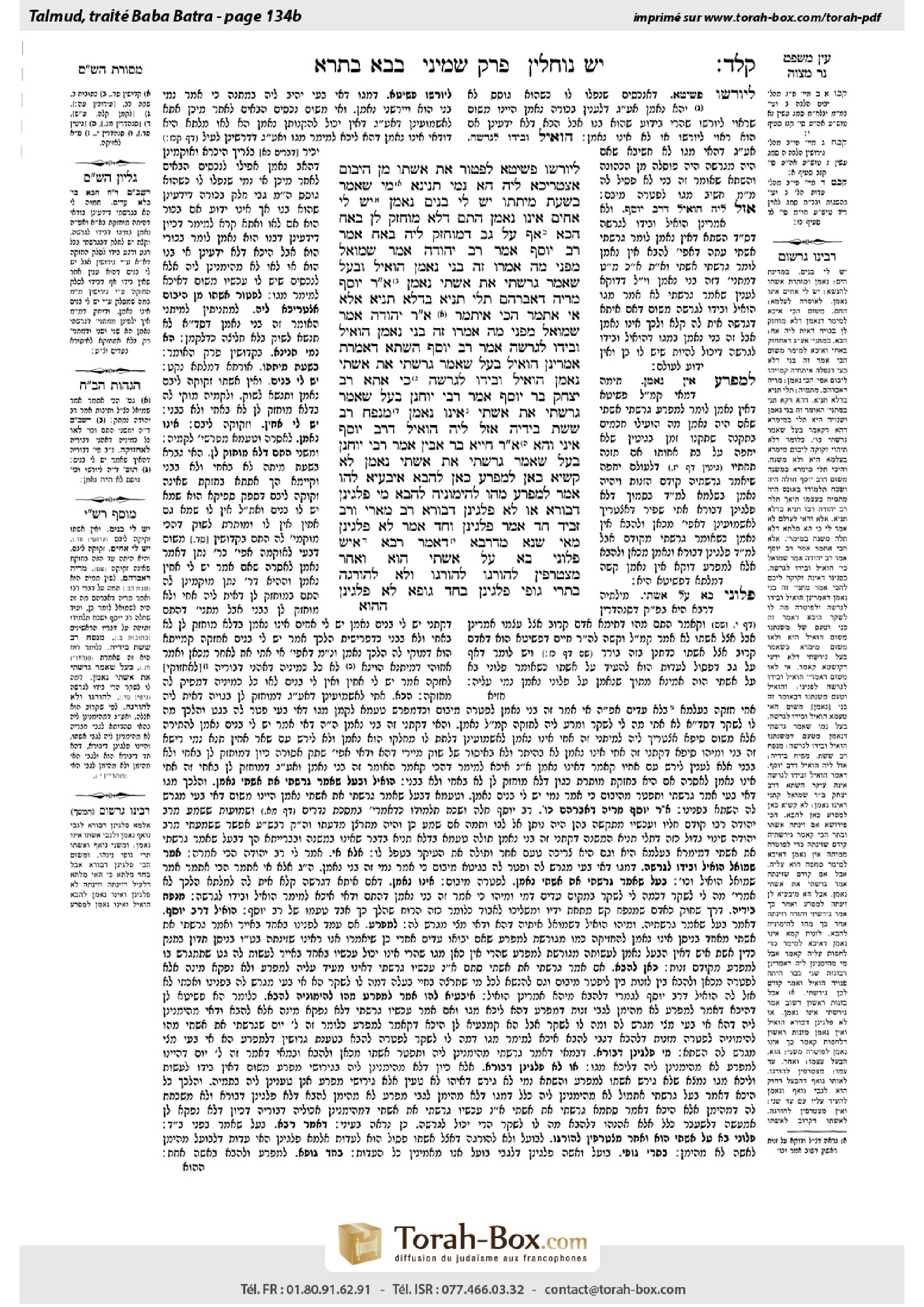
Bava Batra 134b: Talmud study for Daf Yomi
Study the Talmud for Daf Yomi with scanned pages, Hebrew text, English translations from Sefaria and AI-generated French translations.
Passage selection and English or AI-generated French translation are available where the scan has annotations. Daf Study is independent of Torah-Box and Sefaria.
Browse Bava Batra · בבא בתרא · All tractatesBava Batra 134b text and translations
This page of Bava Batra includes the Aramaic text, an English translation and an AI-generated French translation, alongside the scan above.
בבא בתרא קל״ד ב · Aramaic and Hebrew text
לְיוֹרְשׁוֹ – פְּשִׁיטָא! לִפְטוֹר אֶת אִשְׁתּוֹ מִן הַיִּבּוּם אִצְטְרִיכָא לֵיהּ.
הָא נָמֵי תְּנֵינָא – מִי שֶׁאָמַר בִּשְׁעַת מִיתָתוֹ: ״יֵשׁ לִי בָּנִים״ – נֶאֱמָן. ״יֵשׁ לִי אַחִים״ – אֵינוֹ נֶאֱמָן!
הָתָם – דְּלָא מוּחְזָק לַן בְּאָח, הָכָא – אַף עַל גַּב דְּמוּחְזָק לֵיהּ בְּאָח.
אָמַר רַב יוֹסֵף אָמַר רַב יְהוּדָה אָמַר שְׁמוּאֵל, מִפְּנֵי מָה אָמְרוּ: ״זֶה בְּנִי״ – נֶאֱמָן? הוֹאִיל וּבַעַל שֶׁאָמַר: ״גֵּרַשְׁתִּי אֶת אִשְׁתִּי״ – נֶאֱמָן.
אָמַר רַב יוֹסֵף: מָרֵיהּ דְּאַבְרָהָם! תָּלֵי תַּנְיָא בִּדְלָא תַּנְיָא?!
אֶלָּא אִי אִתְּמַר הָכִי אִיתְּמַר: אָמַר רַב יְהוּדָה אָמַר שְׁמוּאֵל, מִפְּנֵי מָה אָמְרוּ: ״זֶה בְּנִי״ נֶאֱמָן? הוֹאִיל וּבְיָדוֹ לְגָרְשָׁהּ.
אָמַר רַב יוֹסֵף: הַשְׁתָּא דְּאָמְרַתְּ אָמְרִינַן ״הוֹאִיל״, בַּעַל שֶׁאָמַר ״גֵּרַשְׁתִּי אֶת אִשְׁתִּי״ – נֶאֱמָן, הוֹאִיל וּבְיָדוֹ לְגָרְשָׁהּ.
כִּי אֲתָא רַב יִצְחָק בַּר יוֹסֵף, אָמַר רַבִּי יוֹחָנָן: בַּעַל שֶׁאָמַר ״גֵּרַשְׁתִּי אֶת אִשְׁתִּי״ – אֵינוֹ נֶאֱמָן. מְנַפַּח רַב שֵׁשֶׁת בִּידֵיהּ: אֲזַל לֵיהּ ״הוֹאִיל״ דְּרַב יוֹסֵף.
אִינִי?! וְהָא אָמַר רַבִּי חִיָּיא בַּר אָבִין אָמַר רַבִּי יוֹחָנָן: בַּעַל שֶׁאָמַר ״גֵּרַשְׁתִּי אֶת אִשְׁתִּי״ – נֶאֱמָן!
לָא קַשְׁיָא; כָּאן לְמַפְרֵעַ,
כָּאן לְהַבָּא.
אִיבַּעְיָא לְהוּ: אָמַר לְמַפְרֵעַ, מַהוּ לְהֵימוֹנֵיהּ לְהַבָּא?
מִי פָּלְגִינַן דִּבּוּרָא, אוֹ לָא פָּלְגִינַן דִּבּוּרָא? רַב מָארִי וְרַב זְבִיד; חַד אָמַר: פָּלְגִינַן, וְחַד אָמַר: לָא פָּלְגִינַן.
מַאי שְׁנָא מִדְּרָבָא? דְּאָמַר רָבָא: ״אִישׁ פְּלוֹנִי בָּא עַל אִשְׁתִּי״ – הוּא וְאַחֵר מִצְטָרְפִין לְהוֹרְגוֹ. לְהוֹרְגוֹ, וְלֹא לְהוֹרְגָהּ!
בִּתְרֵי גוּפֵי פָּלְגִינַן, בְּחַד גּוּפָא לָא פָּלְגִינַן.
Bava Batra 134b · English translation
The Gemara asks: Isn’t it obvious that his claim is deemed credible with regard to someone inheriting from him? Since he could have given this person his property as a gift, it need not be stated that his claim is accepted with regard to his inheritance. The Gemara responds: It was necessary for the mishna to state that his claim is deemed credible with regard to rendering his wife exempt from levirate marriage despite the fact that it is not in his power to render her exempt, but the halakha of inheritance is not a novelty.
The Gemara asks: We already learned this in a mishna (Kiddushin 64a) as well: One who said at the time of his death: I have children, is deemed credible, and his wife is thereby exempt from levirate marriage. If he said: I have brothers, and his wife therefore must enter levirate marriage, he is not deemed credible.
The Gemara answers: There, in that mishna, it is a case where he is not presumed by us to have a brother. Therefore, his wife is already presumed to be exempt from levirate marriage, and his claim that he has a son merely substantiates this presumption. Here, the mishna adds a novelty that even if he is presumed to have a brother, his claim that he has a son is accepted, and his wife is thereby exempted from levirate marriage.
Rav Yosef says that Rav Yehuda says that Shmuel says: For what reason did the Sages say that one who says: This is my son, is deemed credible? Since a husband who says: I divorced my wife, is deemed credible, and his wife is thereby exempt from levirate marriage, he is deemed credible with regard to this claim as well.
As Rav Yosef forgot some of his Torah knowledge due to an illness, he questioned the accuracy of his citation of Rav Yehuda. Rav Yosef said: Master of Abraham! This reasoning makes that which is taught in the Mishna dependent upon that which is not taught, as the credibility of one who claims: This is my son, is stated in the mishna, while the halakha that a husband’s claim that he divorced his wife is accepted is the statement of an amora.
Rather, if this explanation was stated, it was stated like this: Rav Yehuda says that Shmuel says: For what reason did the Sages say that one who says: This is my son, is deemed credible with regard to rendering his wife exempt from levirate marriage? Since it is in his power to divorce her and thereby render her exempt from levirate marriage, he is deemed credible with regard to this claim as well.
Rav Yosef said in addition: Now that you said that we say that the husband is deemed credible since he has the power to divorce her, a husband who says: I divorced my wife, is also deemed credible, since it is in his power to divorce her at any time.
When Rav Yitzḥak bar Yosef came from Eretz Yisrael to Babylonia, he said that Rabbi Yoḥanan says: A husband who says: I have divorced my wife, is not deemed credible. Rav Sheshet waved his hand disparagingly, as if to say that Rav Yosef’s statement that he is deemed credible since it is in his power to divorce her is gone due to Rabbi Yoḥanan’s statement.
The Gemara asks: Is that so? Did Rabbi Yoḥanan actually say that? But doesn’t Rabbi Ḥiyya bar Avin say that Rabbi Yoḥanan says: A husband who says: I have divorced my wife, is deemed credible?
The Gemara answers: That is not difficult. Here, in the statement that the husband is not deemed credible, Rabbi Yoḥanan was referring to a retroactive testimony. For example, in a case where he testified that he divorced her on a certain date, and it is discovered that she engaged in sexual intercourse with another man after that date, his testimony is not accepted concerning whether the woman is liable to receive punishment; she is not considered to have been divorced at the time. This is because it is not in the husband’s power to divorce her retroactively.
By contrast, the statement there, where Rabbi Yoḥanan said that the husband’s testimony is deemed credible, refers to testimony for the future, e.g., where he says that he divorced her on that same day, or without specifying a date, in which case his statement is relevant only for the future. Since it was in his power to divorce her at that time, his testimony is deemed credible; if he dies, she is exempt from levirate marriage, and if she engages in sexual intercourse with another man, she is not considered to have committed adultery.
A dilemma was raised before the Sages: If the husband said that he divorced his wife on a certain date, as a retroactive testimony, what is the halakha concerning his testimony being deemed credible and accepted with regard to the future, rendering her divorced from that time onward, despite the fact that his claim is not accepted with regard to the past?
The dilemma is based on the following fundamental question: Do we divide the husband’s statement, accepting that he divorced his wife inasmuch as she is considered divorced from that time onward, since it is in his power to divorce her now, even though his claim that he divorced her in the past is not accepted? Or do we not divide the statement, and say instead that his claim is rejected altogether, since his claim concerning the past cannot be accepted? Rav Mari and Rav Zevid engaged in a dispute with regard to this issue. One says that we divide the husband’s statement, and one says that we do not divide it.
The Gemara asks: In what way is this case different from Rava’s statement? As Rava says that if a man says: So-and-so engaged in sexual intercourse with my wife, the husband and another witness combine to kill him, i.e., to have him sentenced to death for adultery. The Gemara infers: He combines with another witness to kill him, but not to kill her. The wife is not sentenced to death based on this testimony, even if they testified that she engaged in sexual intercourse willingly, as a husband is disqualified from bearing witness concerning his wife. Evidently, the husband’s testimony is divided; his testimony concerning the man is accepted even though the testimony concerning his wife’s part in the same action is rejected.
The Gemara answers: With regard to two separate bodies we divide the statement. Therefore the husband’s testimony is accepted with regard to the man but rejected with regard to his wife. With regard to one body we do not divide it. That is why one Sage holds that a husband’s claim that he divorced his wife in the past cannot be divided, so that his claim that he divorced her would be accepted while his claim as to when he divorced her would be rejected.
Bava Batra 134b · Traduction française (IA)
Le Guemara pose la question : N’est-ce pas évident que sa déclaration est considérée comme crédible concernant l’héritage d’un héritier ? Puisqu’il aurait pu lui donner ses biens en cadeau, il n’est pas nécessaire de préciser que sa déclaration est acceptée concernant son héritage. Le Guemara répond : Il était nécessaire que la Michna énonce que sa déclaration est considérée comme crédible concernant l’exonération de son épouse du mariage levirat, malgré le fait qu’il ne lui soit pas possible d’exonérer, mais la halakha de l’héritage n’est pas une nouveauté.
Le Guemara pose la question : Nous avons déjà appris cela dans une Michna (Kiddushin 64a) également : Celui qui dit à l’époque de sa mort : J’ai des enfants, est considéré comme crédible, et son épouse est ainsi exemptée du mariage levirat. Si il dit : J’ai des frères, et son épouse doit donc entrer en mariage levirat, il n’est pas considéré comme crédible.
Le Guemara répond : Là, dans cette Michna, il s’agit d’un cas où il n’est pas supposé avoir un frère. Ainsi, son épouse est déjà supposée être exemptée du mariage levirat, et sa déclaration qu’il a un fils ne fait qu’affirmer cette supposition. Ici, la Michna ajoute une nouveauté : même si on le suppose avoir un frère, sa déclaration qu’il a un fils est acceptée, et son épouse est ainsi exemptée du mariage levirat.
Rav Yosef dit que Rav Yehuda dit que Shmuel dit : Pourquoi les Sages ont-ils dit que celui qui dit : C’est mon fils, est considéré comme crédible ? Puisqu’un mari qui dit : J’ai divorcé ma femme, est considéré comme crédible, et sa femme est ainsi exemptée du mariage levirat, il est considéré comme crédible concernant cette déclaration également.
Comme Rav Yosef avait oublié une partie de ses connaissances de la Torah à cause d’une maladie, il a questionné la précision de sa citation de Rav Yehuda. Rav Yosef a dit : Maître d’Abraham ! Cette raisonnement rend ce qui est enseigné dans la Michna dépendant de ce qui n’est pas enseigné, car la crédibilité de celui qui affirme : C’est mon fils, est énoncée dans la Michna, tandis que la halakha selon laquelle la déclaration du mari qu’il a divorcé sa femme est acceptée est la déclaration d’un amora.
Plutôt, si cette explication avait été émise, elle aurait été émise ainsi : Rav Yehuda dit que Shmuel dit : Pourquoi les Sages ont-ils dit que celui qui dit : C’est mon fils, est considéré comme crédible concernant l’exonération de son épouse du mariage levirat ? Puisqu’il est en son pouvoir de divorcer et ainsi d’exonérer son épouse du mariage levirat, il est considéré comme crédible concernant cette déclaration également.
Rav Yosef a dit en outre : Maintenant que vous avez dit que nous disons que le mari est considéré comme crédible puisqu’il a le pouvoir de divorcer, un mari qui dit : J’ai divorcé ma femme est également considéré comme crédible, puisqu’il est en son pouvoir de divorcer à tout moment.
Quand Rav Yitzḥak bar Yosef est venu de la Terre d’Israël vers Babylone, il a dit que Rabbi Yoḥanan dit : Un mari qui dit : J’ai divorcé ma femme n’est pas considéré comme crédible. Rav Sheshet a fait un geste dédaigneux, comme si pour dire que la déclaration de Rav Yosef selon laquelle il est considéré comme crédible puisqu’il a le pouvoir de divorcer est tombée à cause de la déclaration de Rabbi Yoḥanan.
Le Guemara pose la question : Est-ce ainsi ? Rabbi Yoḥanan a-t-il vraiment dit cela ? Mais ne dit pas Rabbi Ḥiyya bar Avin que Rabbi Yoḥanan dit : Un mari qui dit : J’ai divorcé ma femme est considéré comme crédible ?
Le Guemara répond : Ce n’est pas difficile. Ici, dans la déclaration selon laquelle le mari n’est pas considéré comme crédible, Rabbi Yoḥanan faisait référence à un témoignage rétroactif. Par exemple, dans un cas où il a témoigné qu’il avait divorcé d’elle à une date donnée, et qu’on découvre qu’elle a eu des relations sexuelles avec un autre homme après cette date, son témoignage n’est pas accepté concernant la responsabilité de la femme, elle n’est pas considérée comme divorcée à cette époque. Cela est dû au fait qu’il n’est pas en pouvoir du mari de divorcer rétroactivement.
Par contraste, la déclaration là-bas, où Rabbi Yoḥanan a dit que le témoignage du mari est considéré comme crédible, fait référence à un témoignage pour l’avenir, par exemple, dans un cas où il dit qu’il a divorcé d’elle à cette même date, ou sans préciser une date, dans lequel cas sa déclaration est pertinente uniquement pour l’avenir. Puisqu’il était en son pouvoir de divorcer à ce moment-là, son témoignage est considéré comme crédible ; s’il meurt, elle est exemptée du mariage levirat, et si elle a des relations sexuelles avec un autre homme, elle n’est pas considérée comme ayant commis l’adultère.
Un dilemme a été soulevé devant les Sages : Si le mari a dit qu’il a divorcé de sa femme à une date donnée, comme un témoignage rétroactif, quelle est la halakha concernant la crédibilité de son témoignage et son acceptation concernant l’avenir, rendant sa femme divorcée à partir de ce moment, malgré le fait que sa déclaration ne soit pas acceptée concernant le passé ?
Ce dilemme s'appuie sur la question fondamentale suivante : Divisons-nous la déclaration du mari, acceptant qu'il a divorcé de sa femme, en ce sens qu'elle est considérée comme divorcée à partir de ce moment, puisqu'il est en son pouvoir de divorcer maintenant, même si sa déclaration concernant le passé n'est pas acceptée ? Ou ne divisons-nous pas la déclaration, et disons plutôt qu'elle est rejetée entièrement, puisqu'elle ne peut pas être acceptée concernant le passé ? Rav Mari et Rav Zevid ont engagé un débat sur ce sujet. L'un dit que nous divisons la déclaration du mari, et l'autre dit que nous ne la divisons pas.
La Guemara pose la question : Dans quel sens cette situation diffère-t-elle de l'affirmation de Rava ? Rava dit que si un homme dit : tel homme a eu des relations sexuelles avec ma femme, le mari et un autre témoin combinent pour le tuer, c'est-à-dire pour le condamner à mort pour adultère. La Guemara déduit : Il combine avec un autre témoin pour le tuer, mais pas pour tuer elle. La femme n'est pas condamnée à mort sur la base de ce témoignage, même s'ils ont témoigné qu'elle a eu des relations sexuelles volontairement, car le mari est disqualifié pour témoigner concernant sa femme. Évidemment, le témoignage du mari est divisé ; son témoignage concernant l'homme est accepté, même si le témoignage concernant la part de sa femme dans la même action est rejeté.
La Guemara répond : Concernant deux corps séparés, nous divisons le témoignage. C'est pourquoi le témoignage du mari est accepté concernant l'homme mais rejeté concernant sa femme. Concernant un seul corps, nous ne le divisons pas. C'est pourquoi un Sage affirme que la revendication du mari selon laquelle il a divorcé sa femme autrefois ne peut être divisée, de sorte que sa revendication selon laquelle il l'a divorcée serait acceptée, tandis que sa revendication concernant la date du divorce serait rejetée.
Traduction française générée par IA à partir de l’édition anglaise de Sefaria. Vérifie toujours un passage avec le texte source.
Text from Sefaria: William Davidson Edition - Vocalized Aramaic (CC BY NC); William Davidson Edition - English (CC BY NC).