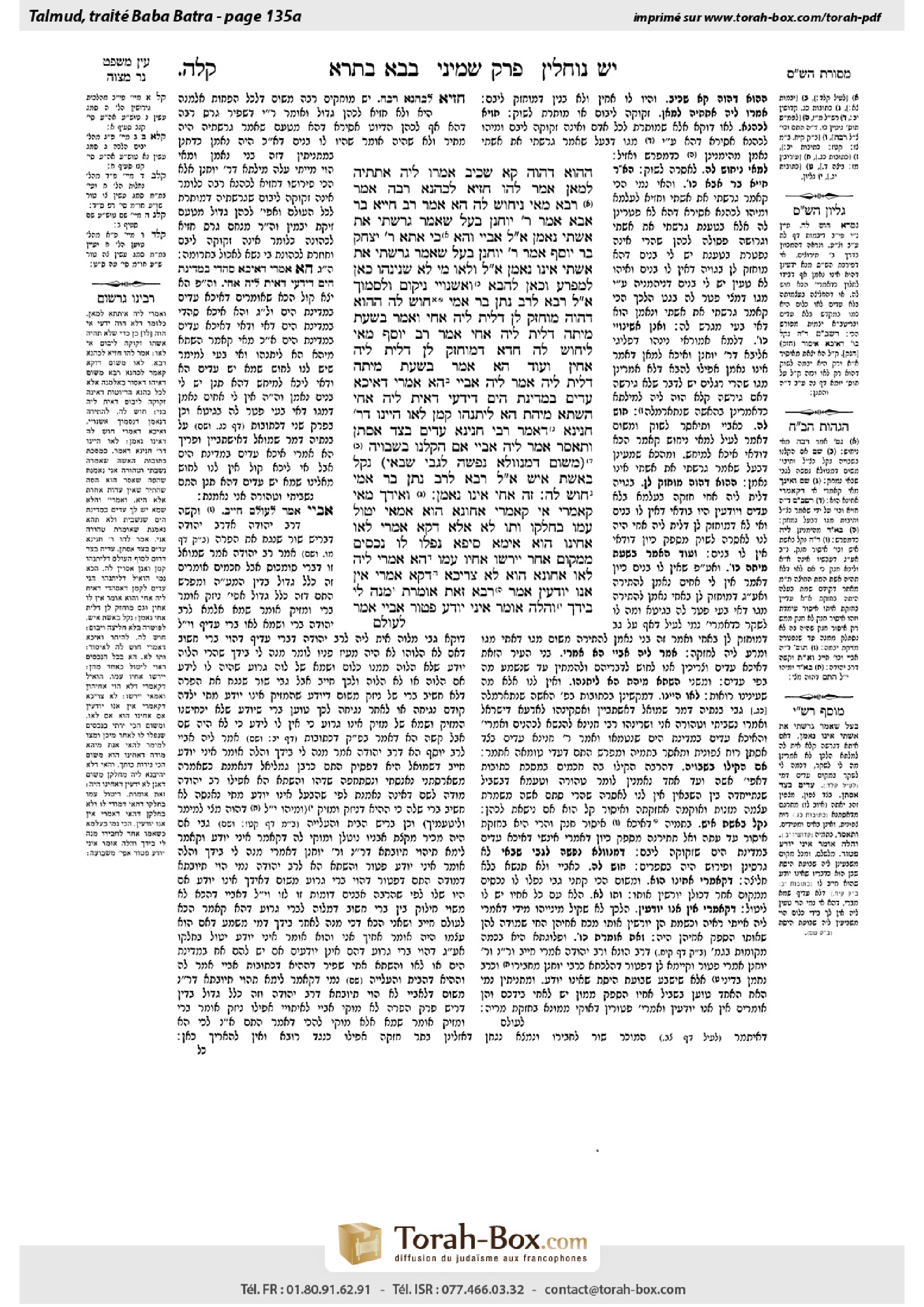
Bava Batra 135a: Talmud study for Daf Yomi
Study the Talmud for Daf Yomi with scanned pages, Hebrew text, English translations from Sefaria and AI-generated French translations.
Passage selection and English or AI-generated French translation are available where the scan has annotations. Daf Study is independent of Torah-Box and Sefaria.
Browse Bava Batra · בבא בתרא · All tractatesBava Batra 135a text and translations
This page of Bava Batra includes the Aramaic text, an English translation and an AI-generated French translation, alongside the scan above.
בבא בתרא קל״ה א · Aramaic and Hebrew text
הָהוּא דַּהֲוָה קָא שָׁכֵיב, אֲמַרוּ לֵיהּ: אִתְּתֵיהּ לְמַאן? אֲמַר לְהוּ: חַזְיָא לְכָהֲנָא רַבָּה.
אָמַר רָבָא: מַאי נֵיחוּשׁ לַהּ? הָא אָמַר רַב חִיָּיא בַּר אַבָּא אָמַר רַבִּי יוֹחָנָן: בַּעַל שֶׁאָמַר ״גֵּרַשְׁתִּי אֶת אִשְׁתִּי״ – נֶאֱמָן! אֲמַר לֵיהּ אַבָּיֵי, וְהָא כִּי אֲתָא רַבִּי יִצְחָק בַּר יוֹסֵף אָמַר רַבִּי יוֹחָנָן: בַּעַל שֶׁאָמַר ״גֵּרַשְׁתִּי אֶת אִשְׁתִּי״ – אֵינוֹ נֶאֱמָן! אֲמַר לֵיהּ: (וְלָאו) מִי לָא שַׁנִּינְהוּ – כָּאן לְמַפְרֵעַ, וְכָאן לְהַבָּא?
וְאַשִּׁנּוּיֵי נֵיקוּם וְלִסְמוֹךְ?! אֲמַר לֵיהּ רָבָא לְרַב נָתָן בַּר אַמֵּי: חוּשׁ לַהּ.
הָהוּא דַּהֲוָה מוּחְזָק לַן דְּלֵית לֵיהּ אַחֵי, וַאֲמַר בִּשְׁעַת מִיתָה דְּלֵית לֵיהּ אַחֵי. אֲמַר רַב יוֹסֵף: מַאי לֵיחוּשׁ לַהּ? חֲדָא, דְּמוּחְזָק לַן דְּלֵית לֵיהּ אַחִין. וְעוֹד, הָא אָמַר בִּשְׁעַת מִיתָה דְּלֵית לֵיהּ. אֲמַר לֵיהּ אַבָּיֵי: הָא אָמְרִי דְּאִיכָּא עֵדִים בִּמְדִינַת הַיָּם דְּיָדְעִי דְּאִית לֵיהּ אַחֵי!
הַשְׁתָּא מִיהַת הָא לֵיתַנְהוּ קַמַּן; לָאו הַיְינוּ דְּרַבִּי חֲנִינָא – דְּאָמַר רַבִּי חֲנִינָא: עֵדִים בְּצַד אַסְתָּן, וְתֵאָסֵר?!
אֲמַר לֵיהּ אַבָּיֵי: אִם הֵקַלְנוּ בִּשְׁבוּיָה – מִשּׁוּם דִּמְנַוְּולָא נַפְשָׁהּ לְגַבֵּי שַׁבַּאי; נָקֵל בְּאֵשֶׁת אִישׁ?! אָמַר לֵיהּ רָבָא לְרַב נָתָן בַּר אַמֵּי: חוּשׁ לַהּ.
״זֶה אָחִי״ – אֵינוֹ נֶאֱמָן. וְאִידַּךְ מַאי קָאָמְרִי? אִי קָאָמְרִי ״אֲחוּנָא הוּא״, אַמַּאי יִטּוֹל עִמּוֹ בְּחֶלְקוֹ וְתוּ לָא? אֶלָּא דְּקָא אָמְרִי ״לָאו אָחִינוּ הוּא״?
אֵימָא סֵיפָא: נָפְלוּ לוֹ נְכָסִים מִמָּקוֹם אַחֵר – יִירְשׁוּ אֶחָיו עִמּוֹ. הָא אָמְרִי לֵיהּ: ״לָאו אֲחוּנָא הוּא״!
לָא צְרִיכָא, דְּקָא אָמְרִי: ״אֵין אָנוּ יוֹדְעִין״.
אָמַר רָבָא, זֹאת אוֹמֶרֶת: ״מָנֶה לִי בְּיָדְךָ״, וְהַלָּה אוֹמֵר ״אֵינִי יוֹדֵעַ״ – פָּטוּר.
אַבָּיֵי אָמַר:
Bava Batra 135a · English translation
The Gemara relates: There was a certain man, who was presumed to have brothers but no children, who was dying. His wife was therefore presumed to be obligated in levirate marriage. Those with him said to him: To whom may his wife, i.e., your wife, be married? Is she required to enter into levirate marriage, or is she permitted to marry whomever she wishes? He said to them: She is fit to marry even a High Priest. She is not required to enter into levirate marriage.
Rava said: With what possibility need we be concerned with regard to her? Doesn’t Rabbi Ḥiyya bar Abba say that Rabbi Yoḥanan says: A husband who says: I have divorced my wife, is deemed credible, and she is exempt from levirate marriage? Therefore, this woman will be exempt as well. Abaye said to him: But when Rav Yitzḥak bar Yosef came from Eretz Yisrael, he said that Rabbi Yoḥanan says: A husband who says: I have divorced my wife, is not deemed credible. Rava said to him: But didn’t we resolve the contradiction, concluding that here Rabbi Yoḥanan was referring to a retroactive testimony and there he was referring to testimony for the future? Therefore, according to both versions of Rabbi Yoḥanan’s statement, the husband should be deemed credible in this case.
Abaye responded: But shall we arise and rely on answers in a halakhic ruling? Although the contradiction can be resolved in this manner, there is no guarantee that this resolution is correct. Therefore Rav Yitzḥak bar Yosef’s statement should still be taken into consideration. Rava subsequently said to Rav Natan bar Ami: Be concerned about it. There may be a dispute with regard to this issue, as the resolution cannot be relied upon.
The Gemara relates: There was a certain man who was presumed by us, i.e., the court, to have no brothers, and he said at the time of his death that he has no brothers. Rav Yosef said: With what possibility need we be concerned with regard to his wife, in terms of her requiring levirate marriage? For one, he is presumed by us to have no brothers, and furthermore, he said at the time of his death that he has none. Abaye said to him: But don’t people say that there are witnesses overseas who know that he has brothers? Therefore, we should be concerned that this report is accurate.
Rav Yosef responded: In any event, now the witnesses are not present before us, so this possibility does not need to be taken into account. Isn’t this the same as Rabbi Ḥanina’s ruling in a case where women who were captured and subsequently liberated claimed that they were not raped in captivity (Ketubot 23a)? As although people said there were witnesses elsewhere who could testify that they were raped, Rabbi Ḥanina says that they were permitted to marry a priest, reasoning: Just because there may be witnesses in the north [istan], i.e., in a distant place, will the woman be forbidden?
Abaye said to him: If we were lenient with regard to a captive woman, due to, among other reasons, the fact that she makes herself repulsive before the captor so that he will not want to rape her, and we assume that she was not raped, should we be lenient with regard to a married woman? Rava said to Rav Natan bar Ami: Be concerned about it. Do not permit this woman to remarry until the matter is clarified.
§ The mishna teaches that one who says: This is my brother, is not deemed credible with regard to his other brothers’ share of their father’s inheritance. Rather, the man in question receives a portion only from the portion of the one who testified concerning him. The Gemara clarifies: And what do the other brothers say? If they say: He is our brother, why does the man in question take a portion of the inheritance only with the one who testified, from his portion, and nothing more? If the other brothers admit that he is their brother, they should give him a share of their portions as well. Rather, they are saying: He is not our brother.
The Gemara questions this: Say the last clause of the mishna: If property came into the possession of the man in question from somewhere else, and he died, the brothers of the one who testified shall inherit the man in question’s property with him. Why should they inherit with him? Didn’t they say to him: He is not our brother?
The Gemara answers: No, it is necessary to state this ruling only in a case where they say: We do not know if he is our brother. Therefore, they are not obligated to give him a portion of their inheritance, as he cannot prove to them that he is their brother. Nevertheless, they can claim a portion of his inheritance after his death, on the basis of their brother’s testimony.
Rava says: That is to say that if one says to another: I have one hundred dinars in your possession, and the other person says: I do not know, he is exempt, similar to this case, where the brothers who claim that they do not know if this person is their brother are not obligated to share their inheritance with him.
Abaye said:
Bava Batra 135a · Traduction française (IA)
Le Guemara rapporte : Il y avait un homme, qui était supposé avoir des frères mais pas d'enfants, qui était mourant. Son épouse était donc supposée être tenue à une alliance levirat. Ceux qui étaient avec lui lui dirent : À qui cette femme, c'est-à-dire votre femme, peut-elle se marier ? Est-elle tenue à une alliance levirat, ou est-elle autorisée à se marier à qui elle veut ? Il lui répondit : Elle est digne de se marier même à un grand prêtre. Elle n'est pas tenue à une alliance levirat.
Rava dit : Avec quelle possibilité devons-nous nous préoccuper concernant elle ? N’est-ce pas que Rabbi Ḥiyya bar Abba dit que Rabbi Yoḥanan dit : Un mari qui dit : J’ai divorcé ma femme, est considéré comme crédible, et elle est exemptée de l’alliance levirat ? Par conséquent, cette femme sera également exemptée. Abaye dit à lui : Mais lorsque Rav Yitzḥak bar Yosef est venu d’Eretz Yisrael, il a dit que Rabbi Yoḥanan dit : Un mari qui dit : J’ai divorcé ma femme, n’est pas considéré comme crédible. Rava dit à lui : Mais n’avons-nous pas résolu la contradiction, concluant que dans ce cas Rabbi Yoḥanan faisait référence à un témoignage rétrospectif et là il faisait référence à un témoignage futur ? Par conséquent, selon les deux versions de la déclaration de Rabbi Yoḥanan, le mari devrait être considéré comme crédible dans ce cas-ci.
Abaye répondit : Mais devons-nous nous lever et nous appuyer sur des réponses dans un décret halakhique ? Bien que la contradiction puisse être résolue ainsi, il n’y a pas de garantie que cette résolution soit correcte. Par conséquent, la déclaration de Rav Yitzḥak bar Yosef devrait encore être prise en compte. Rava dit ensuite à Rav Natan bar Ami : Soyez prudent à ce sujet. Il peut y avoir un désaccord concernant cette question, car la résolution ne peut pas être retenue.
Le Guemara rapporte : Il y avait un homme qui était considéré par nous, c'est-à-dire la cour, comme n'ayant aucun frère, et il a déclaré à l'époque de sa mort qu'il n'avait aucun frère. Rav Yosef dit : Avec quelle possibilité devons-nous nous préoccuper concernant sa femme, en termes de son obligation d’alliance levirat ? D'une part, il est considéré par nous comme n'ayant aucun frère, et de plus, il a déclaré à l'époque de sa mort qu'il en avait aucun. Abaye dit à lui : Mais ne dit-on pas que des témoins à l’étranger savent qu'il a des frères ? Par conséquent, nous devrions nous préoccuper que ce rapport soit exact.
Rav Yosef répondit : En tout cas, maintenant les témoins ne sont pas présents devant nous, donc cette possibilité ne doit pas être prise en compte. N’est-ce pas la même chose que la décision de Rabbi Ḥanina dans un cas où des femmes capturées et ensuite libérées affirmaient qu’elles n’avaient pas été violées (Ketubot 23a) ? Bien que les gens disent qu’il y a des témoins ailleurs qui pourraient témoigner qu’elles avaient été violées, Rabbi Ḥanina dit qu’elles étaient autorisées à se marier avec un prêtre, en raisonnant : Juste parce qu’il peut y avoir des témoins au nord [istan], c’est-à-dire dans un lieu éloigné, la femme sera-t-elle interdite ?
Abaye dit à lui : Si nous sommes indulgents envers une femme captive, en raison, entre autres raisons, du fait qu’elle se rend repoussante devant le captif afin qu’il ne veuille pas la violer, et nous supposons qu’elle n’a pas été violée, devons-nous être indulgents envers une femme mariée ? Rava dit à Rav Natan bar Ami : Soyez prudent à ce sujet. Ne permettez pas à cette femme de se remarier jusqu’à ce que la question soit clarifiée.
§ La mitsna enseigne que celui qui dit : C’est mon frère, n’est pas considéré comme crédible concernant la part de ses frères dans la succession de leur père. Plutôt, l’homme en question reçoit une part seulement de la part de celui qui a témoigné à son sujet. Le Guemara clarifie : Et que disent les autres frères ? Si ils disent : Il est notre frère, pourquoi l’homme en question prend-il une part de la succession seulement avec celui qui a témoigné, de sa part, et rien de plus ? Si les autres frères admettent qu’il est leur frère, ils devraient lui donner une part de leurs parts également. Plutôt, ils disent : Il n’est pas notre frère.
Le Guemara questionne cela : Dites la dernière clause de la mitsna : Si la propriété est entrée en possession de l’homme en question d’un autre endroit, et qu’il est mort, les frères du témoin héritent de la propriété de l’homme en question avec lui. Pourquoi devraient-ils hériter avec lui ? N’ont-ils pas dit à lui : Il n’est pas notre frère ?
Le Guemara répond : Non, il est nécessaire d’énoncer cette décision uniquement dans un cas où ils disent : Nous ne savons pas s’il est notre frère. Par conséquent, ils ne sont pas obligés de lui donner une part de leur succession, car il ne peut pas prouver à eux qu’il est leur frère. Cependant, ils peuvent revendiquer une part de sa succession après sa mort, sur la base du témoignage de leur frère.
Rava dit : Cela signifie que si l’un dit à un autre : J’ai cent drachmes en votre possession, et l’autre dit : Je ne sais pas, il est exempt, semblable à ce cas, où les frères qui disent qu’ils ne savent pas si cette personne est leur frère ne sont pas obligés de partager leur héritage avec lui.
Abaye dit :
Traduction française générée par IA à partir de l’édition anglaise de Sefaria. Vérifie toujours un passage avec le texte source.
Text from Sefaria: William Davidson Edition - Vocalized Aramaic (CC BY NC); William Davidson Edition - English (CC BY NC).