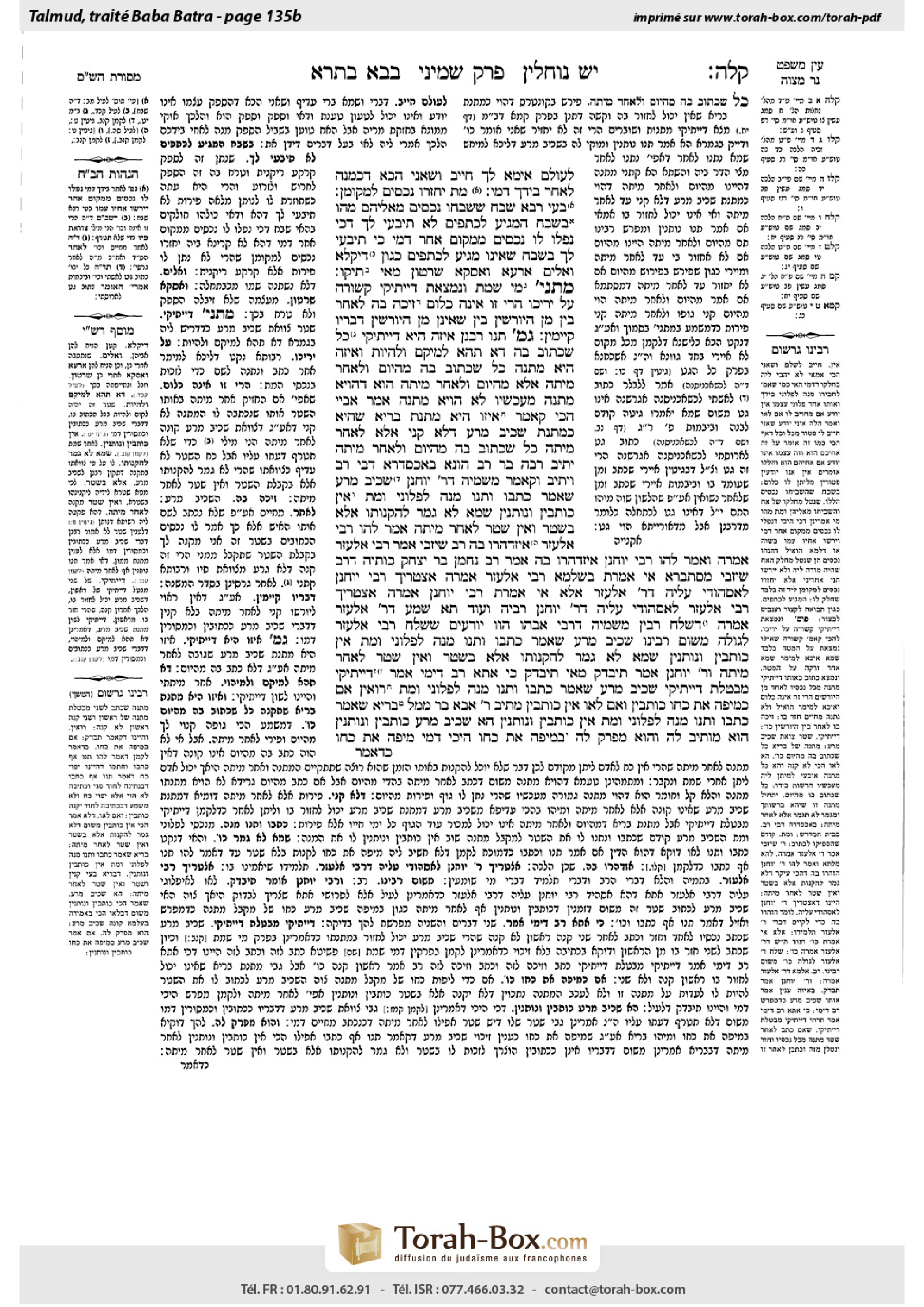
Bava Batra 135b: Talmud study for Daf Yomi
Study the Talmud for Daf Yomi with scanned pages, Hebrew text, English translations from Sefaria and AI-generated French translations.
Passage selection and English or AI-generated French translation are available where the scan has annotations. Daf Study is independent of Torah-Box and Sefaria.
Browse Bava Batra · בבא בתרא · All tractatesBava Batra 135b text and translations
This page of Bava Batra includes the Aramaic text, an English translation and an AI-generated French translation, alongside the scan above.
בבא בתרא קל״ה ב · Aramaic and Hebrew text
לְעוֹלָם אֵימָא לָךְ חַיָּיב; וְשָׁאנֵי הָכָא, דִּכְ״מָנֶה לְאַחֵר בְּיָדְךָ״ דָּמֵי.
מֵת – יַחְזְרוּ נְכָסִים לִמְקוֹמָן. בָּעֵי רָבָא: שֶׁבַח שֶׁשָּׁבְחוּ נְכָסִים מֵאֲלֵיהֶם, מַהוּ?
בְּשֶׁבַח הַמַּגִּיעַ לַכְּתֵפַיִם – לָא תִּיבְּעֵי לָךְ, דְּכִי נָפְלוּ לוֹ נְכָסִים מִמָּקוֹם אַחֵר דָּמֵי. כִּי תִּיבְּעֵי לָךְ – בְּשֶׁבַח שֶׁאֵינוֹ מַגִּיעַ לַכְּתֵפַיִם; כְּגוֹן דִּיקְלָא וַאֲלֵים, אַרְעָא וְאַסְּקָא שִׂרְטוֹן; מַאי? תֵּיקוּ.
מַתְנִי׳ מִי שֶׁמֵּת וְנִמְצֵאת דְּיָיתֵיקֵי קְשׁוּרָה עַל יְרֵיכוֹ – הֲרֵי זוֹ אֵינָהּ כְּלוּם. זִיכָּה בָּהּ לְאַחֵר – בֵּין מִן הַיּוֹרְשִׁין, בֵּין שֶׁאֵינָן מִן הַיּוֹרְשִׁין – דְּבָרָיו קַיָּימִין.
גְּמָ׳ תָּנוּ רַבָּנַן: אֵיזֶה הִיא דְּיָיתֵיקֵי? כֹּל שֶׁכָּתוּב בָּהּ: ״דָּא תְּהֵא לְמֵיקַם וְלִהְיוֹת״. וְאֵיזֶה הִיא מַתָּנָה? כֹּל שֶׁכָּתוּב בָּהּ: ״מֵהַיּוֹם וּלְאַחַר מִיתָה״.
אֶלָּא ״מֵהַיּוֹם וּלְאַחַר מִיתָה״ – הוּא דְּהָוְיָא מַתָּנָה, ״מֵעַכְשָׁיו״ – לָא הָוְיָא מַתָּנָה?! אָמַר אַבָּיֵי, הָכִי קָאָמַר: אֵיזוֹ הִיא מַתְּנַת בָּרִיא שֶׁהִיא כְּמַתְּנַת שְׁכִיב מְרַע – דְּלָא קָנֵי אֶלָּא לְאַחַר מִיתָה? כֹּל שֶׁכָּתוּב בָּהּ: ״מֵהַיּוֹם וּלְאַחַר מִיתָה״.
יָתֵיב רַבָּה בַּר רַב הוּנָא בְּאַכְסַדְרָא דְּבֵי רַב, וְיָתֵיב וְקָאָמַר מִשְּׁמֵיהּ דְּרַבִּי יוֹחָנָן: שְׁכִיב מְרַע שֶׁאָמַר ״כִּתְבוּ וּתְנוּ מָנֶה לִפְלוֹנִי״, וּמֵת – אֵין כּוֹתְבִין וְנוֹתְנִין; שֶׁמָּא לֹא גָּמַר לְהַקְנוֹתוֹ אֶלָּא בִּשְׁטָר, וְאֵין שְׁטָר לְאַחַר מִיתָה.
אֲמַר לְהוּ רַבִּי אֶלְעָזָר: אִיזְדְּהַרוּ בַּהּ. רַב שֵׁיזְבִי אָמַר: רַבִּי אֶלְעָזָר אָמְרָה, וַאֲמַר לְהוּ רַבִּי יוֹחָנָן: אִיזְדְּהַרוּ בַּהּ.
אָמַר רַב נַחְמָן בַּר יִצְחָק: כְּוָתֵיהּ דְּרַב שֵׁיזְבִי מִסְתַּבְּרָא. אִי אָמְרַתְּ בִּשְׁלָמָא רַבִּי אֶלְעָזָר אַמְרַהּ, אִצְטְרִיךְ רַבִּי יוֹחָנָן לְאַסְהוֹדֵי עֲלֵיהּ דְּרַבִּי אֶלְעָזָר. אֶלָּא אִי אָמְרַתְּ רַבִּי יוֹחָנָן אַמְרַהּ, אִצְטְרִיךְ רַבִּי אֶלְעָזָר לְאַסְהוֹדֵי עֲלֵיהּ דְּרַבִּי יוֹחָנָן רַבֵּיהּ?!
וְעוֹד, תָּא שְׁמַע דְּרַבִּי אֶלְעָזָר אַמְרַהּ, דִּשְׁלַח רָבִין מִשְּׁמֵיהּ דְּרַבִּי אֲבָהוּ: הֱווּ יוֹדְעִים שֶׁשָּׁלַח רַבִּי אֶלְעָזָר לַגּוֹלָה מִשּׁוּם רַבֵּינוּ: שְׁכִיב מְרַע שֶׁאָמַר ״כִּתְבוּ וּתְנוּ מָנֶה לִפְלוֹנִי״, וּמֵת – אֵין כּוֹתְבִין וְנוֹתְנִין; שֶׁמָּא לֹא גָּמַר לְהַקְנוֹתוֹ אֶלָּא בִּשְׁטָר, וְאֵין שְׁטָר לְאַחַר מִיתָה. וְרַבִּי יוֹחָנָן אָמַר: תִּיבָּדֵק.
מַאי ״תִּיבָּדֵק״? כִּי אֲתָא רַב דִּימִי אָמַר: דְּיָיתֵיקֵי מְבַטֶּלֶת דְּיָיתֵיקֵי. שְׁכִיב מְרַע שֶׁאָמַר: ״כִּתְבוּ וּתְנוּ מָנֶה לִפְלוֹנִי״, וּמֵת – רוֹאִין; אִם כִּמְיַפֶּה אֶת כֹּחוֹ – כּוֹתְבִין, וְאִם לָאו – אֵין כּוֹתְבִין.
מֵתִיב רַבִּי אַבָּא בַּר מֶמֶל: בָּרִיא שֶׁאָמַר ״כִּתְבוּ וּתְנוּ מָנֶה לִפְלוֹנִי״, וּמֵת – אֵין כּוֹתְבִין וְנוֹתְנִין. הָא שְׁכִיב מְרַע – כּוֹתְבִין וְנוֹתְנִין! הוּא מוֹתֵיב לַהּ וְהוּא מְפָרֵק לַהּ – בִּמְיַפֶּה אֶת כֹּחוֹ.
הֵיכִי דָּמֵי מְיַפֶּה אֶת כֹּחוֹ?
Bava Batra 135b · English translation
Actually, I will say to you that one who responds to a claim that he does not know if he owes the one hundred dinars is obligated to pay; but here, in the case of the brothers, it is different. The brothers are not obligated to share their portion with the man in question because the brother who testified is like one who claims: Another person has one hundred dinars in your possession. Since the claimant is not the one who is owed the money, the other party can reject his claim by merely answering that he does not know whether he owes him.
§ The mishna teaches: If the man in question dies, the property he received from the father’s inheritance shall return to its place, i.e., to the possession of the brother who testified on his behalf, and if the man in question received property from elsewhere, it is inherited by all the brothers equally. Rava raises a dilemma: With regard to the enhancement of the property received by the man in question from the portion of the brother who testified, where its enhanced value was the result of an enhancement that happened naturally, as opposed to one that resulted from exertion, what is the halakha? Who inherits it?
The Gemara elaborates: With regard to enhancement that reaches shoulders, i.e., ripe produce that needs only to be harvested from the field, do not raise the dilemma, as it is considered like property that came into his possession from elsewhere. It is not considered part of the land that was given to him by the brother who testified, and it is therefore divided among all the brothers. Rather, let the dilemma be raised with regard to enhancement that does not reach shoulders, and is not considered separate from the ground, such as a palm tree that thickened, or land that yielded silt. What is the halakha in this case? Is the enhancement included in the property itself, or is it considered separate property? The Gemara comments: The dilemma shall stand unresolved.
MISHNA: With regard to one who died, and a will written by a person on his deathbed [dayetikei] is found bound to his thigh, which clearly indicates that it was written by him and was not forged, this is nothing. The will is not valid, as he did not give it to anyone, and he may have reconsidered. If he transferred ownership of the will to the designated recipient through another person, whether one of the heirs or whether not one of the heirs, his statement stands.
GEMARA: The Sages taught (Tosefta 8:10): Which deed is considered a dayetikei, and is collected by the designated recipient after the death of the giver? Any deed in which it is written: This will be to stand and exist after my death. And which type is considered a deed of gift? Any deed in which it is written: From today and after my death.
The Gemara asks: Is it considered a deed of gift only if the expression: From today and after my death, is written, whereas if it is written only: From now, it is not considered a deed of gift? Abaye said that this is what the baraita is saying: Which deed of gift of a healthy person is considered like the deed of gift of a person on his deathbed, in that the recipient acquires it only after the death of the giver? Any deed in which it is written: From today and after my death.
§ Rabba bar Rav Huna was sitting in the balcony of Rav’s study hall, and sat and said in the name of Rabbi Yoḥanan: If there is a person on his deathbed who says: Write a deed of transfer, granting property of mine to another, and give with it one hundred dinars to so-and-so, and he then died, one does not write and give it. This is because perhaps he resolved to transfer it to him only with a deed of transfer, and since the deed was not written in his lifetime it cannot be written after his death, as a deed of transfer is not effective after the death of the owner.
Rabba bar Rav Huna continued that when Rabbi Yoḥanan stated this halakha, Rabbi Elazar said to the other Sages: Heed this halakha; it is correct. Rav Sheizevi said: That is not what happened; Rabbi Elazar is the one who said this halakha, and it was Rabbi Yoḥanan who said to them: Heed this halakha.
Rav Naḥman bar Yitzḥak said: It is reasonable to say that the incident was in accordance with the version presented by Rav Sheizevi. Granted, if you say that Rabbi Elazar said the halakha, Rabbi Yoḥanan needed to affirm the ruling of Rabbi Elazar. But if you say that Rabbi Yoḥanan was the one who said it, did Rabbi Elazar need to affirm the ruling of Rabbi Yoḥanan, his teacher?
And furthermore, come and hear proof that Rabbi Elazar was the one who said this halakha, from another statement of his, as Ravin sent a message in the name of Rabbi Abbahu: Know that Rabbi Elazar sent a ruling to the exile in the name of our teacher, stating that if there is a person on his deathbed who says: Write a deed of transfer and give with it one hundred dinars to so-and-so, and he then died, one does not write and give it. This is because perhaps he resolved to transfer it only with a deed of transfer, and since the deed was not written in his lifetime it cannot be written after his death, as a deed of transfer is not effective after the death of the owner. And Rabbi Yoḥanan says: This ruling is correct; however, the wording of the deed should be examined.
The Gemara asks: What did Rabbi Yoḥanan mean by saying that the wording should be examined? The Gemara answers: When Rav Dimi came from Eretz Yisrael to Babylonia, he stated two halakhot. The first was that a dayetikei cancels a previous dayetikei. The second explains the examination to which Rabbi Yoḥanan was referring: If there is a person on his deathbed who said: Write a deed of transfer and give with it one hundred dinars to so-and-so, and he then died, the court must see what his intention was in instructing the other person to write a deed of transfer; if it was to enhance the recipient’s power by writing a document proving that he was given the gift, one writes the document even after his death, as he intended to give the money anyway. But if not, rather it was the giver’s intention to transfer the gift specifically through a deed of transfer, one does not write it and give the money, as a deed of transfer is not effective after the death of the owner.
Rabbi Abba bar Memel raises an objection from a baraita: If there is a healthy person who said: Write a deed of transfer and give with it one hundred dinars to so-and-so, and he then died, one does not write and give it. Rabbi Abba bar Memel inferred: But if a person on his deathbed states this request, one writes and gives it. He raises the objection and he resolves it: The ruling of that baraita is in a case where he was enhancing the recipient’s legal power by writing him a document of proof.
The Gemara explains: What are the circumstances under which it is apparent that he was enhancing his legal power?
Bava Batra 135b · Traduction française (IA)
En réalité, je vais vous dire que celui qui répond à une réclamation qu'il ne sait pas s'il doit cent dinars est tenu de payer ; mais ici, dans le cas des frères, c'est différent. Les frères ne sont pas tenus de partager leur part avec l'homme en question, car le frère qui a témoigné est comme celui qui affirme : un autre a cent dinars en votre possession. Puisque le réclamant n'est pas celui à qui l'argent appartient, l'autre partie peut rejeter sa réclamation en répondant simplement qu'il ne sait pas s'il lui doit quelque chose.
§ La mitsna enseigne : Si l'homme en question meurt, la propriété qu'il a reçue de l'héritage du père revient à sa place, c'est-à-dire à la possession du frère qui a témoigné en son faveur, et si l'homme en question a reçu une propriété d'ailleurs, elle est héritée par tous les frères de manière égale. Rava soulève un dilemme : concernant l'amélioration de la propriété reçue par l'homme en question par la part du frère qui a témoigné, où la valeur augmentée provient d'une amélioration naturelle, contrairement à celle résultant d'un effort, quelle est la halakha ? Qui hérite de cela ?
La Guemara développe : concernant l'amélioration qui atteint l'épaule, c'est-à-dire des produits mûrs qui n'ont besoin que d'être récoltés dans le champ, ne soulève pas le dilemme, car cela est considéré comme une propriété qui est entrée en possession de lui d'ailleurs. Il n'est pas considéré comme faisant partie de la terre donnée par le frère qui a témoigné, et il est donc divisé entre tous les frères. Plutôt, soulevez le dilemme concernant l'amélioration qui ne touche pas l'épaule et n'est pas considérée comme séparée du sol, telle qu'un palmier qui s'est épaissi ou un terrain qui a produit de la limaille. Quelle est la halakha dans ce cas ? L'amélioration est-elle incluse dans la propriété elle-même, ou est-elle considérée comme une propriété séparée ? La Guemara commente : le dilemme restera sans réponse.
MICHNA : Concernant celui qui est mort, et un testament écrit par une personne à son chevet est trouvé attaché à sa cuisse, qui indique clairement qu'il a été écrit par lui et n'a pas été falsifié, cela n'est rien. Le testament n'est pas valide, car il n'a pas été donné à quelqu'un, et il peut avoir changé d'avis. Si l'homme a transféré la possession du testament au destinataire désigné par un autre, que ce soit un héritier ou non, son déclaration est valable.
GUEMARA : Les Sages enseignent (Tosefta 8:10) : Quel acte est considéré comme un dayetikei, et est récupéré par le destinataire désigné après la mort du donneur ? Tout acte dans lequel il est écrit : Cet acte sera valable et existera après ma mort. Et quel type est considéré comme un don ? Tout acte dans lequel il est écrit : À partir d'aujourd'hui et après ma mort.
La Guemara pose la question : Est-ce considéré comme un don uniquement si l'expression : À partir d'aujourd'hui et après ma mort, est écrite, alors que si elle est écrite seulement : À partir de maintenant, elle n'est pas considérée comme un don ? Abaye dit que c'est ce que dit la baraïta : Quel don d'une personne en bonne santé est considéré comme un don d'une personne à son chevet, dans le sens où le destinataire l'acquiert seulement après la mort du donneur ? Tout acte dans lequel il est écrit : À partir d'aujourd'hui et après ma mort.
§ Rabba bar Rav Huna était assis sur le balcon de la salle de study de Rav, et a dit en nom de Rabbi Yoḥanan : Si une personne est à son chevet et dit : Écris un acte de transfert, donnant une propriété à un autre, et donne avec cela cent dinars à tel et tel, et il meurt ensuite, on n'écrit pas et ne donne pas. C'est parce que peut-être il a décidé de le transférer à lui uniquement par un acte de transfert, et comme l'acte n'a pas été écrit durant sa vie, il ne peut pas être écrit après sa mort, car un acte de transfert n'est pas efficace après la mort du propriétaire.
Rabba bar Rav Huna a poursuivi en disant que lorsque Rabbi Yoḥanan a déclaré cette halakha, Rabbi Elazar a dit aux autres Sages : Tenez compte de cette halakha ; c'est correct. Rav Sheizevi a dit : Ce n'est pas ce qui s'est produit ; c'est Rabbi Elazar qui a dit cette halakha, et c'est Rabbi Yoḥanan qui a dit à eux : Tenez compte de cette halakha.
Rav Naḥman bar Yitzḥak a dit : Il est raisonnable de dire que l'incident s'est produit selon la version présentée par Rav Sheizevi. En effet, si vous dites que c'est Rabbi Elazar qui a dit la halakha, Rabbi Yoḥanan avait besoin d'affirmer la décision de Rabbi Elazar. Mais si vous dites que c'est Rabbi Yoḥanan qui l'a dit, Rabbi Elazar avait-il besoin d'affirmer la décision de Rabbi Yoḥanan, son maître ?
Et de plus, venez entendre la preuve que c'est Rabbi Elazar qui a dit cette halakha, à partir d'une autre déclaration de la sienne, car Ravin a envoyé un message en nom de Rabbi Abbahu : Sachez que Rabbi Elazar a envoyé un avis à l'exil en nom de notre maître, indiquant que si une personne est à son chevet et dit : Écris un acte de transfert et donne avec cela cent dinars à tel et tel, et il meurt ensuite, on n'écrit pas et ne donne pas. C'est parce que peut-être il a décidé de le transférer uniquement par un acte de transfert, et comme l'acte n'a pas été écrit durant sa vie, il ne peut pas être écrit après sa mort, car un acte de transfer n'est pas efficace après la mort du propriétaire. Et Rabbi Yoḥanan dit : Cette décision est correcte ; cependant, l'expression de l'acte devrait être examinée.
La Guemara pose la question : Quel était le sens que le maître Yoḥanan donnait lorsqu'il disait qu'il fallait examiner la formulation ? La Guemara répond : Quand Rav Dimi est venu de la Terre d'Israël vers Babylone, il a énoncé deux halakhot. La première était que les dayetikei annulent un dayetikei précédent. La seconde explique l'examen auquel le maître Yoḥanan faisait référence : Si une personne, sur son lit de mort, dit : Écris un acte de donation et donne avec lui cent dinars à tel ou tel, et qu'il meurt ensuite, la cour doit voir ce que l'intention de cette personne était en demandant à l'autre personne d'écrire un acte de donation ; si c'était pour renforcer le pouvoir juridique du destinataire en écrivant un document prouvant qu'il avait reçu le don, on écrit l'acte même après sa mort, car il avait l'intention de donner l'argent de toute façon. Mais si ce n'est pas le cas, c'est-à-dire si l'intention du donneur était de transférer le don spécifiquement par un acte de donation, on ne l'écrit pas et on ne donne pas l'argent, car un acte de donation n'est pas efficace après la mort du propriétaire.
Le maître Abba bar Memel émet une objection à partir d'une baraïta : Si une personne en bonne santé dit : Écris un acte de donation et donne avec lui cent dinars à tel ou tel, et qu'il meurt ensuite, on ne l'écrit pas et on ne le donne pas. Le maître Abba bar Memel conclut : Mais si une personne, sur son lit de mort, formule cette demande, on l'écrit et on le donne. Il émet l'objection et il la résout : La décision de cette baraïta est dans un cas où il cherchait à renforcer le pouvoir juridique du destinataire en lui écrivant un document de preuve.
La Guemara explique : Quelles sont les circonstances dans lesquelles il est évident qu'il cherchait à renforcer son pouvoir juridique ?
Traduction française générée par IA à partir de l’édition anglaise de Sefaria. Vérifie toujours un passage avec le texte source.
Text from Sefaria: William Davidson Edition - Vocalized Aramaic (CC BY NC); William Davidson Edition - English (CC BY NC).