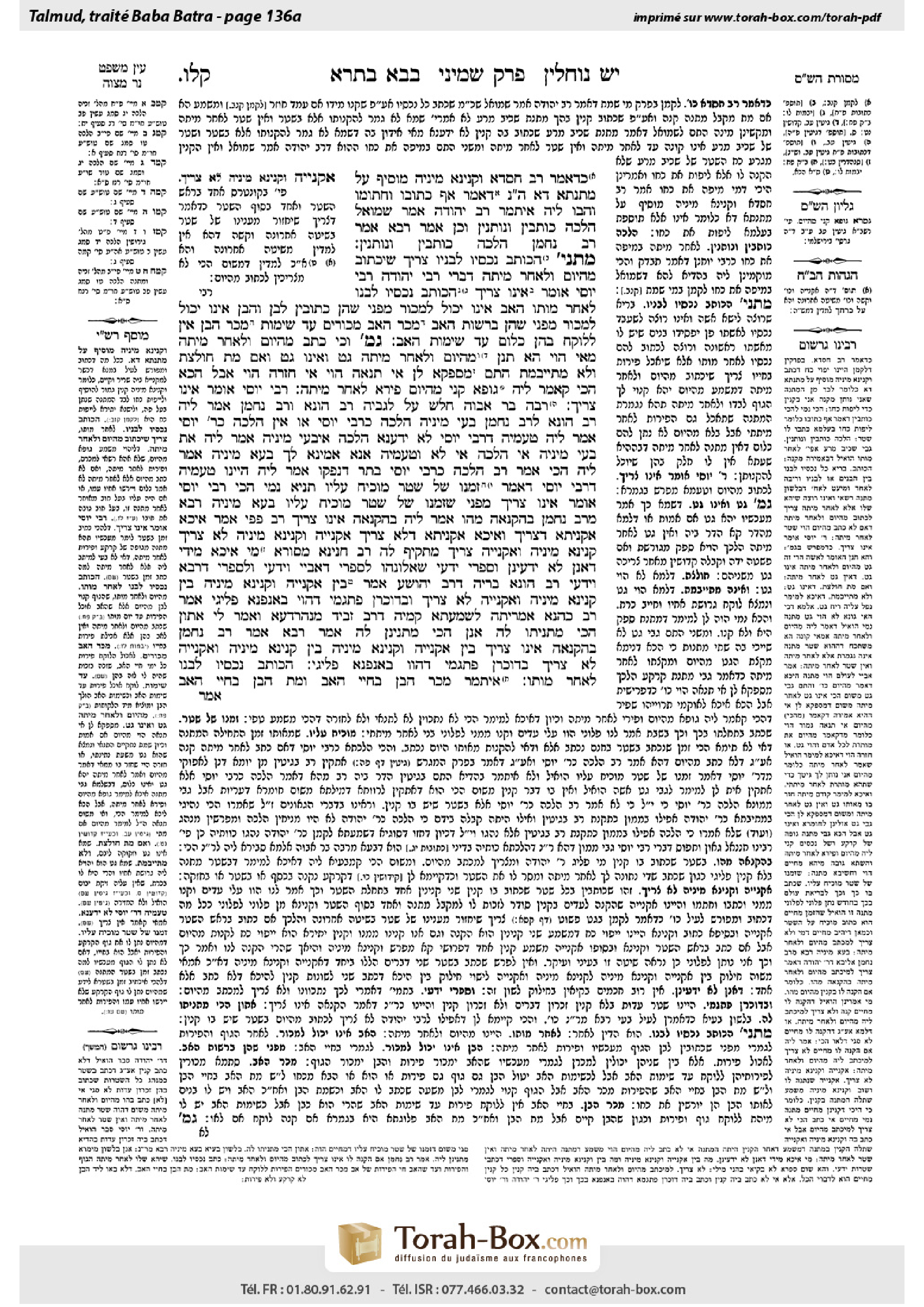
Bava Batra 136a: Talmud study for Daf Yomi
Study the Talmud for Daf Yomi with scanned pages, Hebrew text, English translations from Sefaria and AI-generated French translations.
Passage selection and English or AI-generated French translation are available where the scan has annotations. Daf Study is independent of Torah-Box and Sefaria.
Browse Bava Batra · בבא בתרא · All tractatesBava Batra 136a text and translations
This page of Bava Batra includes the Aramaic text, an English translation and an AI-generated French translation, alongside the scan above.
בבא בתרא קל״ו א · Aramaic and Hebrew text
כִּדְאָמַר רַב חִסְדָּא: ״וּקְנֵינָא מִינֵּיהּ מוֹסִיף עַל מַתַּנְתָּא דָּא״; הָכָא נָמֵי – דְּאָמַר: ״אַף כְּתוֹבוּ וַחֲתוֹמוּ וְהַבוּ לֵיהּ״.
אִיתְּמַר רַב יְהוּדָה אָמַר שְׁמוּאֵל, הֲלָכָה: כּוֹתְבִין וְנוֹתְנִין. וְכֵן אָמַר רָבָא אָמַר רַב נַחְמָן, הֲלָכָה: כּוֹתְבִין וְנוֹתְנִין.
מַתְנִי׳ הַכּוֹתֵב נְכָסָיו לְבָנָיו, צָרִיךְ שֶׁיִּכְתּוֹב ״מֵהַיּוֹם וּלְאַחַר מִיתָה״, דִּבְרֵי רַבִּי יְהוּדָה. רַבִּי יוֹסֵי אוֹמֵר: אֵינוֹ צָרִיךְ.
הַכּוֹתֵב נְכָסָיו לִבְנוֹ לְאַחַר מוֹתוֹ – הָאָב אֵינוֹ יָכוֹל לִמְכּוֹר, מִפְּנֵי שֶׁהֵן כְּתוּבִין לַבֵּן; וְהַבֵּן אֵינוֹ יָכוֹל לִמְכּוֹר, מִפְּנֵי שֶׁהֵן בִּרְשׁוּת הָאָב.
מָכַר הָאָב – מְכוּרִים עַד שֶׁיָּמוּת. מָכַר הַבֵּן – אֵין לַלּוֹקֵחַ בָּהֶן כְּלוּם עַד שֶׁיָּמוּת הָאָב.
גְּמָ׳ וְכִי כָּתַב ״מֵהַיּוֹם וּלְאַחַר מִיתָה״, מַאי הָוֵי? הָא תְּנַן: ״מֵהַיּוֹם וּלְאַחַר מִיתָה״ – גֵּט וְאֵינוֹ גֵּט; וְאִם מֵת, חוֹלֶצֶת וְלֹא מִתְיַיבֶּמֶת!
הָתָם – מְסַפְּקָא לַן אִי תְּנָאָה הָוֵי, אִי חֲזָרָה הָוֵי; אֲבָל הָכָא – הָכִי קָאָמַר לֵיהּ: גּוּפָא קְנִי מֵהַיּוֹם, פֵּירָא לְאַחַר מִיתָה.
רַבִּי יוֹסֵי אוֹמֵר: אֵינוֹ צָרִיךְ. רַבָּה בַּר אֲבוּהּ חֲלַשׁ, עָל לְגַבֵּיהּ רַב הוּנָא וְרַב נַחְמָן. אָמַר לֵיהּ רַב הוּנָא לְרַב נַחְמָן, בְּעִי מִינֵּיהּ: הֲלָכָה כְּרַבִּי יוֹסֵי, אוֹ אֵין הֲלָכָה כְּרַבִּי יוֹסֵי? אָמַר לֵיהּ: טַעְמֵיהּ דְּרַבִּי יוֹסֵי לָא יָדַעְנָא, הֲלָכָה אֶיבְעֵי מִינֵּיהּ? אֲמַר לֵיהּ: אַתְּ בְּעִי מִינֵּיהּ אִי הֲלָכָה אִי לָא, וְטַעְמֵיהּ אֲנָא אָמֵינָא לָךְ.
בְּעָא מִינֵּיהּ. אֲמַר לֵיהּ, הָכִי אָמַר רַב: הֲלָכָה כְּרַבִּי יוֹסֵי. בָּתַר דִּנְפַקוּ, אֲמַר לֵיהּ: הַיְינוּ טַעְמֵיהּ דְּרַבִּי יוֹסֵי, דְּאָמַר: זְמַנּוֹ שֶׁל שְׁטָר מוֹכִיחַ עָלָיו. תַּנְיָא נָמֵי הָכִי, רַבִּי יוֹסֵי אוֹמֵר: אֵינוֹ צָרִיךְ, מִפְּנֵי שֶׁזְּמַנּוֹ שֶׁל שְׁטָר מוֹכִיחַ עָלָיו.
בְּעָא מִינֵּיהּ רָבָא מֵרַב נַחְמָן: בְּהַקְנָאָה, מַהוּ? אֲמַר לֵיהּ: בְּהַקְנָאָה – אֵינוֹ צָרִיךְ.
רַב פַּפֵּי אָמַר: אִיכָּא אַקְנְיָתָא דִּצְרִיךְ, וְאִיכָּא אַקְנְיָתָא דְּלָא צְרִיךְ. ״אַקְנְיֵיהּ וּקְנֵינָא מִינֵּיהּ״ – לָא צָרִיךְ. ״קְנֵינָא מִינֵּיהּ וְאַקְנְיֵיהּ״ – צְרִיךְ.
מַתְקֵיף לַהּ רַב חֲנִינָא מִסּוּרָא: מִי אִיכָּא מִידֵּי דַּאֲנַן לָא יָדְעִינַן, וְסָפְרֵי יָדְעִי? שְׁאֵלוּנְהוּ לְסָפְרֵי דְאַבָּיֵי – וְיָדְעִי, וּלְסָפְרֵי דְרָבָא – וְיָדְעִי.
רַב הוּנָא בְּרֵיהּ דְּרַב יְהוֹשֻׁעַ אָמַר: בֵּין ״אַקְנְיֵיהּ וּקְנֵינָא מִינֵּיהּ״, בֵּין ״קְנֵינָא מִינֵּיהּ וְאַקְנְיֵיהּ״ – לָא צְרִיךְ; וּבְ״דוּכְרַן פִּתְגָמֵי דַּהֲוֵי בְּאַנְפַּנָא״ פְּלִיגִי.
אָמַר רַב כָּהֲנָא: אַמְרִיתַהּ לִשְׁמַעְתָּא קַמֵּיהּ דְּרַב זְבִיד מִנְּהַרְדְּעָא, וַאֲמַר לִי: אַתּוּן – הָכִי מַתְנִיתוּ לַהּ; אֲנַן – הָכִי מַתְנֵינַן לָהּ: אָמַר רָבָא אָמַר רַב נַחְמָן, בְּהַקְנָאָה, אֵינוֹ צָרִיךְ – בֵּין ״אַקְנְיֵיהּ וּקְנֵינָא מִינֵּיהּ״, בֵּין ״קְנֵינָא מִינֵּיהּ וְאַקְנְיֵיהּ״ – לָא צְרִיךְ. בְּ״דוּכְרַן פִּתְגָמֵי דַּהֲווֹ בְּאַנְפַּנָא״ – פְּלִיגִי.
הַכּוֹתֵב נְכָסָיו לִבְנוֹ לְאַחַר מוֹתוֹ. אִיתְּמַר: מָכַר הַבֵּן בְּחַיֵּי הָאָב, וּמֵת הַבֵּן בְּחַיֵּי הָאָב –
Bava Batra 136a · English translation
It is as Rav Ḥisda says that if it is written in the will: And we acquired it from him through an act of acquisition in addition to this gift, this formulation does not cancel the will’s power to take effect after the person’s death, as the intention of referring to it as a gift is merely to enhance the legal power of the recipient by confirming the transfer through an act of acquisition. Here too, in a case where he says: Write and sign a document as well, and give it to him, it is apparent that his request is to enhance the legal power of the recipient by writing a document in addition to transferring the gift itself.
It was stated that Rav Yehuda says that Shmuel says that the halakha is that one writes a document and gives the money in this case. And Rava says similarly that Rav Naḥman says that the halakha is that one writes a document and gives the money in this case.
MISHNA: A healthy person who writes a document granting his property to his sons in his lifetime, but wishes to continue to derive benefit from it until his death, must write: I give the property from today and after my death. This is the statement of Rabbi Yehuda. Rabbi Yosei says: He need not write: From today and after my death; it is sufficient for him to write that the transfer will take effect after he dies.
If one writes a document granting his property to his son from today and after his death, the father cannot sell the property because it is written as granted to the son, and the son cannot sell it because it is still in the possession of the father with regard to using the property and consuming its produce.
If the father sold the property, it is sold to the purchaser inasmuch as he may use it and consume its produce until the father dies, at which point it belongs to the son. If the son sold it during his father’s lifetime, the purchaser has no right to use it until the father dies.
GEMARA: And if he wrote: I give the property from today and after my death, what of it? Didn’t we learn in a mishna (Gittin 72a): If a husband said to his wife: This is your bill of divorce from today and after my death, it is a bill of divorce but not a complete bill of divorce, and therefore if he dies without children his wife performs the ritual through which a woman is freed of her levirate bonds [ḥalitza], as perhaps the bill of divorce is invalid and she is bound by the levirate bond and may not remarry without first performing ḥalitza. But she does not enter into levirate marriage, as perhaps the bill of divorce is valid, and it is forbidden for a divorcée to marry her former husband’s brother.
The Gemara answers: There, we are uncertain if the expression: And after my death, is meant as a condition, i.e., if I die you will be divorced retroactively from today, or if it is a retraction of the statement: From today, meaning that the divorce would take effect only after his death, which would render it invalid. But here, in the case of a deed of gift, there is no contradiction in the statement, as this is what the father is presumably saying to him: Acquire the property itself today, and the produce after my death.
§ The mishna teaches: Rabbi Yosei says that he need not write: From today and after my death. The Gemara relates: Rabba bar Avuh was sick, and Rav Huna and Rav Naḥman entered to visit him. Rav Huna said to Rav Naḥman: Ask him whether the halakha is in accordance with the opinion of Rabbi Yosei or the halakha is not in accordance with the opinion of Rabbi Yosei. Rav Naḥman said to Rav Huna: I do not know Rabbi Yosei’s reasoning; can I ask him about the halakha? Rav Huna said to Rav Naḥman: You ask him if the halakha is in accordance with his opinion or not, and I will tell you his reasoning afterward.
Rav Naḥman asked Rabba bar Avuh. Rabba bar Avuh said to him that this is what Rav says: The halakha is in accordance with the opinion of Rabbi Yosei. After they left, Rav Huna said to Rav Naḥman that this is Rabbi Yosei’s reasoning: He says that writing: From today and after my death, is unnecessary because the date written in a document proves when it takes effect. The Gemara adds: That is also taught in a baraita (Tosefta, Ketubot 8:4): Rabbi Yosei says that he need not write: From today and after my death, because the date written in a document proves when it takes effect.
§ Rava asked Rav Naḥman: In a case where the father performed an act of transfer, transferring his property to his son after his death, what is the halakha? Is it still necessary to write: From today and after my death? Rav Naḥman said to him: In a case where he performed an act of transfer, he need not write: From today and after my death.
Rav Pappi said: There is a case of transfer where he needs to write: From today and after my death, and there is a case of transfer where he does not need to do so. If it is written in the deed that he transferred it to him and we, the witnesses, acquired it from him, he does not need to write: From today and after my death. But if the statement is written in the opposite order: We acquired it from him and he transferred it to him, he still needs to write: From today and after my death.
Rav Ḥanina of Sura objects to this distinction: Is there anything that we, the Sages, do not know, and the scribes know? The distinction between the two opposite orderings of the above statement was unknown to the Sages. The Gemara relates that the Sages asked Abaye’s scribes and they knew the distinction, and they asked Rava’s scribes and they also knew the distinction.
Rav Huna, son of Rav Yehoshua, said: Whether the wording is he transferred it to him and we acquired it from him, or whether it is we acquired it from him and he transferred it to him, he need not write: From today and after my death, as the act of transfer is mentioned in any event. And Rabbi Yehuda and Rabbi Yosei in the mishna disagree whether the phrase: From today and after my death, is necessary only with regard to a case where the deed merely states: This is a record of the proceedings that took place in our presence, without any mention of an act of transfer.
Rav Kahana said: I stated this halakha in the presence of Rav Zevid of Neharde’a, and he said to me: You teach it like this, i.e., as a question and answer followed by a dispute; we teach it like this, i.e., as a single, unbroken statement: Rava says that Rav Naḥman says that in a case where transfer is mentioned in the deed, the owner need not write: From today and after my death. This is the halakha whether the wording is he transferred it to him and we acquired it from him, or whether the wording is we acquired it from him and he transferred it to him; he need not write: From today and after my death. They disagree only with regard to a case where the wording is: This is a record of the proceedings that took place in our presence.
§ The mishna teaches that if one writes a document granting his property to his son from today and after his death, neither he nor the son can sell the property. It was stated that in a case where the son sold the property during the father’s lifetime, and then the son died during the father’s lifetime, after which the father died as well,
Bava Batra 136a · Traduction française (IA)
C'est ce que dit Rav Ḥisda : si l'on écrit dans le testament : Et nous l'avons acquis de lui par un acte d'acquisition en plus de ce don, cette formulation n'annule pas le pouvoir du testament à prendre effet après la mort de la personne, car l'intention de le qualifier de don est simplement de renforcer le pouvoir juridique du destinataire en confirmant la transmission par un acte d'acquisition. De même, dans le cas où l'on dit : Écris et signe un document également, et donne-le-lui, il est évident que sa demande est de renforcer le pouvoir juridique du destinataire en écrivant un document en plus de la transmission du don lui-même.
Il a été dit que Rav Yehuda dit que Shmuel dit que la halakha est que l'on écrit un document et qu'on donne l'argent dans ce cas. Et Rava dit de même que Rav Naḥman dit que la halakha est que l'on écrit un document et qu'on donne l'argent dans ce cas.
MICHNA : Un homme sain d'esprit qui écrit un document transférant ses biens à ses fils pendant sa vie, mais qui souhaite continuer à en tirer profit jusqu'à sa mort, doit écrire : Je donne les biens aujourd'hui et après ma mort. C'est l'opinion de Rabbi Yehuda. Rabbi Yosei dit : Il n'est pas nécessaire d'écrire : D'aujourd'hui et après ma mort ; il suffit qu'il écrive que la transmission prend effet après sa mort.
Si l'on écrit un document transférant ses biens à son fils à partir d'aujourd'hui et après sa mort, le père ne peut pas vendre les biens car ils sont mentionnés comme donnés au fils, et le fils ne peut pas les vendre car ils restent en possession du père en ce qui concerne l'utilisation des biens et la consommation de leurs produits.
Si le père vend les biens, ils sont vendus à l'acheteur, car il peut les utiliser et en consommer les produits jusqu'à la mort du père, après quoi ils appartiennent au fils. Si le fils les vend pendant la vie de son père, l'acheteur n'a pas le droit d'en user jusqu'à la mort du père.
GUEMARA : Et s'il écrit : Je donne les biens d'aujourd'hui et après ma mort, que faire ? N'avons-nous pas appris dans une mishna (Gittin 72a) : Si un mari dit à sa femme : C'est ton divorce d'aujourd'hui et après ma mort, c'est un divorce mais pas un divorce complet, et donc si il meurt sans enfants, sa femme effectue la cérémonie par laquelle une femme est libérée de ses liens leviriques [ḥalitza], car peut-être le divorce est invalide et elle est liée par le lien levirique et ne peut pas se remarier sans d'abord effectuer ḥalitza. Mais elle ne peut pas entrer en mariage levirique, car peut-être le divorce est valide, et il est interdit à une divorcée de se remarier avec le frère du mari décédé.
La Guemara répond : Là, nous ne savons pas si l'expression : Et après ma mort, signifie une condition, c'est-à-dire si je meurs, tu seras divorcée rétroactivement d'aujourd'hui, ou si c'est une rétractation de l'expression : D'aujourd'hui, signifiant que le divorce prend effet uniquement après sa mort, ce qui le rend invalide. Mais ici, dans le cas d'un don, il n'y a pas de contradiction dans l'expression, car c'est ce que le père dit au fils : Acquière les biens eux-mêmes aujourd'hui, et les produits après ma mort.
§ La mishna enseigne : Rabbi Yosei dit que l'on n'a pas besoin d'écrire : D'aujourd'hui et après ma mort. La Guemara rapporte : Rabba bar Avuh était malade, et Rav Huna et Rav Naḥman entrèrent le voir. Rav Huna dit à Rav Naḥman : Demande-lui si la halakha suit l'opinion de Rabbi Yosei ou si la halakha ne suit pas l'opinion de Rabbi Yosei. Rav Naḥman dit à Rav Huna : Je ne connais pas la raison de Rabbi Yosei ; puis-je lui demander sur la halakha ? Rav Huna dit à Rav Naḥman : Tu lui demandes si la halakha suit son opinion ou non, et je te dirai sa raison après.
Rav Naḥman demanda à Rabba bar Avuh. Rabba bar Avuh dit à lui que c'est ce que Rav dit : La halakha suit l'opinion de Rabbi Yosei. Après qu'ils soient partis, Rav Huna dit à Rav Naḥman que c'est la raison de Rabbi Yosei : Il dit que l'écriture : D'aujourd'hui et après ma mort, n'est pas nécessaire car la date écrite dans un document prouve quand il prend effet. La Guemara ajoute : Cela est également enseigné dans une baraïta (Tosefta, Ketubot 8:4) : Rabbi Yosei dit qu'il n'est pas nécessaire d'écrire : D'aujourd'hui et après ma mort, car la date écrite dans un document prouve quand il prend effet.
§ Rava demanda à Rav Naḥman : Dans le cas où le père a accompli un acte de transfert, transférant ses biens à son fils après sa mort, quelle est la halakha ? Est-il encore nécessaire d'écrire : D'aujourd'hui et après ma mort ? Rav Naḥman dit à lui : Dans le cas où il a accompli un acte de transfert, il n'est pas nécessaire d'écrire : D'aujourd'hui et après ma mort.
Rav Pappi dit : Il y a un cas de transfert où il faut écrire : D'aujourd'hui et après ma mort, et il y a un cas de transfert où il n'est pas nécessaire de le faire. Si l'on écrit dans le document qu'il a transféré les biens à lui et nous, les témoins, l'avons acquis de lui, il n'est pas nécessaire d'écrire : D'aujourd'hui et après ma mort. Mais si l'expression est écrite dans l'ordre inverse : Nous l'avons acquis de lui et il a transféré les biens à lui, il faut encore écrire : D'aujourd'hui et après ma mort.
Rav Ḥanina de Sura s'oppose à cette distinction : Y a-t-il quelque chose que les Sages ne connaissent pas, et que les scribes connaissent ? La distinction entre les deux ordres inverses de l'expression ci-dessus était inconnue des Sages. La Guemara rapporte que les Sages ont demandé aux scribes d'Abaye et ils connaissaient la distinction, et ils ont demandé aux scribes de Rava et ils connaissaient également la distinction.
Rav Huna, fils de Rav Yéhoshua, a dit : Qu'importe que la formulation soit : il l'a transféré à lui et nous l'avons acquis de lui, ou qu'elle soit : nous l'avons acquis de lui et il l'a transféré à lui, il n'est pas nécessaire d'écrire : à partir d'aujourd'hui et après ma mort, car l'acte de transfert est mentionné dans tous les cas. Et Rabbi Yéhuda et Rabbi Yosei dans la mitsva s'opposent sur le fait que la formule : à partir d'aujourd'hui et après ma mort, soit nécessaire uniquement dans le cas où le document mentionne simplement : ceci est un registre des affaires qui ont eu lieu en notre présence, sans mention d'acte de transfert.
Rav Kahana a dit : J'ai exposé cette halakha en présence de Rav Zévid de Néharda, et il m'a dit : Tu l'enseignes ainsi, c'est-à-dire comme une question et une réponse suivie d'un débat ; nous l'enseignons ainsi, c'est-à-dire comme une déclaration continue : Rava dit que Rav Naḥman dit que dans le cas où le transfert est mentionné dans le document, le propriétaire n'a pas besoin d'écrire : à partir d'aujourd'hui et après ma mort. C'est la halakha, qu'il s'agisse de la formulation : il l'a transféré à lui et nous l'avons acquis de lui, ou qu'il s'agisse de la formulation : nous l'avons acquis de lui et il l'a transféré à lui ; il n'est pas nécessaire d'écrire : à partir d'aujourd'hui et après ma mort. Ils s'opposent uniquement dans le cas où la formulation est : ceci est un registre des affaires qui ont eu lieu en notre présence.
§ La mitsva enseigne que si l'on écrit un document transférant sa propriété à son fils à partir d'aujourd'hui et après sa mort, ni lui ni le fils ne peuvent vendre la propriété. Il a été dit que dans le cas où le fils vend la propriété pendant la vie du père, et ensuite le fils meurt pendant la vie du père, après quoi le père meurt également,
Traduction française générée par IA à partir de l’édition anglaise de Sefaria. Vérifie toujours un passage avec le texte source.
Text from Sefaria: William Davidson Edition - Vocalized Aramaic (CC BY NC); William Davidson Edition - English (CC BY NC).