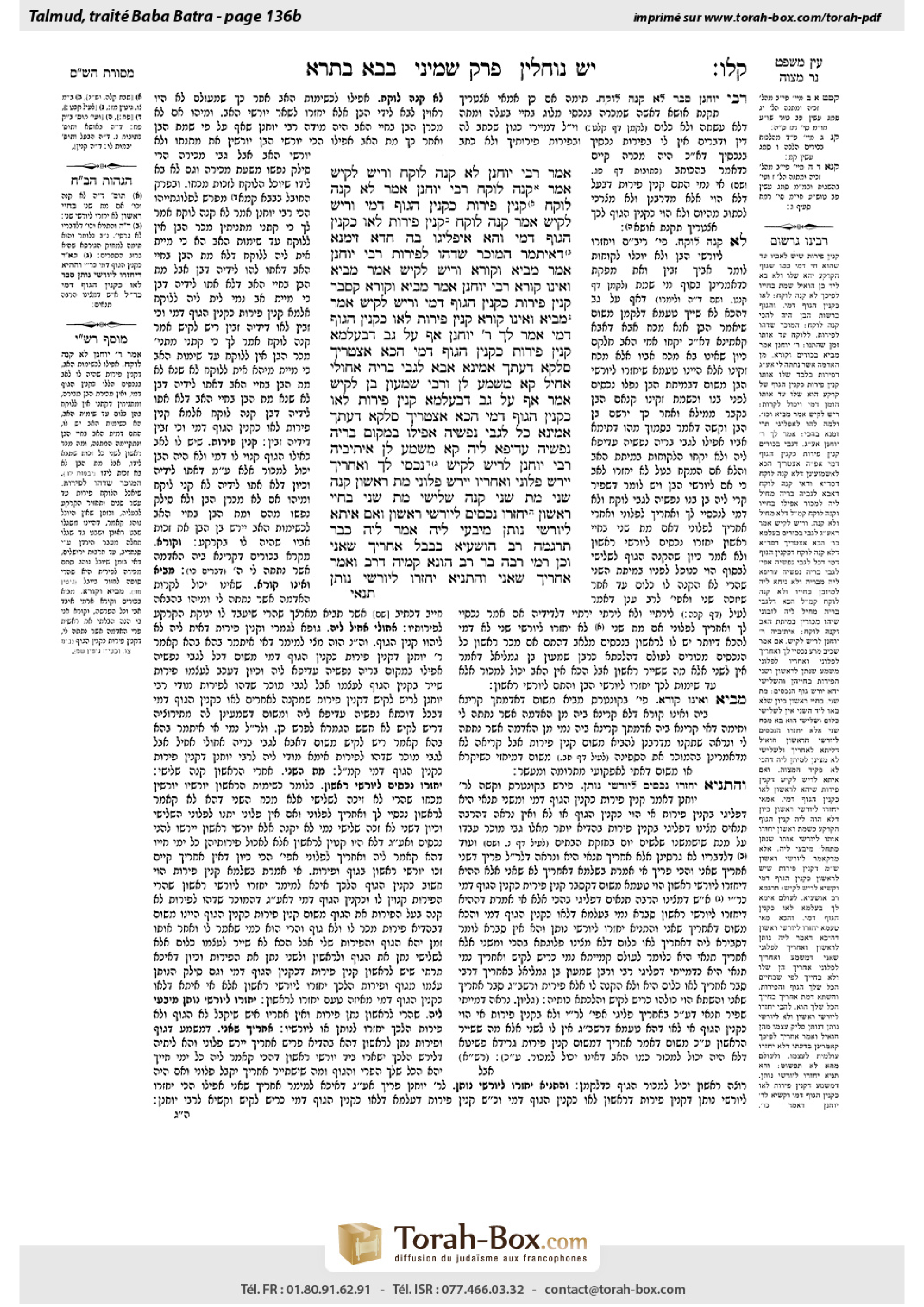
Bava Batra 136b: Talmud study for Daf Yomi
Study the Talmud for Daf Yomi with scanned pages, Hebrew text, English translations from Sefaria and AI-generated French translations.
Passage selection and English or AI-generated French translation are available where the scan has annotations. Daf Study is independent of Torah-Box and Sefaria.
Browse Bava Batra · בבא בתרא · All tractatesBava Batra 136b text and translations
This page of Bava Batra includes the Aramaic text, an English translation and an AI-generated French translation, alongside the scan above.
בבא בתרא קל״ו ב · Aramaic and Hebrew text
אָמַר רַבִּי יוֹחָנָן: לֹא קָנָה לוֹקֵחַ. וְרֵישׁ לָקִישׁ אָמַר: קָנָה לוֹקֵחַ.
רַבִּי יוֹחָנָן אָמַר: לֹא קָנָה לוֹקֵחַ – קִנְיַן פֵּירוֹת כְּקִנְיַן הַגּוּף דָּמֵי.
וְרֵישׁ לָקִישׁ אָמַר: קָנָה לוֹקֵחַ – קִנְיַן פֵּירוֹת לָאו כְּקִנְיַן הַגּוּף דָּמֵי.
וְהָא אִיפְּלִיגוּ בַּהּ חֲדָא זִימְנָא! דְּאִיתְּמַר: הַמּוֹכֵר שָׂדֵהוּ לְפֵירוֹת – רַבִּי יוֹחָנָן אָמַר: מֵבִיא וְקוֹרֵא. וְרֵישׁ לָקִישׁ אָמַר: מֵבִיא, וְאֵינוֹ קוֹרֵא.
רַבִּי יוֹחָנָן אָמַר מֵבִיא וְקוֹרֵא – קָסָבַר: קִנְיַן פֵּירוֹת כְּקִנְיַן הַגּוּף דָּמֵי. וְרֵישׁ לָקִישׁ אָמַר: מֵבִיא וְאֵינוֹ קוֹרֵא – קִנְיַן פֵּירוֹת לָאו כְּקִנְיַן הַגּוּף דָּמֵי!
אָמַר לָךְ רַבִּי יוֹחָנָן: אַף עַל גַּב דִּבְעָלְמָא קִנְיַן פֵּירוֹת כְּקִנְיַן הַגּוּף דָּמֵי, הָכָא אִצְטְרִיךְ; סָלְקָא דַעְתָּךְ אָמֵינָא: אַבָּא לְגַבֵּי בְּרֵיהּ אַחוֹלֵי אַחֵיל, קָא מַשְׁמַע לַן.
וְרַבִּי שִׁמְעוֹן בֶּן לָקִישׁ אָמַר: אַף עַל גַּב דִּבְעָלְמָא קִנְיַן פֵּירוֹת לָאו כְּקִנְיַן הַגּוּף דָּמֵי, הָכָא אִצְטְרִיךְ; סָלְקָא דַעְתָּךְ אָמֵינָא: כֹּל לְגַבֵּי נַפְשֵׁיהּ, אֲפִילּוּ בִּמְקוֹם בְּרֵיהּ, נַפְשֵׁיהּ עֲדִיפָא לֵיהּ; קָא מַשְׁמַע לַן.
אֵיתִיבֵיהּ רַבִּי יוֹחָנָן לְרֵישׁ לָקִישׁ: ״נְכָסַי לְךָ, וְאַחֲרֶיךָ יִירַשׁ פְּלוֹנִי, וְאַחֲרָיו יִירַשׁ פְּלוֹנִי״ – מֵת רִאשׁוֹן, קָנָה שֵׁנִי. מֵת שֵׁנִי, קָנָה שְׁלִישִׁי.
מֵת שֵׁנִי בְּחַיֵּי רִאשׁוֹן – יַחְזְרוּ נְכָסִים לְיוֹרְשֵׁי רִאשׁוֹן.
וְאִם אִיתָא, לְיוֹרְשֵׁי נוֹתֵן מִיבְּעֵי לֵיהּ!
אֲמַר לֵיהּ: כְּבָר תַּרְגְּמַהּ רַב הוֹשַׁעְיָא בְּבָבֶל: ״אַחֲרֶיךָ״ שָׁאנֵי. וְכֵן רָמֵי רַבָּה בַּר רַב הוּנָא קַמֵּיהּ דְּרַב, וְאָמַר: ״אַחֲרֶיךָ״ שָׁאנֵי.
וְהָתַנְיָא: יַחְזְרוּ לְיוֹרְשֵׁי נוֹתֵן!
Bava Batra 136b · English translation
Rabbi Yoḥanan says: The purchaser did not acquire the property, and Reish Lakish says: The purchaser acquired the property.
The Gemara explains their reasoning: Rabbi Yoḥanan says that the purchaser did not acquire the property because he holds that ownership of the rights to use an item and the profits it engenders is considered to be like ownership of the item itself. Even though the property itself did not belong to the father, it is as though the father owned the property, because all of the produce belonged to him in practice. Therefore, the son’s sale can take effect only after the father’s death. If the son dies first, since he never attained ownership, his sale can never come to fruition.
And Reish Lakish says: The purchaser acquired the property, because he holds that ownership of the rights to use an item and the profits it engenders is not considered to be like ownership of the item itself. Therefore, the father’s rights do not prevent the son, who owns the property itself, from selling it, and eventually the purchaser receives full rights to it.
The Gemara asks: But didn’t they already engage in a dispute concerning this issue one time? As it was stated: With regard to one who sells his field for just its produce, meaning that he retains ownership over the field itself and he sells the rights to all of its produce to someone else, Rabbi Yoḥanan says: The purchaser brings first fruits from this field to the Temple and recites the verses in the Torah associated with the bringing of the first fruits, in which he thanks God for: “The land that You, Lord, have given me” (Deuteronomy 26:10). And Reish Lakish says: The purchaser brings the first fruits, but he does not recite the verses, since it is not his field.
The Gemara explains the reason behind the dispute: Rabbi Yoḥanan says he brings the first fruits and recites the verses because he maintains that ownership of the rights to use an item and the profits it engenders is considered to be like the ownership of the item itself. Even though the field itself does not belong to him, it is as if he acquired the field because all of the produce belongs to him in practice. And Reish Lakish says that he brings the first fruits and does not recite the verses because he holds that ownership of the rights to use an item and the profits it engenders is not considered to be like the ownership of the item itself. Why was it necessary for them to engage in a dispute concerning this issue twice?
The Gemara answers: It was necessary for the dispute to be stated also in the context of one who sells his father’s property and then dies. This is because Rabbi Yoḥanan could have said to you that although in general ownership of the rights to use an item and the profits it engenders is considered to be like the ownership of the item itself, here it was necessary to emphasize this principle, because it might enter your mind to say that with regard to a father and son, the father presumably waived his rights in the property itself. Rabbi Yoḥanan teaches us that even in this case, the father’s ownership of the rights to use an item and the profits it engenders is considered to be like the ownership of the item itself.
And Rabbi Shimon ben Lakish could have said that although in general ownership of the rights to use an item and the profits it engenders is not considered to be like the ownership of the item itself, as one who sells the produce of his field retains full ownership of the land itself, here it was necessary to emphasize this principle, as it might enter your mind to say that in any sale concerning oneself, even vis-à-vis his son, one grants preference to himself. Accordingly, if one grants the property itself to his son, reserving the rights to the produce for himself, he retains the rights to the property itself as well. Reish Lakish teaches us that he does not retain the rights to the property.
Rabbi Yoḥanan raised an objection to the opinion of Reish Lakish from a baraita (Tosefta 8:4): If one states: My property will go to you after my death for your use during your lifetime, and after you die, so-and-so will inherit the property, and after the one who inherits after you dies, so-and-so will inherit the property, in this case, when the first recipient dies, the second acquires it, and when the second dies, the third acquires it.
If the second dies during the lifetime of the first, the property returns after his death to the heirs of the first, and does not go to the third designated recipient, as his right was to inherit it from the second, who never received it.
And if it is so that ownership of the rights to use an item and the profits is not considered to be like ownership of the item itself, the baraita should have stated that the property returns to the heirs of the giver, as the first and second recipients received only the right to use the property and enjoy its profits during their lifetimes, after which it was designated to be transferred to others. Therefore, in a case where the transfer does not apply, the property should return to the possession of the one who owns the property itself, namely the giver and his heirs.
Reish Lakish said to him: Rav Hoshaya already interpreted in Babylonia that a case of after you, i.e., where the owner said to the recipient: After you die so-and-so will inherit the property, is different, as the giver intended to grant full ownership of the property to the first recipient as well, including both the rights to the produce and the property itself. And Rabba bar Rav Huna also raised this contradiction before Rav, and Rav said in response: After you, is different.
The Gemara asks: But isn’t it taught in another baraita that if the second designated recipient dies before the first, after the death of the first the property returns to the heirs of the giver?
Bava Batra 136b · Traduction française (IA)
Rabbi Yoḥanan dit : Le acheteur n'a pas acquis la propriété, et Reish Lakish dit : L'acheteur a acquis la propriété.
La Guemara explique leur raisonnement : Rabbi Yoḥanan dit que l'acheteur n'a pas acquis la propriété car il considère que l'ownership des droits d'utilisation d'un objet et des profits qu'il génère est considérée comme équivalente à l'ownership de l'objet lui-même. Même si l'objet lui-même n'appartenait pas au père, il est comme s'il appartenait au père, car tous les produits appartenaient en pratique à ce dernier. Ainsi, la vente du fils ne peut prendre effet qu'après la mort du père. Si le fils meurt d'abord, puisque jamais il n'a acquis l'ownership, sa vente ne peut jamais aboutir.
Et Reish Lakish dit : L'acheteur a acquis la propriété, car il considère que l'ownership des droits d'utilisation d'un objet et des profits qu'il génère n'est pas considérée comme équivalente à l'ownership de l'objet lui-même. Ainsi, les droits du père ne bloquent pas le fils, qui possède l'objet lui-même, de le vendre, et finalement l'acheteur obtient pleinement les droits sur l'objet.
La Guemara pose une question : Mais n'ont-ils pas déjà engagé un débat sur ce sujet auparavant ? Comme il est dit : Concernant celui qui vend son champ pour seulement ses produits, c'est-à-dire qu'il conserve la propriété du champ lui-même et il vend les droits à tous ses produits à quelqu'un d'autre, Rabbi Yoḥanan dit : L'acheteur apporte les premiers fruits de ce champ au Temple et récite les versets de la Torah associés à l'apport des premiers fruits, dans lesquels il remercie Dieu pour : « La terre que Tu, Seigneur, as donnée à moi » (Deutéronome 26:10). Et Reish Lakish dit : L'acheteur apporte les premiers fruits, mais il ne récite pas les versets, car ce n'est pas son champ.
La Guemara explique la raison du débat : Rabbi Yoḥanan dit qu'il apporte les premiers fruits et récite les versets car il maintient que la propriété des droits d'utilisation d'un objet et des profits qu'il génère est considérée comme équivalente à la propriété de l'objet lui-même. Même si l'objet lui-même n'appartient pas à lui, il est comme s'il avait acquis le champ, car tous les produits lui appartiennent en pratique. Et Reish Lakish dit qu'il apporte les premiers fruits et ne récite pas les versets car il considère que la propriété des droits d'utilisation d'un objet et des profits qu'il génère n'est pas considérée comme équivalente à la propriété de l'objet lui-même. Pourquoi fallait-il engager ce débat sur ce sujet deux fois ?
La Guemara répond : Il fallait que ce débat soit évoqué également dans le contexte d'une personne qui vend la propriété de son père et meurt ensuite. C'est parce que Rabbi Yoḥanan pourrait avoir dit à vous que bien que, en général, l'ownership des droits d'utilisation d'un objet et des profits qu'il génère soit considérée comme équivalente à l'ownership de l'objet lui-même, ici il fallait souligner ce principe, car il pourrait entrer en vous l'idée que concernant un père et un fils, le père a probablement renoncé à ses droits sur la propriété elle-même. Rabbi Yoḥanan nous enseigne que même dans ce cas, l'ownership des droits d'utilisation d'un objet et des profits qu'il génère est considérée comme équivalente à l'ownership de l'objet lui-même.
Et Rabbi Shimon ben Lakish pourrait avoir dit que bien que, en général, l'ownership des droits d'utilisation d'un objet et des profits qu'il génère ne soit pas considérée comme équivalente à l'ownership de l'objet lui-même, comme celui qui vend les produits de son champ conserve l'ownership du champ lui-même, ici il fallait souligner ce principe, car il pourrait entrer en vous l'idée que dans toute vente concernant soi-même, même vis-à-vis de son fils, on accorde la préférence à soi-même. Ainsi, si l'on accorde la propriété elle-même à son fils, en réservant les droits aux produits pour soi-même, il conserve les droits sur la propriété elle-même. Reish Lakish nous enseigne qu'il ne conserve pas les droits sur la propriété.
Rabbi Yoḥanan a soulevé une objection contre l'opinion de Reish Lakish à partir d'une baraïta (Tosefta 8:4) : Si l'on dit : Ma propriété ira à toi après ma mort pour ton usage pendant ta vie, et après que tu meurs, tel que-ci héritera de la propriété, et après que celui qui héritera après toi meurt, tel que-ci héritera de la propriété, dans ce cas, quand le premier destinataire meurt, le second acquiert la propriété, et quand le second meurt, le troisième acquiert la propriété.
Si le second meurt pendant la vie du premier, la propriété retourne après sa mort aux héritiers du premier, et ne va pas au troisième destinataire désigné, car son droit était d'hériter de la propriété du second, qui n'a jamais reçu la propriété.
Et si l'ownership des droits d'utilisation d'un objet et des profits n'est pas considérée comme équivalente à l'ownership de l'objet lui-même, la baraïta devrait avoir dit que la propriété retourne aux héritiers du donneur, car les premiers et seconds destinataires ont reçu seulement le droit d'utiliser la propriété et d'en profiter pendant leur vie, après quoi elle était désignée pour être transférée à d'autres. Ainsi, dans un cas où le transfert ne s'applique pas, la propriété devrait retourner à la possession de celui qui possède la propriété elle-même, à savoir le donneur et ses héritiers.
Reish Lakish a dit à lui : Rav Hoshaya a déjà interprété à Babylone que le cas de « après toi », c'est-à-dire où le propriétaire dit au destinataire : Après que tu meurs, tel que-ci héritera de la propriété, est différent, car le donneur a l'intention de conférer à l'objet d'usage au premier destinataire, y compris les droits sur les produits et la propriété elle-même. Et Rabba bar Rav Huna a également soulevé ce paradoxe devant Rav, et Rav a répondu en disant : « Après toi » est différent.
La Guemara pose la question : Mais n'est-il pas enseigné dans une autre baraïta que si le second destinataire désigné meurt avant le premier, après la mort du premier, la propriété revient aux héritiers du donneur ?
Traduction française générée par IA à partir de l’édition anglaise de Sefaria. Vérifie toujours un passage avec le texte source.
Text from Sefaria: William Davidson Edition - Vocalized Aramaic (CC BY NC); William Davidson Edition - English (CC BY NC).