Bava Batra 137b: Talmud study for Daf Yomi
Study the Talmud for Daf Yomi with scanned pages, Hebrew text, English translations from Sefaria and AI-generated French translations.
Passage selection and English or AI-generated French translation are available where the scan has annotations. Daf Study is independent of Torah-Box and Sefaria.
Browse Bava Batra · בבא בתרא · All tractatesBava Batra 137b text and translations
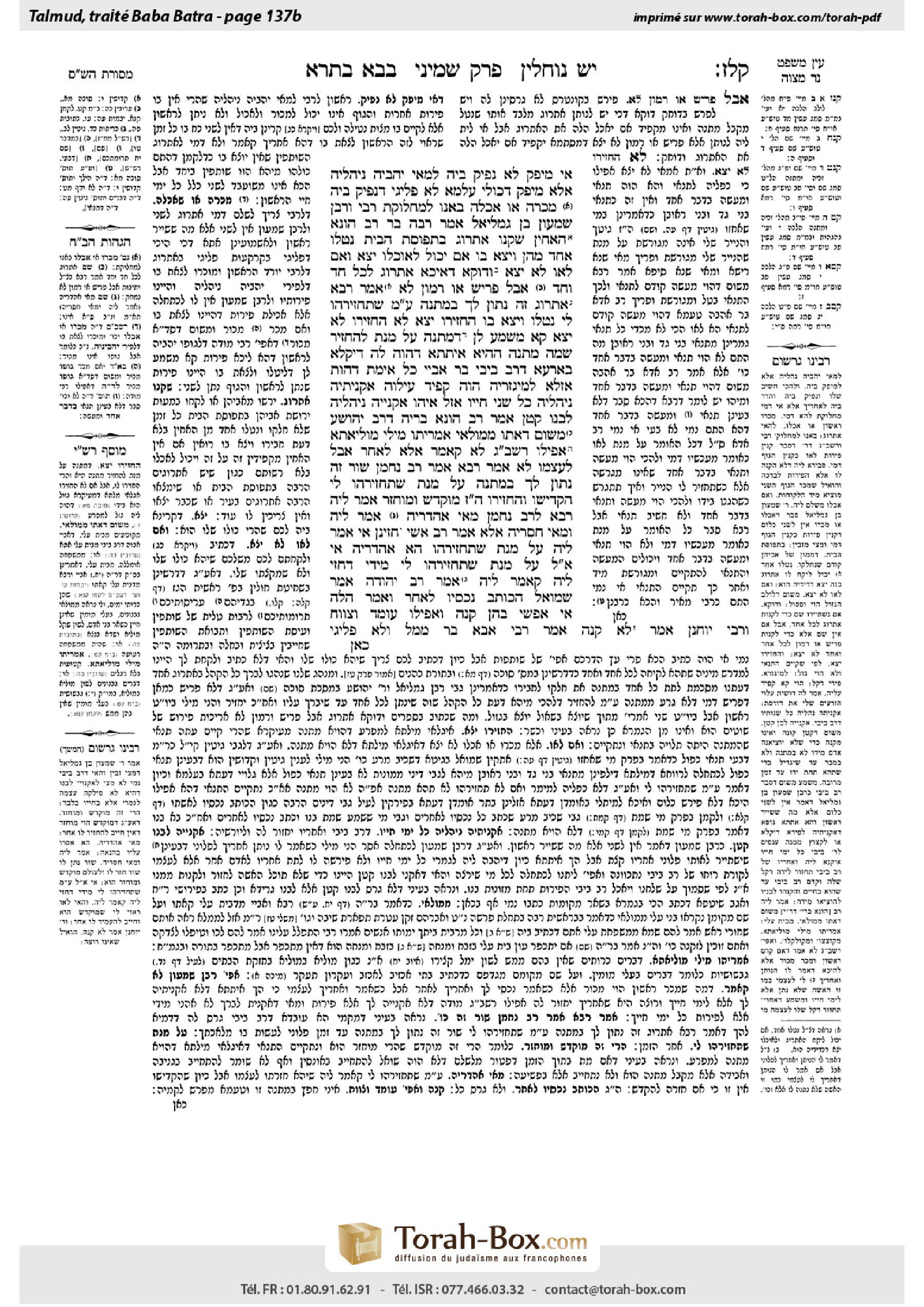
This page of Bava Batra includes the Aramaic text, an English translation and an AI-generated French translation, alongside the scan above.
בבא בתרא קל״ז ב · Aramaic and Hebrew text
אִי מִיפָּק לָא נָפֵיק בֵּיהּ, לְמַאי יַהֲבֵיהּ נִיהֲלֵיהּ?
אֶלָּא מִיפָּק – דְּכוּלֵּי עָלְמָא לָא פְּלִיגִי, דְּנָפֵיק בֵּיהּ; מְכָרָהּ אוֹ אֲכָלָהּ – בָּאנוּ לְמַחְלוֹקֶת רַבִּי וְרַבָּן שִׁמְעוֹן בֶּן גַּמְלִיאֵל.
אָמַר רַבָּה בַּר רַב הוּנָא: הָאַחִין שֶׁקָּנוּ אֶתְרוֹג בִּתְפוּסַת הַבַּיִת; נְטָלוֹ אֶחָד מֵהֶן וְיָצָא בּוֹ – אִם יָכוֹל לְאוֹכְלוֹ, יָצָא; וְאִם לָאו, לֹא יָצָא.
וְדַוְקָא דְּאִיכָּא אֶתְרוֹג לְכׇל חַד וְחַד, אֲבָל פָּרִישׁ אוֹ רִמּוֹן – לֹא.
אָמַר רָבָא: ״אֶתְרוֹג זֶה נָתוּן לְךָ בְּמַתָּנָה, עַל מְנָת שֶׁתַּחְזִירֵהוּ לִי״, נְטָלוֹ וְיָצָא בּוֹ; הֶחְזִירוֹ – יָצָא, לֹא הֶחְזִירוֹ – לֹא יָצָא. קָא מַשְׁמַע לַן דְּמַתָּנָה עַל מְנָת לְהַחֲזִיר – שְׁמָהּ מַתָּנָה.
הַהִיא אִיתְּתָא דַּהֲוָה לַהּ דִּיקְלָא בְּאַרְעָא דְּרַב בִּיבִי בַּר אַבָּיֵי. כׇּל אֵימַת דַּהֲוָת אָזְלָא לְמִיגְזְרֵיהּ, הֲוָה קָפֵיד עִילָּוַהּ. אַקְנִיתֵיהּ נִיהֲלֵיהּ כֹּל שְׁנֵי חַיָּיו. אֲזַל אִיהוּ אַקְנְיֵיהּ נִיהֲלֵיהּ לִבְנוֹ קָטָן.
אָמַר רַב הוּנָא בְּרֵיהּ דְּרַב יְהוֹשֻׁעַ: מִשּׁוּם דְּאָתוּ מִמּוּלָאֵי, אָמְרִיתוּ מִילֵּי מוּלְיָאתָא? אֲפִילּוּ רַבָּן שִׁמְעוֹן בֶּן גַּמְלִיאֵל לָא קָאָמַר אֶלָּא לְאַחֵר, אֲבָל לְעַצְמוֹ – לֹא.
אָמַר רָבָא אָמַר רַב נַחְמָן: ״שׁוֹר זֶה נָתוּן לְךָ בְּמַתָּנָה, עַל מְנָת שֶׁתַּחְזִירֵהוּ לִי״; הִקְדִּישׁוֹ וְהֶחְזִירוֹ – הֲרֵי זֶה מוּקְדָּשׁ וּמוּחְזָר.
אֲמַר לֵיהּ רָבָא לְרַב נַחְמָן: מַאי אַהְדְּרֵיהּ? אֲמַר לֵיהּ: וּמַאי חַסְּרֵיהּ? אֶלָּא אָמַר רַב אָשֵׁי: חָזֵינַן; אִי אֲמַר לֵיהּ: ״עַל מְנָת שֶׁתַּחְזִירֵהוּ״ – הָא אַהְדְּרֵיהּ. אִי אֲמַר לֵיהּ: ״עַל מְנָת שֶׁתַּחְזִירֵהוּ לִי״ – מִידֵּי דַּחֲזֵי לֵיהּ קָאָמַר לֵיהּ.
אָמַר רַב יְהוּדָה אָמַר שְׁמוּאֵל: הַכּוֹתֵב נְכָסָיו לְאַחֵר, וְאָמַר הַלָּה ״אִי אֶפְשִׁי בָּהֶן״ – קָנָה, וַאֲפִילּוּ עוֹמֵד וְצוֹוֵחַ. וְרַבִּי יוֹחָנָן אָמַר: לֹא קָנָה.
אָמַר רַבִּי אַבָּא בַּר מֶמֶל: וְלָא פְּלִיגִי;
Bava Batra 137b · English translation
if he does not fulfill his obligation with it, for what purpose did the owner give it to him?
Rather, with regard to fulfilling his obligation, everyone agrees that he fulfills his obligation with it. It is only in a case where the first recipient sold it or consumed it, that we have arrived at the dispute between Rabbi Yehuda HaNasi and Rabban Shimon ben Gamliel. According to Rabbi Yehuda HaNasi, if he sold it, the second recipient can repossess the etrog from the purchaser, and if he consumed it he must pay the second recipient its value, whereas according to Rabban Shimon ben Gamliel, he owes nothing to the second recipient, as the etrog belongs to him.
Rabba bar Rav Huna says: In a case of brothers who acquired an etrog with money from the jointly held property of the estate, and one of them took it on Sukkot and attempted to fulfill his obligation with it, the halakha depends on the limits of his ownership of the etrog: If he may eat it, i.e., his brothers allow him to do so, he has fulfilled his obligation to perform the mitzva, and if not, he has not fulfilled his obligation.
And this is specifically in a case where there is an etrog for each and every one of the brothers; but if the other brothers get merely a quince or a pomegranate, he has not fulfilled his obligation even if he has the right to eat it.
Rava says: If one person said to another: This etrog is given to you as a gift on the condition that you return it to me, and the recipient took it on Sukkot and attempted to fulfill his obligation with it, if he ultimately returned it, he has fulfilled his obligation; if he did not return it, he has not fulfilled his obligation, as he did not fulfill the condition, thereby retroactively invalidating the gift. The Gemara explains that Rava teaches us that a gift given on the condition that it be returned is considered a valid gift.
§ The Gemara relates: There was a certain woman who had a palm tree on the land of Rav Beivai bar Abaye. Whenever she would go to harvest the produce from it, he would get angry at her for trampling on his crops. Since she did not wish to anger him, she decided to temporarily waive her right to the tree’s produce, and transferred ownership of it to him for all the years of his life, so that after his death she would once again be able to harvest the produce. He then went and transferred it to his minor son, so that it would remain in his family even following his death.
Rav Huna, son of Rav Yehoshua, said to Rav Beivai bar Abaye: Is it because you descend from truncated [mula’ei] people, as Rav Beivai’s family traced their lineage to Eli, all of whose descendants were condemned to premature death (see I Samuel 2:31), that you speak truncated [mulyata] and unsound matters? Even Rabban Shimon ben Gamliel, who holds that in a case where one says: My property is given to you, and after you, to so-and-so, if the first recipient sells the property the sale is valid, says so only in a case where it was to be given to another person; but if the giver said that it will return to himself, he did not say that the first recipient can sell it, as the giver clearly intended to maintain his ownership of the property. Accordingly, Rav Huna, son of Rav Yehoshua, held that Rav Beivai’s sale did not take effect.
§ Rava says that Rav Naḥman says: If one said to another: This ox is given to you as a gift on the condition that you return it to me, and the recipient consecrated it and then returned it to him, it is consecrated and returned. The consecration takes effect, and although the owner may not use it, nevertheless it is considered returned and the condition is fulfilled.
Rava said to Rav Naḥman: What did he return to him? The ox was not returned to the possession of the giver, as it is consecrated. Rav Naḥman said to him: And what did he cause him to lose? He returned the ox. Rather, Rav Ashi said: We must rule in this case based on what we see. If the giver said to the recipient: On the condition that you return it, it is considered returned, as he returned it. But if he said to him: On the condition that you return it to me, he was effectively saying to him that he must return something fit for him to use. Consequently, the consecration prevents the condition from being fulfilled, and both the gift and the consecration are retroactively nullified.
§ Rav Yehuda says that Shmuel says: If one writes a document granting his property to another, and the other person says: I do not want it, he acquires it, and this is the halakha even if he is standing and shouting in protest that he does not want it. And Rabbi Yoḥanan says that he does not acquire it.
Rabbi Abba bar Memel said: And they do not disagree with each other:
Bava Batra 137b · Traduction française (IA)
Si l'on ne remplit pas son obligation avec cela, à quel titre l'propriétaire l'a-t-il donné à l'autre ?
En réalité, concernant la remise de l'obligation, tout le monde convient qu'on remplit son obligation avec cela. C'est seulement dans le cas où le premier récipiendaire l'a vendu ou consommé que nous avons atteint le débat entre Rabbi Yéhuda HaNasi et Rabban Shimon ben Gamliel. Selon Rabbi Yéhuda HaNasi, si l'on a vendu cela, le second récipiendaire peut reprendre la citronne auprès du vendeur, et si l'on l'a consommée, il doit payer au second récipiendaire sa valeur, tandis que selon Rabban Shimon ben Gamliel, il ne doit rien au second récipiendaire, car la citronne appartient à lui.
Rabba bar Rav Huna dit : Dans le cas de frères qui ont acquis une citronne avec de l'argent provenant de la propriété commune de l'immobilier, et l'un d'eux l'a emporté pour la fête des Tabernacles et a tenté de remplir son obligation avec cela, la halakha dépend des limites de sa propriété sur la citronne : Si l'on peut manger cela, c'est-à-dire que ses frères lui permettent de le faire, il a rempli son obligation de faire la mitsva, et si non, il n'a pas rempli son obligation.
Et c'est spécifiquement dans le cas où il y a un citron pour chaque frère ; mais si les autres frères n'ont qu'un pamplemousse ou une grenade, il n'a pas rempli son obligation même s'il a le droit de manger cela.
Rava dit : Si une personne a dit à une autre : Ce citron est donné à toi en tant que cadeau à la condition que tu me le rendes, et le récipiendaire l'a emporté pour la fête des Tabernacles et a tenté de remplir son obligation avec cela, si il a finalement rendu le citron, il a rempli son obligation ; si il n'a pas rendu le citron, il n'a pas rempli son obligation, car il n'a pas rempli la condition, invalidant ainsi rétroactivement le cadeau. La Guemara explique que Rava nous enseigne qu'un cadeau donné à la condition qu'il soit rendu est considéré comme un cadeau valide.
§ La Guemara rapporte : Il y avait une certaine femme qui avait un palmier sur la terre de Rav Beivai bar Abaye. Chaque fois qu'elle allait récolter les produits de ce palmier, il se mettait en colère contre elle pour avoir foulé à ses cultures. Comme elle ne voulait pas le mettre en colère, elle a décidé de temporairement renoncer à son droit sur les produits du palmier, et de transférer la propriété de ce palmier à lui pour toute la durée de ses jours, afin qu'après sa mort elle puisse à nouveau récolter les produits. Il est ensuite allé et a transféré ce palmier à son fils mineur, afin qu'il reste dans sa famille même après sa mort.
Rav Huna, fils de Rav Yéhoshua, a dit à Rav Beivai bar Abaye : Est-ce à cause que tu descends de gens tronqués [mula’ei], comme la famille de Rav Beivai trace son lignage à Eli, dont tous les descendants furent condamnés à la mort prématurée (voir I Samuel 2:31), que tu parles de manière tronquée [mulyata] et incohérente ? Même Rabban Shimon ben Gamliel, qui considère que dans le cas où l'on dit : Mon bien est donné à toi, et après toi, à tel et tel, si le premier récipiendaire vend le bien, la vente est valide, dit cela uniquement dans le cas où il était destiné à un autre ; mais si le donneur a dit qu'il reviendra à lui-même, il n'a pas dit que le premier récipiendaire puisse vendre le bien, car le donneur a clairement l'intention de conserver sa propriété. Ainsi, Rav Huna, fils de Rav Yéhoshua, considérait que la vente de Rav Beivai n'avait pas d'effet.
§ Rava dit que Rav Naḥman dit : Si l'on a dit à un autre : Cet taureau est donné à toi en tant que cadeau à la condition que tu me le rendes, et le récipiendaire l'a consacré puis l'a rendu, il est consacré et rendu. La consécration est effective, et bien que l'propriétaire ne puisse pas l'utiliser, il est considéré comme rendu et la condition est remplie.
Rava a dit à Rav Naḥman : Qu'est-ce qu'il a rendu à lui ? Le taureau n'était pas rendu à la possession du donneur, car il était consacré. Rav Naḥman a dit à lui : Et qu'est-ce qu'il a fait perdre ? Il a rendu le taureau. Plutôt, Rav Ashi a dit : Nous devons décider dans ce cas sur la base de ce que nous voyons. Si le donneur a dit au récipiendaire : À la condition que tu me le rendes, il est considéré comme rendu, car il l'a rendu. Mais si il a dit à lui : À la condition que tu me le rendes, il a effectivement dit à lui qu'il doit rendre quelque chose adapté à son usage. Ainsi, la consécration empêche la condition d'être remplie, et à la fois le cadeau et la consécration sont annulés rétroactivement.
§ Rav Yéhuda dit que Shmuel dit : Si l'on écrit un document transférant sa propriété à un autre, et que l'autre dit : Je ne veux pas, il l'acquiert, et c'est la halakha même s'il est debout et crie en protestant qu'il ne veut pas. Et Rabbi Yoḥanan dit qu'il ne l'acquiert pas.
Rabbi Abba bar Memel a dit : Et ils ne s'entendent pas sur ce point :
Traduction française générée par IA à partir de l’édition anglaise de Sefaria. Vérifie toujours un passage avec le texte source.
Text from Sefaria: William Davidson Edition - Vocalized Aramaic (CC BY NC); William Davidson Edition - English (CC BY NC).