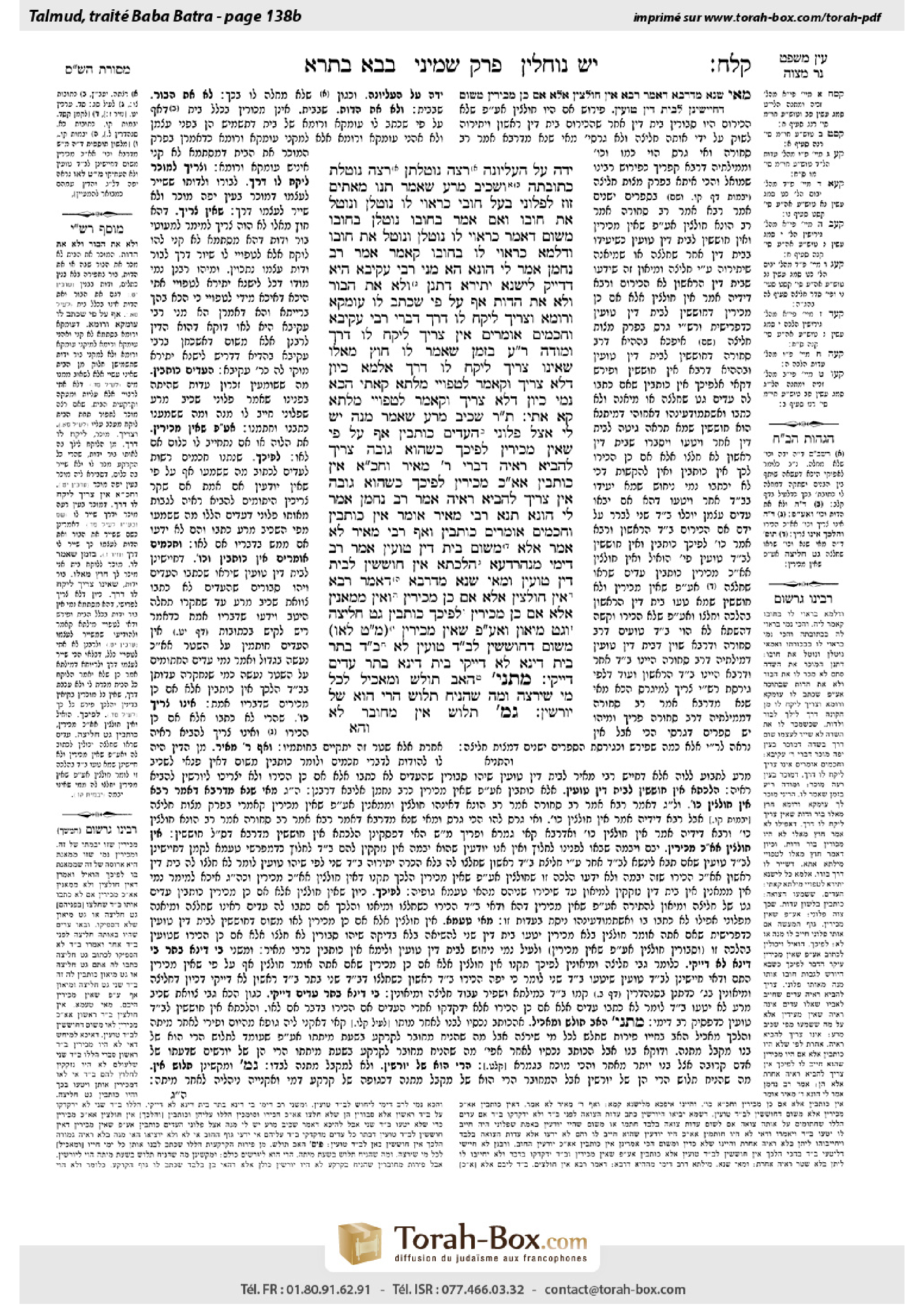
Bava Batra 138b: Talmud study for Daf Yomi
Study the Talmud for Daf Yomi with scanned pages, Hebrew text, English translations from Sefaria and AI-generated French translations.
Passage selection and English or AI-generated French translation are available where the scan has annotations. Daf Study is independent of Torah-Box and Sefaria.
Browse Bava Batra · בבא בתרא · All tractatesBava Batra 138b text and translations
This page of Bava Batra includes the Aramaic text, an English translation and an AI-generated French translation, alongside the scan above.
בבא בתרא קל״ח ב · Aramaic and Hebrew text
יָדָהּ עַל הָעֶלְיוֹנָה; רָצָה – נוֹטַלְתָּן, רָצָה – נוֹטֶלֶת כְּתוּבָּתָהּ.
וּשְׁכִיב מְרַע שֶׁאָמַר: ״תְּנוּ מָאתַיִם זוּז לִפְלוֹנִי בַּעַל חוֹבִי, כָּרָאוּי לוֹ״ – נוֹטְלָן, וְנוֹטֵל אֶת חוֹבוֹ. וְאִם אָמַר: ״בְּחוֹבוֹ״ – נוֹטְלָן בְּחוֹבוֹ.
מִשּׁוּם דְּאָמַר ״כָּרָאוּי לוֹ״ – נוֹטְלָן וְנוֹטֵל אֶת חוֹבוֹ?! וְדִלְמָא ״כָּרָאוּי לוֹ בְּחוֹבוֹ״ קָאָמַר!
אָמַר רַב נַחְמָן, אָמַר לִי הוּנָא: הָא מַנִּי – רַבִּי עֲקִיבָא הִיא, דְּדָיֵיק לִישָּׁנָא יַתִּירָא;
דִּתְנַן: וְלֹא אֶת הַבּוֹר וְלֹא אֶת הַדּוּת, אַף עַל פִּי שֶׁכָּתַב לוֹ עוּמְקָא וְרוּמָא. וְצָרִיךְ לִיקַּח לוֹ דֶּרֶךְ, דִּבְרֵי רַבִּי עֲקִיבָא.
וַחֲכָמִים אוֹמְרִים: אֵינוֹ צָרִיךְ לִיקַּח לוֹ דֶּרֶךְ. וּמוֹדֶה רַבִּי עֲקִיבָא בִּזְמַן שֶׁאָמַר לוֹ ״חוּץ מֵאֵלּוּ״ – שֶׁאֵינוֹ צָרִיךְ לִיקַּח לוֹ דֶּרֶךְ.
אַלְמָא, כֵּיוָן דְּלָא צְרִיךְ, וְקָאָמַר – לְטַפּוֹיֵי מִלְּתָא קָאָתֵי; הָכָא נָמֵי, כֵּיוָן דְּלָא צְרִיךְ, וְקָאָמַר – לְטַפּוֹיֵי מִלְּתָא קָא אָתֵי.
תָּנוּ רַבָּנַן, שְׁכִיב מְרַע שֶׁאָמַר: ״מָנֶה יֵשׁ לִי אֵצֶל פְּלוֹנִי״ – הָעֵדִים כּוֹתְבִין, אַף עַל פִּי שֶׁאֵין מַכִּירִין. לְפִיכָךְ, כְּשֶׁהוּא גּוֹבֶה – צָרִיךְ לְהָבִיא רְאָיָה, דִּבְרֵי רַבִּי מֵאִיר. וַחֲכָמִים אוֹמְרִים: אֵין כּוֹתְבִין אֶלָּא אִם כֵּן מַכִּירִין, לְפִיכָךְ כְּשֶׁהוּא גּוֹבֶה – אֵין צָרִיךְ לְהָבִיא רְאָיָה.
אָמַר רַב נַחְמָן, אָמַר לִי הוּנָא: תָּנָא, רַבִּי מֵאִיר אוֹמֵר: אֵין כּוֹתְבִין, וַחֲכָמִים אוֹמְרִים: כּוֹתְבִין. וְאַף רַבִּי מֵאִיר לָא אָמַר אֶלָּא מִשּׁוּם בֵּית דִּין טוֹעִין. אָמַר רַב דִּימִי מִנְּהַרְדְּעָא, הִלְכְתָא: אֵין חוֹשְׁשִׁין לְבֵית דִּין טוֹעִין.
וּמַאי שְׁנָא מִדְּרָבָא? דְּאָמַר רָבָא: אֵין חוֹלְצִין אֶלָּא אִם כֵּן מַכִּירִין, וְאֵין מְמָאֲנִין אֶלָּא אִם כֵּן מַכִּירִין. לְפִיכָךְ כּוֹתְבִין גֵּט חֲלִיצָה וְגֵט מֵיאוּן, וְאַף עַל פִּי שֶׁאֵין מַכִּירִין.
מַאי טַעְמָא? לָאו מִשּׁוּם דְּחוֹשְׁשִׁין לְבֵית דִּין טוֹעִין?
לָא; בֵּית דִּינָא בָּתַר בֵּית דִּינָא – לָא דָּיְיקִי, בֵּית דִּינָא בָּתַר עֵדִים – דָּיְיקִי.
מַתְנִי׳ הָאָב תּוֹלֵשׁ וּמַאֲכִיל לְכׇל מִי שֶׁיִּרְצֶה, וּמַה שֶּׁהִנִּיחַ תָּלוּשׁ – הֲרֵי הוּא שֶׁל יוֹרְשִׁין.
גְּמָ׳ תָּלוּשׁ אִין, מְחוּבָּר לֹא.
Bava Batra 138b · English translation
she has the advantage; if she wants, she takes the two hundred dinars, and if she wants, she takes payment of her marriage contract.
The baraita continues: And if there was a person on his deathbed who said: Give two hundred dinars to so-and-so, my creditor, as is appropriate for him, the creditor takes the two hundred dinars and takes payment of the debt as well. But if he said: Give him two hundred dinars as payment for the debt, he takes the two hundred dinars as payment for the debt.
The Gemara asks: Because he says: As is appropriate for him, he takes the two hundred dinars and takes payment of the debt as well? But perhaps he was saying: As is appropriate for him as payment for the debt, and meant only to specify the amount of the debt.
Rav Naḥman said: Rav Huna said to me: In accordance with whose opinion is this? It is in accordance with the opinion of Rabbi Akiva, who expounds superfluous language. Rabbi Akiva holds that if one uses unnecessary words, he apparently intended to add a matter.
As we learned in a mishna (64a): One who sells a house without specification has sold neither the pit nor the cistern [dut] with it, even if he writes for the buyer in the bill of sale: With its depth and its height. This is because anything that is not part of the house, like pits and cisterns, must be explicitly mentioned in the contract or else they remain in the seller’s possession. And therefore the seller must purchase for himself a path through the buyer’s domain to reach whatever remains his, because he has sold the area of the house along with the house itself, and he no longer has permission to walk there. This is the statement of Rabbi Akiva.
And the Rabbis say: The seller need not purchase for himself a path through the buyer’s domain, as this is certainly included in what he has withheld for himself from the sale. And Rabbi Akiva concedes that when the seller says to the buyer in the bill of sale: I am selling you this house apart from the pit and the cistern, he need not purchase for himself a path through the buyer’s domain. Since the seller unnecessarily emphasized that the pit and the cistern are not included in the sale, he presumably intended to reserve for himself the right of access to them.
Apparently, according to Rabbi Akiva, since he did not need to state: Apart from the pit and the cistern, and stated it anyway, the seemingly superfluous statement was coming to add a matter. Since the seller unnecessarily stressed that the pit and cistern are not included in the sale, he must have intended to thereby reserve for himself the right of access. Here too, with regard to the gift given by a person on his deathbed to his creditor, since he did not need to say: As is appropriate for him, and said it anyway, this phrase was coming to add a matter, i.e., that the two hundred dinars are in addition to the debt.
§ The Sages taught (Tosefta 8:18): If there was a person on his deathbed who said: I have one hundred dinars owed to me by so-and-so, the witnesses that hear this may write his statement in a document even if they do not know whether the statement is true. Therefore, when the person’s heir collects the debt, he must bring proof of the debt, as the document written by these witnesses is not regarded as proof. This is the statement of Rabbi Meir. And the Rabbis say: The witnesses may not write the document unless they know for a fact that the statement is true. Therefore, when the heir collects the debt, he need not bring proof other than the document written by the witnesses, as it has the status of a promissory note.
Rav Naḥman says: Rav Huna told me that the opposite is taught in another baraita: Rabbi Meir says that the witnesses may not write his statement in a document unless they know for a fact that the statement is true, and the Rabbis say that they may write it even if they do not know whether the statement is true; and even Rabbi Meir said that they may not write it only due to the concern that it might be presented before a court that errs and allows the heirs to collect without furnishing additional proof. Rav Dimi of Neharde’a says: The halakha is that there is no concern about the possibility of a court that errs.
The Gemara asks: And in what way is this case different from Rava’s statement? As Rava says: A court may not supervise ḥalitza unless the judges recognize the yavam and yevama. And a court may not supervise a declaration of the refusal of a girl upon her reaching majority to remain married to the man to whom her mother or brothers married her as a minor after the death of her father, unless they recognize the girl. Therefore, another court may write a document attesting to the performance of ḥalitza or a document stating that a declaration of refusal was made in a court elsewhere based on the testimony of witnesses even if the judges do not recognize these people, relying on the presumption the first court would not have allowed the act to be performed had they not been sure of the identities of the parties.
What is the reason Rava said that the court must recognize the participants in these actions? Is it not due to the concern that a court that errs might write such a document based on the testimony of witnesses without verifying that the participating parties were recognized by the court where the ḥalitza or refusal took place?
The Gemara answers: The two issues are not the same. A court does not normally examine the act of another court, so there is concern that the court where the document is written might assume that the court where the act took place recognized the participating parties. But a court does normally examine the statement of witnesses. Therefore, there is no concern that it will rely on a statement written by witnesses without their knowledge of its accuracy.
MISHNA: In continuation of the case discussed in the previous mishna of a father who wrote a document granting his property to his son but reserved the rights to the produce during his lifetime, the mishna states that the father may detach produce from the land and feed the produce to whomever he wishes, and what he left detached at the time of his death belongs to all the father’s heirs, not only to this son.
GEMARA: The mishna indicates that what the father left detached, yes, it is inherited by all the heirs; but the produce that is connected to the ground at the time of his death, no, it is not inherited by them. Rather, it belongs to the son who received the property.
Bava Batra 138b · Traduction française (IA)
elle a l'avantage ; si elle le veut, elle prend les deux cents dinars, et si elle le veut, elle reçoit le paiement de son contrat de mariage.
La baraïta continue : Et si un homme, sur son lit de mort, a dit : Donnez deux cents dinars à tel et tel, mon créancier, comme il convient, le créancier prend les deux cents dinars et reçoit le paiement de la dette. Mais si il a dit : Donnez-lui deux cents dinars comme paiement de la dette, il prend les deux cents dinars comme paiement de la dette.
La Guemara pose la question : Parce qu'il dit : Comme il convient, il prend les deux cents dinars et reçoit le paiement de la dette ? Mais peut-être qu'il voulait dire : Comme paiement de la dette, et voulait simplement préciser le montant de la dette.
Rav Naḥman a dit : Rav Huna m'a demandé : Selon quel avis est-ce ? C'est selon l'avis de Rabbi Akiva, qui explique les paroles superflues. Rabbi Akiva considère que si l'on utilise des mots inutiles, on a l'intention d'ajouter une chose.
Comme nous avons appris dans une mitsna (64a) : Celui qui vend une maison sans précision n'a pas vendu le puits ni le puits, même s'il écrit à l'acheteur dans le contrat de vente : Avec sa profondeur et sa hauteur. C'est parce que tout ce qui n'est pas partie de la maison, comme les puits et les puits, doit être explicitement mentionné dans le contrat, sinon ils restent dans la possession du vendeur. Et donc le vendeur doit acheter pour lui-même un chemin à travers le domaine de l'acheteur pour atteindre ce qui lui appartient encore, car il a vendu la surface de la maison ainsi que la maison elle-même, et il n'a plus le droit de marcher là. C'est l'avis de Rabbi Akiva.
Et les Rabbins disent : Le vendeur n'a pas besoin d'acheter pour lui-même un chemin à travers le domaine de l'acheteur, car cela est certainement inclus dans ce qu'il a réservé pour lui-même dans la vente. Et Rabbi Akiva reconnaît que lorsque le vendeur dit à l'acheteur dans le contrat de vente : Je vends cette maison sans le puits et le puits, il n'a pas besoin d'acheter pour lui-même un chemin à travers le domaine de l'acheteur. Puisque le vendeur a mis en évidence de manière inutile que le puits et le puits ne sont pas inclus dans la vente, il a probablement voulu réservé pour lui-même le droit d'accès à ces choses.
Apparemment, selon Rabbi Akiva, puisqu'il n'avait pas besoin de dire : À l'exception du puits et du cisternon, et qu'il l'a dit de toute façon, cette déclaration superflue visait à ajouter une matière. Puisque le vendeur a mis en évidence de manière inutile que le puits et le cisternon ne sont pas inclus dans la vente, il a dû vouloir réservé pour lui-même le droit d'accès. Ici aussi, concernant le don fait par une personne sur son lit de mort à son créancier, puisqu'il n'avait pas besoin de dire : Comme il convient, et qu'il l'a dit de toute façon, cette phrase visait à ajouter une matière, c'est-à-dire que les deux cents drachmes sont en plus de la dette.
§ Les Sages ont enseigné (Tosefta 8:18) : Si une personne, sur son lit de mort, disait : J'ai un cent drachmes dus à tel et tel, les témoins qui entendent cela peuvent écrire sa déclaration dans un document même s'ils ne savent pas si cette déclaration est vraie. Ainsi, lorsque l'héritier récupère la dette, il doit apporter la preuve de la dette, car le document écrit par ces témoins n'est pas considéré comme une preuve. C'est l'avis de Rabbi Meir. Et les Rabbins disent : Les témoins ne peuvent pas écrire le document à moins qu'ils ne sachent avec certitude que la déclaration est vraie. Ainsi, lorsque l'héritier récupère la dette, il n'a pas besoin d'apporter une preuve autre que le document écrit par les témoins, car il a le statut d'un billet de change.
Rav Naḥman dit : Rav Huna m'a dit que l'opposé est enseigné dans une autre baraïta : Rabbi Meir dit que les témoins ne peuvent pas écrire sa déclaration dans un document à moins qu'ils ne sachent avec certitude que la déclaration est vraie, et les Rabbins disent que les témoins peuvent écrire la déclaration même s'ils ne savent pas si elle est vraie ; et même Rabbi Meir a dit qu'ils ne peuvent pas écrire la déclaration que par crainte qu'elle ne soit présentée devant un tribunal qui erre et permet aux héritiers de récupérer sans fournir d'autres preuves. Rav Dimi de Neharde’a dit : La halakha est que l'on n'a pas de crainte concernant la possibilité d'un tribunal qui erre.
La Guemara pose la question : Et dans quelle mesure ce cas diffère-t-il de l'affirmation de Rava ? Comme Rava dit : Un tribunal ne peut pas superviser la halitza à moins que les juges reconnaissent le yavam et la yevama. Et un tribunal ne peut pas superviser une déclaration de refus d'une fille lorsqu'elle atteint la majorité pour rester mariée à l'homme à qui sa mère ou ses frères l'ont mariée mineure après la mort de son père, à moins qu'ils reconnaissent la fille. Ainsi, un autre tribunal peut écrire un document attestant de la performance de la halitza ou un document indiquant que la déclaration de refus a été faite devant un tribunal ailleurs, basé sur le témoignage des témoins, même si les juges ne reconnaissent pas ces personnes, en se basant sur la présomption que le premier tribunal ne permettrait pas l'acte à moins qu'ils ne soient certains des identités des parties.
Quelle est la raison pour laquelle Rava a dit que le tribunal doit reconnaître les participants à ces actions ? N'est-ce pas par crainte qu'un tribunal qui s'est trompé puisse écrire un tel document basé sur le témoignage des témoins sans vérifier que les parties impliquées étaient reconnues par le tribunal où la halitza ou le refus a eu lieu ?
La Guemara répond : Les deux questions ne sont pas les mêmes. Un tribunal ne vérifie normalement pas l'acte d'un autre tribunal, donc il y a crainte que le tribunal où le document est écrit puisse supposer que le tribunal où l'acte a eu lieu a reconnu les parties impliquées. Mais un tribunal vérifie normalement le témoignage des témoins. Ainsi, il n'y a pas de crainte qu'il puisse se baser sur un témoignage écrit par des témoins sans leur connaissance de la véracité.
MICHNA : En continuation du cas discuté dans la précédente mishna d’un père qui a rédigé un document transférant sa propriété à son fils mais réservant les droits sur les produits pendant sa vie, la mishna indique que le père peut détacher les produits du sol et nourrir ceux-ci à qui il veut, et ce qu’il a laissé détaché au moment de sa mort appartient à tous les héritiers du père, pas seulement à ce fils.
GUEMARA : La mishna indique que ce que le père a laissé détaché, oui, il est hérité par tous les héritiers ; mais les produits qui sont connectés au sol au moment de sa mort, non, ils ne sont pas hérités par eux. Plutôt, ils appartiennent au fils qui a reçu la propriété.
Traduction française générée par IA à partir de l’édition anglaise de Sefaria. Vérifie toujours un passage avec le texte source.
Text from Sefaria: William Davidson Edition - Vocalized Aramaic (CC BY NC); William Davidson Edition - English (CC BY NC).