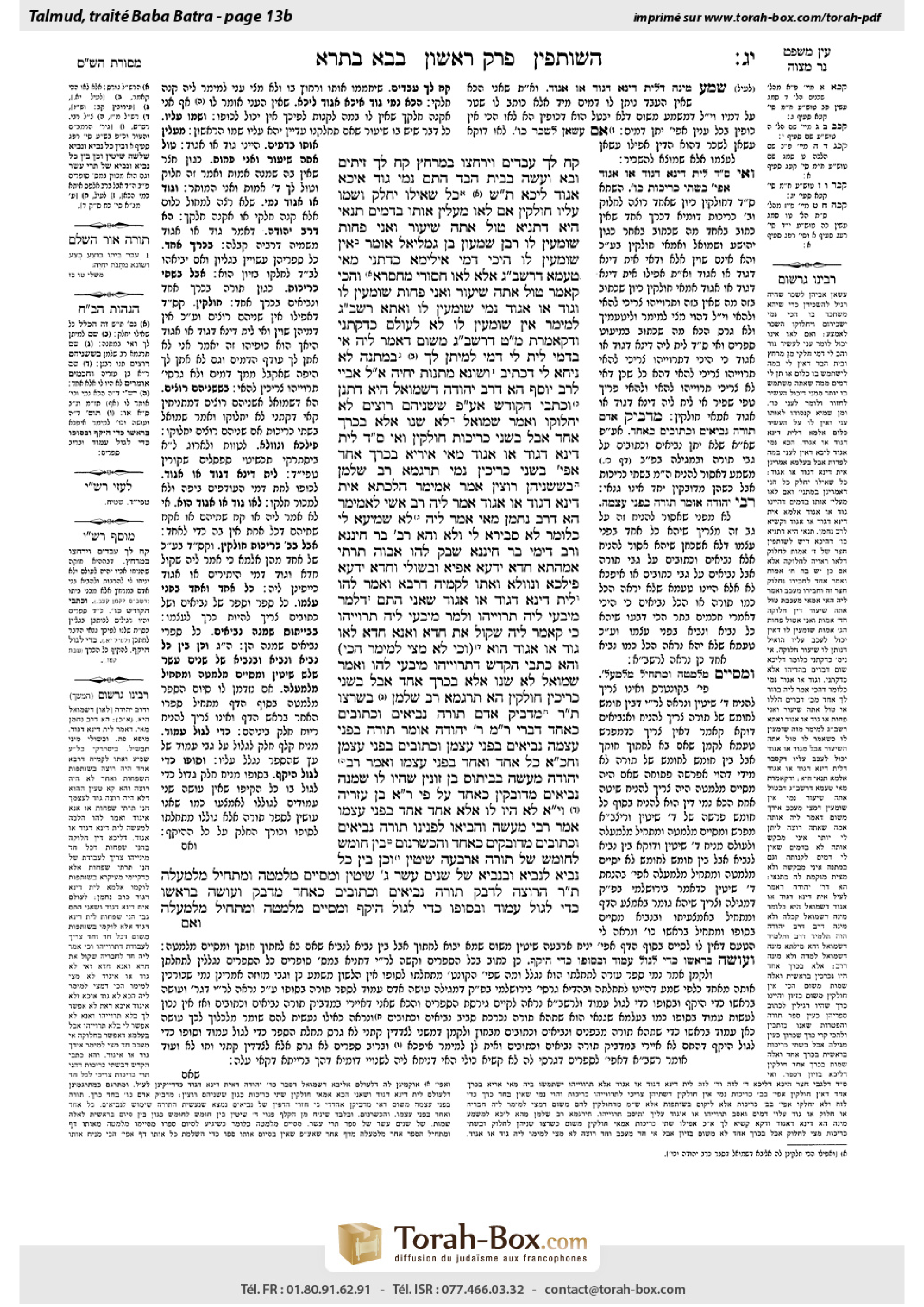
Bava Batra 13b: Talmud study for Daf Yomi
Study the Talmud for Daf Yomi with scanned pages, Hebrew text, English translations from Sefaria and AI-generated French translations.
Passage selection and English or AI-generated French translation are available where the scan has annotations. Daf Study is independent of Torah-Box and Sefaria.
Browse Bava Batra · בבא בתרא · All tractatesBava Batra 13b text and translations
This page of Bava Batra includes the Aramaic text, an English translation and an AI-generated French translation, alongside the scan above.
בבא בתרא י״ג ב · Aramaic and Hebrew text
״קַח לְךָ עֲבָדִים וְיִרְחֲצוּ בַּמֶּרְחָץ״, ״קַח לְךָ זֵיתִים, וּבֹא וַעֲשֵׂה בְּבֵית הַבַּד״! הָתָם נָמֵי, ״גּוּד״ אִיכָּא, ״אֶגּוּד״ לֵיכָּא.
תָּא שְׁמַע: כׇּל שֶׁאִילּוּ יֵחָלֵק וּשְׁמוֹ עָלָיו – חוֹלְקִין, אִם לָאו – מַעֲלִין אוֹתוֹ בְּדָמִים! תַּנָּאֵי הִיא – דְּתַנְיָא: ״טוֹל אַתָּה שִׁיעוּר, וַאֲנִי פָּחוֹת״ – שׁוֹמְעִין לוֹ. רַבָּן שִׁמְעוֹן בֶּן גַּמְלִיאֵל אוֹמֵר: אֵין שׁוֹמְעִין לוֹ.
הֵיכִי דָמֵי? אִילֵּימָא כִּדְתָנֵי – מַאי טַעְמָא דְּרַבָּן שִׁמְעוֹן בֶּן גַּמְלִיאֵל? אֶלָּא לָאו חַסּוֹרֵי מְחַסְּרָא, וְהָכִי קָאָמַר: ״טוֹל אַתָּה שִׁיעוּר וַאֲנִי פָּחוֹת״ – שׁוֹמְעִין לוֹ. וְ״גוּד אוֹ אֶגּוּד״ – נָמֵי שׁוֹמְעִין לוֹ. וַאֲתָא רַבָּן שִׁמְעוֹן בֶּן גַּמְלִיאֵל לְמֵימַר: אֵין שׁוֹמְעִין לוֹ?
לָא, לְעוֹלָם כִּדְקָתָנֵי; וּדְקָאָמְרַתְּ: מַאי טַעְמָא דְּרַבָּן שִׁמְעוֹן בֶּן גַּמְלִיאֵל? מִשּׁוּם דְּאָמַר לֵיהּ: אִי בִּדְמֵי – לֵית לִי דְּמֵי לְמִיתַּן לָךְ; בְּמַתָּנָה – לָא נִיחָא לִי, דִּכְתִיב: ״וְשׂוֹנֵא מַתָּנֹת יִחְיֶה״.
אֲמַר לֵיהּ אַבָּיֵי לְרַב יוֹסֵף: הָא דְּרַב יְהוּדָה – דִּשְׁמוּאֵל הִיא, דִּתְנַן: וְכִתְבֵי הַקּוֹדֶשׁ, אַף עַל פִּי שֶׁשְּׁנֵיהֶם רוֹצִים – לֹא יַחְלוֹקוּ. וְאָמַר שְׁמוּאֵל: לֹא שָׁנוּ אֶלָּא בְּכֶרֶךְ אֶחָד, אֲבָל בִּשְׁנֵי כְּרִיכוֹת – חוֹלְקִין. וְאִי סָלְקָא דַעְתָּךְ לֵית דִּינָא דְּ״גוּד״ אוֹ ״אֶגּוּד״, מַאי אִירְיָא בְּכֶרֶךְ אֶחָד? אֲפִילּוּ בִּשְׁנֵי כְּרִיכִין נָמֵי!
תַּרְגְּמָא רַב שַׁלְמָן – בְּשֶׁשְּׁנֵיהֶן רוֹצִין.
אָמַר אַמֵּימָר, הִלְכְתָא: אִית דִּינָא דְּ״גוּד״ אוֹ ״אֶגּוּד״. אֲמַר לֵיהּ רַב אָשֵׁי לְאַמֵּימָר: הָא דְּרַב נַחְמָן, מַאי? אֲמַר לֵיהּ: לָא שְׁמִיעָא לִי; כְּלוֹמַר, לָא סְבִירָא לִי. וְלָא?! וְהָא רָבִין בַּר חִינָּנָא וְרַב דִּימִי בַּר חִינָּנָא שְׁבַק לְהוּ אֲבוּהּ תַּרְתֵּי אַמְהָתָא, חֲדָא יָדְעָא אָפְיָא וּבַשּׁוֹלֵי, וַחֲדָא יָדְעָא פִּילְכָּא וְנַוְולָא; וַאֲתוֹ לְקַמֵּיהּ דְּרָבָא, וַאֲמַר לְהוּ: לֵית דִּינָא דְּ״גוּד״ אוֹ ״אֶגּוּד״!
שָׁאנֵי הָתָם – דִּלְמַר מִיבְּעֵי לֵיהּ תַּרְוַיְיהוּ, וּלְמָר מִיבְּעֵי לֵיהּ תַּרְוַיְיהוּ; כִּי קָאָמַר לֵיהּ: שְׁקוֹל אַתְּ חֲדָא וַאֲנָא חֲדָא – לָאו ״גּוּד״ אוֹ ״אֶגּוּד״ הוּא. וְכִי לָא מָצֵי לְמֵימַר הָכִי?! וְהָא כִּתְבֵי הַקֹּדֶשׁ, דְּתַרְוַיְיהוּ מִיבְּעֵי לְהוּ, וְאָמַר שְׁמוּאֵל: לֹא שָׁנוּ אֶלָּא בְּכֶרֶךְ אֶחָד, אֲבָל בִּשְׁנֵי כְּרִיכִין – חוֹלְקִין! הָא תַּרְגְּמָא רַב שַׁלְמָן בְּשֶׁרָצוּ.
תָּנוּ רַבָּנַן: מַדְבִּיק אָדָם תּוֹרָה נְבִיאִים וּכְתוּבִים כְּאֶחָד, דִּבְרֵי רַבִּי מֵאִיר. רַבִּי יְהוּדָה אוֹמֵר: תּוֹרָה בִּפְנֵי עַצְמָהּ, נְבִיאִים בִּפְנֵי עַצְמָן, וּכְתוּבִים בִּפְנֵי עַצְמָן. וַחֲכָמִים אוֹמְרִים: כׇּל אֶחָד וְאֶחָד בִּפְנֵי עַצְמוֹ.
וְאָמַר רַבִּי יְהוּדָה: מַעֲשֶׂה בְּבַיְתוֹס בֶּן זוֹנִין, שֶׁהָיוּ לוֹ שְׁמֹנָה נְבִיאִים מְדוּבָּקִין כְּאֶחָד, עַל פִּי רַבִּי אֶלְעָזָר בֶּן עֲזַרְיָה. וְיֵשׁ אוֹמְרִים: לֹא הָיוּ לוֹ אֶלָּא אֶחָד אֶחָד בִּפְנֵי עַצְמוֹ. אָמַר רַבִּי: מַעֲשֶׂה וְהֵבִיאוּ לְפָנֵינוּ תּוֹרָה נְבִיאִים וּכְתוּבִים מְדוּבָּקִים כְּאֶחָד, וְהִכְשַׁרְנוּם.
בֵּין חוּמָּשׁ לְחוּמָּשׁ שֶׁל תּוֹרָה – אַרְבָּעָה שִׁיטִין; וְכֵן בֵּין כׇּל נָבִיא לְנָבִיא. וּבְנָבִיא שֶׁל שְׁנֵים עָשָׂר – שָׁלֹשׁ שִׁיטִין. וּמְסַיֵּים מִלְּמַטָּה, וּמַתְחִיל מִלְּמַעְלָה.
תָּנוּ רַבָּנַן: הָרוֹצֶה לְדַבֵּק תּוֹרָה נְבִיאִים וּכְתוּבִים כְּאֶחָד – מְדַבֵּק; וְעוֹשֶׂה בְּרֹאשׁוֹ כְּדֵי לָגוֹל עַמּוּד, וּבְסוֹפוֹ כְּדֵי לָגוֹל הֶיקֵּף; וּמְסַיֵּים מִלְּמַטָּה וּמַתְחִיל מִלְּמַעְלָה;
Bava Batra 13b · English translation
Go take servants for yourself, and they will bathe in the bathhouse. Or he can say: Go take olives for yourself and come and transform them into oil in the olive press. Evidently, the poor brother cannot say to him: Buy my share. The Gemara rejects this proof: There too the poor brother can say: You set a price and buy my share, as the rich brother has the means to buy his poor brother’s portion; but he is not able to say: Or else I will set a price and buy your share, as the poor brother does not have the money to buy his brother out.
The Gemara further proposes: Come and hear a proof from what is taught in a baraita: Anything which, even after it is divided, each of the parts retains the name of the original item, may be divided. And if the parts will not retain the original name, the item should not be divided, but rather its monetary value is assessed, because one of the joint owners can say to the other: Either you set a price and buy it from me, or I will set a price and buy it from you. The Gemara explains: Actually, this matter is a dispute between tanna’im, as it is taught in a baraita: If a courtyard or the like was not large enough to warrant division into two, and one of the co-owners said to the other: You take a minimum measure of the courtyard, e.g., four cubits, and I will take less, the court listens to him. Rabban Shimon ben Gamliel says: They do not listen to him.
The Gemara clarifies the baraita: What are the circumstances of the case under discussion? If we say it is exactly as it is taught, what is Rabban Shimon ben Gamliel’s reasoning? Why does he rule that the court ignores the party who is prepared to settle for less? Rather, is it not that the baraita is incomplete and this is what it is saying: If one of the co-owners said to the other: You take a minimum measure of the courtyard, and I will take less, all agree that the court listens to him. And the tanna of the baraita adds: And if one says: Either you set a price and buy it from me, or I will set a price and buy it from you, they also listen to him. And Rabban Shimon ben Gamliel comes to say: In the first case the court does listen to him, but they do not listen to him when he says: Either you set a price or I will set a price. Accordingly, this issue is the subject of a tannaitic dispute.
The Gemara rejects this interpretation of the baraita: No, the baraita should actually be understood exactly as it is taught. And with regard to what you said: What is Rabban Shimon ben Gamliel’s reasoning? Why can’t one of the parties say that they should divide the property and he will settle for less? It is because the second one can say to him: If you want me to compensate you with money for the difference between my share and your share, I have no money to give you. And if you wish to give it to me as a gift, I am not at ease with that, as it is written: “But he who hates gifts shall live” (Proverbs 15:27). The baraita indicates that there is a halakha of: Either you set a price or I will set a price, in accordance with the opinion of Rav Yehuda.
As a continuation of this discussion, Abaye said to Rav Yosef: That statement of Rav Yehuda is actually the opinion of Shmuel, his teacher, as we learned in the mishna (11a): But in the case of sacred writings, i.e., a scroll of any of the twenty-four books of the Bible, that were inherited by two people, they may not divide them, even if both of them wish to do so, because it would be a show of disrespect to cut the scroll in half. And Shmuel said: They taught that sacred writings should not be divided only if they are contained in one scroll; but when they are contained in two scrolls, they may be divided. And if it should enter your mind to say that there is no halakha of: Either you set a price or I will set a price, why does the halakha apply specifically to one scroll? Even if the sacred writings were contained in two scrolls, they should also not divide them, since the respective parts will not be even and one of the recipients will have to compensate the other.
Rav Shalman interpreted the mishna: It is referring to a case where they both want to divide the sacred writings; therefore, Shmuel said that they may do so when they are contained in two scrolls. But if just one of them wishes to divide them, there is no proof that he can compel the other one to accept the division.
Ameimar said: The halakha is in accordance with the opinion of Rav Yehuda that there is a halakha of: Either you set a price or I will set a price. Rav Ashi said to Ameimar: What about that statement of Rav Naḥman, who disagrees with Rav Yehuda and says that there is no such halakha? Ameimar said to him: I do not know of it, that is to say, I do not maintain this opinion. The Gemara asks: And is the halakha not in accordance with the opinion of Rav Naḥman? But it happened that the father of Ravin bar Ḥinnana and Rav Dimi bar Ḥinnana died and left them two maidservants, one of whom knew how to bake and to cook, and the other of whom knew how to spin and to weave. One of the brothers suggested that each of them take one of the maidservants entirely for himself and forfeit his rights to the other maidservant. They came before Rava and he said to them: There is no halakha of: Either you set a price or I will set a price.
The Gemara answers: It is different there, since this master wanted both of them and the other master wanted both of them. Therefore, when one of the brothers said to the other: You take one and I will take the other one, it is not a case of: Either you set a price or I will set a price. The Gemara asks: And can we not say so? But there is the case of sacred writings, which both of them presumably want, and Shmuel said: They taught that sacred writings should not be divided only if they are contained in one scroll; but when they are contained in two scrolls, they may be divided. The Gemara answers: Rav Shalman interpreted the mishna: It is referring to a case where they both want to divide the sacred writings, and in such a case they may divide them, provided that they are in two scrolls.
§ The Gemara now begins a general discussion about sacred writings. The Sages taught: A person may attach the Torah, the Prophets, and the Writings together as one scroll; this is the statement of Rabbi Meir. Rabbi Yehuda says: The Torah should be a scroll by itself, the books of the Prophets a scroll by themselves, and the books of the Writings a scroll by themselves. And the Sages say: Each one of the books of the Prophets and the Writings should be a scroll by itself.
And Rabbi Yehuda said: There was an incident involving Baitos ben Zunin, who had eight books of the Prophets attached together as one scroll, and he did this with the approval of Rabbi Elazar ben Azarya. And others say that each and every one of the books was a scroll by itself, in accordance with the opinion of the Sages. Rabbi Yehuda HaNasi said: There was an incident where they brought before us the Torah, the Prophets, and the Writings attached together as one scroll and we ruled in accordance with the opinion of Rabbi Meir and deemed them fit.
The Gemara states: When different books are included in the same scroll, four empty lines of space should be left between each book of the Torah, and similarly between one book of the Prophets and another. But between each of the books of the Twelve Prophets only three empty lines should be left, because they are considered one book. And the scribe may finish a book at the bottom of one column and begin the next book at the top of the next column without leaving any empty space in between.
The Sages taught in a baraita: One who wishes to attach the Torah, the Prophets, and the Writings together as one scroll may attach them. He should leave enough empty parchment at the beginning of the scroll for winding around the pole to which the beginning of the scroll is fastened. And at the end of the scroll he should leave enough empty parchment for winding around the entire circumference of the rolled-up scroll. And he may finish a book at the bottom of one column and begin the next book at the top of the next column without leaving any empty space between them.
Bava Batra 13b · Traduction française (IA)
Allez prendre des serviteurs pour vous, et ils se baigneront dans la maison de bain. Ou il peut dire : Allez prendre des olives pour vous et viens les transformer en huile dans la presse à olives. Évidemment, le frère pauvre ne peut pas dire à lui : Achète ma part. La Guemara rejette cette preuve : Là aussi, le frère pauvre peut dire : Tu fixes un prix et achète ma part, car le frère riche a les moyens d'acheter la part de son frère pauvre ; mais il ne peut pas dire : Ou bien je fixe un prix et achète ta part, car le frère pauvre n'a pas l'argent pour acheter sa part à son frère.
La Guemara propose davantage : Viens écouter une preuve à partir de ce qui est enseigné dans une baraïta : Tout ce qui, même après avoir été divisé, conserve le nom de l'objet original peut être divisé. Et si les parties ne conservent pas le nom original, l'objet ne doit pas être divisé, mais plutôt sa valeur monétaire est évaluée, car l'un des co-propriétaires peut dire à l'autre : Soit tu fixes un prix et l'achètes de moi, soit je fixe un prix et l'achète de toi. La Guemara explique : En réalité, cette question est un débat entre les tannaïm, car il est enseigné dans une baraïta : Si un cour d'entrée ou un tel n'était pas assez grand pour mériter une division en deux, et si l'un des co-propriétaires disait à l'autre : Tu prends une mesure minimale du cour d'entrée, par exemple quatre coudées, et je prendrai moins, la cour écoute. Rabban Shimon ben Gamliel dit : Ils n'écoutent pas.
La Guemara clarifie la baraïta : Quelles sont les circonstances du cas en discussion ? Si nous disons qu'il est exactement comme il est enseigné, quelle est la raison de Rabban Shimon ben Gamliel ? Pourquoi règle-t-il que la cour ignore la partie qui est prête à accepter moins ? Plutôt, n'est-ce pas que la baraïta est incomplète et c'est ce qu'elle dit : Si l'un des co-propriétaires disait à l'autre : Tu prends une mesure minimale du cour d'entrée, et je prendrai moins, tous s'accordent que la cour écoute. Et le tanna de la baraïta ajoute : Et si l'un dit : Soit tu fixes un prix et l'achètes de moi, soit je fixe un prix et l'achète de toi, ils écoutent aussi. Et Rabban Shimon ben Gamliel vient dire : Dans le premier cas, la cour écoute, mais elle n'écoute pas quand il dit : Soit tu fixes un prix, soit je fixe un prix. Ainsi, cette question est l'objet d'un débat tannaitique.
La Guemara rejette cette interprétation de la baraïta : Non, la baraïta devrait être comprise exactement comme elle est enseignée. Et concernant ce que vous avez dit : Quelle est la raison de Rabban Shimon ben Gamliel ? Pourquoi ne peut pas l'une des parties dire qu'ils devraient diviser la propriété et qu'il accepte moins ? C'est parce que l'autre peut lui dire : Si tu veux me compenser en argent pour la différence entre ta part et ma part, je n'ai pas d'argent à te donner. Et si tu veux me donner en cadeau, je ne suis pas à l'aise, car il est écrit : « Mais celui qui déteste les cadeaux vivra » (Proverbes 15:27). La baraïta indique qu'il y a une halakha de : Soit tu fixes un prix, soit je fixe un prix, selon l'opinion de Rav Yéhuda.
En continuation de cette discussion, Abaye dit à Rav Yosef : Cette déclaration de Rav Yéhuda est en réalité l'opinion de Shmuel, son maître, comme nous l'avons appris dans la mishna (11a) : Mais dans le cas des écritures sacrées, c'est-à-dire un rouleau de n'importe quel des vingt-quatre livres de la Bible, hérité par deux personnes, ils ne peuvent pas les diviser, même si les deux veulent le faire, car cela serait un manque de respect de couper le rouleau en deux. Et Shmuel dit : Ils ont enseigné que les écritures sacrées ne doivent pas être divisées uniquement si elles sont contenues dans un seul rouleau ; mais quand elles sont contenues dans deux rouleaux, elles peuvent être divisées. Et si cela entre dans votre pensée de dire qu'il n'y a pas de halakha de : Soit tu fixes un prix, soit je fixe un prix, pourquoi la halakha s'applique-t-elle spécifiquement à un seul rouleau ? Même si les écritures sacrées étaient contenues dans deux rouleaux, ils ne devraient pas les diviser, car les parties ne seraient pas égales et l'un des bénéficiaires devrait compenser l'autre.
Rav Shalman interprète la mishna : Il s'agit d'un cas où ils veulent tous deux diviser les écritures sacrées ; donc Shmuel dit qu'ils peuvent le faire quand elles sont contenues dans deux rouleaux. Mais si seulement l'un d'eux veut les diviser, il n'y a pas de preuve qu'il puisse obliger l'autre à accepter la division.
Ameimar dit : La halakha suit l'opinion de Rav Yéhuda qui affirme qu'il y a une halakha de : Soit tu fixes un prix, soit je fixe un prix. Rav Ashi dit à Ameimar : Et ce que dit Rav Naḥman, qui s'oppose à Rav Yéhuda et qui affirme qu'il n'y a pas de telle halakha ? Ameimar dit à lui : Je ne connais pas cela, c'est-à-dire je ne maintiens pas cette opinion. La Guemara demande : Et la halakha n'est-elle pas selon l'opinion de Rav Naḥman ? Mais il s'est produit que le père de Ravin bar Ḥinnana et de Rav Dimi bar Ḥinnana est décédé et a laissé à ses fils deux servantes, l'une savait cuire et cuisiner, l'autre savait tisser et tisser. L'un des frères a suggéré que chacun prenne une des servantes entièrement pour lui-même et renonce à ses droits sur l'autre servante. Ils se sont présentés devant Rava et il a dit à eux : Il n'y a pas de halakha de : Soit tu fixes un prix, soit je fixe un prix.
La Guemara répond : C'est différent là, car ce maître voulait les deux et l'autre maître voulait les deux. Donc, quand l'un des frères a dit à l'autre : Tu prends l'un et je prends l'autre, ce n'est pas un cas de : Soit tu fixes un prix, soit je fixe un prix. La Guemara demande : Et ne pouvons-nous pas dire cela ? Mais il y a le cas des écritures sacrées, que les deux veulent probablement, et Shmuel dit : Ils ont enseigné que les écritures sacrées ne doivent pas être divisées uniquement si elles sont contenues dans un seul rouleau ; mais quand elles sont contenues dans deux rouleaux, elles peuvent être divisées. La Guemara répond : Rav Shalman interprète la mishna : Il s'agit d'un cas où ils veulent tous deux diviser les écritures sacrées, et dans ce cas, ils peuvent les diviser, à condition qu'elles soient dans deux rouleaux.
§ La Guemara commence maintenant une discussion générale sur les écritures sacrées. Les Sages enseignèrent : une personne peut attacher la Torah, les Prophètes et les Ecritures ensemble en un seul rouleau ; c'est la déclaration de Rabbi Meïr. Rabbi Yéhuda dit : la Torah doit être un rouleau à part, les livres des Prophètes doivent être un rouleau à part, et les livres des Ecritures doivent être un rouleau à part. Et les Sages disent : chaque livre des Prophètes et des Ecritures doit être un rouleau à part.
Et Rabbi Yéhuda dit : Il y avait un cas concernant Baitos ben Zunin, qui avait huit livres des Prophètes attachés ensemble en un seul rouleau, et il l'a fait avec l'approbation de Rabbi Eléazar ben Azaria. Et d'autres disent que chaque livre était un rouleau à part, conformément à l'opinion des Sages. Rabbi Yéhuda HaNasi dit : Il y avait un cas où on nous a présenté la Torah, les Prophètes et les Ecritures attachés ensemble en un seul rouleau, et nous avons rendu un jugement conformément à l'opinion de Rabbi Meïr et avons considéré cela comme acceptable.
La Guemara dit : Lorsque des livres différents sont inclus dans le même rouleau, quatre lignes vides doivent être laissées entre chaque livre de la Torah, et de même entre un livre des Prophètes et un autre. Mais entre chaque livre des Douze Prophètes, seulement trois lignes vides doivent être laissées, car ils sont considérés comme un seul livre. Et le scribe peut terminer un livre en bas d'une colonne et commencer le prochain livre en haut de la colonne suivante sans laisser d'espace vide entre eux.
Les Sages enseignèrent dans une baraïta : celui qui veut attacher la Torah, les Prophètes et les Ecritures ensemble en un seul rouleau peut le faire. Il doit laisser suffisamment de parchemin vide au début du rouleau pour entourer le bâton auquel le début du rouleau est fixé. Et à la fin du rouleau, il doit laisser suffisamment de parchemin vide pour entourer toute la circonférence du rouleau enroulé. Et il peut terminer un livre en bas d'une colonne et commencer le prochain livre en haut de la colonne suivante sans laisser d'espace vide entre eux.
Traduction française générée par IA à partir de l’édition anglaise de Sefaria. Vérifie toujours un passage avec le texte source.
Text from Sefaria: William Davidson Edition - Vocalized Aramaic (CC BY NC); William Davidson Edition - English (CC BY NC).