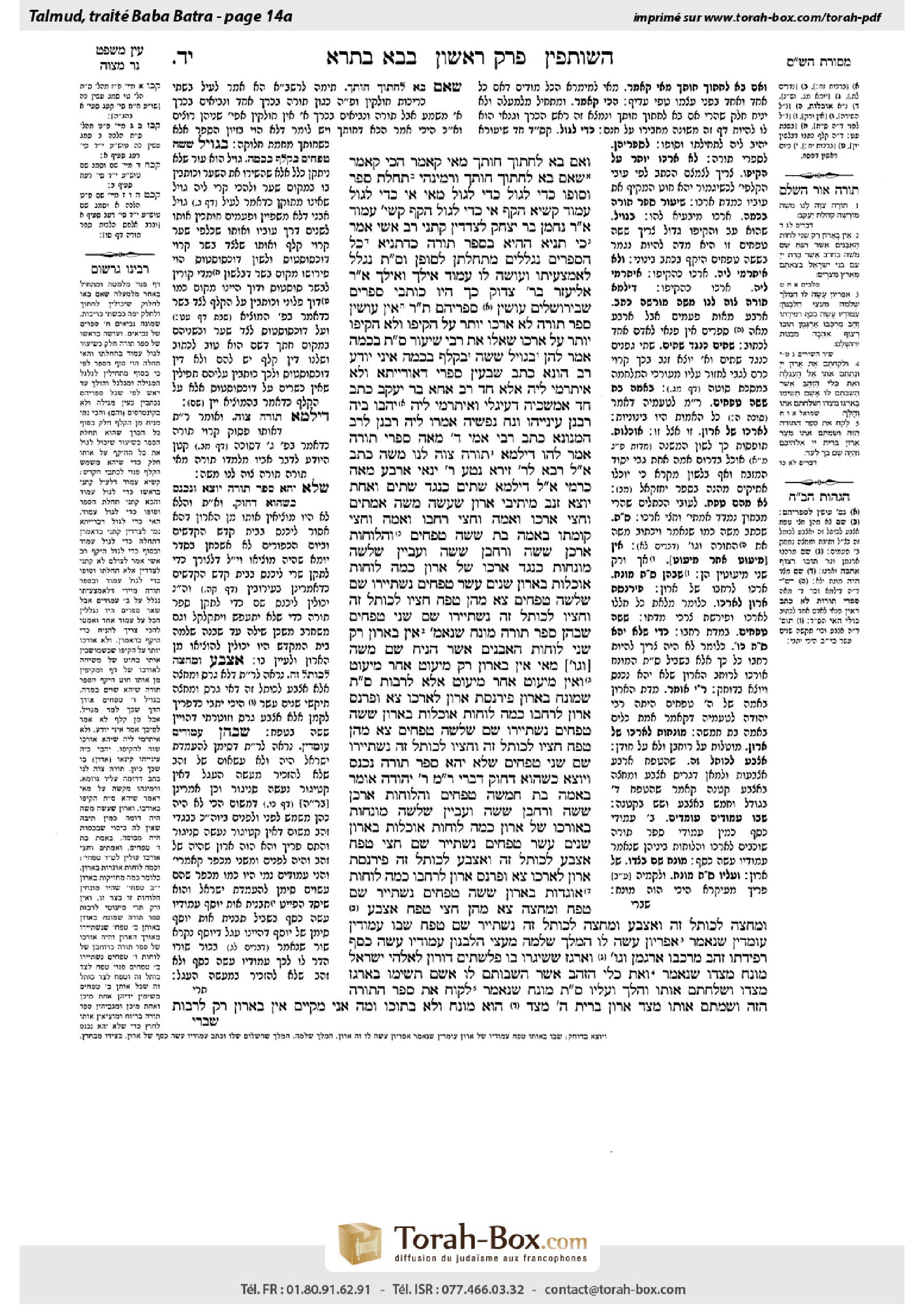
Bava Batra 14a: Talmud study for Daf Yomi
Study the Talmud for Daf Yomi with scanned pages, Hebrew text, English translations from Sefaria and AI-generated French translations.
Passage selection and English or AI-generated French translation are available where the scan has annotations. Daf Study is independent of Torah-Box and Sefaria.
Browse Bava Batra · בבא בתרא · All tractatesBava Batra 14a text and translations
This page of Bava Batra includes the Aramaic text, an English translation and an AI-generated French translation, alongside the scan above.
בבא בתרא י״ד א · Aramaic and Hebrew text
וְאִם בָּא לַחְתּוֹךְ – חוֹתֵךְ. מַאי קָאָמַר? הָכִי קָאָמַר: שֶׁאִם בָּא לַחְתּוֹךְ – חוֹתֵךְ.
וּרְמִינְהִי: תְּחִלַּת סֵפֶר וְסוֹפוֹ – כְּדֵי לָגוֹל. כְּדֵי לָגוֹל מַאי? אִי כְּדֵי לָגוֹל עַמּוּד – קַשְׁיָא הֶקֵּף; אִי כְּדֵי לָגוֹל הֶקֵּף – קַשְׁיָא עַמּוּד!
אָמַר רַב נַחְמָן בַּר יִצְחָק: לִצְדָדִין קָתָנֵי.
רַב אָשֵׁי אָמַר: כִּי תַּנְיָא הָהִיא – בְּסֵפֶר תּוֹרָה. כִּדְתַנְיָא: כׇּל הַסְּפָרִים נִגְלָלִים מִתְּחִלָּתָן לְסוֹפָן; וְסֵפֶר תּוֹרָה נִגְלָל לְאֶמְצָעִיתוֹ, וְעוֹשֶׂה לוֹ עַמּוּד אֵילָךְ וְאֵילָךְ. אֲמַר רַבִּי אֱלִיעֶזֶר בְּרַבִּי צָדוֹק: כָּךְ הָיוּ כּוֹתְבֵי סְפָרִים שֶׁבִּירוּשָׁלַיִם עוֹשִׂין סִפְרֵיהֶם.
תָּנוּ רַבָּנַן: אֵין עוֹשִׂין סֵפֶר תּוֹרָה – לֹא אׇרְכּוֹ יוֹתֵר עַל הֶקֵּיפוֹ, וְלֹא הֶקֵּיפוֹ יוֹתֵר עַל אׇרְכּוֹ. שָׁאֲלוּ אֶת רַבִּי: שִׁיעוּר סֵפֶר תּוֹרָה בְּכַמָּה? אָמַר לָהֶן: בִּגְוִיל – שִׁשָּׁה. בִּקְלָף בְּכַמָּה? אֵינִי יוֹדֵעַ.
רַב הוּנָא כְּתַב שִׁבְעִין סִפְרֵי דְּאוֹרָיְיתָא, וְלָא אִיתְרְמִי לֵיהּ אֶלָּא חַד. רַב אַחָא בַּר יַעֲקֹב כְּתַב חַד אַמַּשְׁכֵּיהּ דְּעִיגְלֵי, וְאִיתְרְמִי לֵיהּ. יְהַבוּ בֵּיהּ רַבָּנַן עֵינַיְיהוּ, וְנָח נַפְשֵׁיהּ.
אֲמַרוּ לֵיהּ רַבָּנַן לְרַב הַמְנוּנָא: כְּתַב רַבִּי אַמֵּי אַרְבַּע מְאָה סִפְרֵי תּוֹרָה. אָמַר לְהוּ: דִילְמָא ״תּוֹרָה צִוָּה לָנוּ מֹשֶׁה״ כְּתַב. אֲמַר לֵיהּ רָבָא לְרַבִּי זֵירָא: נְטַע רַבִּי יַנַּאי אַרְבַּע מְאָה כַּרְמֵי. אֲמַר לֵיהּ: דִּילְמָא שְׁתַּיִם כְּנֶגֶד שְׁתַּיִם, וְאַחַת יוֹצֵא זָנָב.
מֵיתִיבִי: אָרוֹן שֶׁעָשָׂה מֹשֶׁה – אַמָּתַיִם וָחֵצִי אׇרְכּוֹ, וְאַמָּה וָחֵצִי רׇחְבּוֹ, וְאַמָּה וָחֵצִי קוֹמָתוֹ – בְּאַמָּה בַּת שִׁשָּׁה טְפָחִים.
וְהַלּוּחוֹת – אׇרְכָּן שִׁשָּׁה, וְרׇחְבָּן שִׁשָּׁה, וְעׇבְיָין שְׁלֹשָׁה; מוּנָּחוֹת כְּנֶגֶד אׇרְכּוֹ שֶׁל אָרוֹן. כַּמָּה לוּחוֹת אוֹכְלוֹת בָּאָרוֹן – שְׁנֵים עָשָׂר טְפָחִים. נִשְׁתַּיְּירוּ שָׁם שְׁלֹשָׁה טְפָחִים. צֵא מֵהֶן טֶפַח – חֶצְיוֹ לְכוֹתֶל זֶה וְחֶצְיוֹ לְכוֹתֶל זֶה – נִשְׁתַּיְּירוּ שָׁם שְׁנֵי טְפָחִים, שֶׁבָּהֶן סֵפֶר תּוֹרָה מוּנָּח.
שֶׁנֶּאֱמַר: ״אֵין בָּאָרוֹן רַק שְׁנֵי לֻחוֹת הָאֲבָנִים אֲשֶׁר הִנִּחַ שָׁם מֹשֶׁה [וְגוֹ׳]״ – מַאי ״אֵין בָּאָרוֹן רַק״? מִיעוּט אַחַר מִיעוּט; וְאֵין מִיעוּט אַחַר מִיעוּט אֶלָּא לְרַבּוֹת – סֵפֶר תּוֹרָה שֶׁמּוּנָּח בָּאָרוֹן.
פִּירְנַסְתָּ אָרוֹן לְאׇרְכּוֹ; צֵא וּפַרְנֵס אָרוֹן לְרׇחְבּוֹ – כַּמָּה לוּחוֹת אוֹכְלוֹת בָּאָרוֹן? שִׁשָּׁה טְפָחִים. נִשְׁתַּיְּירוּ שָׁם שְׁלֹשָׁה טְפָחִים; צֵא מֵהֶן טֶפַח – חֶצְיוֹ לְכוֹתֶל זֶה וְחֶצְיוֹ לְכוֹתֶל זֶה – נִשְׁתַּיְּירוּ שָׁם שְׁנֵי טְפָחִים, שֶׁלֹּא יְהֵא סֵפֶר תּוֹרָה נִכְנָס וְיוֹצֵא כְּשֶׁהוּא דָּחוּק; דִּבְרֵי רַבִּי מֵאִיר.
רַבִּי יְהוּדָה אוֹמֵר: בְּאַמָּה בַּת חֲמִשָּׁה טְפָחִים. וְהַלּוּחוֹת – אׇרְכָּן שִׁשָּׁה, וְרׇחְבָּן שִׁשָּׁה, וְעׇבְיָין שְׁלֹשָׁה; מוּנָּחוֹת בְּאוֹרְכּוֹ שֶׁל אָרוֹן. כַּמָּה לוּחוֹת אוֹכְלוֹת בָּאָרוֹן – שְׁנֵים עָשָׂר טְפָחִים; נִשְׁתַּיֵּיר שָׁם חֲצִי טֶפַח – אֶצְבַּע לְכוֹתֶל זֶה וְאֶצְבַּע לְכוֹתֶל זֶה.
פִּירְנַסְתָּ אָרוֹן לְאׇרְכּוֹ; צֵא וּפַרְנֵס אָרוֹן לְרׇחְבּוֹ – כַּמָּה לוּחוֹת אוֹגְדוֹת בָּאָרוֹן? שִׁשָּׁה טְפָחִים. נִשְׁתַּיֵּיר שָׁם טֶפַח וּמֶחֱצָה; צֵא מֵהֶן חֲצִי טֶפַח – אֶצְבַּע וּמֶחֱצָה לְכוֹתֶל זֶה וְאֶצְבַּע וּמֶחֱצָה לְכוֹתֶל זֶה – נִשְׁתַּיֵּיר שָׁם טֶפַח, שֶׁבּוֹ עַמּוּדִין עוֹמְדִין – שֶׁנֶּאֱמַר: ״אַפִּרְיוֹן עָשָׂה לוֹ הַמֶּלֶךְ שְׁלֹמֹה מֵעֲצֵי הַלְּבָנוֹן, עַמּוּדָיו עָשָׂה כֶסֶף, רְפִידָתוֹ זָהָב, מֶרְכָּבוֹ אַרְגָּמָן וְגוֹ׳״.
וְאַרְגַּז שֶׁשִּׁיגְּרוּ בּוֹ פְּלִשְׁתִּים דּוֹרוֹן לֵאלֹהֵי יִשְׂרָאֵל מוּנָּח מִצִּדּוֹ, שֶׁנֶּאֱמַר: ״וְאֵת כְּלֵי הַזָּהָב אֲשֶׁר הֲשֵׁבֹתֶם לוֹ, אָשָׁם תָּשִׂימוּ בָאַרְגַּז מִצִּדּוֹ, וְשִׁלַּחְתֶּם אוֹתוֹ וְהָלָךְ״. וְעָלָיו סֵפֶר תּוֹרָה מוּנָּח, שֶׁנֶּאֱמַר: ״לָקֹחַ אֵת סֵפֶר הַתּוֹרָה הַזֶּה, וְשַׂמְתֶּם אֹתוֹ מִצַּד אֲרוֹן בְּרִית ה׳״ – מִצַּד הוּא מוּנָּח, וְלֹא בְּתוֹכוֹ.
וּמָה אֲנִי מְקַיֵּים ״אֵין בָּאָרוֹן רַק״? לְרַבּוֹת
Bava Batra 14a · English translation
And if he wishes to cut the scroll, he may cut it. The Gemara is surprised at this: What is the tanna saying? Why is mention made here of cutting the scroll? The Gemara answers: This is what the tanna is saying: He arranges the text so that if he finishes a book at the bottom of one column, he begins the next book at the top of the next column without leaving any empty space, so that if he wishes to cut the scroll, he may cut it. If he does not begin the next book at the top of the next column, he will not be able to cut the scroll, because it is not fitting for a scroll to begin with an empty space.
The Gemara raises a contradiction between this baraita and another baraita that teaches: Enough parchment should be left at the beginning of the scroll and at its end for winding. The Gemara clarifies: For winding around what? If it means for winding around the pole to which the beginning of the scroll is fastened, this is difficult in light of what is taught in the first baraita, that at the end of the scroll enough parchment should be left for winding around the entire circumference of the scroll. And if it means for winding around the entire circumference, this is difficult in light of what is taught in the first baraita that at the beginning of the scroll enough parchment should be left for winding around the pole.
Rav Naḥman bar Yitzḥak said: The tanna teaches the halakha disjunctively, referring to two separate cases. He issues a general statement requiring that enough parchment be left for winding as needed: At the beginning of the pole, enough to wind around the pole, and at the end of the scroll, enough to wind around the circumference.
Rav Ashi said: When that second baraita is taught, indicating that the same measure of parchment is left at both the beginning and the end of the scroll, it was referring to a Torah scroll, as it is taught in a baraita: All other scrolls are wound from the beginning to the end around a single pole, but a Torah scroll is wound from both ends to the middle around two poles, one of which he attaches at this end of the scroll and the other at the other end. Rabbi Eliezer, son of Rabbi Tzadok, said: This is how the scribes in Jerusalem made their scrolls, i.e., with poles at either end so that it could be rolled to the middle.
§ The Sages taught: A Torah scroll should not be made in such a manner that its length, i.e., its height, is greater than its circumference when it is rolled up; nor should its circumference be greater than its length. They asked Rabbi Yehuda HaNasi: What should the size of a Torah scroll be? Rabbi Yehuda HaNasi said to them: If it was written on a hide that was treated with gallnuts [gevil ] it should be six handbreadths long. They asked him further: How much should it be if it was written on ordinary parchment [kelaf ]? Rabbi Yehuda HaNasi said to them: I do not know.
It is related that Rav Huna wrote seventy Torah scrolls himself, and it happened for him only once that the length and the circumference were equal. Rav Aḥa bar Ya’akov wrote one Torah scroll on calf hide and it happened to have the same length and circumference. The Sages looked at him and his achievement with jealousy, and he died from their envious gaze.
The Sages said to Rav Hamnuna: Rabbi Ami wrote four hundred Torah scrolls. Rav Hamnuna said to them: Perhaps he wrote the verse: “Moses commanded us the Torah” (Deuteronomy 33:4) four hundred times, rather than four hundred complete Torah scrolls, as it is difficult to say that he could have written so many, even over a lifetime. Similarly, Rava said to Rabbi Zeira: Rabbi Yannai planted four hundred vineyards. Rava said to him: Perhaps he did not plant large vineyards, but only the smallest possible vineyards recognized by halakha, which are composed of two vines facing another two vines, with a fifth one protruding like a tail, extending out beyond the square.
The Gemara raises an objection to what is taught with regard to the length of a Torah scroll from a baraita: With regard to the Ark of the Covenant that Moses fashioned, its length was two and one-half cubits, its width was one and one-half cubits, and its height was one and one-half cubits (see Exodus 25:10), the cubit used for these measurements being six handbreadths. Therefore, the Ark was fifteen handbreadths long, nine handbreadths wide, and nine handbreadths high.
The baraita continues: And as for the tablets, their length was six handbreadths, their width was six handbreadths, and their thickness was three handbreadths. The tablets were placed along the length of the Ark, one next to the other. If so, how much space did the tablets occupy along the length of the Ark? Twelve handbreadths, as each tablet was six handbreadths long. Three handbreadths were left there along the length of the Ark, for a total of fifteen handbreadths. Deduct a handbreadth from them: One-half a handbreadth for this wall, namely, the thickness of the wooden Ark itself, and one-half a handbreadth for the other wall. Accordingly, two handbreadths were left there, in which the Torah scroll written by Moses lay.
What biblical source indicates that a Torah scroll was placed there? As it is stated: “There was nothing in the Ark except the two tablets of stone which Moses put there” (I Kings 8:9). What does “there was nothing in the Ark except” mean? This is an example of a restriction following a restriction, as both terms, “nothing” and “except,” indicate that the Ark was empty. And there is a hermeneutical principle that a restriction following a restriction serves only to amplify and include other matters. In this case, it serves to include a Torah scroll that lies in the Ark.
The baraita continues: With this explanation you have accounted for the entire length of the Ark; go now and account for the width of the Ark, which was nine handbreadths. How much space did the tablets occupy of the width of the Ark, which was nine handbreadths wide? Six handbreadths; therefore, three handbreadths were left there along the width of the Ark. Deduct a handbreadth from them: One-half a handbreadth for the thickness of this wall and one-half a handbreadth for the thickness of the other wall. Accordingly, two handbreadths were left there. What was their purpose? These were necessary so that the Torah scroll would be able to go in and out without being pressed; this is the statement of Rabbi Meir.
Rabbi Yehuda disagrees and says: The cubit used for all the measurements of the Ark was five handbreadths long. There-fore, the Ark was twelve and one-half handbreadths long, seven and one-half handbreadths wide, and seven and one-half handbreadths high. And as for the tablets, their length was six handbreadths, their width was six handbreadths, and their thickness was three handbreadths, and they were placed along the length of the Ark, one next to the other. If so, how much space did the tablets occupy along the length of the Ark? Twelve handbreadths, so that one-half a handbreadth was left there, which is two fingerbreadths. One fingerbreadth of those two was for the thickness of this wall and one fingerbreadth of those two was for the thickness of the other wall.
With this explanation, you have accounted for the entire length of the Ark; go now and account for the width of the Ark, which was seven and one-half handbreadths. How much space did the tablets occupy in the Ark? Six handbreadths, meaning that one and one-half handbreadths were left there along the width of the Ark. Deduct one-half a handbreadth, one and one-half fingerbreadths for the thickness of this wall, and one and one-half fingerbreadths for the thickness of the other wall. Accordingly, one handbreadth was left there in which the silver columns were placed on either side of the tablets, as it is stated: “King Solomon made himself a palanquin of the timbers of Lebanon; he made its columns of silver, its back of gold, its seat of purple” (Song of Songs 3:9–10). This is understood as an allusion to the Ark of the Covenant.
And the chest in which the Philistines sent the gift to the God of Israel was placed alongside the Ark, as it is stated: “And put the golden devices which you are restoring to Him for a guilt-offering in a chest by the side of it, and send it away that it may go” (I Samuel 6:8). And upon this chest lay the Torah scroll, as it is stated: “Take this Torah scroll and put it at the side of the Ark of the Covenant of the Lord” (Deuteronomy 31:26). This means that it was placed at the side of the Ark, and not inside it.
And accordingly, how do I realize the meaning of that which is stated: “There was nothing in the Ark except the two tablets of stone which Moses put there,” which, according to the opinion of Rabbi Meir, teaches that something else was in the Ark besides the tablets themselves? It serves to include
Bava Batra 14a · Traduction française (IA)
Et s'il veut couper le rouleau, il peut le couper. La Guemara est surprise par cela : Quel est le tanna qui dit cela ? Pourquoi mentionne-t-il ici la coupe du rouleau ? La Guemara répond : C'est ce que le tanna dit : Il dispose le texte de sorte que s'il termine un livre en bas d'une colonne, il commence le prochain livre en haut de la colonne suivante sans laisser d'espace vide, de sorte que s'il veut couper le rouleau, il peut le couper. S'il ne commence pas le prochain livre en haut de la colonne suivante, il ne pourra pas couper le rouleau, car il n'est pas convenable qu'un rouleau commence avec un espace vide.
La Guemara soulève une contradiction entre cette baraïta et une autre baraïta qui enseigne : Il faut laisser assez de parchemin au début et à la fin du rouleau pour le rouler. La Guemara clarifie : Pour rouler autour de quoi ? Si cela signifie pour rouler autour du bâton auquel le début du rouleau est fixé, cela est difficile à comprendre en lumière de ce qui est enseigné dans la première baraïta, à savoir que la fin du rouleau doit laisser assez de parchemin pour enrouler autour de tout le contour du rouleau. Et si cela signifie pour enrouler autour de tout le contour, cela est difficile à comprendre en lumière de ce qui est enseigné dans la première baraïta, à savoir que le début du rouleau doit laisser assez de parchemin pour enrouler autour du bâton.
Rav Naḥman bar Yitzḥak a dit : Le tanna enseigne la halakha de manière disjunctive, en faisant référence à deux cas distincts. Il formule une déclaration générale exigeant que suffisamment de parchemin soit laissé pour enrouler selon les besoins : au début du bâton, suffisamment pour enrouler autour du bâton, et à la fin du rouleau, suffisamment pour enrouler autour du contour.
Rav Ashi a dit : Lorsque cette deuxième baraïta est enseignée, indiquant que la même mesure de parchemin est laissée à la fois au début et à la fin du rouleau, cela faisait référence à un rouleau de Torah, comme il est enseigné dans une baraïta : Tous les autres rouleaux sont enroulés du début à la fin autour d'un seul bâton, mais un rouleau de Torah est enroulé des deux extrémités vers le milieu autour de deux bâtons, l'un auquel il attache cette extrémité du rouleau et l'autre à l'autre extrémité. Rabbi Eliezer, fils de Rabbi Tzadok, a dit : C'est ainsi que les scribes de Jérusalem faisaient leurs rouleaux, c'est-à-dire avec des bâtons aux deux extrémités afin qu'il puisse être enroulé vers le milieu.
§ Les Sages ont enseigné : Un rouleau de Torah ne doit pas être fait de sorte que sa longueur, c'est-à-dire sa hauteur, soit supérieure à son contour lorsqu'il est enroulé ; ni son contour ne doit être supérieur à sa longueur. Ils ont interrogé Rabbi Yehuda HaNasi : Quelle doit être la taille d'un rouleau de Torah ? Rabbi Yehuda HaNasi a répondu à eux : Si c'était écrit sur un cuir traité avec du gall, il devait être six tefachim de long. Ils ont interrogé davantage : Combien devait-il être s'il était écrit sur du parchemin ordinaire ? Rabbi Yehuda HaNasi a répondu à eux : Je ne sais pas.
Il est rapporté que Rav Huna a lui-même écrit soixante-dix rouleaux de Torah, et cela s'est produit chez lui une seule fois que la longueur et le contour étaient égaux. Rav Aḥa bar Ya’akov a écrit un rouleau de Torah sur un cuir de veau et cela s'est produit qu'il avait la même longueur et le même contour. Les Sages ont regardé lui et son accomplissement avec jalousie, et il est mort de leur regard jaloux.
Les Sages ont dit à Rav Hamnuna : Rabbi Ami a écrit quatre cents rouleaux de Torah. Rav Hamnuna a dit à eux : Peut-être qu'il a répété la verset : « Moïse a commandé nous la Torah » (Deutéronome 33:4) quatre cents fois, plutôt que quatre cents rouleaux de Torah complets, car c'est difficile de dire qu'il ait pu écrire autant, même sur une vie. De même, Rava a dit à Rabbi Zeira : Rabbi Yannai a planté quatre cents vergers. Rava a dit à lui : Peut-être qu'il n'a pas planté de grands vergers, mais seulement les plus petits possibles reconnus par la halakha, qui sont composés de deux vignes face à deux autres vignes, avec une cinquième qui dépasse comme une queue, s'étendant au-delà du carré.
La Guemara soulève une objection à ce qui est enseigné concernant la longueur d'un rouleau de Torah à partir d'une baraïta : Concernant l'Arca du Pacte que Moïse a façonné, sa longueur était deux et demie coudées, sa largeur était une et demie coudées, et sa hauteur était une et demie coudées (voir Exode 25:10), la coudée utilisée pour ces mesures étant six tefachim. Ainsi, l'Arca mesurait quinze tefachim de long, neuf tefachim de large, et neuf tefachim de haut.
La baraïta continue : Et concernant les tables, leur longueur était six tefachim, leur largeur six tefachim, et leur épaisseur trois tefachim. Les tables étaient placées le long de la longueur de l'Arca, l'une à côté de l'autre. Si c'est ainsi, combien d'espace les tables occupaient-elles le long de la longueur de l'Arca ? Douze tefachim, car chaque table était six tefachim de long. Trois tefachim étaient laissés là le long de la longueur de l'Arca, pour un total de quinze tefachim. Soustrayez un tefach : demi-tefach pour ce mur, c'est-à-dire l'épaisseur de l'Arca en bois elle-même, et demi-tefach pour l'autre mur. Ainsi, deux tefachim étaient laissés là, dans lesquels reposait le rouleau de Torah écrit par Moïse.
Quel texte biblique indique que le rouleau de Torah était placé là ? Comme il est dit : « Il n'y avait rien dans l'Arca, sauf les deux tables de pierre que Moïse avait mis là » (I Rois 8:9). Que signifie « il n'y avait rien dans l'Arca, sauf » ? C'est un exemple d'une restriction suivie d'une restriction, car les deux termes, « rien » et « sauf », indiquent que l'Arca était vide. Et il y a un principe herméneutique selon lequel une restriction suivie d'une restriction sert seulement à amplifier et à inclure d'autres choses. Dans ce cas, il sert à inclure un rouleau de Torah qui est placé dans l'Arca.
La baraïta continue : Avec cette explication, vous avez tenu compte de toute la longueur de l'Arca ; allez maintenant et tenez compte de la largeur de l'Arca, qui était de neuf paumes. Combien d'espace les tables occupaient-elles sur la largeur de l'Arca, qui était de neuf paumes de large ? Six paumes ; donc, trois paumes restaient sur la largeur de l'Arca. Retirez une paume d'eux : demi-paume pour l'épaisseur de ce mur et demi-paume pour l'épaisseur de l'autre mur. Ainsi, deux paumes restaient. À quel usage servaient-elles ? C'étaient nécessaires afin que le rouleau de la Torah pût entrer et sortir sans être comprimé ; c'est la déclaration de Rabbi Meir.
Rabbi Yéhuda s'oppose à cela et dit : Le coudée utilisé pour toutes les mesures de l'Arca était de cinq paumes de long. Donc, l'Arca était de douze et demi paumes de long, de sept et demi paumes de large et de sept et demi paumes de haut. Et quant aux tables, leur longueur était de six paumes, leur largeur de six paumes, leur épaisseur de trois paumes, et elles étaient placées le long de la longueur de l'Arca, l'une à côté de l'autre. Si c'est ainsi, combien d'espace les tables occupaient-elles le long de la longueur de l'Arca ? Douze paumes, donc il restait demi-paume, soit deux doigts. Un doigt de ces deux était pour l'épaisseur de ce mur et un doigt de ces deux était pour l'épaisseur de l'autre mur.
Avec cette explication, vous avez tenu compte de toute la longueur de l'Arca ; allez maintenant et tenez compte de la largeur de l'Arca, qui était de sept et demi paumes. Combien d'espace les tables occupaient-elles dans l'Arca ? Six paumes, ce qui signifie que un et demi paumes restaient sur la largeur de l'Arca. Retirez demi-paume, un et demi doigts pour l'épaisseur de ce mur, et un et demi doigts pour l'épaisseur de l'autre mur. Ainsi, un paume restait dans lequel les colonnes d'argent étaient placées de chaque côté des tables, comme il est dit : « Salomon fit lui-même un chariot de bois de cèdre ; il fit ses colonnes d'argent, son dos d'or, son siège de pourpre » (Cantique des Cantiques 3:9–10). Cela est compris comme une allusion à l'Arca du Pacte.
Et le coffre dans lequel les Philistins envoyèrent le don au Dieu d'Israël était placé à côté de l'Arca, comme il est dit : « Et place les objets d'or que tu restitues à Lui en sacrifice expiatoire dans un coffre à côté de lui, et envoie-le loin afin qu'il aille » (1 Samuel 6:8). Et sur ce coffre reposait le rouleau de la Torah, comme il est dit : « Prends ce rouleau de la Torah et place-le à côté de l'Arca du Pacte du Seigneur » (Deutéronome 31:26). Cela signifie qu'il était placé à côté de l'Arca, et non à l'intérieur d'elle.
Et ainsi, comment puis-je comprendre le sens de ce qui est dit : « Il n'y avait rien dans l'Arca, sauf les deux tables de pierre que Moïse y avait mis », qui, selon l'opinion de Rabbi Meir, enseigne que quelque chose d'autre était dans l'Arca en dehors des tables elles-mêmes ? Cela sert à inclure les objets mentionnés dans la Torah.
Traduction française générée par IA à partir de l’édition anglaise de Sefaria. Vérifie toujours un passage avec le texte source.
Text from Sefaria: William Davidson Edition - Vocalized Aramaic (CC BY NC); William Davidson Edition - English (CC BY NC).