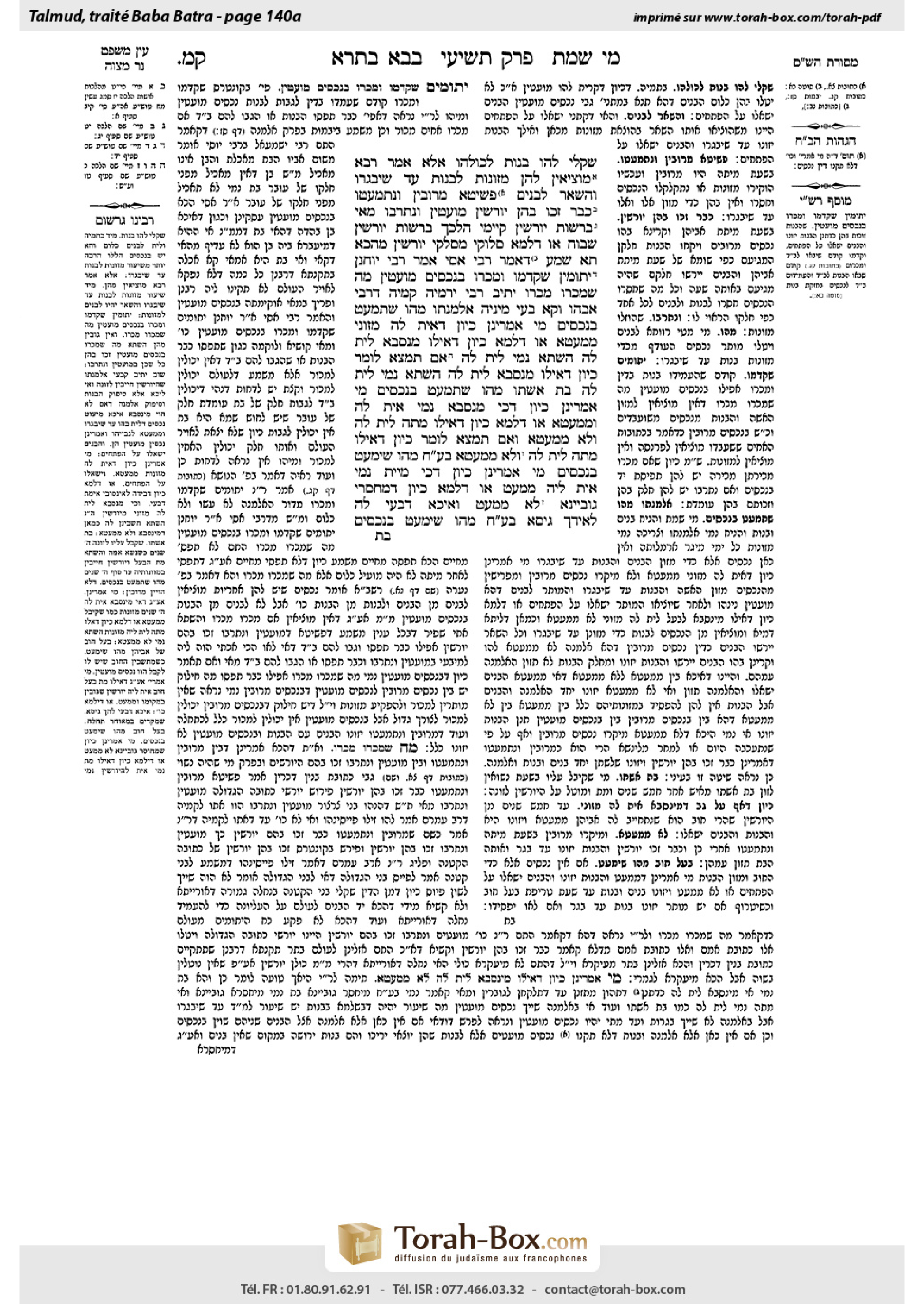
Bava Batra 140a: Talmud study for Daf Yomi
Study the Talmud for Daf Yomi with scanned pages, Hebrew text, English translations from Sefaria and AI-generated French translations.
Passage selection and English or AI-generated French translation are available where the scan has annotations. Daf Study is independent of Torah-Box and Sefaria.
Browse Bava Batra · בבא בתרא · All tractatesBava Batra 140a text and translations
This page of Bava Batra includes the Aramaic text, an English translation and an AI-generated French translation, alongside the scan above.
בבא בתרא ק״מ א · Aramaic and Hebrew text
שָׁקְלִי לְהוּ בָּנוֹת לְכוּלְּהוּ?! אֶלָּא אָמַר רָבָא: מוֹצִיאִין לָהֶן מְזוֹנוֹת לַבָּנוֹת עַד שֶׁיִּבְגְּרוּ, וְהַשְּׁאָר לַבָּנִים.
פְּשִׁיטָא – מְרוּבִּין וְנִתְמַעֲטוּ, כְּבָר זָכוּ בָּהֶן יוֹרְשִׁין. מוּעָטִין וְנִתְרַבּוּ, מַאי? בִּרְשׁוּת יוֹרְשִׁין קָיְימִי – הִלְכָּךְ בִּרְשׁוּת יוֹרְשִׁין שְׁבוּח; אוֹ דִּלְמָא, סַלּוֹקֵי מְסַלְּקִי יוֹרְשִׁין מֵהָכָא?
תָּא שְׁמַע, דְּאָמַר רַבִּי אַסִּי אָמַר רַבִּי יוֹחָנָן: יְתוֹמִין שֶׁקָּדְמוּ וּמָכְרוּ בִּנְכָסִים מוּעָטִין – מַה שֶּׁמָּכְרוּ, מָכְרוּ.
יָתֵיב רַבִּי יִרְמְיָה קַמֵּיהּ דְּרַבִּי אֲבָהוּ, וְקָא בָּעֵי מִינֵּיהּ: אַלְמְנָתוֹ, מַהוּ שֶׁתְּמַעֵט בַּנְּכָסִים? מִי אָמְרִינַן: כֵּיוָן דְּאִית לַהּ מְזוֹנֵי – מְמַעֲטָא; אוֹ דִלְמָא, כֵּיוָן דְּאִילּוּ מִנַּסְבָא – לֵית לַהּ, הַשְׁתָּא נָמֵי לֵית לַהּ?
אִם תִּמְצָא לוֹמַר: כֵּיוָן דְּאִילּוּ מִנַּסְבָא לֵית לַהּ – הַשְׁתָּא נָמֵי לֵית לַהּ; בַּת אִשְׁתּוֹ, מַהוּ שֶׁתְּמַעֵט בַּנְּכָסִים? מִי אָמְרִינַן: כֵּיוָן דְּכִי מִנַּסְבָא נָמֵי אִית לַהּ – וּמְמַעֲטָא; אוֹ דִלְמָא, כֵּיוָן דְּאִילּוּ מֵתָה לֵית לַהּ – וְלָא מְמַעֲטָא?
וְאִם תִּמְצָא לוֹמַר: כֵּיוָן דְּאִילּוּ מֵתָה לֵית לַהּ – וְלָא מְמַעֲטָא; בַּעַל חוֹב – מַהוּ שֶׁיְּמַעֵט בַּנְּכָסִים? מִי אָמְרִינַן: כֵּיוָן דְּכִי מָיֵית נָמֵי אִית לֵיהּ, מְמַעֵט; אוֹ דִלְמָא, כֵּיוָן דִּמְחַסְּרִי גּוּבְיָינָא, לָא מְמַעֵט?
וְאִיכָּא דְּבָעֵי לַהּ לְאִידַּךְ גִּיסָא – בַּעַל חוֹב, מַהוּ שֶׁיְּמַעֵט בַּנְּכָסִים?
Bava Batra 140a · English translation
shall the daughters take all of the estate, even if it is more than is required for their sustenance? Rather, Rava said: The court appropriates sustenance for the daughters until they reach their majority, and the remainder is given to the sons.
§ The Gemara comments: It is obvious that if the estate was large and became small, the heirs, i.e., the sons, already acquired it when it was large. It remains in their possession, and they must provide for the daughters from it. The Gemara asks: If the estate was small, and was therefore not inherited by the sons, and then it became large, what is the halakha? Does even a small estate remain in the possession of the heirs, while the court reserves it for the daughters’ sustenance, and therefore it appreciated in the possession of the heirs and they receive the appreciation in the estate’s value? Or perhaps the heirs are totally removed from possession of a small estate, and the appreciation in value is to the benefit of the daughters receiving sustenance.
The Gemara answers: Come and hear a proof, as Rabbi Asi says that Rabbi Yoḥanan says: In the case of orphans who preemptively sold land from a small estate left to them by their father, before the court appropriated it for the daughters’ sustenance, concerning that which they sold, the sale is valid, even though they acted improperly. One can infer from this that a small estate remains in the possession of the heirs even when they are not authorized to derive benefit from it, and therefore the appreciation in its value belongs to them.
§ Rabbi Yirmeya was sitting before Rabbi Abbahu and raised the following dilemma before him: What is the halakha with regard to the sustenance to which the deceased’s widow is entitled? Does it reduce the value of the estate when evaluating whether the estate is categorized as a large estate or a small estate? Do we say that since she has a right to receive sustenance, it reduces the value of the estate? Or perhaps we say that since if she remarries she does not have a right to sustenance, now as well, for the purposes of determining the value of the estate, she is considered as if she does not have a right to sustenance, and therefore it does not reduce the value of the estate.
Furthermore, if you say that since, if she remarries she does not have a right to sustenance, now as well she is considered as if she does not have a right to sustenance, and it is not taken into account when evaluating the estate, then another dilemma can be raised: What is the halakha with regard to the sustenance one pledged to give, for a certain number of years, to the daughter of his wife from a previous marriage, i.e., his step-daughter, which is an obligation not affected by his death or by her marriage? Does it reduce the value of the estate? Do we say that since, when she marries she also has a right to sustenance, it reduces the value of the estate? Or perhaps we say that since, if she dies she does not have a right to sustenance, it does not reduce the value of the estate.
And if you say that since, if she dies she does not have a right to sustenance, therefore it does not reduce the value of the estate, what is the halakha with regard to a debt owed to the deceased’s creditor? Does it reduce the value of the estate? Do we say that since, when the creditor dies he also has a right to the money owed him, and it is collected by his heirs, therefore it reduces the value of the estate? Or perhaps we say that since it has not yet been collected, it does not reduce the value of the estate.
And there are those who say that Rabbi Yirmeya raised the dilemmas in the opposite direction, i.e., in the reverse order: What is the halakha with regard to a debt owed to a creditor? Does it reduce the value of the estate?
Bava Batra 140a · Traduction française (IA)
Les filles prendront-elles toute la succession, même si elle est plus que ce qui est nécessaire à leur subsistance ? Rava a dit : le tribunal assure la subsistance aux filles jusqu'à ce qu'elles atteignent l'âge de la majorité, et le reste est donné aux fils.
§ La Guemara commente : Il est évident que si la succession était grande et est devenue petite, les héritiers, c'est-à-dire les fils, l'ont déjà acquise lorsqu'elle était grande. Elle reste dans leur possession, et ils doivent subvenir aux besoins des filles à partir d'elle. La Guemara pose la question : si la succession était petite et n'a donc pas été héritée par les fils, et qu'elle est ensuite devenue grande, quelle est la halakha ? La succession petite reste-t-elle dans la possession des héritiers, tandis que le tribunal la réserve pour la subsistance des filles, et donc elle s'apprécie dans la possession des héritiers et ils reçoivent l'appréciation de la valeur de la succession ? Ou bien les héritiers sont-ils totalement exclus de la possession d'une succession petite, et l'appréciation de valeur va au bénéfice des filles qui reçoivent la subsistance ?
La Guemara répond : Viens écouter une preuve, comme Rabbi Asi dit que Rabbi Yoḥanan dit : Dans le cas d'orphelins qui ont vendu un terrain d'une succession petite laissée par leur père, avant que le tribunal ne l'ait attribuée aux filles, concernant ce qu'ils ont vendu, la vente est valide, même s'ils ont agi de manière inappropriée. On peut en déduire que la succession petite reste dans la possession des héritiers même lorsqu'ils ne sont pas autorisés à en tirer un bénéfice, et donc l'appréciation de sa valeur appartient à eux.
§ Rabbi Yirmeya était assis devant Rabbi Abbahu et lui présenta le dilemme suivant : Quelle est la halakha concernant la subsistance à laquelle la veuve du défunt a droit ? Réduit-elle la valeur de la succession lorsqu'on évalue si la succession est considérée comme grande ou petite ? Disons-nous que puisqu'elle a le droit de recevoir la subsistance, cela réduit la valeur de la succession ? Ou bien disons-nous que puisqu'elle ne possède plus le droit à la subsistance si elle se remarie, elle est considérée comme si elle n'avait pas le droit à la subsistance, et donc cela ne réduit pas la valeur de la succession ?
De plus, si tu dis que puisqu'elle ne possède plus le droit à la subsistance si elle se remarie, elle est considérée comme si elle n'avait pas le droit à la subsistance, et qu'elle n'est pas prise en compte lors de l'évaluation de la succession, alors un autre dilemme peut être posé : Quelle est la halakha concernant la subsistance que l'on a promis de donner, pendant un certain nombre d'années, à la fille de son épouse d'une précédente union, c'est-à-dire sa belle-fille, qui est une obligation non affectée par sa mort ou par son mariage ? Réduit-elle la valeur de la succession ? Disons-nous que puisqu'elle a le droit à la subsistance lorsqu'elle se marie, cela réduit la valeur de la succession ? Ou bien disons-nous que puisqu'elle n'a pas le droit à la subsistance si elle meurt, cela ne réduit pas la valeur de la succession ?
Et si tu dis que puisqu'elle ne possède pas le droit à la subsistance en cas de décès, donc cela ne réduit pas la valeur de la succession, quelle est la halakha concernant une dette due à un créancier du défunt ? Réduit-elle la valeur de la succession ? Disons-nous que puisqu'en cas de décès du créancier, il a aussi le droit à l'argent dû, et qu'il est récupéré par ses héritiers, donc cela réduit la valeur de la succession ? Ou bien disons-nous que puisque cela n'a pas encore été récupéré, cela ne réduit pas la valeur de la succession ?
Et il y a ceux qui disent que Rabbi Yirmeya a posé les dilemmes dans l'ordre inverse, c'est-à-dire dans l'ordre opposé : Quelle est la halakha concernant une dette due à un créancier ? Réduit-elle la valeur de la succession ?
Traduction française générée par IA à partir de l’édition anglaise de Sefaria. Vérifie toujours un passage avec le texte source.
Text from Sefaria: William Davidson Edition - Vocalized Aramaic (CC BY NC); William Davidson Edition - English (CC BY NC).