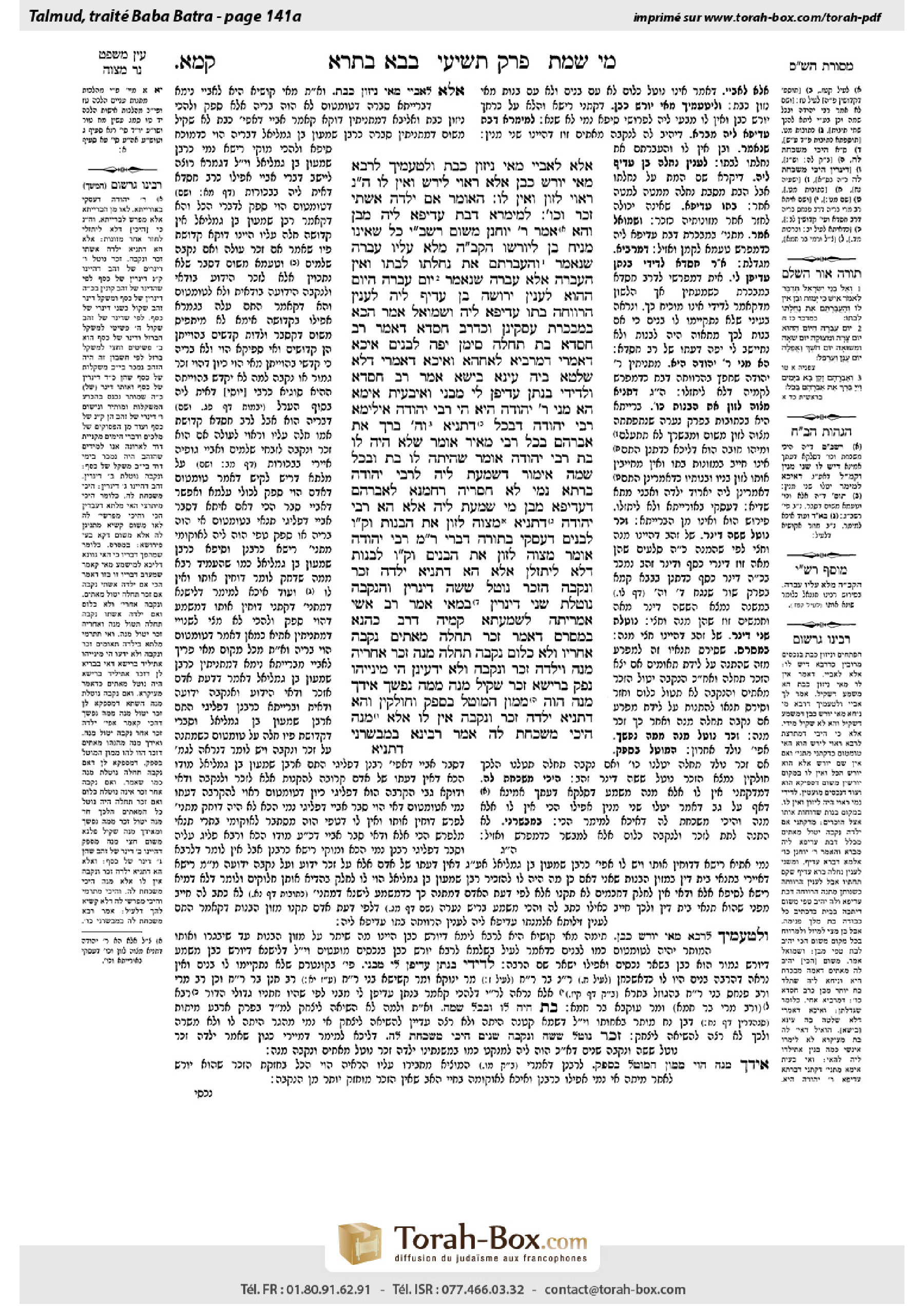
Bava Batra 141a: Talmud study for Daf Yomi
Study the Talmud for Daf Yomi with scanned pages, Hebrew text, English translations from Sefaria and AI-generated French translations.
Passage selection and English or AI-generated French translation are available where the scan has annotations. Daf Study is independent of Torah-Box and Sefaria.
Browse Bava Batra · בבא בתרא · All tractatesBava Batra 141a text and translations
This page of Bava Batra includes the Aramaic text, an English translation and an AI-generated French translation, alongside the scan above.
בבא בתרא קמ״א א · Aramaic and Hebrew text
אֶלָּא לְאַבָּיֵי, מַאי ״נִיזּוֹן כְּבַת״? וּלְטַעְמָיךְ – לְרָבָא מַאי ״יוֹרֵשׁ כְּבֵן״? אֶלָּא רָאוּי לִירַשׁ – וְאֵין לוֹ; הָכָא נָמֵי, רָאוּי לִזּוֹן – וְאֵין לוֹ.
הָאוֹמֵר: אִם יָלְדָה אִשְׁתִּי זָכָר וְכוּ׳. לְמֵימְרָא דְּבַת עֲדִיפָא לֵיהּ מִבֵּן? וְהָא אָמַר רַבִּי יוֹחָנָן מִשּׁוּם רַבִּי שִׁמְעוֹן בֶּן יוֹחַאי: כֹּל שֶׁאֵינוֹ מַנִּיחַ בֵּן לְיוֹרְשׁוֹ – הַקָּדוֹשׁ בָּרוּךְ הוּא מָלֵא עָלָיו עֶבְרָה, שֶׁנֶּאֱמַר: ״וְהַעֲבַרְתֶּם אֶת נַחֲלָתוֹ לְבִתּוֹ״ – וְאֵין ״הַעֲבָרָה״ אֶלָּא עֶבְרָה, שֶׁנֶּאֱמַר: ״יוֹם עֶבְרָה הַיּוֹם הַהוּא״!
לְעִנְיַן יְרוּשָּׁה – בֵּן עֲדִיף לֵיהּ. לְעִנְיַן הַרְוָוחָה – בִּתּוֹ עֲדִיפָא לֵיהּ.
וּשְׁמוּאֵל אָמַר: הָכָא בִּמְבַכֶּרֶת עָסְקִינַן, וְכִדְרַב חִסְדָּא – דְּאָמַר רַב חִסְדָּא: בַּת תְּחִלָּה – סִימָן יָפֶה לְבָנִים. אִיכָּא דְּאָמְרִי: דִּמְרַבְּיָא לַאֲחָהָא, וְאִיכָּא דְאָמְרִי: דְּלָא שָׁלְטָא בֵּיהּ עֵינָא בִּישָׁא. אָמַר רַב חִסְדָּא: וּלְדִידִי – בְּנָתָן עֲדִיפָן לִי מִבְּנֵי.
וְאִיבָּעֵית אֵימָא: הָא מַנִּי – רַבִּי יְהוּדָה הִיא.
הֵי רַבִּי יְהוּדָה? אִילֵימָא רַבִּי יְהוּדָה דְּ״בַכֹּל״ – דְּתַנְיָא: ״וַה׳ בֵּרַךְ אֶת אַבְרָהָם בַּכֹּל״ – רַבִּי מֵאִיר אוֹמֵר: שֶׁלֹּא הָיָה לוֹ בַּת. רַבִּי יְהוּדָה אוֹמֵר: שֶׁהָיְתָה לוֹ בַּת, וּ״בַכֹּל״ שְׁמָהּ. אֵימוֹר דְּשָׁמְעַתְּ לֵיהּ לְרַבִּי יְהוּדָה – בְּרַתָּא נָמֵי לָא חַסְּרֵיהּ רַחֲמָנָא לְאַבְרָהָם; דַּעֲדִיפָא מִבֵּן מִי שָׁמְעַתְּ לֵיהּ?!
אֶלָּא הָא רַבִּי יְהוּדָה – דְּתַנְיָא: מִצְוָה לָזוּן אֶת הַבָּנוֹת, וְקַל וָחוֹמֶר לַבָּנִים – דְּעָסְקִי בַּתּוֹרָה, דִּבְרֵי רַבִּי מֵאִיר. רַבִּי יְהוּדָה אוֹמֵר: מִצְוָה לָזוּן אֶת הַבָּנִים, וְקַל וָחוֹמֶר לִבָּנוֹת – דְּלָא לִיתַּזְלָן.
אֶלָּא הָא דְּתַנְיָא: יָלְדָה זָכָר וּנְקֵבָה – הַזָּכָר נוֹטֵל שִׁשָּׁה דִּינָרִין, וְהַנְּקֵבָה נוֹטֶלֶת שְׁנֵי דִּינָרִין; בְּמַאי?
אָמַר רַב אָשֵׁי: אַמְרִיתַהּ לִשְׁמַעְתָּא קַמֵּיהּ דְּרַב כָּהֲנָא: בִּמְסָרֵס, דְּאָמַר: ״זָכָר תְּחִלָּה – מָאתַיִם, נְקֵבָה אַחֲרָיו – וְלָא כְּלוּם. נְקֵבָה תְּחִלָּה – מָנֶה, זָכָר אַחֲרֶיהָ – מָנֶה״. וְיָלְדָה זָכָר וּנְקֵבָה, וְלָא יָדְעִינַן הֵי מִינַּיְיהוּ נְפַק בְּרֵישָׁא. זָכָר שָׁקֵיל מָנֶה מִמָּה נַפְשָׁךְ, אִידַּךְ מָנֶה – הָוֵה מָמוֹן הַמּוּטָּל בְּסָפֵק, וְחוֹלְקִין.
וְהָא דְּתַנְיָא: יָלְדָה זָכָר וּנְקֵבָה – אֵין לוֹ אֶלָּא מָנֶה, הֵיכִי מַשְׁכַּחַתְּ לַהּ? אָמַר רָבִינָא: בִּ״מְבַשְּׂרֵנִי״ –
Bava Batra 141a · English translation
But according to the opinion of Abaye, what does it mean that the tumtum is sustained as a daughter, since Abaye maintains that the tumtum does not have the rights of a daughter? The Gemara responds: And according to your reasoning, even according to Rava, what does it mean that a tumtum inherits as a son, since Rava concedes that the tumtum and sons do not actually inherit anything? Rather, the baraita means that it is fitting for the tumtum to inherit but he does not actually inherit. Here too, with regard to sustenance, according to Abaye, the baraita means that it is fitting for the tumtum to be sustained, but he is not actually sustained.
§ The mishna teaches: With regard to one who says: If my wife gives birth to a male the offspring shall receive one hundred dinars, if she in fact gave birth to a male, the offspring receives one hundred dinars. If he says: If my wife gives birth to a female the offspring shall receive two hundred dinars, if she in fact gave birth to a female, the offspring receives two hundred dinars. The Gemara asks: Is this to say that for him a daughter is preferable to a son? But this seems to contradict what Rabbi Yoḥanan says in the name of Rabbi Shimon ben Yoḥai: With regard to anyone who does not leave behind a son to inherit from him, the Holy One, Blessed be He, is filled with wrath upon him, as it is stated: “If a man dies, and has no son, then you shall cause his inheritance to pass [veha’avartem] to his daughter” (Numbers 27:8). The term ha’avara means nothing other than wrath, as it is stated: “That day is a day of wrath [evra]” (Zephaniah 1:15).
The Gemara resolves the contradiction: With regard to the matter of inheritance, for him a son is preferable to a daughter, as a son bears his name and retains his ancestral heritage within his father’s tribe, but with regard to the matter of providing for his offspring’s comfort, for him his daughter is preferable to his son, as a son is more capable of coping for himself and the daughter needs more support.
And Shmuel said: Here we are dealing with a mother who is giving birth for the first time, and this is in accordance with the statement of Rav Ḥisda, as Rav Ḥisda says: If one gives birth to a daughter first, it is a good sign for sons. There are those who say that this is because she raises her brothers, i.e., helps in their upbringing, and there are those who say that this is because the evil eye does not have dominion over the father. Rav Ḥisda said: And as for myself, I prefer daughters to sons.
The Gemara adds: And if you wish, say: In accordance with whose statement is this mishna in which preference is given to the daughter? It is in accordance with the statement of Rabbi Yehuda.
The Gemara asks: Which statement of Rabbi Yehuda is this referring to? If we say it is referring to the statement of Rabbi Yehuda with regard to the term “with everything [bakkol],” that is difficult. The Gemara cites Rabbi Yehuda’s statement. As it is taught in a baraita: “And Abraham was old, well stricken in age; and the Lord had blessed Abraham with everything [bakkol]” (Genesis 24:1). Rabbi Meir says: The blessing was that he did not have a daughter. Rabbi Yehuda says: The blessing was that he had a daughter, and her name was Bakkol. Evidently, Rabbi Yehuda understands the birth of a daughter to be a blessing. The Gemara explains the difficulty: Say that you heard Rabbi Yehuda explain that the blessing was that the Merciful One did not even deprive Abraham of a daughter, in addition to his sons. Did you hear him say that a daughter is preferable to a son?
The Gemara proposes another of Rabbi Yehuda’s statements: Rather, it is referring to this other statement of Rabbi Yehuda, as it is taught in a baraita: One is not halakhically obligated to provide sustenance for his children beyond the age of six. Nevertheless, it is a mitzva to provide sustenance for the daughters. And one can infer a fortiori that it is certainly a mitzva to provide for sons, who are engaged in the study of the Torah; this is the statement of Rabbi Meir. Rabbi Yehuda says: It is a mitzva to provide sustenance for the sons. And one can infer a fortiori that it is certainly a mitzva to provide for daughters, so that they not be disgraced by having to beg for their livelihood. This indicates that with regard to providing sustenance for one’s children, Rabbi Yehuda gives preference to the daughters.
§ The mishna discusses a case where one stipulated that if his wife gives birth to a male the offspring shall receive one hundred dinars, and if she gives birth to a female the offspring shall receive two hundred dinars. The mishna states that if she gave birth to both a male and a female, the male receives one hundred dinars and the female receives two hundred. The Gemara asks: But with regard to that which is taught in a baraita (Tosefta 9:4): If she gave birth to a male and a female, the male receives six dinars of gold, which are equivalent to one hundred fifty dinars of silver, and the female receives two dinars of gold, equivalent to fifty dinars of silver, with what situation is this baraita dealing?
Rav Ashi said: I said this halakha before Rav Kahana, and he explained it as teaching about one who inverted the stipulations of his gift. The baraita is referring to one who said: If a male is born first he will receive two hundred dinars, and if a female is born after him she will receive nothing. And if a female is born first she will receive one hundred dinars, and if a male is born after her he will receive one hundred dinars. And the mother gave birth to a male and a female, but we do not know which of them emerged from the womb first. In this case, the male takes one hundred dinars, as whichever way you look at it, this sum is due to him. The other one hundred dinars are property of uncertain ownership and are divided equally between the male and female.
The Gemara asks: And with regard to that which is taught in another baraita: If she gave birth to a male and a female, he receives only one hundred dinars, how can you find these circumstances? Ravina said: This is referring to one who said: I shall give a certain sum to whoever informs me.
Bava Batra 141a · Traduction française (IA)
Mais selon l'opinion d'Abaye, que signifie le fait que le tumtum est nourri comme une fille, puisque Abaye affirme que le tumtum n'a pas les droits d'une fille ? La Guemara répond : Et selon votre raisonnement, même selon Rava, que signifie le fait que le tumtum hérite comme un fils, puisque Rava reconnaît que le tumtum et les fils n'héritent en réalité de rien ? En réalité, la baraïta signifie que c'est convenable que le tumtum hérite, mais qu'il n'hérite effectivement pas. De même, concernant la nourriture, selon Abaye, la baraïta signifie que c'est convenable que le tumtum soit nourri, mais qu'il n'est pas effectivement nourri.
§ La mitsna enseigne : Concernant celui qui dit : Si ma femme donne naissance à un mâle, l'enfant recevra cent dinars, et si elle a effectivement donné naissance à un mâle, l'enfant reçoit cent dinars. Si il dit : Si ma femme donne naissance à une femelle, l'enfant recevra deux cents dinars, et si elle a effectivement donné naissance à une femelle, l'enfant reçoit deux cents dinars. La Guemara demande : Est-ce que cela signifie que pour lui, une fille est préférable à un fils ? Mais cela semble contredire ce que Rabbi Yoḥanan dit au nom de Rabbi Shimon ben Yoḥai : Concernant celui qui ne laisse pas derrière lui un fils pour hériter de lui, le Saint, le Très Haut, est rempli de colère contre lui, comme il est dit : « Si un homme meurt et n'a pas de fils, alors vous ferez passer son héritage [veha’avartem] à sa fille » (Nombres 27:8). Le terme ha’avara signifie rien d'autre que la colère, comme il est dit : « Ce jour est un jour de colère [evra] » (Zacharie 1:15).
La Guemara résout la contradiction : Concernant la question de l'héritage, pour lui un fils est préférable à une fille, car un fils porte son nom et conserve son héritage ancestral dans sa tribu paternelle, mais concernant la question de la prise en charge de ses enfants, pour lui sa fille est préférable à son fils, car un fils est plus capable de s'occuper de lui-même et la fille a besoin de plus de soutien.
Et Shmuel a dit : Ici nous parlons d'une mère qui donne naissance pour la première fois, et cela correspond à l'affirmation de Rav Ḥisda, comme Rav Ḥisda dit : Si l'on donne naissance à une fille d'abord, c'est un bon présage pour des fils. Certains disent que c'est parce qu'elle éduque ses frères, c'est-à-dire qu'elle aide à leur éducation, et d'autres disent que c'est parce que l'œil mauvais n'a pas de pouvoir sur le père. Rav Ḥisda a dit : Et quant à moi, je préfère les filles aux fils.
La Guemara ajoute : Et si vous le souhaitez, dites : Selon la déclaration de qui est cette mitsna où la préférence est donnée à la fille ? Celle-ci correspond à la déclaration de Rabbi Yehuda.
La Guemara demande : De quelle déclaration de Rabbi Yehuda s'agit-il ? Si nous disons qu'il s'agit de la déclaration de Rabbi Yehuda concernant le terme « avec tout [bakkol] », cela est difficile. La Guemara cite la déclaration de Rabbi Yehuda. Comme il est enseigné dans une baraïta : « Et Abraham était vieux, bien vieilli ; et l'Éternel avait béni Abraham avec tout [bakkol] » (Genèse 24:1). Rabbi Meir dit : La bénédiction était qu'il n'avait pas de fille. Rabbi Yehuda dit : La bénédiction était qu'il avait une fille, et son nom était Bakkol. Évidemment, Rabbi Yehuda comprend la naissance d'une fille comme une bénédiction. La Guemara explique la difficulté : Dites que vous avez entendu Rabbi Yehuda expliquer que la bénédiction était que l'Éternel ne lui a pas non plus ôté une fille, en plus de ses fils. Avez-vous entendu qu'il disait qu'une fille est préférable à un fils ?
La Guemara propose une autre déclaration de Rabbi Yehuda : Plutôt, il s'agit de cette autre déclaration de Rabbi Yehuda, comme il est enseigné dans une baraïta : On n'est pas halakhiquement tenu de fournir un soutien à ses enfants au-delà de l'âge de six ans. Cependant, il est un mitsva de fournir un soutien aux filles. Et on peut en déduire a fortiori qu'il est certainement un mitsva de fournir un soutien aux fils, qui sont engagés dans l'étude de la Torah ; c'est la déclaration de Rabbi Meir. Rabbi Yehuda dit : Il est un mitsva de fournir un soutien aux fils. Et on peut en déduire a fortiori qu'il est certainement un mitsva de fournir un soutien aux filles, afin qu'elles ne soient pas honteuses de devoir mendier leur subsistance. Cela indique que concernant le soutien à ses enfants, Rabbi Yehuda préfère les filles.
§ La mitsna discute d'un cas où l'on a stipulé que si sa femme donne naissance à un mâle, l'enfant recevra cent dinars, et si elle donne naissance à une femelle, l'enfant recevra deux cents dinars. La mitsna indique que si elle a donné naissance à un mâle et à une femelle, le mâle reçoit cent dinars et la femelle reçoit deux cents. La Guemara demande : Mais concernant ce qui est enseigné dans une baraïta (Tosefta 9:4) : Si elle a donné naissance à un mâle et à une femelle, le mâle reçoit six dinars d'or, équivalents à cent cinquante dinars d'argent, et la femelle reçoit deux dinars d'or, équivalents à cinquante dinars d'argent, avec quelle situation cette baraïta est-elle en rapport ?
Rav Ashi a dit : J'ai dit cette halakha avant Rav Kahana, et il l'a expliquée comme enseignant concernant celui qui a inversé les stipulations de son don. La baraïta fait référence à celui qui a dit : Si un mâle est né d'abord, il recevra deux cents dinars, et si une femelle est née après lui, elle recevra rien. Et si une femelle est née d'abord, elle recevra cent dinars, et si un mâle est né après elle, il recevra cent dinars. Et la mère a donné naissance à un mâle et à une femelle, mais nous ne savons pas lequel est sorti du ventre en premier. Dans ce cas, le mâle reçoit cent dinars, car quel que soit le point de vue, cette somme lui est due. Les autres cent dinars sont de propriété incertaine et sont divisés également entre le mâle et la femelle.
Le Guemara pose la question : Et concernant ce qui est enseigné dans une autre baraïta : Si elle a donné naissance à un mâle et à une femelle, il reçoit seulement cent dinars, comment peut-on trouver ces circonstances ? Ravina dit : Cela fait référence à celui qui a dit : Je donnerai une certaine somme à celui qui m'informe.
Traduction française générée par IA à partir de l’édition anglaise de Sefaria. Vérifie toujours un passage avec le texte source.
Text from Sefaria: William Davidson Edition - Vocalized Aramaic (CC BY NC); William Davidson Edition - English (CC BY NC).