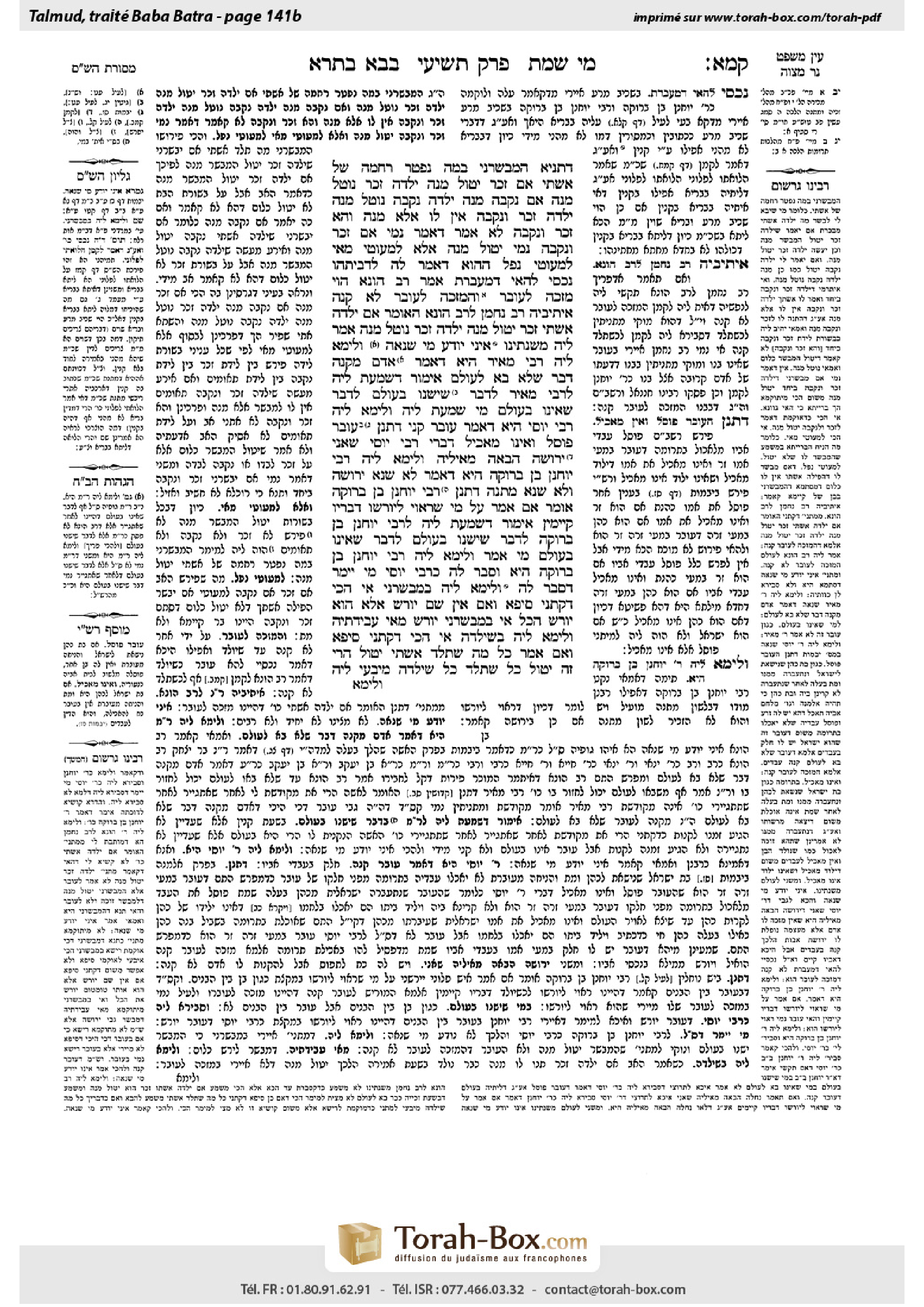
Bava Batra 141b: Talmud study for Daf Yomi
Study the Talmud for Daf Yomi with scanned pages, Hebrew text, English translations from Sefaria and AI-generated French translations.
Passage selection and English or AI-generated French translation are available where the scan has annotations. Daf Study is independent of Torah-Box and Sefaria.
Browse Bava Batra · בבא בתרא · All tractatesBava Batra 141b text and translations
This page of Bava Batra includes the Aramaic text, an English translation and an AI-generated French translation, alongside the scan above.
בבא בתרא קמ״א ב · Aramaic and Hebrew text
דְּתַנְיָא: ״הַמְבַשְּׂרֵנִי בַּמֶּה נִפְטַר רַחְמָהּ שֶׁל אִשְׁתִּי; אִם זָכָר – יִטּוֹל מָנֶה״, יָלְדָה זָכָר – נוֹטֵל מָנֶה. ״אִם נְקֵבָה – מָנֶה״; יָלְדָה נְקֵבָה – נוֹטֵל מָנֶה, יָלְדָה זָכָר וּנְקֵבָה – אֵין לוֹ אֶלָּא מָנֶה.
וְהָא ״זָכָר וּנְקֵבָה״ לָא אֲמַר! דְּאָמַר נָמֵי ״אִם זָכָר וּנְקֵבָה נָמֵי – יִטּוֹל מָנֶה״. אֶלָּא לְמַעוֹטֵי מַאי? לְמַעוֹטֵי נֵפֶל.
הָהוּא דַּאֲמַר לַהּ לִדְבֵיתְהוּ: נִכְסַי לְהַאי דִּמְעַבְּרַתְּ. אָמַר רַב הוּנָא: הָוֵי מְזַכֶּה לְעוּבָּר, וְהַמְזַכֶּה לְעוּבָּר לֹא קָנָה.
אֵיתִיבֵיהּ רַב נַחְמָן לְרַב הוּנָא: הָאוֹמֵר ״אִם יָלְדָה אִשְׁתִּי זָכָר – יִטּוֹל מָנֶה״, יָלְדָה זָכָר – נוֹטֵל מָנֶה! אֲמַר לֵיהּ: מִשְׁנָתֵינוּ – אֵינִי יוֹדֵעַ מִי שְׁנָאָהּ.
וְלֵימָא לֵיהּ: רַבִּי מֵאִיר הִיא, דְּאָמַר: אָדָם מַקְנֶה דָּבָר שֶׁלֹּא בָּא לָעוֹלָם!
אֵימוֹר דְּשָׁמְעַתְּ לֵיהּ לְרַבִּי מֵאִיר – לְדָבָר שֶׁיֶּשְׁנוֹ בָּעוֹלָם; לְדָבָר שֶׁאֵינוֹ בָּעוֹלָם מִי שָׁמְעַתְּ לֵיהּ?!
וְלֵימָא לֵיהּ: רַבִּי יוֹסֵי הִיא, דְּאָמַר: עוּבָּר קָנֵי! דִּתְנַן: עוּבָּר פּוֹסֵל וְאֵינוֹ מַאֲכִיל, דִּבְרֵי רַבִּי יוֹסֵי.
שָׁאנֵי יְרוּשָּׁה, הַבָּאָה מֵאֵילֶיהָ.
וְלֵימָא לֵיהּ: רַבִּי יוֹחָנָן בֶּן בְּרוֹקָה הִיא, דַּאֲמַר: לָא שְׁנָא יְרוּשָּׁה וְלָא שְׁנָא מַתָּנָה! דִּתְנַן, רַבִּי יוֹחָנָן בֶּן בְּרוֹקָה אוֹמֵר: אִם אָמַר עַל מִי שֶׁרָאוּי לְיוֹרְשׁוֹ – דְּבָרָיו קַיָּימִין!
אֵימוֹר דְּשָׁמְעַתְּ לֵיהּ לְרַבִּי יוֹחָנָן בֶּן בְּרוֹקָה – לְדָבָר שֶׁיֶּשְׁנוֹ בָּעוֹלָם; לְדָבָר שֶׁאֵינוֹ בָּעוֹלָם מִי אָמַר?!
וְלֵימָא לֵיהּ: רַבִּי יוֹחָנָן בֶּן בְּרוֹקָה הִיא, וְסָבַר לַהּ כְּרַבִּי יוֹסֵי! מִי יֵימַר דְּסָבַר לַהּ?
וְלֵימָא לֵיהּ: בִּ״מְבַשְּׂרֵנִי״! אִי הָכִי, דְּקָתָנֵי סֵיפָא: וְאִם אֵין שָׁם יוֹרֵשׁ אֶלָּא הוּא – יוֹרֵשׁ הַכֹּל; אִי בִּ״מְבַשְּׂרֵנִי״, יוֹרֵשׁ מַאי עֲבִידְתֵּיהּ?
וְלֵימָא לֵיהּ בְּשֶׁיָּלְדָה! אִי הָכִי, דְּקָתָנֵי סֵיפָא: וְאִם אָמַר ״כׇּל מַה שֶּׁתֵּלֵד אִשְׁתִּי – יִטּוֹל״, הֲרֵי זֶה יִטּוֹל; ״כׇּל שֶׁתֵּלֵד״?! ״כָּל שֶׁיָּלְדָה״ מִיבְּעֵי לֵיהּ!
Bava Batra 141b · English translation
This is as it is taught in a baraita (Tosefta 9:5): In a case where one said: Whoever informs me as to what opened my wife’s womb, i.e., what the sex of her child is, if it is a male, the one who informs me shall receive one hundred dinars. Therefore, if the wife gave birth to a male, the one who informed him receives one hundred dinars. If he also said: If it is a female he shall receive one hundred dinars, if she gave birth to a female, he receives one hundred dinars. If she gave birth to a male and a female, he receives only one hundred dinars.
The Gemara challenges: But since he did not say anything about a male and a female, if she gave birth to a male and a female, he should not receive anything. Why does the baraita state that he receives one hundred dinars? The Gemara answers: This is referring to where he also said: If she gives birth to a male and a female he shall also receive one hundred dinars. The Gemara asks: But if he stated all of the possibilities, what did his stipulations serve to exclude? The Gemara answers: They serve to exclude a case where she gives birth to a non-viable newborn, in which case he receives nothing.
§ The Gemara relates: There was a certain man who said to his wife: My property is given to the one with whom you are pregnant. Rav Huna said: This is a case of one who transfers ownership of an item to a fetus, and in the case of one who transfers ownership of an item to a fetus, the fetus does not acquire the item.
Rav Naḥman raised an objection to the opinion of Rav Huna from the mishna, which states: With regard to one who says: If my wife gives birth to a male the offspring shall receive one hundred dinars, if she in fact gave birth to a male, the offspring receives one hundred dinars. This indicates that the fetus did acquire the money. Rav Huna said to him: I do not know who taught our mishna. It is not identifiable with a known opinion, and presumably the text has been corrupted.
The Gemara asks why Rav Huna replied in this manner: But let him say to Rav Naḥman: It is in accordance with the opinion of Rabbi Meir, who says: A person can transfer ownership of an entity that has not yet come into the world, e.g., produce that has not yet grown. Just as he maintains that one can transfer ownership of an entity that has not yet come into the world, so too, he maintains that one can transfer ownership of an item to a fetus, who has not yet been born.
The Gemara rejects this explanation: Say that you heard Rabbi Meir express this opinion with regard to transferring ownership of an entity that has not yet come into the world to an entity that is in the world. Did you hear him speak of transferring ownership to an entity that has not yet come into the world, e.g., a fetus?
The Gemara proposes another resolution to Rav Naḥman’s objection: But let Rav Huna say to Rav Naḥman: It is in accordance with the opinion of Rabbi Yosei, who says: A fetus acquires ownership, as we learned in a mishna (Yevamot 67a): With regard to an Israelite woman who married a priest and he died and left her pregnant, the fetus disqualifies its father’s Canaanite slaves from partaking of teruma, because until it is born the fetus is not considered a priest, and the slaves, who are part of its inheritance, are not the slaves of a priest. And the fetus does not enable its mother to partake of teruma, even though it is the child of a priest. This is the statement of Rabbi Yosei. It is evident from this mishna that Rabbi Yosei holds that a fetus inherits its father’s property.
The Gemara rejects this explanation: Inheritance is different, since, unlike a gift, it comes into the possession of the heir by itself, without a formal act of acquisition. Therefore, a fetus can acquire an inheritance, but not a gift.
The Gemara proposes another resolution to Rav Naḥman’s objection: But let Rav Huna say to Rav Naḥman: It is in accordance with the opinion of Rabbi Yoḥanan ben Beroka, who says: The case of an inheritance is not different, and the case of a gift one gives to his heir is not different, i.e., the same halakhot apply to both. As we learned in a mishna (130a): Rabbi Yoḥanan ben Beroka says: If one said about a person who is fit to inherit from him, e.g., one of his sons: This person will inherit all of my property, his statement stands.
The Gemara rejects this explanation: Say that you heard Rabbi Yoḥanan ben Beroka express this opinion with regard to a gift given to an entity that already exists in the world, but does he say anything with regard to a gift given to an entity that has not yet come into the world?
The Gemara proposes another resolution to Rav Naḥman’s objection: But let Rav Huna say to Rav Naḥman: It is in accordance with the opinion of Rabbi Yoḥanan ben Beroka, who compares a gift to an inheritance, and he holds in accordance with the opinion of Rabbi Yosei, that a fetus is fit to inherit. The Gemara rejects this explanation: Who says that Rabbi Yoḥanan ben Beroka holds in accordance with the opinion of Rabbi Yosei?
The Gemara proposes another resolution to Rav Naḥman’s objection: But let Rav Huna say to Rav Naḥman that the mishna is referring not to one who gave a gift to the fetus, but to one who said: I shall give a certain sum to whoever informs me. This person is in the world. The Gemara rejects this explanation as well: If that is so, then concerning that which the last clause of the mishna teaches: And if there is no heir other than the tumtum, the tumtum inherits all of the estate, if the mishna is referring to one who said: I shall give a certain sum to whoever informs me, what is the purpose of mentioning an heir, since the mishna is not discussing a gift to the heir at all?
The Gemara proposes another resolution to Rav Naḥman’s objection: But let Rav Huna say to Rav Naḥman: The mishna is referring to a case where the gift was made after his wife had already given birth but he did not yet know the sex of the baby. The Gemara rejects this explanation as well: If that is so, then concerning that which the latter clause of the mishna teaches: Whatever offspring my wife gives birth to shall receive a certain sum, and she gave birth to a tumtum, the tumtum receives it, there is a difficulty. According to this explanation, the phrase: Whatever offspring my wife gives birth to, is incorrect. The mishna should have said: Whatever offspring my wife gave birth to.
Bava Batra 141b · Traduction française (IA)
C’est ce qui est enseigné dans une baraïta (Tosefta 9:5) : Dans un cas où l’on dit : Celui qui me dit ce qui a ouvert le ventre de ma femme, c’est-à-dire le sexe de son enfant, si c’est un garçon, celui qui me le dit recevra cent dinars. Ainsi, si la femme a donné naissance à un garçon, celui qui l’a informé reçoit cent dinars. Si l’on a aussi dit : Si c’est une fille, il recevra cent dinars, si elle a donné naissance à une fille, il reçoit cent dinars. Si elle a donné naissance à un garçon et à une fille, il reçoit seulement cent dinars.
Le Guemara soulève un défi : Mais puisque l’on n’a pas dit quoi que ce soit concernant un garçon et une fille, si elle a donné naissance à un garçon et à une fille, il ne devrait rien recevoir. Pourquoi la baraïta dit-elle qu’il reçoit cent dinars ? Le Guemara répond : Cela fait référence à un cas où l’on a aussi dit : Si elle donne naissance à un garçon et à une fille, il recevra aussi cent dinars. Le Guemara demande : Mais si l’on a énoncé toutes les possibilités, à quoi ses stipulations servent-elles à exclure ? Le Guemara répond : Elles servent à exclure un cas où elle donne naissance à un nouveau-né non viable, dans lequel cas il reçoit rien.
§ Le Guemara rapporte : Il y avait un certain homme qui a dit à sa femme : Mon bien est donné à celui avec qui tu es enceinte. Rav Huna a dit : C’est un cas où l’on transfère la propriété d’un objet à un fœtus, et dans le cas où l’on transfère la propriété d’un objet à un fœtus, le fœtus ne l’acquiert pas.
Rav Naḥman a soulevé une objection contre l’opinion de Rav Huna à partir de la michna, qui stipule : Concernant celui qui dit : Si ma femme donne naissance à un garçon, l’enfant recevra cent dinars, et si elle a effectivement donné naissance à un garçon, l’enfant reçoit cent dinars. Cela indique que le fœtus a acquis l’argent. Rav Huna a dit à lui : Je ne sais pas qui a enseigné notre michna. Celle-ci n’est pas identifiable avec une opinion connue, et probablement le texte a été corrompu.
Le Guemara demande pourquoi Rav Huna a répondu ainsi : Mais laisse-le dire à Rav Naḥman : C’est selon l’opinion de Rabbi Meir, qui dit : Une personne peut transférer la propriété d’un être qui n’a pas encore entré dans le monde, par exemple, des productions qui n’ont pas encore poussé. Tout comme il maintient que l’on peut transférer la propriété d’un être qui n’a pas encore entré dans le monde, ainsi aussi, il maintient que l’on peut transférer la propriété d’un objet à un fœtus, qui n’a pas encore été né.
Le Guemara rejette cette explication : Dis que tu as entendu Rabbi Meir exprimer cette opinion concernant le transfert de la propriété d’un être qui n’a pas encore entré dans le monde à un être qui est dans le monde. As-tu entendu parler du transfert de la propriété à un être qui n’a pas encore entré dans le monde, par exemple, un fœtus ?
Le Guemara propose une autre résolution à l’objection de Rav Naḥman : Mais laissez Rav Huna dire à Rav Naḥman : C’est selon l’opinion de Rabbi Yosei, qui dit : Le fœtus acquiert la propriété, comme nous l’avons appris dans une mitsna (Yevamot 67a) : Concernant une femme israélite qui a épousé un prêtre et il est mort et l’a laissée enceinte, le fœtus disqualifie les serviteurs cananéens de son père de participer à la terouma, car jusqu’à ce qu’il soit né, le fœtus n’est pas considéré comme un prêtre, et les serviteurs, qui font partie de son héritage, ne sont pas les serviteurs d’un prêtre. Et le fœtus ne permet pas à sa mère de participer à la terouma, même s’il est le fils d’un prêtre. C’est l’affirmation de Rabbi Yosei. Il est évident de cette mitsna que Rabbi Yosei considère que le fœtus hérite de la propriété de son père.
Le Guemara rejette cette explication : L’héritage est différent, car, contrairement à un don, il entre en possession de l’héritier par lui-même, sans un acte formel d’acquisition. Ainsi, un fœtus peut acquérir un héritage, mais pas un don.
Le Guemara propose une autre résolution à l’objection de Rav Naḥman : Mais laissez Rav Huna dire à Rav Naḥman : C’est selon l’opinion de Rabbi Yoḥanan ben Beroka, qui dit : Le cas de l’héritage n’est pas différent, et le cas d’un don que l’on donne à son héritier n’est pas différent, c’est-à-dire les mêmes halakhot s’appliquent aux deux. Comme nous l’avons appris dans une mitsna (130a) : Rabbi Yoḥanan ben Beroka dit : Si l’on dit concernant une personne qui est digne d’hériter de lui, par exemple, l’un de ses fils : Cette personne héritera de toute ma propriété, sa déclaration tient.
Le Guemara rejette cette explication : Dis que tu as entendu Rabbi Yoḥanan ben Beroka exprimer cette opinion concernant un don donné à un être qui existe déjà dans le monde, mais dit-il quelque chose concernant un don donné à un être qui n’a pas encore entré dans le monde ?
Le Guemara propose une autre résolution à l’objection de Rav Naḥman : Mais laisse Rav Huna dire à Rav Naḥman : C’est selon l’opinion de Rabbi Yoḥanan ben Beroka, qui compare un don à un héritage, et il suit l’opinion de Rabbi Yosei, que le fœtus est digne d’héritage. Le Guemara rejette cette explication : Qui dit que Rabbi Yoḥanan ben Beroka suit l’opinion de Rabbi Yosei ?
Le Guemara propose une autre résolution à l’objection de Rav Naḥman : Mais laisse Rav Huna dire à Rav Naḥman que la mitsva ne fait pas référence à celui qui a donné un don au fœtus, mais à celui qui a dit : Je donnerai une certaine somme à celui qui m’informe. Cette personne est dans le monde. Le Guemara rejette cette explication également : Si c’est ainsi, alors concernant ce que la dernière clause de la mitsva enseigne : Et si il n’y a pas d’héritier autre que le tumtum, le tumtum hérite de toute l’immobilier, si la mitsva fait référence à celui qui a dit : Je donnerai une certaine somme à celui qui m’informe, à quoi sert-il de mentionner un héritier, puisque la mitsva ne discute pas d’un don à l’héritier du tout ?
La Guemara propose une autre solution à l'objection de Rav Naḥman : Mais laissez Rav Huna dire à Rav Naḥman : La Michna fait référence à un cas où le don a été fait après que sa femme ait déjà donné naissance à un enfant, mais qu'il ne savait pas le sexe de l'enfant. La Guemara rejette cette explication également : Si c'est ainsi, alors concernant la partie finale de la Michna qui enseigne : Tout enfant que ma femme donnera naissance recevra une certaine somme, et elle a donné naissance à un tumtum, le tumtum reçoit cette somme, il y a une difficulté. Selon cette explication, la phrase : Tout enfant que ma femme donnera naissance est incorrecte. La Michna aurait dû dire : Tout enfant que ma femme a donné naissance.
Traduction française générée par IA à partir de l’édition anglaise de Sefaria. Vérifie toujours un passage avec le texte source.
Text from Sefaria: William Davidson Edition - Vocalized Aramaic (CC BY NC); William Davidson Edition - English (CC BY NC).