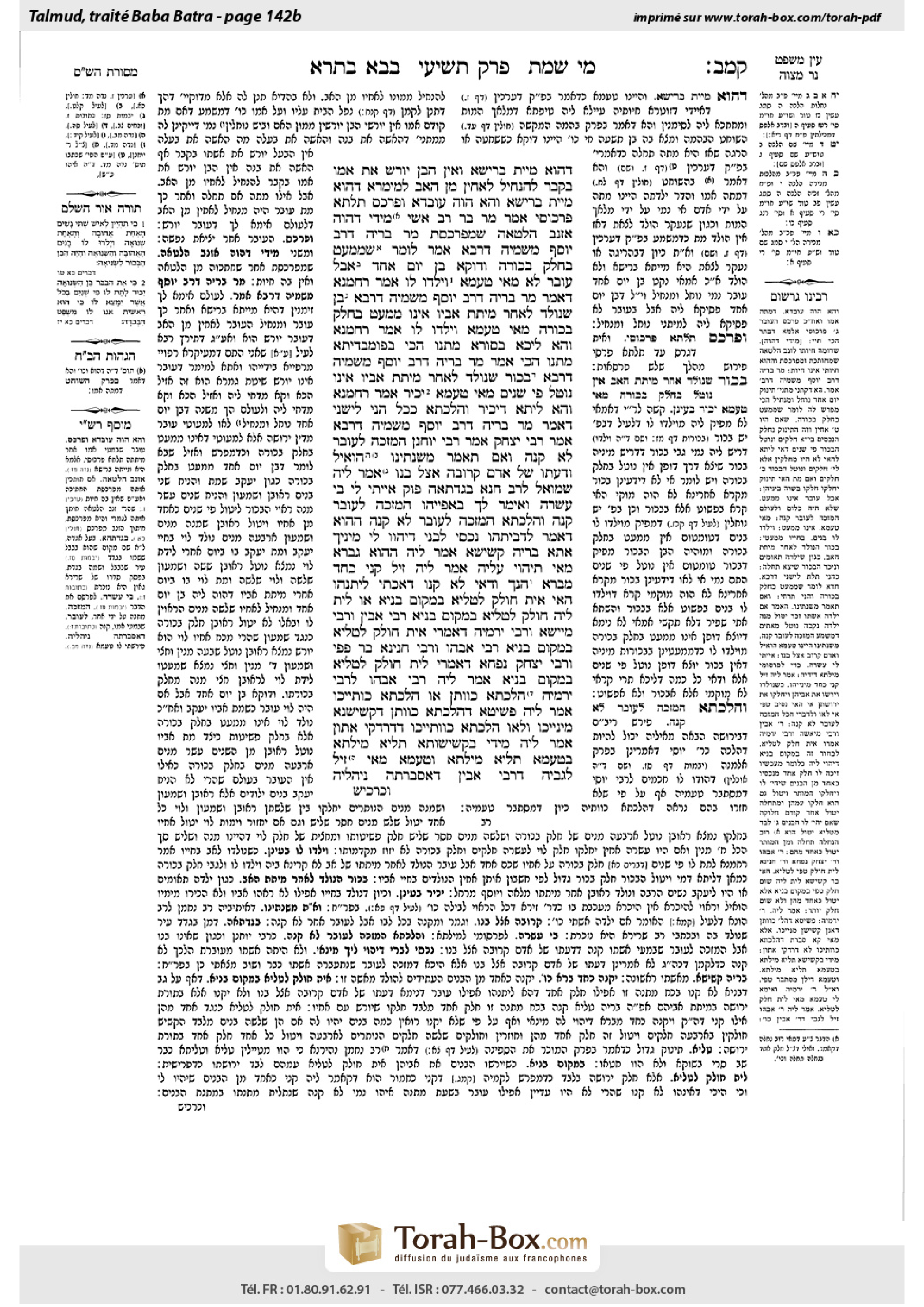
Bava Batra 142b: Talmud study for Daf Yomi
Study the Talmud for Daf Yomi with scanned pages, Hebrew text, English translations from Sefaria and AI-generated French translations.
Passage selection and English or AI-generated French translation are available where the scan has annotations. Daf Study is independent of Torah-Box and Sefaria.
Browse Bava Batra · בבא בתרא · All tractatesBava Batra 142b text and translations
This page of Bava Batra includes the Aramaic text, an English translation and an AI-generated French translation, alongside the scan above.
בבא בתרא קמ״ב ב · Aramaic and Hebrew text
דְּהוּא מָיֵית בְּרֵישָׁא, וְאֵין הַבֵּן יוֹרֵשׁ אֶת אִמּוֹ בַּקֶּבֶר לְהַנְחִיל לָאַחִין מִן הָאָב.
לְמֵימְרָא דְּהוּא מָיֵית בְּרֵישָׁא?! וְהָא הֲוָה עוֹבָדָא, וּפַרְכֵּס תְּלָתָא פִּרְכּוּסֵי! אָמַר מָר בַּר רַב אָשֵׁי: מִידֵּי דְּהָוֵה אַזְּנַב הַלְּטָאָה, שֶׁמְּפַרְכֶּסֶת.
מָר בְּרֵיהּ דְּרַב יוֹסֵף מִשְּׁמֵיהּ דְּרָבָא אָמַר: לוֹמַר שֶׁמְּמַעֵט בְּחֵלֶק בְּכוֹרָה. וְדַוְקָא בֶּן יוֹם אֶחָד, אֲבָל עוּבָּר – לָא. מַאי טַעְמָא? ״וְיָלְדוּ לוֹ״ אָמַר רַחֲמָנָא.
דְּאָמַר מָר בְּרֵיהּ דְּרַב יוֹסֵף מִשְּׁמֵיהּ דְּרָבָא: בֵּן שֶׁנּוֹלַד לְאַחַר מִיתַת אָבִיו – אֵינוֹ מְמַעֵט בְּחֵלֶק בְּכוֹרָה. מַאי טַעְמָא? ״וְיָלְדוּ לוֹ״ אָמַר רַחֲמָנָא, וְהָא לֵיכָּא.
בְּסוּרָא – מַתְנוּ הָכִי. בְּפוּמְבְּדִיתָא – מַתְנוּ הָכִי: אָמַר מָר בְּרֵיהּ דְּרַב יוֹסֵף מִשְּׁמֵיהּ דְּרָבָא: בְּכוֹר שֶׁנּוֹלַד לְאַחַר מִיתַת אָבִיו – אֵינוֹ נוֹטֵל פִּי שְׁנַיִם. מַאי טַעְמָא? ״יַכִּיר״ אָמַר רַחֲמָנָא, וְהָא לֵיתָא דְּיַכִּיר. וְהִלְכְתָא כְּכׇל הָנֵי לִישָּׁנֵי דְּאָמַר מָר בְּרֵיהּ דְּרַב יוֹסֵף מִשְּׁמֵיהּ דְּרָבָא.
אָמַר רַבִּי יִצְחָק אָמַר רַבִּי יוֹחָנָן: הַמְזַכֶּה לְעוּבָּר – לֹא קָנָה. וְאִם תֹּאמַר: מִשְׁנָתֵינוּ! הוֹאִיל וְדַעְתּוֹ שֶׁל אָדָם קְרוֹבָה אֵצֶל בְּנוֹ.
אֲמַר לֵיהּ שְׁמוּאֵל לְרַב חָנָא בַּגְדָּתָאָה: פּוֹק אַיְיתִי לִי בֵּי עַשְׂרָה, וְאֵימַר לָךְ בְּאַפַּיְיהוּ: הַמְזַכֶּה לְעוּבָּר קָנָה. וְהִלְכְתָא: הַמְזַכֶּה לְעוּבָּר לֹא קָנָה.
הָהוּא דַּאֲמַר לִדְבֵיתְהוּ: ״נִכְסַי לִבְנֵי דְּיִהְווּ לִי מִינִּיךְ״. אֲתָא בְּרֵיהּ קַשִּׁישָׁא, אֲמַר לֵיהּ: ״הַהוּא גַּבְרָא מַאי תֶּיהְוֵי עֲלֵיהּ?״ אָמַר לֵיהּ: ״זִיל קְנִי כְּחַד מִבְּרָא״. הָנָךְ – וַדַּאי לָא קָנוּ, דְּאַכַּתִּי לֵיתַנְהוּ.
הַאי – אִית חוּלָק לְטַלְיָא בִּמְקוֹם בְּנַיָּא, אוֹ לֵית לֵיהּ חוּלָק לְטַלְיָא בִּמְקוֹם בְּנַיָּא? רַבִּי אָבִין וְרַבִּי מְיָישָׁא וְרַבִּי יִרְמְיָה דְּאָמְרִי: אִית חוּלָק לְטַלְיָא בִּמְקוֹם בְּנַיָּא. רַבִּי אֲבָהוּ וְרַבִּי חֲנִינָא בַּר פַּפִּי וְרַבִּי יִצְחָק נַפָּחָא דְּאָמְרִי: לֵית חוּלָק לְטַלְיָא בִּמְקוֹם בְּנַיָּא.
אֲמַר לֵיהּ רַבִּי אֲבָהוּ לְרַבִּי יִרְמְיָה: הִלְכְתָא כְּווֹתַן, אוֹ הִלְכְתָא כְּוָתַיְיכוּ? אֲמַר לֵיהּ: פְּשִׁיטָא דְּהִלְכְתָא כְּווֹתַן – דְּקַשִּׁישְׁנָא מִינַּיְיכוּ, וְלָאו הִלְכְתָא כְּווֹתַיְיכוּ – דְּדַרְדְּקֵי אַתּוּן. אֲמַר לֵיהּ: מִידֵּי בְּקַשִּׁישׁוּתָא תַּלְיָא מִילְּתָא?! בְּטַעְמָא תַּלְיָא מִילְּתָא! וְטַעְמָא מַאי? זִיל לְגַבֵּיהּ דְּרַבִּי אָבִין – דְּאַסְבַּרְתַּהּ נִיהֲלֵיהּ,
Bava Batra 142b · English translation
The reason is that we presume that the fetus died first, before its mother died, and the son does not inherit from his mother while in the grave, in order to bequeath the inheritance to his paternal brothers. The halakha is that if a son dies, and afterward his mother dies, the deceased son does not inherit from his mother and subsequently bequeath the inheritance to his paternal brothers, who are not related to the mother. But in other cases, where it is not his mother’s estate, a fetus inherits property.
The Gemara asks: Is this to say that it is certain that the fetus died first? But there was an incident where the mother died and the fetus made three spasmodic motions afterward. Apparently, a fetus can die after the mother. Mar bar Rav Ashi said: That incident was just as it is with the tail of the lizard, which jerks after being severed from the lizard, but it is just a spasmodic motion which does not indicate that it is still alive.
Mar, son of Rav Yosef, says in the name of Rava: The mishna comes to say that a one-day-old child reduces the portion of the firstborn. The firstborn is entitled to a double portion of the inheritance, and this is calculated taking into account the portion due to his dead brother. And it is in this context that specifically the portion of a one-day-old child is taken into account, but the portion of a fetus is not taken into account, even though a fetus also inherits property. What is the reason for this? The Merciful One states concerning the portion of the firstborn: “If a man has two wives, the one beloved, and the other hated, and they bore him children, both the beloved and the hated; and if the firstborn son be hers that was hated” (Deuteronomy 21:15). The term “children” excludes a fetus.
This is similar to another halakha, as Mar, son of Rav Yosef, says in the name of Rava: A son who was born after his father’s death does not reduce the firstborn’s portion. What is the reason for this? The Merciful One states in the Torah: “And they bore him children,” and this term “children” does not apply to a fetus.
The Gemara notes: In Sura they taught Mar’s statement that way, but in Pumbedita they taught it this way: Mar, son of Rav Yosef, says in the name of Rava: A firstborn who was born after his father’s death does not receive a double portion. What is the reason for this? The Merciful One states in the Torah: “But he shall acknowledge the firstborn, the son of the hated, by giving him a double portion” (Deuteronomy 21:17), and in this case the father is not there that he can acknowledge him. The Gemara concludes: And the halakha is in accordance with all these versions of that which Mar, son of Rav Yosef, says in the name of Rava. Accordingly, a one-day-old child reduces the portion of the firstborn, a son born after his father’s death does not reduce the firstborn’s portion, and a firstborn born after his father’s death does not receive a double portion.
§ Rabbi Yitzḥak says that Rabbi Yoḥanan says: With regard to one who transfers ownership of an item to a fetus, the fetus does not acquire the item. And if you say that the statement of our mishna (140b), with regard to one who gives a gift to his unborn child, indicates that an item can be transferred to a fetus, the circumstances there are unique. Since the disposition of a person is to be inclined toward his son, the Sages validated such a transfer, but one cannot transfer an item to the unborn child of another.
Shmuel said to Rav Ḥana of Baghdad: Go out and bring me an assembly of ten men, and I will say a halakha to you in their presence, so that it will be well publicized. The halakha was: With regard to one who transfers ownership of an item to a fetus, the fetus acquires the item. The Gemara concludes: And the halakha is that with regard to one who transfers ownership of an item to a fetus, the fetus does not acquire the item.
§ The Gemara relates: There was a certain man who said to his wife, before she conceived: My property is given to the sons that I will have from you. His older son from a previous marriage came and said to him: That man, i.e., me, what will become of him, i.e., will I receive nothing? He said to his son: Go and acquire a portion like one of the sons who will be born, i.e., you will receive a share as well. The Gemara comments: Those sons who were not yet born certainly did not acquire the property, and do not receive more than their share as heirs, as they are not yet in existence.
The Gemara asks: With regard to this son, does the young man [letalya] receive an additional share of the inheritance in a case where there are other sons from the second wife, since his father gave him an additional share, or does the young man not receive an additional share of the inheritance where there are other sons? There are Rabbi Avin, and Rabbi Meyasha, and Rabbi Yirmeya, who all say: The young man does receive an additional share of the inheritance where there are other sons. And there are Rabbi Abbahu, and Rabbi Ḥanina bar Pappi, and Rabbi Yitzḥak Nappaḥa, who all say: The young man does not receive an additional share of the inheritance where there are other sons.
Rabbi Abbahu said to Rabbi Yirmeya: Is the halakha in accordance with our opinion, or is the halakha in accordance with your opinion? Rabbi Yirmeya said to Rabbi Abbahu: It is obvious that the halakha is in accordance with our opinion, as we are older than you, and the halakha is not in accordance with your opinion, as you are youngsters [dardekei]. Rabbi Abbahu said to Rabbi Yirmeya in reply: Does the matter depend upon age? The matter depends upon the reason behind the ruling. Rabbi Yirmeya asked him: And what is your reason? Rabbi Abbahu replied: Go to Rabbi Avin, as I explained this halakha to him,
Bava Batra 142b · Traduction française (IA)
La raison est que nous supposons que le fœtus est mort en premier, avant que sa mère ne meure, et que le fils ne hérite pas de sa mère alors qu'elle est dans la tombe, afin de transmettre la succession à ses frères paternels. La halakha est que si un fils meurt et que sa mère meurt ensuite, le fils décédé ne hérite pas de sa mère et ne transmet pas la succession à ses frères paternels, qui ne sont pas apparentés avec la mère. Mais dans d'autres cas, où il ne s'agit pas de la succession de la mère, le fœtus hérite de la propriété.
La Guemara pose la question : Voulait-on dire que c'est certain que le fœtus est mort en premier ? Mais il y avait un cas où la mère est morte et le fœtus a fait trois mouvements convulsifs après. Apparemment, un fœtus peut mourir après la mère. Mar bar Rav Ashi a dit : Ce cas est comme la queue du lézard, qui tremble après avoir été séparée du lézard, mais c'est juste un mouvement convulsif qui ne montre pas qu'il est encore vivant.
Mar, fils de Rav Yosef, dit en nom de Rava : La Michna vise à dire qu'un enfant d'un jour réduit la part du premier-né. Le premier-né a le droit à une double part de la succession, et cela est calculé en tenant compte de la part due à son frère décédé. C'est dans ce contexte que la part d'un enfant d'un jour est prise en compte, mais la part d'un fœtus n'est pas prise en compte, même si un fœtus hérite également de la propriété. Quelle est la raison de cela ? L'Éternel dit concernant la part du premier-né : « Si un homme a deux épouses, l'une chérie et l'autre haïe, et qu'elles lui ont donné des enfants, les deux, la chérie et l'haïe ; et si le premier-né est celui de l'haïe », (Deutéronome 21:15). Le terme « enfants » exclut un fœtus.
Cela ressemble à une autre halakha, comme Mar, fils de Rav Yosef, dit en nom de Rava : Un fils né après la mort de son père ne réduit pas la part du premier-né. Quelle est la raison de cela ? L'Éternel dit dans la Torah : « Et ils lui ont donné des enfants », et ce terme « enfants » ne s'applique pas à un fœtus.
La Guemara note : À Sura, ils enseignèrent la déclaration de Mar ainsi, mais à Pumbedita, ils l'enseignèrent ainsi : Mar, fils de Rav Yosef, dit en nom de Rava : Un premier-né né après la mort de son père ne reçoit pas une double part. Quelle est la raison de cela ? L'Éternel dit dans la Torah : « Mais il doit reconnaître le premier-né, le fils de l'haïe, en lui donnant une double part » (Deutéronome 21:17), et dans ce cas, le père n'est pas là pour le reconnaître. La Guemara conclut : Et la halakha est selon toutes ces versions de ce que Mar, fils de Rav Yosef, dit en nom de Rava. Ainsi, un enfant d'un jour réduit la part du premier-né, un fils né après la mort de son père ne réduit pas la part du premier-né, et un premier-né né après la mort de son père ne reçoit pas une double part.
§ Rabbi Yitzḥak dit que Rabbi Yoḥanan dit : Concernant celui qui transfère la propriété d'un objet à un fœtus, le fœtus ne l'acquiert pas. Et si vous dites que la déclaration de notre Michna (140b), concernant celui qui donne un cadeau à son enfant non né, indique que l'objet peut être transféré à un fœtus, les circonstances là-bas sont spéciales. Puisque la disposition d'une personne est de se tourner vers son fils, les Sages ont validé ce transfert, mais on ne peut pas transférer un objet au fœtus d'une autre personne.
Shmuel a dit à Rav Ḥana de Baghdad : Sortez et apportez-moi un groupe de dix hommes, et je vous dirai une halakha devant eux, afin qu'elle soit bien connue. La halakha était : Concernant celui qui transfère la propriété d'un objet à un fœtus, le fœtus l'acquiert. La Guemara conclut : Et la halakha est que concernant celui qui transfère la propriété d'un objet à un fœtus, le fœtus ne l'acquiert pas.
§ La Guemara rapporte : Il y avait un certain homme qui a dit à sa femme, avant qu'elle ne concevît : Ma propriété est donnée aux fils que j'aurai avec toi. Son fils aîné d'une précédente union est venu et a dit à lui : Ce homme, c'est-à-dire moi, que deviendra-t-il, c'est-à-dire recevrai-je quelque chose ? Il a dit à son fils : Allez et acquérez une part comme l'un des fils qui seront nés, c'est-à-dire que vous recevrez une part également. La Guemara commente : Ces fils qui n'étaient pas encore nés n'ont certainement pas acquis la propriété, et ne reçoivent pas plus que leur part en tant qu'héritiers, car ils n'existent pas encore.
La Guemara pose la question : Concernant ce fils, le jeune homme [letalya] reçoit-il une part supplémentaire de la succession dans le cas où il y a d'autres fils de la deuxième épouse, puisque son père lui a donné une part supplémentaire, ou ne reçoit-il pas une part supplémentaire de la succession où il y a d'autres fils ? Il y a Rabbi Avin, et Rabbi Meyasha, et Rabbi Yirmeya, qui disent tous : Le jeune homme reçoit une part supplémentaire de la succession où il y a d'autres fils. Et il y a Rabbi Abbahu, et Rabbi Ḥanina bar Pappi, et Rabbi Yitzḥak Nappaḥa, qui disent tous : Le jeune homme ne reçoit pas une part supplémentaire de la succession où il y a d'autres fils.
Rabbi Abbahu a dit à Rabbi Yirmeya : La halakha est-elle selon notre opinion, ou selon votre opinion ? Rabbi Yirmeya a dit à Rabbi Abbahu : Il est évident que la halakha est selon notre opinion, car nous sommes plus âgés que vous, et la halakha n'est pas selon votre opinion, car vous êtes jeunes [dardekei]. Rabbi Abbahu a dit à Rabbi Yirmeya en réponse : La question dépend-elle de l'âge ? La question dépend de la raison du jugement. Rabbi Yirmeya a demandé à lui : Et quelle est votre raison ? Rabbi Abbahu a répondu : Allez chez Rabbi Avin, car je lui ai expliqué cette halakha,
Traduction française générée par IA à partir de l’édition anglaise de Sefaria. Vérifie toujours un passage avec le texte source.
Text from Sefaria: William Davidson Edition - Vocalized Aramaic (CC BY NC); William Davidson Edition - English (CC BY NC).