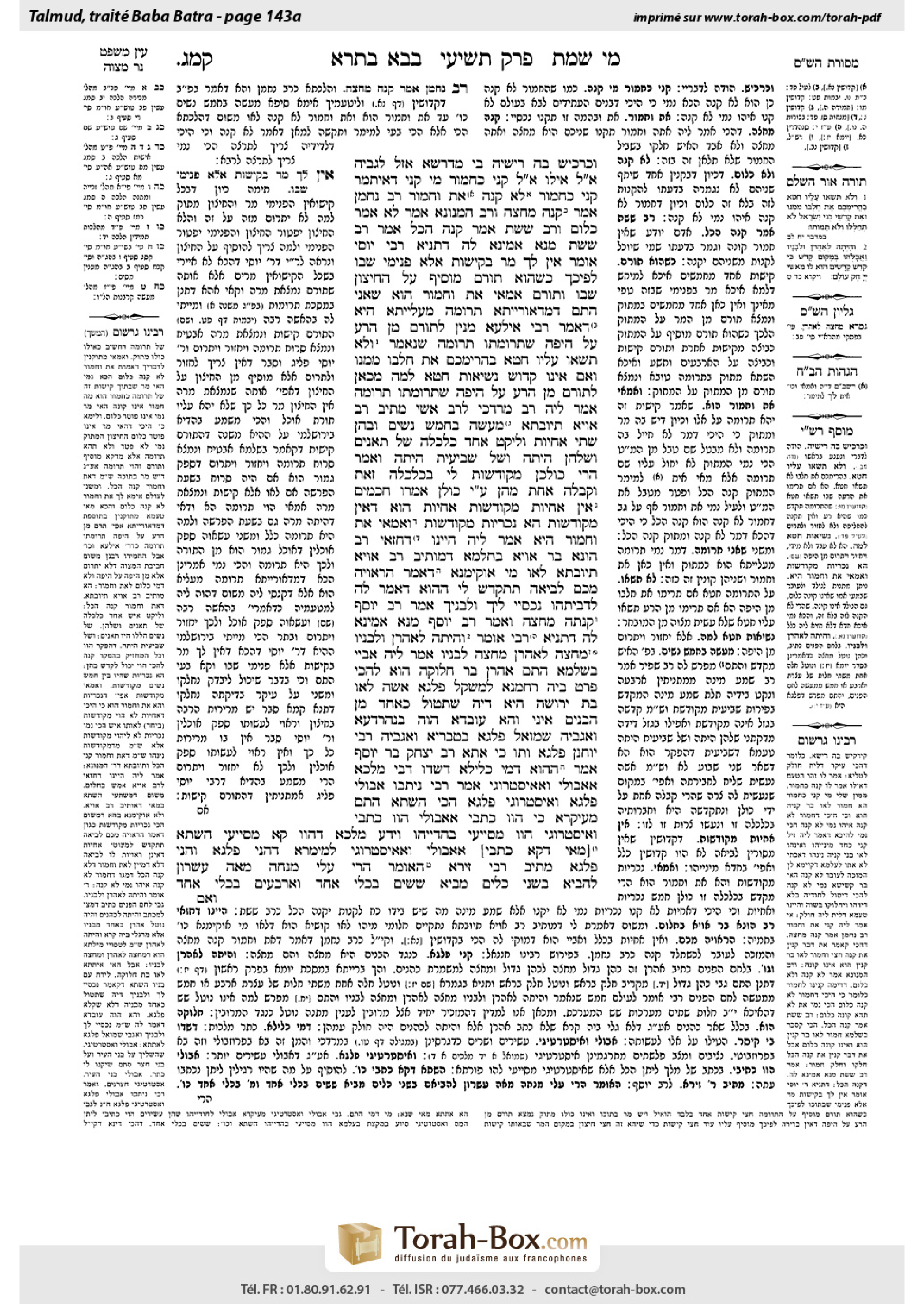
Bava Batra 143a: Talmud study for Daf Yomi
Study the Talmud for Daf Yomi with scanned pages, Hebrew text, English translations from Sefaria and AI-generated French translations.
Passage selection and English or AI-generated French translation are available where the scan has annotations. Daf Study is independent of Torah-Box and Sefaria.
Browse Bava Batra · בבא בתרא · All tractatesBava Batra 143a text and translations
This page of Bava Batra includes the Aramaic text, an English translation and an AI-generated French translation, alongside the scan above.
בבא בתרא קמ״ג א · Aramaic and Hebrew text
וְכַרְכֵּישׁ בָּהּ רֵישֵׁיהּ בֵּי מִדְרְשָׁא. אֲזַל לְגַבֵּיהּ, אֲמַר לֵיהּ: אִילּוּ אֲמַר לֵיהּ ״קְנִי כַּחֲמוֹר״, מִי קָנֵי?!
דְּאִיתְּמַר: ״קְנִי כַּחֲמוֹר״ – לֹא קָנָה. ״אַתְּ וַחֲמוֹר״ – רַב נַחְמָן אָמַר: קָנָה מֶחֱצָה, וְרַב הַמְנוּנָא אָמַר: לֹא אָמַר כְּלוּם. וְרַב שֵׁשֶׁת אָמַר: קָנָה הַכֹּל.
אָמַר רַב שֵׁשֶׁת: מְנָא אָמֵינָא לַהּ? דְּתַנְיָא, רַבִּי יוֹסֵי אוֹמֵר: אֵין לְךָ מַר בַּקִּישּׁוּת, אֶלָּא פְּנִימִי שֶׁבּוֹ. לְפִיכָךְ, כְּשֶׁהוּא תּוֹרֵם – מוֹסִיף עַל הַחִיצוֹן שֶׁבּוֹ, וְתוֹרֵם.
אַמַּאי? ״אַתְּ וַחֲמוֹר״ הוּא!
שָׁאנֵי הָתָם, דְּמִדְּאוֹרָיְיתָא תְּרוּמָה מְעַלַּיְיתָא הִיא –
דְּאָמַר רַבִּי אִילְעָא: מִנַּיִן לַתּוֹרֵם מִן הָרַע עַל הַיָּפֶה – שֶׁתְּרוּמָתוֹ תְּרוּמָה? שֶׁנֶּאֱמַר: ״וְלֹא תִשְׂאוּ עָלָיו חֵטְא, בַּהֲרִימְכֶם אֶת חֶלְבּוֹ מִמֶּנּוּ״ – וְאִם אֵינוֹ קָדוֹשׁ, נְשִׂיאוּת חֵטְא לָמָּה? מִכָּאן לַתּוֹרֵם מִן הָרַע עַל הַיָּפֶה, שֶׁתְּרוּמָתוֹ תְּרוּמָה.
אֲמַר לֵיהּ רַב מָרְדֳּכַי לְרַב אָשֵׁי, מֵתִיב רַב אַוְיָא תְּיוּבְתָּא: מַעֲשֶׂה בְּחָמֵשׁ נָשִׁים וּבָהֶן שְׁתֵּי אֲחָיוֹת, וְלִיקֵּט אֶחָד כַּלְכָּלָה שֶׁל תְּאֵנִים – וְשֶׁלָּהֶן הָיְתָה, וְשֶׁל שְׁבִיעִית הָיְתָה; וְאָמַר: ״הֲרֵי כּוּלְּכֶן מְקוּדָּשׁוֹת לִי בְּכַלְכַּלָּה זֹאת״; וְקִבְּלָה אַחַת מֵהֶן עַל יְדֵי כּוּלָּן. אָמְרוּ חֲכָמִים: אֵין אֲחָיוֹת מְקוּדָּשׁוֹת.
אֲחָיוֹת הוּא דְּאֵין מְקוּדָּשׁוֹת – הָא נָכְרִיּוֹת מְקוּדָּשׁוֹת; וְאַמַּאי? ״אַתְּ וַחֲמוֹר״ הִיא!
אֲמַר לֵיהּ: הַיְינוּ דַּחֲזַאי רַב הוּנָא בַּר אַוְיָא בְּחֶלְמָא – דְּמוֹתֵיב רַב אַוְיָא תְּיוּבְתָּא. לָאו מִי אוֹקֵימְנָא דְּאָמַר: ״הָרְאוּיָה מִכֶּם לְבִיאָה תִּתְקַדֵּשׁ לִי״?
הָהוּא דַּאֲמַר לַהּ לִדְבֵיתְהוּ: ״נִכְסַיי לִיךְ וְלִבְנִיךְ״, אָמַר רַב יוֹסֵף: קָנְתָה מֶחֱצָה. וְאָמַר רַב יוֹסֵף: מְנָא אָמֵינָא לַהּ? דְּתַנְיָא, רַבִּי אוֹמֵר: ״וְהָיְתָה לְאַהֲרֹן וּלְבָנָיו״ – מֶחֱצָה לְאַהֲרֹן מֶחֱצָה לְבָנָיו.
אֲמַר לֵיהּ אַבָּיֵי: בִּשְׁלָמָא הָתָם, אַהֲרֹן בַּר חֲלוּקָּה הוּא; לְהָכִי פְּרַט בֵּיהּ רַחֲמָנָא – לְמִשְׁקַל פַּלְגָא. אִשָּׁה – לָאו בַּת יְרוּשָּׁה הִיא, דַּיָּה שֶׁתִּטּוֹל כְּאֶחָד מִן הַבָּנִים.
אִינִי?! וְהָא עוֹבָדָא הֲוָה בִּנְהַרְדְּעָא, וְאַגְבְּיַהּ שְׁמוּאֵל פַּלְגָא! בִּטְבֶרְיָא, וְאַגְבְּיַהּ רַבִּי יוֹחָנָן פַּלְגָא! וְתוּ, כִּי אֲתָא רַב יִצְחָק בַּר יוֹסֵף, אָמַר: הָהוּא דְּמֵי כְלִילָא דִּשְׁדוֹ דְּבֵי מַלְכָּא אַאַבּוּלֵי וְאַאִיסְטְרוּגֵי, אָמַר רַבִּי: נִיתְּבוּ אַבּוּלֵי פַּלְגָא וְאִיסְטְרוּגֵי פַּלְגָא!
הָכִי הַשְׁתָּא?! הָתָם, מֵעִיקָּרָא כִּי הֲווֹ כָּתְבִי – אַאַבּוּלֵי הֲווֹ כָּתְבִי; וְאִיסְטְרוּגֵי הֲווֹ מְסַיְּיעִי בַּהֲדַיְיהוּ, וְיָדַע מַלְכָּא דַּהֲווֹ קָא מְסַיְּיעִי; הַשְׁתָּא מַאי דְּקָא כָּתְבִי אַאַבּוּלֵי וְאַאִיסְטְרוּגֵי, לְמֵימְרָא דְּהָנֵי פַּלְגָא וְהָנֵי פַּלְגָא.
מֵתִיב רַבִּי זֵירָא: הָאוֹמֵר ״הֲרֵי עָלַי מִנְחָה מֵאָה עִשָּׂרוֹן, לְהָבִיא בִּשְׁנֵי כֵלִים״ – מֵבִיא שִׁשִּׁים בִּכְלִי אֶחָד, וְאַרְבָּעִים בִּכְלִי אֶחָד.
Bava Batra 143a · English translation
and he nodded [vekharkeish] his head in the study hall in approval of this explanation. Rabbi Yirmeya went to Rabbi Avin, who said to him: Rabbi Abbahu’s reasoning is that if a father said to his son: Acquire an item as a donkey does, does he acquire it? In the same manner that the son would not acquire anything if his acquisition were likened to that of a donkey, which possesses no ability to acquire an item, so too, since the father compared the son’s acquisition to the acquisition effected by his unborn children, who possess no ability to acquire property, the son did not acquire any property.
This is as it was stated: With regard to one who says to another: Acquire an item as a donkey does, he does not acquire any property, as a donkey cannot acquire property. But with regard to one who says: You and a donkey shall both acquire my property, there is a disagreement. Rav Naḥman says: The person acquires his half of the property, and Rav Hamnuna says: It is as though the giver does not say anything. Since the beneficiary was included with the donkey in the same acquisition, he does not acquire any property, just as the donkey does not acquire any property. Rav Sheshet says: The person acquires all the property. As the giver knew that a donkey cannot acquire property, he intended for the person, who was capable of acquiring property, to acquire all the property.
Rav Sheshet said: From where do I say this? As it is taught in a baraita: Rabbi Yosei says: There is nothing bitter in the cucumber other than its inner part, which is sometimes bitter and inedible and unfit to be separated as teruma. Therefore, since one does not know if the cucumber he separates as teruma is bitter inside, when he separates teruma, he adds part of another cucumber as teruma, in addition to the outer part of the cucumber, which is edible. And he separates both as teruma, thereby ensuring that the teruma consists of sufficient edible cucumber.
Rav Sheshet asks: Why does the separation of teruma take effect? Is it not analogous to one who states: You and a donkey shall acquire an item, since he designated as teruma both the outer part of the cucumber, which is fit to become teruma, and the inedible inner part, which is not fit to become teruma? Since this does not invalidate the separation of teruma with regard to the edible outer part, one can infer that although the donkey cannot acquire property, this does not prevent the person from acquiring the property.
The Gemara replies: It is different there, as by Torah law the bitter inner part is also properly considered teruma, even though by rabbinic law if one separated inferior produce as teruma he must again separate produce of superior quality as teruma. Therefore, when one designates the entire cucumber as teruma, he is not designating both fit and unfit produce.
This is as Rabbi Ile’a says: From where is it derived that the halakha with regard to one who separates teruma from poor-quality produce for superior-quality produce is that his teruma is valid teruma? It is as it is stated with regard to teruma: “And you shall bear no sin by reason of it, seeing that you have set apart from it the best thereof” (Numbers 18:32). By inference, this indicates that it is a transgression to separate the inferior part of the produce as teruma. Rabbi Ile’a explains the proof: And if the inferior produce is not sanctified as teruma, why does it involve the bearing of sin, as it is a meaningless act? From here one can derive that that the halakha with regard to one who separates teruma from poor-quality produce for superior-quality produce is that although he acted improperly, his teruma is valid teruma.
§ The Gemara cited Rav Hamnuna’s opinion that if one says: You and a donkey shall acquire my property, he did not say anything. Rav Mordekhai said to Rav Ashi: Rav Avya raises an objection to Rav Hamnuna’s opinion from a mishna (Kiddushin 50b): An incident occurred involving five women, and among them were two sisters, and one person gathered a basket of figs that belonged to them, and the fruit was of the Sabbatical Year, and he said: You are hereby all betrothed to me with this basket, and one of them accepted it on behalf of all of them. The Sages said: The sisters are not betrothed, as it is prohibited to marry the sister of one’s wife during her lifetime.
One can infer from the mishna: It is only the sisters who are not betrothed, but the unrelated women are betrothed. But why is that so? It is analogous to one who states: You and a donkey shall acquire an item. Since he tried to betroth two women ineligible for betrothal together with the eligible women, the betrothal should not take effect even with regard to the eligible women.
Rav Ashi said to Rav Mordekhai: This is why I saw Rav Huna bar Avya in a dream, because you were going to tell me that Rav Avya raised an objection to Rav Hamnuna’s opinion. But as for this objection, didn’t we interpret the mishna in Kiddushin as referring to where he says: Those of you who are eligible for engaging in sexual intercourse with me shall be betrothed to me? Since the sisters were forbidden to him, they were not included in the betrothal in the first place, and there was no impediment to the betrothal of the eligible women taking effect. The case is therefore not comparable to the case discussed by Rav Hamnuna.
§ The Gemara relates: There was a certain man who said to his wife: My property is given to you and to your sons. Rav Yosef says: In such a case, the wife acquires half of the property, even though the man did not specify how much of his property he was giving her. And Rav Yosef said: From where do I say this? As it is taught in a baraita: Rabbi Yehuda HaNasi says: The verse states with regard to the shewbread: “And it shall be for Aaron and his sons” (Leviticus 24:9). This means half for Aaron and half for his sons. One can infer from the baraita that when it is specified that a gift is to be divided between an individual and a group, the intention is that the individual receives half.
Abaye said to Rav Yosef: Granted, there, in the case of the shewbread, Aaron is eligible to receive a share of the shewbread as a priest; it is for this reason that the Merciful One specified him separately, so that he should take more than other priests, i.e., half. But with regard to a woman, who is not eligible to inherit her husband’s property, it is sufficient for her to receive a portion of the inheritance as one of the sons, not half of all the property.
The Gemara raises an objection: Is that so? But there was an incident in Neharde’a where a man gave a gift to an individual and to a group of people, and Shmuel collected half the sum for the individual. There was a similar case in Tiberias, and Rabbi Yoḥanan collected half the sum for the individual. And furthermore, when Rav Yitzḥak bar Yosef came from Eretz Yisrael he said: There was a certain coronation tax that was placed by the royal house on the city councilmen [a’abulei] and on the prominent citizens [ve’a’isterugei]. Rabbi Yehuda HaNasi said: Let the city councilmen give half and the prominent citizens half. This indicates that when two groups are mentioned together, the intent is that each one represents half.
The Gemara rejects this argument: How can the case concerning the tax be compared to the other cases? There, initially, when they would write the writ of assessment, they would write that it was placed on the city councilmen alone. And the prominent citizens would assist them in raising the sum, and the king knew that they were assisting them. Therefore, now, the meaning of what they wrote: It is placed on the city councilmen and on the prominent citizens, is to say that these should give half of the tax, and those should give half.
Rabbi Zeira raises an objection to Rav Yosef’s ruling from a baraita (Tosefta, Menaḥot 12:7): With regard to one who says: It is incumbent upon me to bring a meal-offering of one hundred tenths of an ephah in two vessels, he brings sixty-tenths in one vessel, and the remaining forty-tenths in one vessel, as no more than sixty-tenths may be brought in a single vessel.
Bava Batra 143a · Traduction française (IA)
et il a incliné la tête dans la salle de étude en signe d'approbation de cette explication. Rabbi Yirmeya est allé trouver Rabbi Avin, qui lui a dit : La raison de Rabbi Abbahu est que si un père dit à son fils : Acquiers un objet comme un âne, acquiert-il cet objet ? De la même manière que le fils ne pourrait acquérir quoi que ce soit si son acquisition était comparée à celle d'un âne, qui n'a pas la capacité d'acquérir un objet, de même, puisque le père a comparé l'acquisition du fils à celle des enfants non nés, qui n'ont pas la capacité d'acquérir des biens, le fils n'a pas acquis de propriété.
C'est comme il a été dit : Concernant celui qui dit à un autre : Acquiers un objet comme un âne, il ne possède pas de propriété, car un âne ne peut pas acquérir de propriété. Mais concernant celui qui dit : Vous et un âne acquérirez ma propriété, il y a un désaccord. Rav Naḥman dit : La personne acquiert la moitié de la propriété, et Rav Hamnuna dit : C'est comme si le donneur ne disait rien. Puisque le bénéficiaire était inclus avec l'âne dans la même acquisition, il ne possède pas de propriété, tout comme l'âne ne possède pas de propriété. Rav Sheshet dit : La personne acquiert toute la propriété. Puisque le donneur savait qu'un âne ne pouvait pas acquérir de propriété, il a voulu que la personne, qui avait la capacité d'acquérir de la propriété, acquière toute la propriété.
Rav Sheshet a dit : D'où dis-je cela ? Comme il est enseigné dans une baraïta : Rabbi Yosei dit : Il n'y a rien de piquant dans le concombre autre que sa partie intérieure, qui est parfois piquante et inedible et inadaptée à être séparée comme terouma. Ainsi, puisque l'on ne sait pas si le concombre qu'on sépare comme terouma est piquant à l'intérieur, lorsqu'on sépare la terouma, on ajoute une partie d'un autre concombre comme terouma, en plus de la partie extérieure du concombre, qui est comestible. Et on sépare les deux comme terouma, ce qui garantit que la terouma est composée d'un concombre comestible suffisant.
Rav Sheshet pose la question : Pourquoi l'acte de séparation de terouma est-il efficace ? N'est-ce pas analogue à celui qui dit : Vous et un âne acquérirez un objet, puisque l'on a désigné comme terouma à la fois la partie extérieure du concombre, qui est adaptée à devenir terouma, et la partie inedible intérieure, qui n'est pas adaptée à devenir terouma ? Puisque cela ne rend pas l'acte de séparation de terouma invalide concernant la partie extérieure comestible, on peut en déduire que bien que l'âne ne puisse pas acquérir de propriété, cela ne bloque pas la personne d'acquérir la propriété.
La Guemara répond : C'est différent là-bas, car selon la loi divine, la partie intérieure piquante est également considérée comme terouma, même si selon la loi rabbinique, si l'on sépare des produits de mauvaise qualité comme terouma, il faut à nouveau séparer des produits de qualité supérieure comme terouma. Ainsi, lorsqu'on désigne l'intégralité du concombre comme terouma, on ne désigne pas à la fois des produits adaptés et inadaptés à devenir terouma.
C'est comme Rabbi Ile’a dit : D'où dérive-t-il que la halakha concernant celui qui sépare la terouma à partir de produits de mauvaise qualité pour des produits de qualité supérieure est que sa terouma est valide ? C'est comme il est dit concernant la terouma : « Et vous ne porterez point de péché à cause de cela, car vous avez séparé de cela la meilleure partie » (Nombres 18:32). Par déduction, cela indique qu'il est un péché de séparer la partie inférieure des produits comme terouma. Rabbi Ile’a explique la preuve : Et si la partie inférieure n'est pas sanctifiée comme terouma, pourquoi cela implique-t-il un péché, puisque c'est un acte inutile ? D'où l'on peut déduire que la halakha concernant celui qui sépare la terouma à partir de produits de mauvaise qualité pour des produits de qualité supérieure est que bien qu'il ait agi de manière inappropriée, sa terouma est valide.
§ La Guemara cite l'opinion de Rav Hamnuna selon laquelle si l'on dit : Vous et un âne acquérez ma propriété, il n'a pas dit quoi que ce soit. Rav Mordekhai a dit à Rav Ashi : Rav Avya soulève un objet contre l'opinion de Rav Hamnuna à partir d'une mitsva (Kiddushin 50b) : Un incident s'est produit impliquant cinq femmes, dont deux sœurs, et une personne a ramassé un panier de figues qui leur appartenait, et les fruits étaient de l'année sabbatique, et il a dit : Vous êtes tous ici fiancés à moi avec ce panier, et l'une d'entre elles a accepté à l'intention de toutes. Les Sages ont dit : Les sœurs ne sont pas fiancées, car il est interdit de marier la sœur de l'épouse pendant sa vie.
On peut en déduire à partir de la mitsva : C'est seulement les sœurs qui ne sont pas fiancées, mais les femmes non apparentées sont fiancées. Mais pourquoi est-ce ainsi ? C'est analogue à celui qui dit : Vous et un âne acquérez un objet. Puisque l'on a tenté de fiancer deux femmes non éligibles avec les femmes éligibles, la fiancée ne devrait pas prendre effet même concernant les femmes éligibles.
Rav Ashi a dit à Rav Mordekhai : C'est pourquoi j'ai vu Rav Huna bar Avya dans un rêve, parce que tu allais me dire que Rav Avya soulève un objet contre l'opinion de Rav Hamnuna. Mais concernant cette objection, n'avons-nous pas interprété la mitsva de Kiddushin comme faisant référence à où il dit : Ceux d'entre vous qui sont éligibles à avoir des relations sexuelles avec moi seront fiancés à moi ? Puisque les sœurs étaient interdites à lui, elles n'étaient pas incluses dans la fiancée d'abord, et il n'y avait pas d'obstacle à l'effet de la fiancée des femmes éligibles. Le cas est donc différent de celui discuté par Rav Hamnuna.
§ La Guemara relate : Il y avait un certain homme qui a dit à sa femme : Ma propriété est donnée à toi et à tes fils. Rav Yosef dit : Dans ce cas, la femme acquiert la moitié de la propriété, même si l'homme n'a pas spécifié combien de sa propriété il lui donnait. Et Rav Yosef dit : D'où dis-je cela ? Comme il est enseigné dans une baraïta : Rabbi Yehuda HaNasi dit : La parabole mentionne concernant le pain de consécration : « Et il sera pour Aaron et ses fils » (Lévitique 24:9). Cela signifie la moitié pour Aaron et la moitié pour ses fils. On peut en déduire à partir de la baraïta que lorsqu'il est spécifié qu'un don est divisé entre un individu et un groupe, l'intention est que l'individu reçoive la moitié.
Abaye a dit à R. Yosef : Cela est vrai, là-bas, dans le cas du pain de proposition, Aaron est digne de recevoir une part du pain de proposition en tant que prêtre ; c'est pour cette raison que l'Éternel a spécifié lui-même, afin qu'il prenne plus que les autres prêtres, c'est-à-dire la moitié. Mais concernant une femme, qui n'est pas digne d'hériter de la propriété de son mari, il suffit qu'elle reçoive une part de l'héritage en tant que fille, pas la moitié de toute la propriété.
La Guemara soulève une objection : Est-ce que cela est vrai ? Mais il y avait un incident à Nehardea où un homme avait donné un don à une personne et à un groupe de personnes, et Shmuel a collecté la moitié de la somme pour la personne. Il y avait aussi un cas similaire à Tébérija, et R. Yochanan a collecté la moitié de la somme pour la personne. Et de plus, quand R. Yitzhak bar Yosef est venu d'Israël, il a dit : Il y avait une certaine taxe de couronnement imposée par la maison royale aux membres du conseil municipal [a'abulei] et aux citoyens distingués [ve'a'isterugei]. R. Yehuda HaNasi a dit : Que les membres du conseil municipal donnent la moitié et que les citoyens distingués donnent la moitié. Cela montre que lorsque deux groupes sont mentionnés ensemble, l'intention est que chacun représente la moitié.
La Guemara rejette cet argument : Comment peut-on comparer le cas de la taxe à ceux d'autres cas ? Là-bas, au départ, lorsqu'ils écrivaient le document d'évaluation, ils écrivaient qu'il était imposé aux membres du conseil municipal seul. Et les citoyens distingués les accompagnaient dans la collecte de la somme, et le roi savait qu'ils les accompagnaient. Donc maintenant, le sens de ce qu'ils ont écrit : Il est imposé aux membres du conseil municipal et aux citoyens distingués, est de dire que ceux-ci doivent donner la moitié de la taxe, et ceux-là la moitié.
Rabbi Zéira soulève une objection contre la décision de R. Yosef à partir d'une baraïta (Tosefta, Menaḥot 12:7) : Concernant celui qui dit : Il m'est imposé de présenter une offrande de table d'une centaine d'ephah dixièmes dans deux vases, il présente soixante dixièmes dans un vase, et les quarante dixièmes restants dans un vase, car on ne peut pas présenter plus de soixante dixièmes dans un seul vase.
Traduction française générée par IA à partir de l’édition anglaise de Sefaria. Vérifie toujours un passage avec le texte source.
Text from Sefaria: William Davidson Edition - Vocalized Aramaic (CC BY NC); William Davidson Edition - English (CC BY NC).