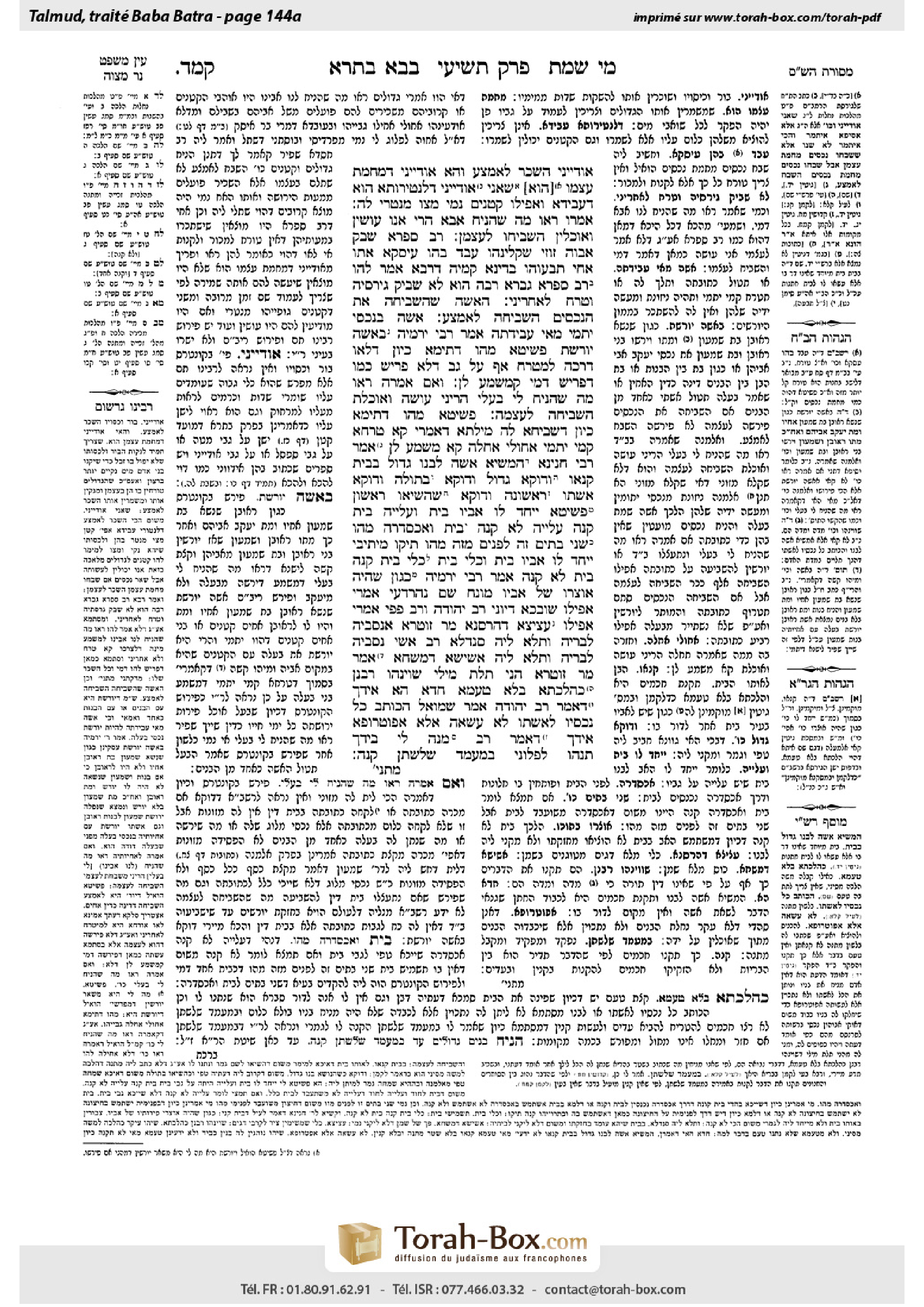
Bava Batra 144a: Talmud study for Daf Yomi
Study the Talmud for Daf Yomi with scanned pages, Hebrew text, English translations from Sefaria and AI-generated French translations.
Passage selection and English or AI-generated French translation are available where the scan has annotations. Daf Study is independent of Torah-Box and Sefaria.
Browse Bava Batra · בבא בתרא · All tractatesBava Batra 144a text and translations
This page of Bava Batra includes the Aramaic text, an English translation and an AI-generated French translation, alongside the scan above.
בבא בתרא קמ״ד א · Aramaic and Hebrew text
אוּדְיָינֵי – הַשָּׂכָר לָאֶמְצַע. וְהָא אוּדְיָינֵי, דְּמֵחֲמַת עַצְמוֹ הוּא! שָׁאנֵי אוּדְיָינֵי – דְּלִנְטִירוּתָא הוּא דַּעֲבִידָא, וַאֲפִילּוּ קְטַנִּים נָמֵי מָצוּ מְנַטְּרִי לַהּ.
אָמְרוּ ״רְאוּ מַה שֶּׁהִנִּיחַ אַבָּא, הֲרֵי אָנוּ עוֹשִׂין וְאוֹכְלִין״ – הִשְׁבִּיחוּ לְעַצְמָן. רַב סָפְרָא שְׁבַק אֲבוּהּ זוּזֵי. שַׁקְלִינְהוּ, עֲבַד בְּהוּ עִיסְקָא. אֲתוֹ אַחֵי, תַּבְעוּהוּ בְּדִינָא קַמֵּיהּ דְּרָבָא; אֲמַר לְהוּ: רַב סָפְרָא גַּבְרָא רַבָּה הוּא, לָא שָׁבֵיק גִּירְסֵיהּ וְטָרַח לְאַחֲרִינֵי.
הָאִשָּׁה שֶׁהִשְׁבִּיחָה אֶת הַנְּכָסִים – הִשְׁבִּיחָה לָאֶמְצַע. אִשָּׁה בְּנִכְסֵי יַתְמֵי מַאי עֲבִידְתַּהּ? אָמַר רַבִּי יִרְמְיָה: בְּאִשָּׁה יוֹרֶשֶׁת.
פְּשִׁיטָא! מַהוּ דְּתֵימָא: כֵּיוָן דְּלָאו דַּרְכַּהּ לְמִטְרַח, אַף עַל גַּב דְּלָא פָּרֵישׁ – כְּמוֹ דְּפָרֵישׁ דָּמֵי, קָמַשְׁמַע לַן.
וְאִם אָמְרָה: ״רְאוּ מַה שֶּׁהִנִּיחַ לִי בַּעְלִי, הֲרֵינִי עוֹשָׂה וְאוֹכֶלֶת״ – הִשְׁבִּיחָה לְעַצְמָהּ. פְּשִׁיטָא! מַהוּ דְּתֵימָא: כֵּיוָן דִּשְׁבִיחָא לַהּ מִילְּתָא, דְּאָמְרִי: קָא טָרְחָא קַמֵּי יַתְמֵי – אַחוֹלֵי אַחֲלָה; קָא מַשְׁמַע לַן.
אָמַר רַבִּי חֲנִינָא: הַמַּשִּׂיא אִשָּׁה לִבְנוֹ גָּדוֹל בַּבַּיִת – קְנָאוֹ. וְדַוְקָא גָּדוֹל, וְדַוְקָא בְּתוּלָה, וְדַוְקָא אִשְׁתּוֹ רִאשׁוֹנָה, וְדַוְקָא שֶׁהִשִּׂיאוֹ רִאשׁוֹן.
פְּשִׁיטָא, יִיחֵד לוֹ אָבִיו בַּיִת וַעֲלִיָּיה – בַּיִת קָנָה, עֲלִיָּיה לֹא קָנָה. בַּיִת וְאַכְסַדְרָה, מַהוּ? שְׁנֵי בָתִּים זֶה לִפְנִים מִזֶּה, מַהוּ? תֵּיקוּ.
מֵיתִיבִי: יִיחֵד לוֹ אָבִיו בַּיִת וּכְלֵי בַיִת – כְּלֵי בַיִת קָנָה, בַּיִת לֹא קָנָה! אָמַר רַבִּי יִרְמְיָה: כְּגוֹן שֶׁהָיָה אוֹצָרוֹ שֶׁל אָבִיו מוּנָּח שָׁם. נְהַרְדָּעֵי אָמְרִי: אֲפִילּוּ שׁוֹבָכָא דְיוֹנֵי. רַב יְהוּדָה וְרַב פַּפֵּי אָמְרִי: אֲפִילּוּ עֲצִיצָא דְהַרְסָנָא. מָר זוּטְרָא אַנְסְבֵיהּ לִבְרֵיהּ, וּתְלָא לֵיהּ סַנְדָּלָא. רַב אָשֵׁי אַנְסְבֵיהּ לִבְרֵיהּ, וּתְלָא לֵיהּ אֲשִׁישָׁא דְמִשְׁחָא.
אָמַר מָר זוּטְרָא, הָנֵי תְּלָת מִילֵּי שַׁוִּינְהוּ רַבָּנַן כְּהִלְכְתָא בְּלָא טַעְמָא: חֲדָא – הָא, אִידַּךְ – דְּאָמַר רַב יְהוּדָה אָמַר שְׁמוּאֵל: הַכּוֹתֵב כׇּל נְכָסָיו לְאִשְׁתּוֹ – לֹא עֲשָׂאָהּ אֶלָּא אַפּוֹטְרוֹפָּא. אִידַּךְ – דְּאָמַר רַב: מָנֶה לִי בְּיָדְךָ, תְּנֵהוּ לִפְלוֹנִי; בְּמַעֲמַד שְׁלָשְׁתָּן – קָנָה.
Bava Batra 144a · English translation
a mortar [udaini], which people pay to use, the rent goes to the middle? But isn’t the profit accruing from a mortar considered profit accruing on his, i.e., the adult son’s, own account, as the adult son must supervise its operation, and there is no outlay from the property? The Gemara dismisses this objection: A mortar is different, as for its typical use it can suffice with supervision, and even minors are able to supervise its use. Since the adults do not contribute anything more than the minors, they cannot demand a greater share of the profits.
§ The mishna teaches: If the adult sons said from the outset: See that which our father left behind; we are going to engage in business with our share of the property and profit from it, then they enhanced the property for themselves. The Gemara relates: Rav Safra’s father left him dinars. Rav Safra took them and entered into a business venture with them. His brothers came and charged him in a court of law before Rava, claiming their share of the profits. Rava said to them: Rav Safra is a great man; he does not abandon his studies and toil for others. It is therefore clear that if he invested the money, it was for his own profit, even if he did not explicitly declare so at the outset.
§ The mishna teaches: With regard to a wife who enhanced the property of her deceased husband, she enhanced it so that the profit goes to the middle. The Gemara asks: What is the deceased’s wife doing with the orphans’ property? What rights does she have to the property? Rav Yirmeya said: The mishna is referring to a wife who is an heiress, e.g., if she were the daughter of her husband’s brother, and both brothers died without leaving sons, in which case she inherits in her father’s stead.
The Gemara asks: Isn’t it obvious that the halakha in this case is the same as with regard to any other heir? The Gemara replies: It is necessary to state this, lest you say that since it is not a woman’s way to toil to enhance property, then even though she did not expressly state that she is toiling for herself, it is considered as though she had expressly stated this. The mishna teaches us that only if she expressly stated this do the profits accrue to her.
The mishna teaches: And if she said: See that which my husband left me; I am going to engage in business with my share and profit from it, then she enhanced the property for herself. The Gemara asks: Isn’t this obvious? The Gemara explains: It is necessary to state this, lest you say that since it is praiseworthy for her to enhance the property on behalf of the orphans, as people will say: See how she toils for the orphans, she relinquishes her right to the profits and they should divide them equally. The mishna teaches us that this is not the case.
Rabbi Ḥanina says: In the case of one who marries a woman to his eldest son and arranges the wedding feast in a house that he designated for the purpose of the wedding canopy and the wedding feast, the son acquires the house as a gift. The Gemara notes: And this is the halakha specifically in the case of the eldest son, and specifically if he is marrying a virgin, and specifically when this woman is his first wife, and specifically when the father married him off first among his sons. When all these conditions exist, it is presumed that the father has a particular fondness toward the son, due to which he gave him the house.
The Gemara clarifies the details of this halakha: It is obvious that if his father designated a house for the son’s nuptials and there is an upper story above the house, the son acquired the house, but he did not acquire the upper story. If he designated a house for the son, and there is a portico [ve’akhsadra] in front of the house, what is the halakha? If there were two houses, one within the other, and the inner one was designated for the son’s nuptials, what is the halakha? The Gemara concludes: These questions shall stand unresolved.
The Gemara raises an objection from a baraita: If his father designated a house and furniture for his son’s nuptials, the son acquired the furniture, but he did not acquire the house. Rabbi Yirmeya says: This is referring to a case where his father’s storeroom was placed there. It is clear that just as his father did not intend to give him the storeroom, neither did he intend to give him the house. The Sages of Neharde’a say: Even if there is only a dovecote in the house that belongs to the father, the son does not acquire the house. Rav Yehuda and Rav Pappi say: Even if there is only a pot [atzitza] of small fried fish, the son does not acquire the house. Mar Zutra married off his son, and hung a sandal in the house, to indicate that he did not intend to give the house as a gift. Rav Ashi married off his son, and hung a jug [ashisha] of oil in the house.
Mar Zutra says: These three matters were instituted by the Sages as a halakha without any explanation of their process, i.e., they instituted these enactments despite the fact that the mechanism by which they function is unclear: One is this halakha with regard to the son acquiring the house designated for his nuptials. Another is that which Rav Yehuda says that Shmuel says: One who writes a deed granting all of his property to his wife renders her only a steward of his property, i.e., he intends only to put her in charge of the property and she does not acquire it. Another is that which Rav says: With regard to one who says to another: I have one hundred dinars in your possession; give it to so-and-so, if this occurred in the presence of all three parties, that third person acquires it, without need of witnesses or a formal act of acquisition.
Bava Batra 144a · Traduction française (IA)
un mortier [udaini], dont les gens paient pour l'utiliser, le loyer va-t-il au milieu ? Mais n'est-ce pas le profit issu d'un mortier considéré comme un profit qui revient à son compte, c'est-à-dire au compte du fils aîné, puisque le fils aîné doit surveiller son utilisation et qu'il n'y a pas d'investissement provenant de la propriété ? La Guemara rejette cette objection : un mortier est différent, car pour son utilisation typique il suffit de la surveillance, et même les mineurs peuvent surveiller son utilisation. Puisque les adultes ne contribuent pas davantage que les mineurs, ils ne peuvent pas exiger une part plus grande des profits.
§ La mitsva enseigne : Si les fils aînés dirent dès le début : Voyez ce que notre père a laissé derrière lui ; nous allons entreprendre un commerce avec notre part de la propriété et en tirer profit, alors ils ont amélioré la propriété pour eux-mêmes. La Guemara rapporte : Le père de Rav Safra lui a laissé des dinars. Rav Safra les a pris et a entrepris un commerce avec eux. Ses frères sont venus et ont porté une action en justice devant Rava, réclamant leur part des profits. Rava a dit à eux : Rav Safra est un grand homme ; il ne renonce pas à ses études et à son travail pour les autres. Il est donc clair que s'il a investi l'argent, c'était pour son propre profit, même s'il n'avait pas explicitement déclaré cela au départ.
§ La mitsva enseigne : En ce qui concerne une épouse qui a amélioré la propriété de son mari décédé, elle l'a améliorée de sorte que le profit va au milieu. La Guemara pose la question : Qu'est-ce que la veuve fait avec la propriété des orphelins ? Quels droits a-t-elle sur la propriété ? Rav Yirmeya a dit : la mitsva fait référence à une épouse qui est une héritière, c'est-à-dire si elle était la fille du frère de son mari, et que les deux frères sont décédés sans avoir laissé d'enfants, dans ce cas elle hérite à la place de son père.
La Guemara pose la question : N'est-ce pas évident que la halakha dans ce cas est la même qu'avec n'importe quel autre héritier ? La Guemara répond : il est nécessaire d'énoncer cela, afin que l'on ne dise pas que puisque ce n'est pas la manière d'une femme de se donner de la peine pour améliorer une propriété, alors même qu'elle n'a pas explicitement déclaré qu'elle se donnait de la peine pour elle-même, cela est considéré comme si elle avait explicitement déclaré cela. La mitsna nous enseigne que seul si elle a explicitement déclaré cela les profits reviennent à elle.
La mitsna enseigne : Et si elle dit : Voyez ce que mon mari m'a laissé ; je vais entreprendre un commerce avec ma part et en tirer profit, alors elle a amélioré la propriété pour elle-même. La Guemara pose la question : N'est-ce pas évident ? La Guemara explique : il est nécessaire d'énoncer cela, afin que l'on ne dise pas que puisque c'est louable qu'elle améliore la propriété au bénéfice des orphelins, comme les gens diront : Voyez comme elle se donne de la peine pour les orphelins, elle renonce à son droit aux profits et ils devraient les partager équitablement. La mitsna nous enseigne que cela n'est pas le cas.
Rabbi Ḥanina dit : Dans le cas d'une personne qui épouse une femme à son fils aîné et organise le banquet de mariage dans une maison qu'il a désignée à l'usage du dais de mariage et du banquet, le fils acquiert la maison comme un cadeau. La Guemara note : et c'est précisément la halakha dans le cas du fils aîné, et précisément s'il épouse une vierge, et précisément si cette femme est sa première épouse, et précisément lorsque le père a marié son fils en premier parmi ses fils. Lorsque toutes ces conditions sont réunies, on suppose que le père a une affection particulière pour le fils, en raison de laquelle il lui a donné la maison.
La Guemara clarifie les détails de cette halakha : Il est évident que si son père a désigné une maison pour les noces du fils et qu'il y a un étage au-dessus de la maison, le fils acquiert la maison, mais pas l'étage supérieur. Si son père a désigné une maison pour les noces du fils et qu'il y a un portique [ve’akhsadra] devant la maison, quelle est la halakha ? Si deux maisons, l'une à l'intérieur de l'autre, et que l'intérieure a été désignée pour les noces du fils, quelle est la halakha ? La Guemara conclut : ces questions restent sans réponse.
La Guemara évoque une objection tirée d'une baraïta : Si son père a désigné une maison et des meubles pour les noces de son fils, le fils acquiert les meubles, mais pas la maison. Rabbi Yirmeya dit : cela fait référence à un cas où la pièce de stockage du père était placée là. Il est clair que tout comme le père n'avait pas l'intention de lui donner la pièce de stockage, il n'avait pas l'intention de lui donner la maison. Les Sages de Neharde’a disent : même s'il n'y a qu'un poulaillon dans la maison qui appartient au père, le fils ne possède pas la maison. Rav Yehuda et Rav Pappi disent : même s'il n'y a qu'une casserole [atzitza] de petits poissons frits, le fils ne possède pas la maison. Mar Zutra a marié son fils et a accroché un sandal dans la maison, pour indiquer qu'il n'avait pas l'intention de donner la maison en cadeau. Rav Ashi a marié son fils et a accroché une jarre [ashisha] d'huile dans la maison.
Mar Zutra dit : ces trois choses ont été instituées par les Sages comme une halakha sans explication de leur processus, c'est-à-dire qu'ils ont institué ces édicts malgré le fait que le mécanisme par lequel ils fonctionnent est inconnu : l'une est cette halakha concernant le fils qui acquiert la maison désignée pour ses noces. Une autre est celle que Rav Yehuda rapporte que Shmuel a dit : celui qui écrit un acte de donation de toute sa propriété à sa femme la rend seulement un administrateur de sa propriété, c'est-à-dire qu'il veut seulement la mettre à sa charge et elle ne l'acquiert pas. Une autre est celle que Rav dit : concernant celui qui dit à un autre : j'ai cent dinars en votre possession ; donnez-les à tel ou tel, si cela s'est produit en présence des trois parties, ce troisième acquiert cela, sans besoin de témoins ou d'acte formel d'acquisition.
Traduction française générée par IA à partir de l’édition anglaise de Sefaria. Vérifie toujours un passage avec le texte source.
Text from Sefaria: William Davidson Edition - Vocalized Aramaic (CC BY NC); William Davidson Edition - English (CC BY NC).