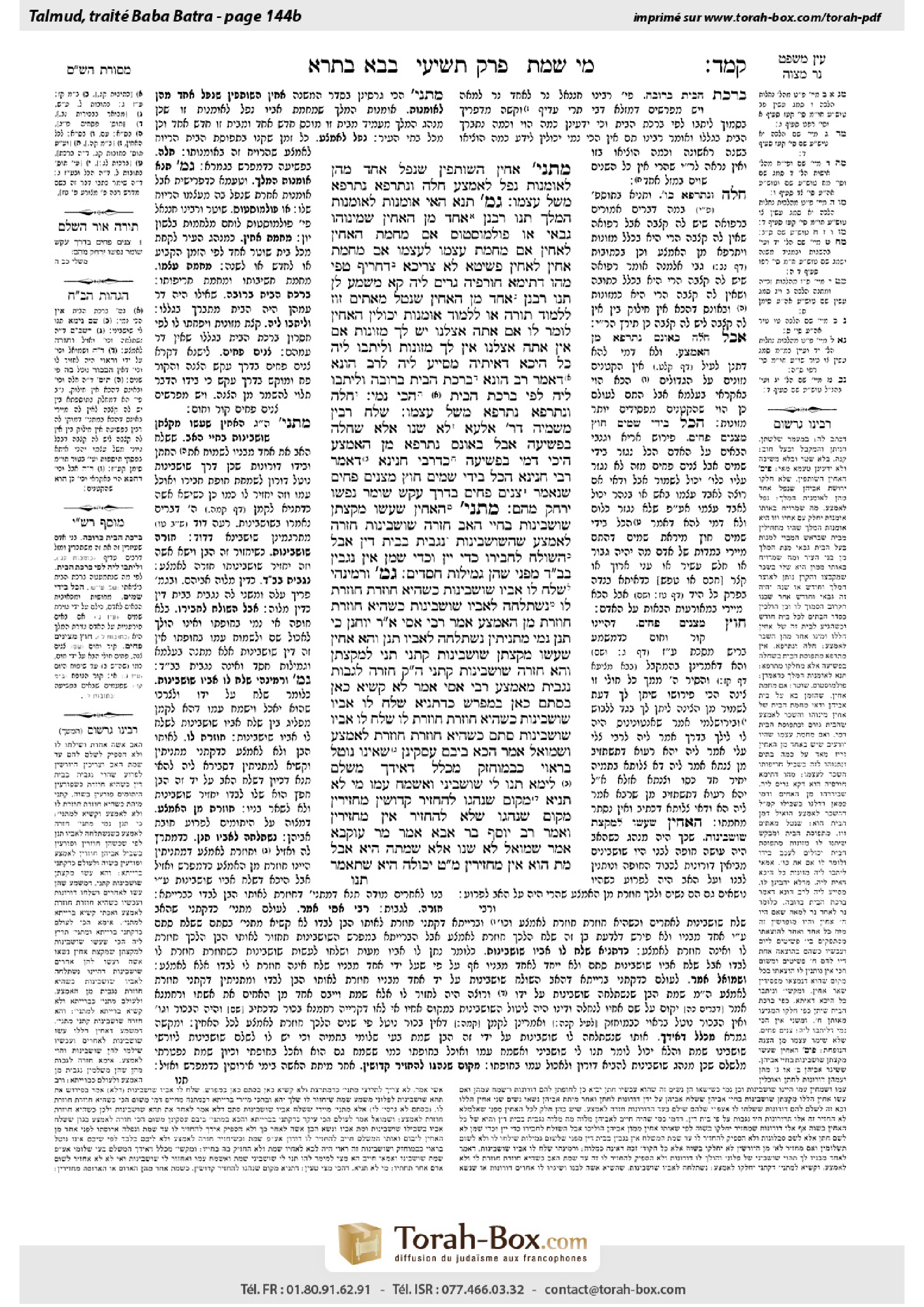
Bava Batra 144b: Talmud study for Daf Yomi
Study the Talmud for Daf Yomi with scanned pages, Hebrew text, English translations from Sefaria and AI-generated French translations.
Passage selection and English or AI-generated French translation are available where the scan has annotations. Daf Study is independent of Torah-Box and Sefaria.
Browse Bava Batra · בבא בתרא · All tractatesBava Batra 144b text and translations
This page of Bava Batra includes the Aramaic text, an English translation and an AI-generated French translation, alongside the scan above.
בבא בתרא קמ״ד ב · Aramaic and Hebrew text
מַתְנִי׳ אַחִין הַשּׁוּתָּפִין שֶׁנָּפַל אֶחָד מֵהֶן לְאוּמָּנוּת – נָפַל לָאֶמְצַע. חָלָה וְנִתְרַפֵּא – נִתְרַפֵּא מִשֶּׁל עַצְמוֹ.
גְּמָ׳ תָּנָא: הַאי אוּמָּנוּת – לְאוּמָּנוּת הַמֶּלֶךְ. תָּנוּ רַבָּנַן: אֶחָד מִן הָאַחִין שֶׁמִּינּוּהוּ גַּבַּאי אוֹ פּוּלְמוֹסְטוּס; אִם מֵחֲמַת הָאַחִין – לָאַחִין, אִם מֵחֲמַת עַצְמוֹ – לְעַצְמוֹ.
אִם מֵחֲמַת אַחִין לָאַחִין – פְּשִׁיטָא! לָא צְרִיכָא, דְּחָרִיף טְפֵי; מַהוּ דְּתֵימָא: חוּרְפֵּיהּ גָּרֵים לֵיהּ, קָא מַשְׁמַע לַן.
תָּנוּ רַבָּנַן: אֶחָד מִן הָאַחִין שֶׁנָּטַל מָאתַיִם זוּז לִלְמוֹד תּוֹרָה אוֹ לִלְמוֹד אוּמָּנוּת – יְכוֹלִין הָאַחִין לוֹמַר לוֹ: אִם אַתָּה אֶצְלֵנוּ – יֵשׁ לְךָ מְזוֹנוֹת, אִם אֵין אַתָּה אֶצְלֵנוּ – אֵין לְךָ מְזוֹנוֹת.
וְלִיתְּבוּ לֵיהּ כֹּל הֵיכָא דְּאִיתֵיהּ! מְסַיַּיע לֵיהּ לְרַב הוּנָא, דְּאָמַר רַב הוּנָא: בִּרְכַּת הַבַּיִת בְּרוּבָּה. וְלִיתְּבוּ לֵיהּ לְפִי בִּרְכַּת הַבַּיִת! הָכִי נָמֵי.
חָלָה וְנִתְרַפֵּא – נִתְרַפֵּא מִשֶּׁל עַצְמוֹ. שְׁלַח רָבִין מִשְּׁמֵיהּ דְּרַבִּי אִלְעָא: לֹא שָׁנוּ אֶלָּא שֶׁחָלָה בִּפְשִׁיעָה, אֲבָל בְּאוֹנֶס – נִתְרַפֵּא מִן הָאֶמְצַע. הֵיכִי דָּמֵי בִּפְשִׁיעָה? כִּדְרַבִּי חֲנִינָא – דְּאָמַר רַבִּי חֲנִינָא: הַכֹּל בִּידֵי שָׁמַיִם, חוּץ מִצִּנִּים פַּחִים; שֶׁנֶּאֱמַר: ״צִנִּים פַּחִים בְּדֶרֶךְ עִקֵּשׁ, שׁוֹמֵר נַפְשׁוֹ יִרְחַק מֵהֶם״.
מַתְנִי׳ הָאַחִין שֶׁעָשׂוּ מִקְצָתָן שׁוֹשְׁבִינוּת בְּחַיֵּי הָאָב, חָזְרָה שׁוֹשְׁבִינוּת – חָזְרָה לָאֶמְצַע; שֶׁהַשּׁוֹשְׁבִינוּת נִגְבֵּית בְּבֵית דִּין. אֲבָל הַשּׁוֹלֵחַ לַחֲבֵירוֹ כַּדֵּי יַיִן וְכַדֵּי שֶׁמֶן – אֵין נִגְבִּין בְּבֵית דִּין, מִפְּנֵי שֶׁהֵן גְּמִילוּת חֲסָדִים.
גְּמָ׳ וּרְמִינְהִי: שָׁלַח לוֹ אָבִיו שׁוֹשְׁבִינוּת, כְּשֶׁהִיא חוֹזֶרֶת – חוֹזֶרֶת לוֹ. נִשְׁתַּלְּחָה לְאָבִיו שׁוֹשְׁבִינוּת, כְּשֶׁהִיא חוֹזֶרֶת – חוֹזֶרֶת מִן הָאֶמְצַע. אָמַר רַבִּי אַסִּי אָמַר רַבִּי יוֹחָנָן: כִּי תְּנַן נָמֵי מַתְנִיתִין, נִשְׁתַּלְּחָה לְאָבִיו תְּנַן.
וְהָא ״אַחִין שֶׁעָשׂוּ מִקְצָתָן שׁוֹשְׁבִינוּת״ קָתָנֵי! תְּנִי: ״לְמִקְצָתָן״. וְהָא ״חָזְרָה שׁוֹשְׁבִינוּת״ קָתָנֵי! הָכִי קָאָמַר: חָזְרָה לִגְבּוֹת – נִגְבֵּית מֵאֶמְצַע.
רַבִּי אַסִּי אָמַר: לָא קַשְׁיָא; כָּאן בִּסְתָם, כָּאן בִּמְפָרֵשׁ – כִּדְתַנְיָא: שָׁלַח לוֹ אָבִיו שׁוֹשְׁבִינוּת, כְּשֶׁהִיא חוֹזֶרֶת – חוֹזֶרֶת לוֹ. שָׁלַח אָבִיו שׁוֹשְׁבִינוּת סְתָם, כְּשֶׁהִיא חוֹזֶרֶת – חוֹזֶרֶת לָאֶמְצַע.
וּשְׁמוּאֵל אָמַר: הָכָא בְּיָבָם עָסְקִינַן, שֶׁאֵינוֹ נוֹטֵל בָּרָאוּי כִּבְמוּחְזָק.
מִכְּלָל דְּאִידַּךְ – מְשַׁלֵּם? לֵימָא: ״תְּנוּ לִי שׁוֹשְׁבִינִי וְאֶשְׂמַח עִמּוֹ״!
מִי לָא תַּנְיָא: מָקוֹם שֶׁנָּהֲגוּ לְהַחְזִיר קִדּוּשִׁין – מַחְזִירִין, מָקוֹם שֶׁנָּהֲגוּ שֶׁלֹּא לְהַחְזִיר – אֵין מַחְזִירִין. וְאָמַר רַב יוֹסֵף בַּר אַבָּא אָמַר מָר עוּקְבָא אָמַר שְׁמוּאֵל: לֹא שָׁנוּ אֶלָּא שֶׁמֵּתָה הִיא, אֲבָל מֵת הוּא – אֵין מַחְזִירִין, מַאי טַעְמָא? יְכוֹלָה הִיא שֶׁתֹּאמַר:
Bava Batra 144b · English translation
MISHNA: With regard to brothers who were also partners, and it occurred that one of them was summoned to public service, which is assessed per family, he was summoned from the middle, i.e., the profits or expenses of his service are divided among them. If one of the brothers became sick and sought treatment, the cost of the treatment is paid from his own resources.
GEMARA: The Sages taught: This service mentioned in the mishna is referring to forced imperial service, but if one of the brothers engaged in a trade of his own volition, the profits are his alone. The Sages taught in a baraita (Tosefta 10:5): In the case of one of the brothers who was appointed as a tax collector or a military commander [polmustos], a position with the potential for profit, if he was appointed on account of all the brothers, as the procedure was to impress a representative from each family for this purpose, any profit accrues to all the brothers. If he was appointed on account of himself, the profit accrues to himself.
The Gemara asks: Isn’t it obvious that if he was appointed on account of all the brothers, then the profit accrues to all the brothers? The Gemara responds: No, it is necessary to state this halakha in a case where the brother appointed was sharper, i.e., more capable, than the other brothers. Lest you say that his sharpness caused him to be selected for the position, and he should receive all the profits, the baraita teaches us that his talent notwithstanding, since he was selected as a representative of the family, the profit accrues to all the brothers.
The Sages taught: With regard to one of the brothers, who took two hundred dinars from the common inheritance to support himself when he went to another place to study Torah or to learn a trade, the brothers can say to him: If you are here with us, you are entitled to sustenance along with us. If you are not here with us, you are not entitled to sustenance.
The Gemara asks: But shouldn’t they give him his sustenance wherever he is? The Gemara answers: This ruling supports the opinion of Rav Huna, as Rav Huna says: The blessing of the house is in its abundance. This means that the extent to which blessing permeates a home is proportionate to the number of people who live there, and when many people live together the expenses per capita decrease. The Gemara asks: But shouldn’t they give him his sustenance according to the blessing of the house, i.e., the expenses he would incur even if he were in the house? The Gemara responds: Indeed, they are required to provide for those expenses that he would incur in any event.
§ The mishna teaches: If one of the brothers became sick and sought treatment, the cost of the treatment is paid from his own resources. Ravin sent a ruling in the name of Rabbi Ela: They taught this only in a case where he became ill through negligence. But if he became ill through circumstances beyond his control, the cost of the treatment is paid from the middle, i.e., from the common inheritance. The Gemara asks: What are the circumstances in which it is considered negligence? This is in accordance with the statement of Rabbi Ḥanina, as Rabbi Ḥanina says: All occurrences that befall man are in the hand of Heaven except for colds and obstacles [paḥim], from which one is able to protect himself, as it is stated: “Colds and snares are on the path of the crooked; he who guards his soul shall keep far from them” (Proverbs 22:5).
MISHNA: It was common practice for friends of a groom to give him gifts in order to help cover the expenses of the wedding feast. These gifts are known as gifts of groomsmen, and would be reciprocated in turn. While the groom and the groomsman were at times the recipient and the giver of the gifts, respectively, the gifts were at times provided by the father of the groomsman and received by the father of the groom. In the case of brothers, some of whom brought gifts of groomsmen in their father’s lifetime, which were provided by their father, when the gifts of groomsmen are reciprocated after the father’s death, when one of the brothers gets married, they are reciprocated to the middle, i.e., the gift is divided among the brothers. This is because gifts of groomsmen are a legal debt owed to the father, collectible in court. But with regard to one who sends his friend jugs of wine or jugs of oil, a reciprocal gift is not collectible in court, because they are considered acts of kindness.
GEMARA: And the Gemara raises a contradiction between the mishna’s ruling that the gifts of groomsmen are reciprocated to the middle, and the first clause of a baraita: If a father sent his son with gifts of groomsmen, when they are reciprocated when that son gets married, they are reciprocated to that son. If his father was sent gifts of groomsmen for the wedding of one of his sons, when they are reciprocated from the father’s estate, they are reciprocated from the middle, i.e., the cost of the gift is divided among the brothers. Rabbi Asi says that Rabbi Yoḥanan says: When we learned the mishna as well, we learned it as teaching the halakha with regard to gifts of groomsmen that were sent to the father for the wedding of one of his sons, not with regard to gifts of groomsmen sent by the father.
The Gemara objects: But the mishna teaches the halakha with regard to brothers, some of whom brought gifts of groomsmen. The Gemara responds: Emend the text of the mishna and teach it as saying: With regard to brothers, to some of whom gifts of groomsmen were brought. The Gemara objects: But the mishna explicitly teaches the halakha if the gifts of groomsmen are reciprocated. The Gemara responds: This is what the mishna is saying: When it is collected from the brothers in return, it is collected from the middle.
Rabbi Asi says: Even if the text of the mishna is not emended, it is not difficult and can be reconciled with the baraita. Here in the mishna it is referring to where the father sent the gifts of groomsmen without specifying which son should be ascribed credit for bringing the gifts. There in the baraita, it is referring to where the father specified that the credit for the gifts of groomsmen should be ascribed to a specific son, who receives gifts in return, as it is taught in another baraita: If his father sent gifts of groomsmen on his, i.e., the son’s, behalf, then when the gift is reciprocated, it is reciprocated to him, i.e., to that specific son. If his father sent gifts of groomsmen without specification, then when the gift is reciprocated, it is reciprocated to the middle.
And Shmuel says: Here in the mishna we are dealing with a man whose married brother died childless [yavam]. The son who brought the gifts of groomsmen died childless, his brother entered into levirate marriage with the widow, and the gifts of groomsmen were reciprocated at the wedding of the yavam. Although the yavam inherits the property of his brother, since the reciprocal gifts were not extant when his brother died, they do not belong solely to him; rather, they are divided among the brothers. This is because the yavam does not take in inheritance the property due the deceased as he does the property the deceased already possessed.
The Gemara asks: Is it possible to conclude by inference from Shmuel’s statement that the other side, i.e., a friend who had received gifts of groomsmen from the deceased, is obligated to repay the gifts of groomsmen he received from the deceased? Why should this be so? Let him say: Give me my groomsman and I will rejoice with him. Since the one who gave him the gifts is deceased, he is not obligated to reciprocate.
Isn’t it taught in a baraita (Tosefta, Pesaḥim 3:1) with regard to similar circumstances: In a place where people are accustomed to return the betrothal money when the betrothed man or woman dies, they return it; in a place where people are accustomed not to return it, they do not return it. And Rav Yosef bar Abba says that Mar Ukva says that Shmuel says: They taught this only with regard to when the woman dies, in which case one follows the local custom. But if the man dies, all agree that they do not return the money. What is the reason for this? Since she can say:
Bava Batra 144b · Traduction française (IA)
MICHNA : Concernant des frères qui étaient également associés, et il s'est produit que l'un d'eux a été appelé à un service public, qui est évalué par famille, il a été appelé du milieu, c'est-à-dire que les profits ou les dépenses de son service sont partagés entre eux. Si l'un des frères est tombé malade et a demandé des soins médicaux, les frais des soins sont payés à partir de ses propres ressources.
GUEMARA : Les Sages ont enseigné : Ce service mentionné dans la mishna fait référence au service impérial obligatoire, mais si l'un des frères a entrepris un commerce de son propre gré, les profits sont à lui seul. Les Sages ont enseigné dans une baraïta (Tosefta 10:5) : Dans le cas d'un des frères qui a été nommé récolteur d'impôts ou commandant militaire [polmustos], un poste susceptible de profit, si l'on l'a nommé en faveur de tous les frères, comme la procédure était de désigner un représentant de chaque famille à cet effet, tout profit revient à tous les frères. Si l'on l'a nommé en faveur de lui-même, le profit revient à lui seul.
La Guemara pose la question : N'est-ce pas évident que si l'on l'a nommé en faveur de tous les frères, alors le profit revient à tous les frères ? La Guemara répond : Non, il est nécessaire d'énoncer cette halakha dans un cas où le frère nommé était plus compétent, c'est-à-dire plus capable, que les autres frères. De peur que vous disiez que sa compétence a causé son élection pour ce poste, et qu'il devrait recevoir tous les profits, la baraïta nous apprend que, malgré son talent, puisqu'il a été élu comme représentant de la famille, le profit revient à tous les frères.
Les Sages ont enseigné : Concernant l'un des frères, qui a pris deux cents drachmes de l'héritage commun pour se sustenter lorsqu'il est allé dans un autre lieu étudier la Torah ou apprendre un métier, les frères peuvent lui dire : Si tu es ici avec nous, tu as droit à la subsistance avec nous. Si tu n'es pas ici avec nous, tu n'as pas droit à la subsistance.
La Guemara pose la question : Mais ne devraient-ils pas lui fournir sa subsistance là où il est ? La Guemara répond : Cette décision soutient l'opinion de Rav Huna, car Rav Huna dit : La bénédiction de la maison est dans sa richesse. Cela signifie que l'étendue dans laquelle la bénédiction pénètre dans une maison est proportionnelle au nombre de personnes qui y habitent, et lorsque beaucoup de personnes habitent ensemble, les dépenses par personne diminuent. La Guemara pose la question : Mais ne devraient-ils pas lui fournir sa subsistance selon la bénédiction de la maison, c'est-à-dire les dépenses qu'il aurait à supporter même s'il était dans la maison ? La Guemara répond : En effet, ils sont tenus de couvrir ces dépenses qu'il aurait à supporter dans tous les cas.
§ La mishna enseigne : Si l'un des frères est tombé malade et a demandé des soins médicaux, les frais des soins sont payés à partir de ses propres ressources. Ravin a envoyé un jugement au nom de Rabbi Ela : Ils ont enseigné cela uniquement dans le cas où il est tombé malade par négligence. Mais si l'il est tombé malade en dehors de son contrôle, les frais des soins sont payés du milieu, c'est-à-dire à partir de l'héritage commun. La Guemara pose la question : Quels sont les circonstances où cela est considéré comme une négligence ? Cela est selon la déclaration de Rabbi Ḥanina, car Rabbi Ḥanina dit : Tous les événements qui affectent l'homme sont entre les mains de Dieu, sauf les froides et les obstacles [paḥim], desquels on peut se protéger, comme il est dit : « Les froides et les pièges sont sur le chemin du déviant ; celui qui garde son âme se tient loin d'eux » (Proverbes 22:5).
MICHNA : Il était coutume que les amis du mari lui offrent des cadeaux afin de couvrir les dépenses du banquet de mariage. Ces cadeaux sont appelés cadeaux des compagnons de mariage, et étaient réciproquement offerts. Bien que le mari et le compagnon de mariage fussent parfois respectivement récepteur et donneur des cadeaux, les cadeaux étaient parfois offerts par le père du compagnon de mariage et reçus par le père du mari. Dans le cas de frères, certains desquels ont offert des cadeaux des compagnons de mariage pendant la vie de leur père, qui étaient offerts par leur père, lorsque les cadeaux des compagnons de mariage sont réciproqués après la mort du père, lorsqu'un des frères se marie, ils sont réciproqués au milieu, c'est-à-dire que le cadeau est divisé entre les frères. Cela est dû au fait que les cadeaux des compagnons de mariage constituent une dette légale envers le père, récoltable en justice. Mais concernant celui qui envoie à son ami des tonneaux de vin ou de huile, un cadeau réciproque n'est pas récoltable en justice, car ils sont considérés comme des actes de bonté.
GUEMARA : Et la Guemara soulève une contradiction entre la décision de la mishna selon laquelle les cadeaux des compagnons de mariage sont réciproqués au milieu, et la première clause d'une baraïta : Si un père a envoyé son fils avec des cadeaux des compagnons de mariage, lorsqu'ils sont réciproqués lorsqu'il se marie, ils sont réciproqués à ce fils. Si son père a reçu des cadeaux des compagnons de mariage pour le mariage d'un de ses fils, lorsqu'ils sont réciproqués à partir de l'actif du père, ils sont réciproqués au milieu, c'est-à-dire que le coût du cadeau est divisé entre les frères. Rabbi Asi dit que Rabbi Yoḥanan dit : Lorsque nous avons appris la mishna, nous l'avons apprise comme enseignant la halakha concernant les cadeaux des compagnons de mariage envoyés au père pour le mariage d'un de ses fils, et non concernant les cadeaux des compagnons de mariage envoyés par le père.
La Guemara s'oppose : Mais la Michna enseigne la halakha concernant les frères, certains desquels ont offert des cadeaux des compagnons de mariage. La Guemara répond : Corrigez le texte de la Michna et enseignez-le comme disant : Concernant les frères, à certains desquels des cadeaux des compagnons de mariage ont été offerts. La Guemara s'oppose : Mais la Michna enseigne explicitement la halakha si les cadeaux des compagnons de mariage sont réciproqués. La Guemara répond : C'est ce que la Michna dit : Lorsqu'ils sont recueillis par les frères en retour, ils sont recueillis du milieu.
Rabbi Asi dit : Même si le texte de la michna n'est pas modifié, il n'est pas difficile et peut être concilié avec la baraïta. Ici, dans la michna, il s'agit de la situation où le père a envoyé les présents des camarades de mariage sans spécifier quel fils doit être crédité pour avoir apporté les présents. Là, dans la baraïta, il s'agit de la situation où le père a spécifié que le crédit des présents des camarades de mariage doit être attribué à un fils spécifique, qui reçoit des présents en retour, comme il est enseigné dans une autre baraïta : Si son père a envoyé les présents des camarades de mariage à son compte, c'est-à-dire en son nom, alors lorsque les présents sont réciproqués, ils sont réciproqués à lui, c'est-à-dire à ce fils spécifique. Si son père a envoyé les présents des camarades de mariage sans spécification, alors lorsque les présents sont réciproqués, ils sont réciproqués au milieu.
Et Shmuel dit : Ici, dans la michna, nous parlons d'un homme dont le frère marié est mort sans enfants [yavam]. Le fils qui a apporté les présents des camarades de mariage est mort sans enfants, son frère a entré en mariage levirat avec la veuve, et les présents des camarades de mariage ont été réciproqués lors du mariage du yavam. Bien que le yavam hérite des biens de son frère, puisque les présents réciproques n'étaient pas existants lors de la mort de son frère, ils n'appartiennent pas uniquement à lui ; ils sont partagés entre les frères. Cela est dû au fait que le yavam ne prend pas en héritage les biens dus au défunt, comme il le fait pour les biens que le défunt possédait déjà.
La Guemara demande : Est-il possible de conclure par déduction à partir de la déclaration de Shmuel que l'autre côté, c'est-à-dire un ami qui avait reçu les présents des camarades de mariage du défunt, est tenu de rembourser les présents des camarades de mariage qu'il a reçus du défunt ? Pourquoi devrait-il en être ainsi ? Laissez-le dire : Donnez-moi mes camarades de mariage et je me réjouirai avec lui. Puisque celui qui lui a donné les présents est décédé, il n'est pas tenu de réciproquer.
Ne s'agit-il pas d'une baraïta (Tosefta, Pesaḥim 3:1) concernant des circonstances similaires : Dans un lieu où les gens sont habitués de rendre l'argent de fiancaille lorsque le fiancé ou la fiancée meurt, ils le rendent ; dans un lieu où les gens ne sont pas habitués de le rendre, ils ne le rendent pas. Et Rav Yosef bar Abba dit que Mar Ukva dit que Shmuel dit : Ils ont enseigné cela uniquement dans le cas où la femme meurt, dans lequel on suit la coutume locale. Mais si l'homme meurt, tous s'accordent sur le fait qu'ils ne rendent pas l'argent. Quelle est la raison de cela ? Puisque elle peut dire :
Traduction française générée par IA à partir de l’édition anglaise de Sefaria. Vérifie toujours un passage avec le texte source.
Text from Sefaria: William Davidson Edition - Vocalized Aramaic (CC BY NC); William Davidson Edition - English (CC BY NC).