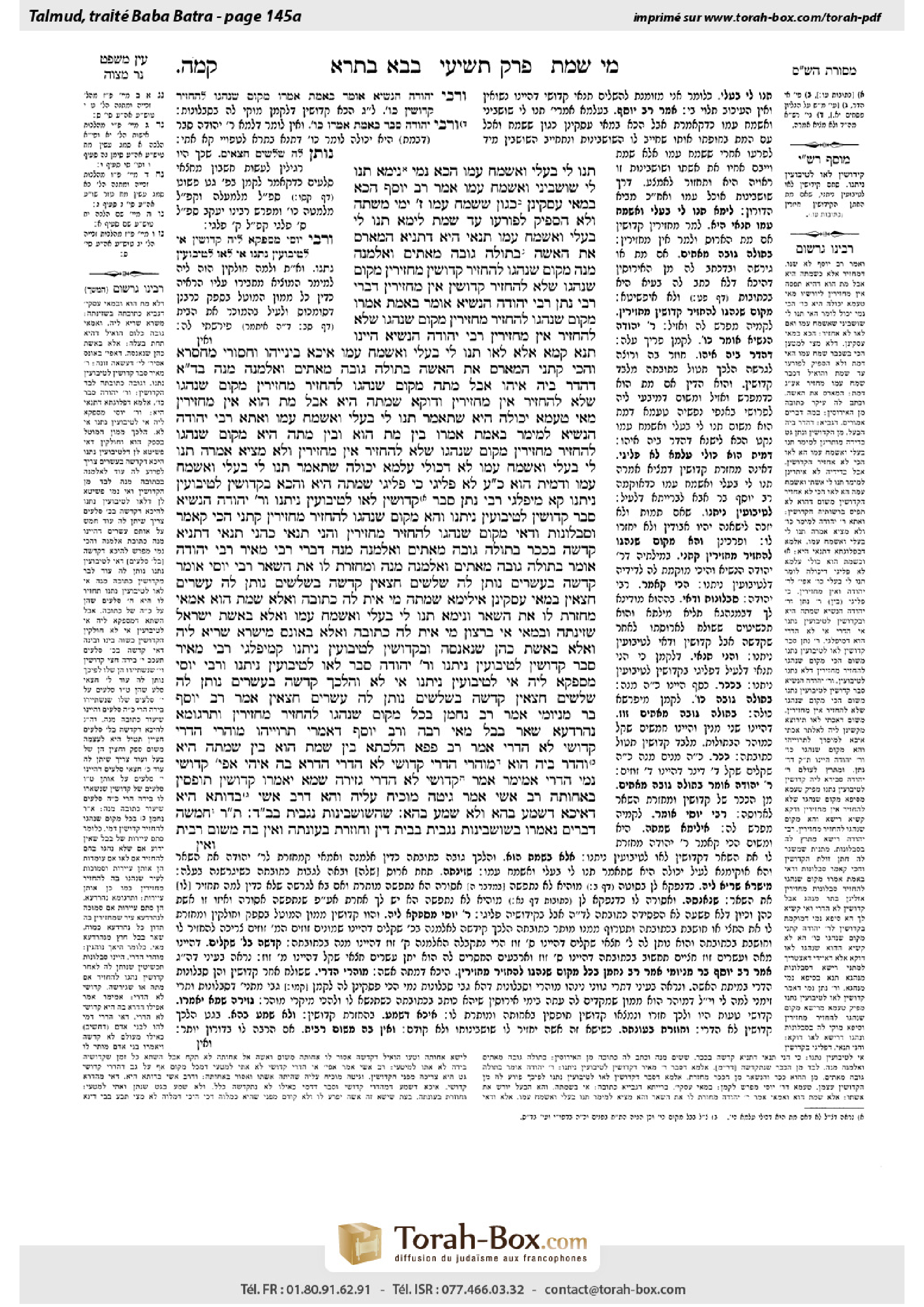
Bava Batra 145a: Talmud study for Daf Yomi
Study the Talmud for Daf Yomi with scanned pages, Hebrew text, English translations from Sefaria and AI-generated French translations.
Passage selection and English or AI-generated French translation are available where the scan has annotations. Daf Study is independent of Torah-Box and Sefaria.
Browse Bava Batra · בבא בתרא · All tractatesBava Batra 145a text and translations
This page of Bava Batra includes the Aramaic text, an English translation and an AI-generated French translation, alongside the scan above.
בבא בתרא קמ״ה א · Aramaic and Hebrew text
״תְּנוּ לִי בַּעְלִי וְאֶשְׂמַח עִמּוֹ״. הָכָא נָמֵי, נֵימָא: ״תְּנוּ לִי שׁוֹשְׁבִינִי וְאֶשְׂמַח עִמּוֹ״!
אָמַר רַב יוֹסֵף: הָכָא בְּמַאי עָסְקִינַן – כְּגוֹן שֶׁשָּׂמַח עִמּוֹ שִׁבְעָה יְמֵי מִשְׁתֶּה, וְלֹא הִסְפִּיק לְפוֹרְעוֹ עַד שֶׁמֵּת.
לֵימָא ״תְּנוּ לִי בַּעְלִי וְאֶשְׂמַח עִמּוֹ״ – תַּנָּאֵי הִיא? דְּתַנְיָא: הַמְאָרֵס אֶת הָאִשָּׁה; בְּתוּלָה – גּוֹבָה מָאתַיִם, וְאַלְמָנָה – מָנֶה. מָקוֹם שֶׁנָּהֲגוּ לְהַחְזִיר קִדּוּשִׁין – מַחְזִירִין, מָקוֹם שֶׁנָּהֲגוּ שֶׁלֹּא לְהַחְזִיר קִדּוּשִׁין – אֵין מַחְזִירִין, דִּבְרֵי רַבִּי נָתָן. רַבִּי יְהוּדָה הַנָּשִׂיא אוֹמֵר, בֶּאֱמֶת אָמְרוּ: מָקוֹם שֶׁנָּהֲגוּ לְהַחְזִיר – מַחְזִירִין, מָקוֹם שֶׁנָּהֲגוּ שֶׁלֹּא לְהַחְזִיר – אֵין מַחְזִירִין.
רַבִּי יְהוּדָה הַנָּשִׂיא הַיְינוּ תַּנָּא קַמָּא! אֶלָּא לָאו ״תְּנוּ לִי בַּעְלִי וְאֶשְׂמַח עִמּוֹ״ אִיכָּא בֵּינַיְיהוּ –
וְחַסּוֹרֵי מְחַסְּרָא, וְהָכִי קָתָנֵי: הַמְאָרֵס אֶת הָאִשָּׁה, בְּתוּלָה – גּוֹבָה מָאתַיִם, וְאַלְמָנָה – מָנֶה. בַּמֶּה דְּבָרִים אֲמוּרִים – דַּהֲדַר בֵּיהּ אִיהוּ; אֲבָל מֵתָה – מָקוֹם שֶׁנָּהֲגוּ לְהַחְזִיר, מַחְזִירִין; מָקוֹם שֶׁנָּהֲגוּ שֶׁלֹּא לְהַחְזִיר, אֵין מַחְזִירִין. וְדַוְקָא שֶׁמֵּתָה הִיא, אֲבָל מֵת הוּא – אֵין מַחְזִירִין. מַאי טַעְמָא? יְכוֹלָה הִיא שֶׁתֹּאמַר: ״תְּנוּ לִי בַּעְלִי וְאֶשְׂמַח עִמּוֹ״.
וַאֲתָא רַבִּי יְהוּדָה הַנָּשִׂיא לְמֵימַר, בֶּאֱמֶת אָמְרוּ: בֵּין מֵת הוּא, וּבֵין מֵתָה הִיא; מָקוֹם שֶׁנָּהֲגוּ לְהַחְזִיר – מַחְזִירִין, מָקוֹם שֶׁנָּהֲגוּ שֶׁלֹּא לְהַחְזִיר – אֵין מַחְזִירִין; וְלָא מָצְיָא אָמְרָה: ״תְּנוּ לִי בַּעְלִי וְאֶשְׂמַח עִמּוֹ״!
לָא; דְּכוּלֵּי עָלְמָא יְכוֹלָה שֶׁתֹּאמַר: ״תְּנוּ לִי בַּעְלִי וְאֶשְׂמַח עִמּוֹ״. וּדְמִית הוּא – כּוּלֵּי עָלְמָא לָא פְּלִיגִי, כִּי פְּלִיגִי – שֶׁמֵּתָה הִיא; וְהָכָא בְּקִדּוּשִׁין לְטִיבּוּעִין נִיתְּנוּ קָא מִיפַּלְגִי – רַבִּי נָתָן סָבַר: קִדּוּשִׁין לָאו לְטִיבּוּעִין נִיתְּנוּ, וְרַבִּי יְהוּדָה הַנָּשִׂיא סָבַר: קִדּוּשִׁין לְטִיבּוּעִין נִיתְּנוּ.
וְהָא ״מָקוֹם שֶׁנָּהֲגוּ לְהַחְזִיר מַחְזִירִין״ קָתָנֵי! הָכִי קָאָמַר: וְסִבְלוֹנוֹת – וַדַּאי מָקוֹם שֶׁנָּהֲגוּ לְהַחְזִיר, מַחֲזִירִין.
וְהָנֵי תַּנָּאֵי – כְּהָנֵי תַּנָּאֵי, דְּתַנְיָא: קִדְּשָׁהּ בְּכִכָּר – בְּתוּלָה גּוֹבָה מָאתַיִם, וְאַלְמָנָה מָנֶה; דִּבְרֵי רַבִּי מֵאִיר. רַבִּי יְהוּדָה אוֹמֵר: בְּתוּלָה גּוֹבָה מָאתַיִם, וְאַלְמָנָה מָנֶה; וּמַחְזֶרֶת לוֹ אֶת הַשְּׁאָר. רַבִּי יוֹסֵי אוֹמֵר: קִדְּשָׁהּ בְּעֶשְׂרִים – נוֹתֵן לָהּ שְׁלֹשִׁים חֲצָאִין. קִדְּשָׁהּ בִּשְׁלֹשִׁים – נוֹתֵן לָהּ עֶשְׂרִים חֲצָאִין.
בְּמַאי עָסְקִינַן? אִילֵימָא שֶׁמֵּתָה, מִי אִית לַהּ כְּתוּבָּה?! וְאֶלָּא שֶׁמֵּת הוּא – אַמַּאי מַחְזֶרֶת לוֹ אֶת הַשְּׁאָר? וְנֵימָא: ״תְּנוּ לִי בַּעְלִי וְאֶשְׂמַח עִמּוֹ״! וְאֶלָּא בְּאֵשֶׁת יִשְׂרָאֵל שֶׁזִּינְּתָה. וּבְמַאי? אִי בְּרָצוֹן – מִי אִית לַהּ כְּתוּבָּה? וְאֶלָּא בְּאוֹנֶס – מִישְׁרֵא שַׁרְיָא לֵיהּ!
וְאֶלָּא בְּאֵשֶׁת כֹּהֵן שֶׁנֶּאֶנְסָה, וּבְקִדּוּשִׁין לְטִיבּוּעִין נִיתְּנוּ קָמִיפַּלְגִי – רַבִּי מֵאִיר סָבַר: קִדּוּשִׁין לְטִיבּוּעִין נִיתְּנוּ, וְרַבִּי יְהוּדָה סָבַר: לָאו לְטִיבּוּעִין נִיתְּנוּ. וְרַבִּי יוֹסֵי – מְסַפְּקָא לֵיהּ אִי לְטִיבּוּעִין נִיתְּנוּ אִי לָא,
וְהִלְכָּךְ קִדְּשָׁהּ בְּעֶשְׂרִים – נוֹתֵן לָהּ שְׁלֹשִׁים חֲצָאִין. קִדְּשָׁהּ בִּשְׁלֹשִׁים – נוֹתֵן לָהּ עֶשְׂרִים חֲצָאִין.
אָמַר רַב יוֹסֵף בַּר מִנְיוֹמֵי אָמַר רַב נַחְמָן: בְּכׇל מָקוֹם שֶׁנָּהֲגוּ לְהַחְזִיר – מַחְזִירִין. וְתַרְגּוּמָא: נְהַרְדְּעָא. שְׁאָר בָּבֶל מַאי? רַבָּה וְרַב יוֹסֵף דְּאָמְרִי תַּרְוַיְיהוּ: מוּהְרֵי הָדְרִי, קִדּוּשֵׁי לָא הָדְרִי. אָמַר רַב פָּפָּא, הִלְכְתָא: בֵּין שֶׁמֵּת הוּא, בֵּין שֶׁמֵּתָה הִיא, וַהֲדַר בֵּיהּ הוּא – מוּהְרֵי הָדְרִי, קִדּוּשֵׁי לָא הָדְרִי. הֲדַרָא בָּהּ אִיהִי – אֲפִילּוּ קִדּוּשֵׁי נָמֵי הָדְרִי.
אַמֵּימָר אָמַר: קִדּוּשֵׁי לָא הָדְרִי, גְּזֵירָה שֶׁמָּא יֹאמְרוּ קִדּוּשִׁין תּוֹפְסִין בַּאֲחוֹתָהּ. רַב אָשֵׁי אָמַר: גִּיטָּהּ מוֹכִיחַ עָלֶיהָ. וְהָא דְּרַב אָשֵׁי בְּדוּתָא הִיא, דְּאִיכָּא דְּשָׁמַע בְּהָא וְלָא שָׁמַע בְּהָא.
שֶׁהַשּׁוֹשְׁבִינוּת נִגְבֵּית בְּבֵית דִּין. תָּנוּ רַבָּנַן, חֲמִשָּׁה דְּבָרִים נֶאֶמְרוּ בְּשׁוֹשְׁבִינוּת: נִגְבֵּית בְּבֵית דִּין, וְחוֹזֶרֶת בְּעוֹנָתָהּ, וְאֵין בָּהּ מִשּׁוּם רִבִּית,
Bava Batra 145a · English translation
Give me my husband and I will rejoice with him, i.e., it is not my fault that we are not getting married, she is not required to return the betrothal money. Here too, let him say: Give me my groomsman and I will rejoice with him.
Rav Yosef said: With what are we dealing here? Shmuel’s statement is referring to a case where the original recipient, in reciprocation, rejoiced with the brother who brought the gifts of groomsmen during the seven days of the wedding feast, but did not suffice to repay him before the brother died. Since it was the usual practice to send the gifts of groomsmen after the groomsman rejoiced with the betrothed man for seven days, he is obligated to reciprocate the gifts of groomsmen, and the yavam cannot claim them for himself.
The Gemara suggests: Shall we say that Shmuel’s statement that a betrothed woman can claim: Give me my husband and I will rejoice with him, is a dispute between tanna’im? As it is taught in a baraita: With regard to one who betrothed a woman and then he divorces her or dies, if she is a virgin, she collects two hundred dinars in payment of her marriage contract. And if she is a widow, she collects one hundred dinars. In a place where people were accustomed to return the betrothal money when the betrothed man or woman died, they return it. In a place where people were accustomed not to return the betrothal money, they do not return it. This is the statement of Rabbi Natan. Rabbi Yehuda HaNasi says: Actually they said: In a place where people were accustomed to return it, they return it; in a place where people were accustomed not to return it, they do not return it.
The Gemara clarifies: The opinion of Rabbi Yehuda HaNasi is identical to the opinion of the first tanna, i.e., Rabbi Natan. Rather, is it not that the difference between them concerns the validity of the claim: Give me my husband and I will rejoice with him?
And the statement in the baraita is incomplete and this is what it is teaching: With regard to one who betrothed a woman and then the betrothal is terminated, if she is a virgin, she collects two hundred dinars in payment of her marriage contract, and if she is a widow, she collects one hundred dinars. In what case is this statement said? It is said where he retracted, i.e., he died or divorced her. But with regard to where she died, the halakha is as follows: In a place where people were accustomed to return the betrothal money, they return it; in a place where people were accustomed not to return the betrothal money, they do not return it. And this applies specifically to where she died; but if he died, they do not return it. What is the reason for this? It is because she can say: Give me my husband and I will rejoice with him. This is the statement of Rabbi Natan.
And Rabbi Yehuda HaNasi came to say: Actually they said: Whether he died or whether she died, in a place where people were accustomed to return it, they return it; in a place where people were accustomed not to return it, they do not return it, and she cannot say: Give me my husband and I will rejoice with him.
The Gemara rejects this explanation: No, everyone agrees that she can say: Give me my husband and I will rejoice with him, and in a case where he died, everyone agrees that she does not have to return the betrothal money. They disagree in a case where she died, and here it is with regard to the question of whether betrothal money is given as a sunk cost, i.e., that it is not returned even if the betrothal is not consummated, that they disagree. Rabbi Natan holds that betrothal money is not given as a sunk cost, and in a place where people were accustomed to return it, they return it. And Rabbi Yehuda HaNasi holds that betrothal money is given as a sunk cost.
The Gemara asks: But doesn’t the baraita teach that according to Rabbi Yehuda HaNasi, in a place where people were accustomed to return it, they return it? This indicates that Rabbi Yehuda HaNasi does not hold that the betrothal money was given as a sunk cost. The Gemara replies: This is not referring to the betrothal money, which is not returned in any event. This is what the baraita is saying: But with regard to presents, which the betrothed man sent his betrothed following the betrothal, certainly in a place where people were accustomed to return them, they return them.
The Gemara notes: The dispute between these tanna’im, in the following baraita, is like the dispute between those tanna’im just mentioned, as it is taught in a baraita: In a case where the man betrothed a woman with a talent of silver, equivalent to six thousand dinars, if she was a virgin she collects in payment of her marriage contract two hundred dinars over and above this amount, and if she was a widow she collects one hundred dinars over and above this amount. This is the statement of Rabbi Meir. Rabbi Yehuda says: A virgin collects two hundred dinars and a widow one hundred dinars, and she returns the rest of the betrothal money to him. Rabbi Yosei says: If he betrothed her with twenty, he gives her thirty halves; if he betrothed her with thirty, he gives her twenty halves, as the Gemara will explain.
The Gemara clarifies the baraita: With what are we dealing? If we say the baraita is referring to when she died, is she entitled to receive payment of her marriage contract? Rather, perhaps the baraita is referring to where he died, in which case why does Rabbi Yehuda state that she returns the rest of the betrothal money to him? Let her say: Give me my husband and I will rejoice with him. Rather, perhaps the baraita is referring to the case of the wife, i.e., the betrothed, of an Israelite, who committed adultery, who cannot claim that she is available to marry her betrothed, as it is prohibited for her to engage in intercourse with him. The Gemara challenges: This is also difficult, as with what circumstance is the baraita dealing? If it is referring to where she committed adultery willingly, is she entitled to receive payment of her marriage contract? Rather, it is referring to a case of rape. But in that case, she is permitted to him. Why should she return the betrothal money?
Rather, the baraita is referring to the wife, i.e., the betrothed, of a priest, who was raped and is prohibited from engaging in intercourse with her betrothed. She therefore cannot claim: Give me my husband and I will rejoice with him, yet she is entitled to receive payment of her marriage contract, and the tanna’im disagree with regard to whether betrothal money is given as a sunk cost: Rabbi Meir holds that betrothal money is given as a sunk cost. Rabbi Yehuda holds that it is not given as a sunk cost. And Rabbi Yosei is uncertain if it is given as a sunk cost or not.
The Gemara explains Rabbi Yosei’s opinion: And since it is uncertain whether or not she is required to return the betrothal money, therefore, she returns only half the money: If he betrothed her with twenty sela, which are equivalent to eighty dinars, she owes him forty dinars. Yet, if she is widowed or divorced, she is entitled to one hundred dinars in payment of her marriage contract, so he or his estate gives her thirty halves of a sela, which are equivalent to sixty dinars, so that she receives one hundred dinars in all. If he betrothed her with thirty sela, which are equivalent to one hundred twenty dinars, she owes him sixty dinars. Since she is entitled to one hundred dinars in payment of her marriage contract, he gives her twenty halves of a sela, equivalent to forty dinars.
Rav Yosef bar Minyumi says that Rav Naḥman says: In every place where they were accustomed to return the betrothal money, they return it. And the interpretation of this statement is that it is referring to Neharde’a. The Gemara asks: With regard to the rest of Babylonia, what is the halakha? Rabba and Rav Yosef both say: The presents are returned and the betrothal money is not returned. Rav Pappa said: The halakha is that whether he died or whether she died or whether he retracted his agreement to the betrothal and divorced her, the presents are returned and the betrothal money is not returned. If she retracted her agreement to the betrothal and requested a divorce, even the betrothal money is returned.
Ameimar said: The betrothal money is not returned. This is a rabbinic decree, lest people say that betrothal takes effect with her sister. If the betrothal money is returned, people are likely to think that the betrothal is retroactively nullified and that the man can betroth her sister, whereas in fact the betrothal was not retroactively nullified and he cannot betroth her. Rav Ashi said: Her bill of divorce proves for her that she was betrothed, so this concern is not in effect. The Gemara comments: And this statement of Rav Ashi is a mistake, since there are those who heard about this, i.e., the return of the betrothal money, but did not hear about that, i.e., the bill of divorce.
§ The mishna teaches: If the gifts of groomsmen are reciprocated after the father’s death, they are reciprocated to the middle, because gifts of groomsmen are a legal debt owed to the father, collectible in court. The Sages taught (Tosefta 10:8): Five statements were said with regard to gifts of groomsmen: They are collectible in court; and they are reciprocated only at their relevant time, i.e., at the time of the groomsman’s own wedding; and they are not subject to the prohibition of interest, i.e., it is permitted to reciprocate with a gift of greater value than the original gift;
Bava Batra 145a · Traduction française (IA)
Donne-moi mon mari et je me réjouirai avec lui, c'est-à-dire ce n'est pas ma faute que nous ne nous marions pas, elle n'est pas tenue de rembourser l'argent de fiançailles. Ici aussi, qu'il dise : Donne-moi mon fiancé et je me réjouirai avec lui.
Rav Yosef a dit : De quoi sommes-nous en train de parler ? La déclaration de Shmuel fait référence à un cas où la personne initiale, en retour, se réjouissait avec le frère qui avait offert les présents de fiancé pendant les sept jours du banquet de mariage, mais ces présents n'étaient pas suffisants pour lui rendre compte avant que le frère ne meure. Puisqu'il était coutume de faire parvenir les présents de fiancé après que le fiancé eut réjoui la femme fiancée pendant sept jours, il est tenu de les rendre, et le yavam ne peut prétendre les revendre.
La Guemara suggère : Devons-nous dire que la déclaration de Shmuel selon laquelle une femme fiancée peut dire : Donne-moi mon mari et je me réjouirai avec lui, est un débat entre les tannaïm ? Comme il est enseigné dans une baraïta : En ce qui concerne celui qui a fiancé une femme et qui ensuite l'a divorcée ou est mort, si elle est vierge, elle reçoit deux cents drachmes en paiement de son contrat de mariage. Et si elle est veuve, elle reçoit cent drachmes. Dans un lieu où les gens étaient habitués à rembourser l'argent de fiançailles lors de la mort du fiancé ou de la fiancée, ils le remboursent. Dans un lieu où les gens n'étaient pas habitués à le rembourser, ils ne le remboursent pas. C'est l'opinion de Rabbi Natan. Rabbi Yehuda HaNasi dit : En réalité, ils ont dit : Dans un lieu où les gens étaient habitués à le rembourser, ils le remboursent ; dans un lieu où les gens n'étaient pas habitués à le rembourser, ils ne le remboursent pas.
La Guemara clarifie : L'opinion de Rabbi Yehuda HaNasi est identique à l'opinion du premier tanna, c'est-à-dire Rabbi Natan. Plutôt, ne serait-ce pas que la différence entre eux concerne la validité de la revendication : Donne-moi mon mari et je me réjouirai avec lui ?
Et la déclaration dans la baraïta est incomplète et c'est ce qu'elle enseigne : En ce qui concerne celui qui a fiancé une femme et ensuite le fiancement est rompu, si elle est vierge, elle reçoit deux cents drachmes en paiement de son contrat de mariage, et si elle est veuve, elle reçoit cent drachmes. Dans quel cas cette déclaration est-elle dite ? Elle est dite dans le cas où il a rétracté, c'est-à-dire qu'il est mort ou qu'il l'a divorcée. Mais concernant le cas où elle est morte, la halakha est la suivante : Dans un lieu où les gens étaient habitués à rembourser l'argent de fiançailles, ils le remboursent ; dans un lieu où les gens n'étaient pas habitués à le rembourser, ils ne le remboursent pas. Et cela s'applique spécifiquement au cas où elle est morte ; mais si lui est mort, ils ne le remboursent pas. Quelle est la raison de cela ? C'est parce qu'elle peut dire : Donne-moi mon mari et je me réjouirai avec lui. C'est l'opinion de Rabbi Natan.
Et Rabbi Yehuda HaNasi a voulu dire : En réalité, ils ont dit : Quel que soit le cas, mort ou non, dans un lieu où les gens étaient habitués à le rembourser, ils le remboursent ; dans un lieu où les gens n'étaient pas habitués à le rembourser, ils ne le remboursent pas, et elle ne peut pas dire : Donne-moi mon mari et je me réjouirai avec lui.
La Guemara rejette cette explication : Non, tout le monde est d'accord sur le fait qu'elle puisse dire : Donne-moi mon mari et je me réjouirai avec lui, et dans le cas où il est mort, tout le monde est d'accord sur le fait qu'elle n'a pas à rembourser l'argent de fiançailles. Ils divergent dans le cas où elle est morte, et c'est là que la question de savoir si l'argent de fiançailles est considéré comme un coût irrécupérable, c'est-à-dire qu'il n'est pas remboursé même si le fiancement n'est pas consumé, est le point de divergence. Rabbi Natan considère que l'argent de fiançailles n'est pas un coût irrécupérable, et dans un lieu où les gens étaient habitués à le rembourser, ils le remboursent. Rabbi Yehuda HaNasi considère que l'argent de fiançailles est un coût irrécupérable.
La Guemara pose une question : Mais ne dit pas la baraïta que selon Rabbi Yehuda HaNasi, dans un lieu où les gens étaient habitués à le rembourser, ils le remboursent ? Cela indique que Rabbi Yehuda HaNasi ne considère pas que l'argent de fiançailles est un coût irrécupérable. La Guemara répond : Ce n'est pas à propos de l'argent de fiançailles, qui n'est jamais remboursé. C'est ce que la baraïta dit : Mais concernant les présents, que le fiancé a envoyés à sa fiancée après le fiancement, certainement dans un lieu où les gens étaient habitués à les rembourser, ils les remboursent.
La Guemara souligne : Le débat entre ces tannaïm, dans la baraïta suivante, est semblable au débat entre ces tannaïm mentionnés précédemment, comme il est enseigné dans une baraïta : Dans le cas où un homme a fiancé une femme avec un talent d'argent, équivalent à six mille drachmes, si elle était vierge, elle reçoit en paiement de son contrat de mariage deux cents drachmes supplémentaires, et si elle était veuve, elle reçoit cent drachmes supplémentaires. C'est l'opinion de Rabbi Meir. Rabbi Yehuda dit : Une vierge reçoit deux cents drachmes et une veuve cent drachmes, et elle remet le reste de l'argent de fiançailles à lui. Rabbi Yosei dit : Si l'homme a fiancé avec vingt, il lui donne trente moitiés ; si l'homme a fiancé avec trente, il lui donne vingt moitiés, comme la Guemara l'expliquera plus tard.
La Guemara clarifie la baraïta : De quoi sommes-nous en train de parler ? Si nous disons que la baraïta fait référence au cas où elle est morte, est-elle digne de recevoir le paiement de son contrat de mariage ? Plutôt, peut-être la baraïta fait référence au cas où il est mort, dans ce cas, pourquoi Rabbi Yehuda dit qu'elle remet le reste de l'argent de fiançailles à lui ? Laisse-la dire : Donne-moi mon mari et je me réjouirai avec lui. Plutôt, peut-être la baraïta fait référence au cas de la femme, c'est-à-dire la fiancée d'un Israélite, qui a commis l'adultère, qui ne peut pas prétendre qu'elle est disponible pour épouser son fiancé, car il est interdit qu'elle ait des relations sexuelles avec lui. La Guemara conteste : Cela est également difficile, car dans quel cas la baraïta fait référence ? Si elle a commis l'adultère volontairement, est-elle digne de recevoir le paiement de son contrat de mariage ? Plutôt, elle fait référence au cas d'une viols. Mais dans ce cas, elle est autorisée à lui. Pourquoi devrait-elle rembourser l'argent de fiançailles ?
En réalité, la baraïta fait référence à la femme, c'est-à-dire la fiancée, d'un prêtre, qui a été violée et qui est interdite de faire l'acte sexuel avec sa fiancée. Elle ne peut donc pas dire : Donnez-moi mon mari et je me réjouirai avec lui, toutefois elle a le droit de recevoir le paiement de son contrat de mariage, et les tannaïm divergent sur la question de savoir si l'argent de fiancailles est considéré comme un coût irrécupérable : Rabbi Meir affirme que l'argent de fiancailles est considéré comme un coût irrécupérable. Rabbi Yéhuda affirme qu'il ne l'est pas. Et Rabbi Yosei est incertain quant à savoir s'il est considéré comme un coût irrécupérable ou non.
Le Guemara explique l'opinion de Rabbi Yosei ainsi : Et puisque c'est incertain qu'elle doive rendre l'argent de fiancailles, elle rend donc seulement la moitié de l'argent : Si l'homme l'a fiancée avec vingt sela, ce qui équivaut à quatre-vingts dinars, elle doit lui rendre quarante dinars. Cependant, si elle est veuve ou divorcée, elle a le droit de recevoir cent dinars en paiement de son contrat de mariage, donc il ou son héritage lui donne trente moitiés de sela, ce qui équivaut à soixante dinars, de sorte qu'elle reçoit en tout cent dinars. Si l'homme l'a fiancée avec trente sela, ce qui équivaut à cent vingt dinars, elle doit lui rendre soixante dinars. Puisqu'elle a le droit de recevoir cent dinars en paiement de son contrat de mariage, il lui donne vingt moitiés de sela, équivalent à quarante dinars.
Rav Yosef bar Minyumi dit que Rav Naḥman dit : Dans tout lieu où on était coutume de rendre l'argent de fiancailles, on le rend. Et l'interprétation de cette déclaration est qu'elle fait référence à Nehardea. Le Guemara pose la question : En ce qui concerne le reste de Babylone, quelle est la halakha ? Rabba et Rav Yosef disent tous les deux : Les présents sont rendus et l'argent de fiancailles ne l'est pas. Rav Pappa a dit : La halakha est que, qu'il meure ou qu'elle meure ou qu'il révoque son engagement de fiancailles et divorce d'elle, les présents sont rendus et l'argent de fiancailles ne l'est pas. Si elle révoque son engagement de fiancailles et demande un divorce, même l'argent de fiancailles est rendu.
Ameimar a dit : L'argent de fiancailles n'est pas rendu. C'est une décision rabbinique, afin que les gens ne disent pas que le fiancement prend effet avec sa sœur. Si l'argent de fiancailles est rendu, les gens pourraient penser que le fiancement est annulé de manière rétroactive et que l'homme peut fiancer sa sœur, alors que, en réalité, le fiancement n'a pas été annulé de manière rétroactive et qu'il ne peut pas fiancer sa sœur. Rav Ashi a dit : Son acte de divorce prouve qu'elle était fiancée, donc cette préoccupation n'est pas valable. Le Guemara commente : Et cette déclaration de Rav Ashi est une erreur, puisqu'il y a ceux qui ont entendu cela, c'est-à-dire le retour de l'argent de fiancailles, mais n'ont pas entendu cela, c'est-à-dire l'acte de divorce.
§ La mitsva enseigne : Si les présents des camarades de mariage sont réciproqués après la mort du père, ils sont réciproqués à la moitié, car les présents des camarades de mariage sont une dette légale envers le père, payable en justice. Les Sages ont enseigné (Tosefta 10:8) : Cinq déclarations ont été faites concernant les présents des camarades de mariage : Ils sont payables en justice ; et ils sont réciproqués uniquement à leur moment propre, c'est-à-dire au moment du mariage du camarade de mariage ; et ils ne sont pas soumis à l'interdiction d'intérêt, c'est-à-dire qu'il est permis de réciproquer avec un présent de valeur supérieure au présent original ;
Traduction française générée par IA à partir de l’édition anglaise de Sefaria. Vérifie toujours un passage avec le texte source.
Text from Sefaria: William Davidson Edition - Vocalized Aramaic (CC BY NC); William Davidson Edition - English (CC BY NC).