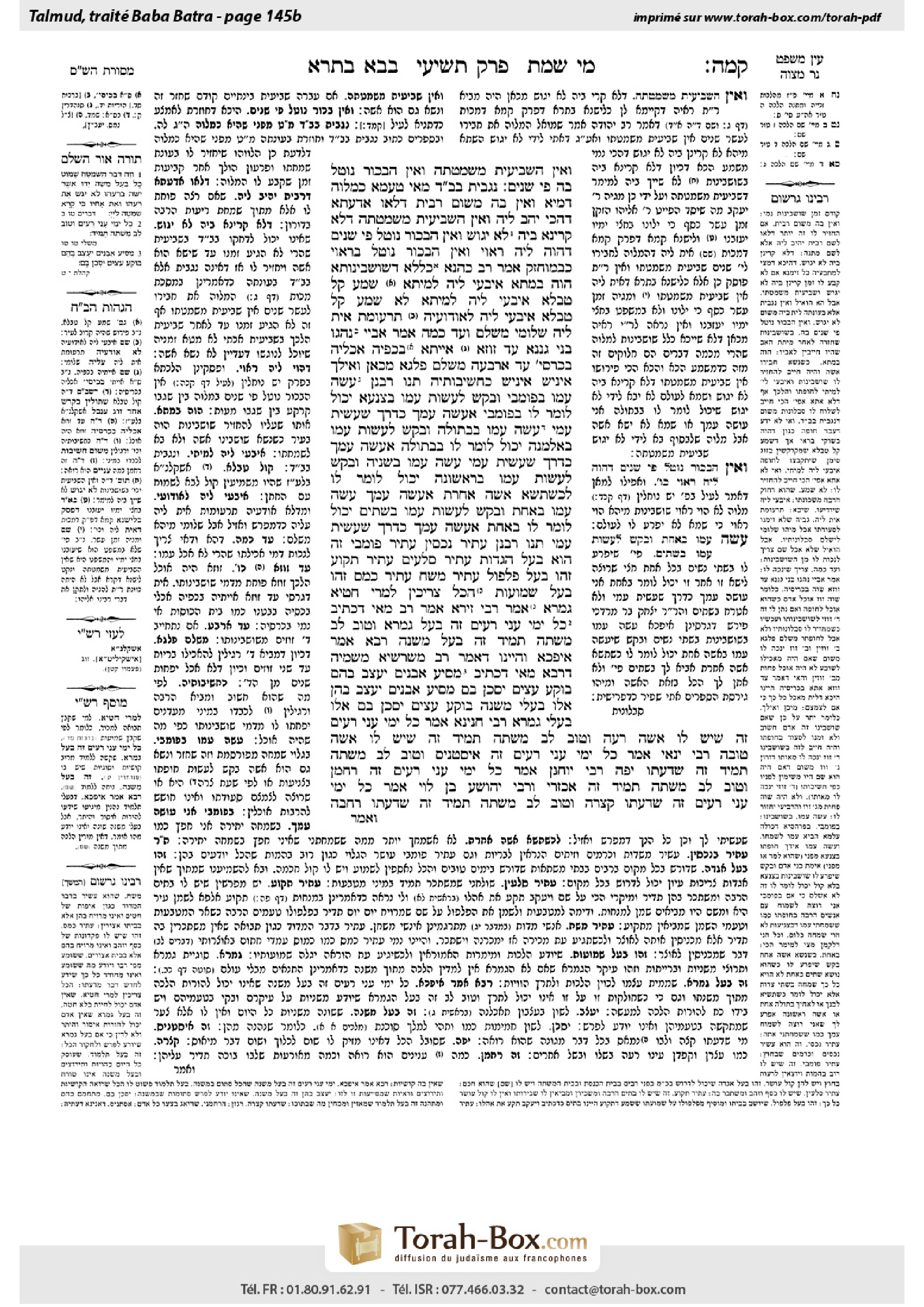
Bava Batra 145b: Talmud study for Daf Yomi
Study the Talmud for Daf Yomi with scanned pages, Hebrew text, English translations from Sefaria and AI-generated French translations.
Passage selection and English or AI-generated French translation are available where the scan has annotations. Daf Study is independent of Torah-Box and Sefaria.
Browse Bava Batra · בבא בתרא · All tractatesBava Batra 145b text and translations
This page of Bava Batra includes the Aramaic text, an English translation and an AI-generated French translation, alongside the scan above.
בבא בתרא קמ״ה ב · Aramaic and Hebrew text
וְאֵין הַשְּׁבִיעִית מְשַׁמַּטְתָּהּ, וְאֵין הַבְּכוֹר נוֹטֵל בָּהּ פִּי שְׁנַיִם.
נִגְבֵּית בְּבֵית דִּין – מַאי טַעְמָא? כְּמִלְוֶה דָּמְיָא. וְאֵין בָּהּ מִשּׁוּם רִבִּית – דְּלָאו אַדַּעְתָּא דְּהָכִי יְהַב לֵיהּ. וְאֵין הַשְּׁבִיעִית מְשַׁמַּטְתָּהּ – דְּלָא קָרֵינָא בֵּיהּ: ״לֹא יִגֹּשׂ״.
וְאֵין הַבְּכוֹר נוֹטֵל פִּי שְׁנַיִם – דְּהָוֵה לֵיהּ רָאוּי, וְאֵין הַבְּכוֹר נוֹטֵל בָּרָאוּי כִּבְמוּחְזָק.
אָמַר רַב כָּהֲנָא, כְּלָלָא דְשׁוֹשְׁבִינוּתָא: הֲוָה בְּמָתָא – אִיבְּעִי לֵיהּ לְמֵיתֵא. שְׁמַע קָל טַבְלָא – אִיבְּעִי לֵיהּ לְמֵיתֵא. לָא שְׁמַע קָל טַבְלָא – אִיבְּעִי לֵיהּ לְאוֹדוֹעֵיהּ; תַּרְעוֹמֶת אִית לֵיהּ, שַׁלּוֹמֵי מְשַׁלֵּם.
וְעַד כַּמָּה? אָמַר אַבָּיֵי: נָהֲגוּ בְּנֵי גְנָנָא, עַד זוּזָא – אַיְּיתֵא בְּכַפֵּיהּ אַכְלֵיהּ בִּכְרֵסֵיהּ. עַד אַרְבְּעָה – מְשַׁלֵּם פַּלְגָא. מִכָּאן וְאֵילָךְ – אִינִישׁ אִינִישׁ כַּחֲשִׁיבוּתֵיהּ.
תָּנוּ רַבָּנַן: עָשָׂה עִמּוֹ בְּפוּמְבֵּי, וּבִקֵּשׁ לַעֲשׂוֹת עִמּוֹ בְּצִנְעָא – יָכוֹל לוֹמַר לוֹ: בְּפוּמְבֵּי אֶעֱשֶׂה עִמְּךָ, כְּדֶרֶךְ שֶׁעָשִׂיתָ עִמִּי. עָשָׂה עִמּוֹ בִּבְתוּלָה, וּבִקֵּשׁ לַעֲשׂוֹת עִמּוֹ בְּאַלְמָנָה – יָכוֹל לוֹמַר לוֹ: בִּבְתוּלָה אֶעֱשֶׂה עִמְּךָ, כְּדֶרֶךְ שֶׁעָשִׂיתָ עִמִּי.
עָשָׂה עִמּוֹ בַּשְּׁנִיָּה, וּבִקֵּשׁ לַעֲשׂוֹת עִמּוֹ בָּרִאשׁוֹנָה – יָכוֹל לוֹמַר לוֹ: לִכְשֶׁתִּשָּׂא אִשָּׁה אַחֶרֶת, אֶעֱשֶׂה עִמְּךָ. עָשָׂה עִמּוֹ בְּאַחַת, וּבִקֵּשׁ לַעֲשׂוֹת עִמּוֹ בִּשְׁתַּיִם – יָכוֹל לוֹמַר לוֹ: בְּאַחַת אֶעֱשֶׂה עִמְּךָ, כְּדֶרֶךְ שֶׁעָשִׂיתָ עִמִּי.
תָּנוּ רַבָּנַן: עַתִּיר נִכְסִין עַתִּיר פּוּמְבֵּי – זֶה הוּא בַּעַל הַגָּדוֹת. עַתִּיר סְלָעִים עַתִּיר תְּקוֹעַ – זֶהוּ בַּעַל פִּלְפּוּל. עַתִּיר מְשַׁח עַתִּיר כְּמָס – זֶהוּ בַּעַל שְׁמוּעוֹת. הַכֹּל צְרִיכִין לְמָרֵי חִטַּיָּא – תַּלְמוּד.
אָמַר רַבִּי זֵירָא אָמַר רַב, מַאי דִּכְתִיב: ״כׇּל יְמֵי עָנִי רָעִים״? זֶה בַּעַל תַּלְמוּד. ״וְטוֹב לֵב מִשְׁתֶּה תָמִיד״ – זֶה בַּעַל מִשְׁנָה.
רָבָא אָמַר: אִיפְּכָא. וְהַיְינוּ דְּאָמַר רַב מְשַׁרְשְׁיָא מִשְּׁמֵיהּ דְּרָבָא, מַאי דִּכְתִיב: ״מַסִּיעַ אֲבָנִים יֵעָצֵב בָּהֶם, בּוֹקֵעַ עֵצִים יִסָּכֶן בָּם״? ״מַסִּיעַ אֲבָנִים יֵעָצֵב בָּהֶן״ – אֵלּוּ בַּעְלֵי מִשְׁנָה. ״בּוֹקֵעַ עֵצִים יִסָּכֶן בָּם״ – אֵלּוּ בַּעְלֵי תַלְמוּד.
רַבִּי חֲנִינָא אָמַר: ״כׇּל יְמֵי עָנִי רָעִים״ – זֶה שֶׁיֵּשׁ לוֹ אִשָּׁה רָעָה. ״וְטוֹב לֵב מִשְׁתֶּה תָמִיד״ – זֶה שֶׁיֵּשׁ לוֹ אִשָּׁה טוֹבָה. רַבִּי יַנַּאי אָמַר: ״כׇּל יְמֵי עָנִי רָעִים״ – זֶה אִיסְטְנִיס. ״וְטוֹב לֵב מִשְׁתֶּה תָמִיד״ – זֶה שֶׁדַּעְתּוֹ יָפָה.
רַבִּי יוֹחָנָן אָמַר: ״כׇּל יְמֵי עָנִי רָעִים״ – זֶה רַחְמָן. ״וְטוֹב לֵב מִשְׁתֶּה תָמִיד״ – זֶה אַכְזָרִי. וְרַבִּי יְהוֹשֻׁעַ בֶּן לֵוִי אָמַר: ״כׇּל יְמֵי עָנִי רָעִים״ – זֶה שֶׁדַּעְתּוֹ קְצָרָה. ״וְטוֹב לֵב מִשְׁתֶּה תָמִיד״ – זֶה שֶׁדַּעְתּוֹ רְחָבָה.
Bava Batra 145b · English translation
and the Sabbatical Year does not abrogate them; and the firstborn does not take a double portion of them.
The baraita states that gifts of groomsmen are collectible in court. What is the reason for this? It is that they are considered similar to a loan. The baraita states: And they are not subject to the prohibition of interest. The reason is that it was not with that in mind that he gave him a larger gift. Rather, he did so on account of his joy at his friend’s wedding. The baraita states: And the Sabbatical Year does not abrogate them. The reason is that one cannot read the verse concerning the abrogation of debts during the occurrence of the Sabbatical Year: “He shall not exact it of his neighbor and his brother, because the Lord’s release has been proclaimed” (Deuteronomy 15:2), with regard to gifts of groomsmen. Since one cannot choose to exact the gifts until the time of one’s own wedding, they are not addressed by this verse.
The baraita states: And the firstborn does not take a double portion from them. The reason is that they constitute potential inheritance, and the firstborn does not take in inheritance the property due the deceased as he does the property the deceased possessed.
§ Rav Kahana said: The principle with regard to the reciprocation of gifts of groomsmen is: If the recipient was in town when his groomsman wed, he should have come to the wedding, and even if he did not come, he is obligated to send the gifts of groomsmen. If he was not in town, but he was nearby and he heard the sound of the drum announcing the wedding, he should have come. If he was far away and did not hear the sound of the drum, the betrothed man should have informed him. If he did not inform him, the recipient has a grievance against the betrothed man because he did not inform him about the wedding, but he still repays the gifts of groomsmen.
In this case, since he did not partake of the wedding feast, he is entitled to deduct a sum from the reciprocal gift. The Gemara asks: And up to how much can he deduct? Abaye said: The members of a wedding feast were accustomed to deduct according to the following principle: If the gift of groomsmen that the reciprocal giver received was up to a dinar, he now pays nothing, because what a person brings in his hand he consumes in his stomach. If the gift of groomsmen was up to four dinars, he now pays half. From that sum onward, each person deducts according to his prominence, i.e., in accordance with the outlay that would have been required to honor the reciprocal giver properly, had he participated in the wedding feast.
The Sages taught (Tosefta 10:9): If one served as groomsman for his friend at a public [pumbei] wedding, and when the groomsman himself wed, he requested that his friend reciprocate by serving as a groomsman for him at a private wedding, the friend can say to him: I am willing to reciprocate and serve as groomsman for you only at a public wedding, where the rejoicing is greater, in the manner you served as a groomsman for me. If one served as a groomsman for his friend when he married a virgin, and he requested that his friend reciprocate by serving as a groomsman for him when he marries a widow, the friend can say to him: I shall serve as a groomsman for you only when you marry a virgin, in the manner you served as a groomsman for me.
If one served as a groomsman for his friend when he married a second wife, and he requested that his friend reciprocate by serving as a groomsman for him when he marries a first wife, the friend can say to him: When you marry another woman I will serve as a groomsman for you. If one served as a groomsman for his friend when he married one woman, and he requested that his friend reciprocate by serving as a groomsman for him when he marries two women, the friend can say to him: I will serve as a groomsman for you when you marry one woman, in the manner you served as a groomsman for me.
§ The Sages taught in a baraita: There are different types of Torah scholars. There is a scholar who is wealthy in figurative property and wealthy in public renown; this is the master of homiletics. There is a scholar who is wealthy in coins and wealthy in houses; this is the master of dialectics. There is one who is wealthy in oil and wealthy in hidden stores; this is the master of halakhic traditions. Everyone is dependent on the owner of wheat; this is the master of Talmud, who understands the reasons behind the rulings and traditions.
Rabbi Zeira says that Rav says: What is the meaning of that which is written: “All the days of the poor are terrible; and for the good-hearted it is always a feast” (Proverbs 15:15)? “All the days of the poor are terrible”; this is referring to the master of Talmud, who is wearied by the difficulty of his Talmud study. “And for the good-hearted it is always a feast”; this is referring to the master of Mishna, who recites the mishnayot by rote and is not wearied thereby.
Rava says: The opposite is true. And this is consistent with that which Rav Mesharshiyya says in the name of Rava: What is the meaning of that which is written: “He who quarries stones shall be hurt by them; and he that chops wood shall be warmed thereby” (Ecclesiastes 10:9). “He who quarries stones shall be hurt by them”; these are the masters of Mishna. They exert themselves to memorize the mishnayot, but since one cannot reach practical conclusions from the mishna, they are comparable to one who carries a heavy load without benefiting from it. “He that chops wood shall be warmed thereby”; these are the masters of Talmud, who attain the benefit of their exertions in the form of practical conclusions.
The Gemara cites other interpretations of this verse. Rabbi Ḥanina says: “All the days of the poor are terrible”; this is referring to one who has a wicked wife. “And for the good-hearted it is always a feast”; this is referring to one who has a good wife. Rabbi Yannai says: “All the days of the poor are terrible”; this is referring to one who is delicate [istenis] and overly sensitive, because he constantly encounters unpleasant situations. “And for the good-hearted it is always a feast”; this is referring to one who is relaxed and not particular with regard to his food or his surroundings.
Rabbi Yoḥanan says: “All the days of the poor are terrible”; this is referring to an empathetic person, because he is constantly affected by the suffering in the world. “And for the good-hearted it is always a feast”; this is referring to a cruel person, who is not pained by the suffering of others. And Rabbi Yehoshua ben Levi says: “All the days of the poor are terrible”; this is referring to a person of impatient disposition. “And for the good-hearted it is always a feast”; this is referring to a person of patient disposition.
Bava Batra 145b · Traduction française (IA)
et l'année sabbatique ne les annule pas ; et le premier-né ne prend pas une part double d'entre eux.
La baraïta affirme que les présents des camarades de mariage sont réclamables devant le tribunal. Pourquoi ? Parce qu'ils sont considérés comme semblables à un prêt. La baraïta affirme : Et ils ne sont pas soumis à l'interdiction des intérêts. La raison est que ce n'était pas avec cet objectif qu'il lui a donné un présent plus important. Plutôt, il l'a fait en raison de sa joie pour le mariage de son ami. La baraïta affirme : Et l'année sabbatique ne les annule pas. La raison est que l'on ne peut pas appliquer la versette concernant l'annulation des dettes pendant l'année sabbatique : « Il ne doit pas exiger cela de son voisin et de son frère, car l'année de libération du Seigneur a été proclamée » (Deutéronome 15:2), aux présents des camarades de mariage. Puisque l'on ne peut pas exiger les présents jusqu'au moment de son propre mariage, ils ne sont pas abordés par cette versette.
La baraïta affirme : Et le premier-né ne prend pas une part double d'entre eux. La raison est qu'ils constituent un héritage potentiel, et le premier-né ne prend pas en héritage la propriété due au défunt comme il le fait pour la propriété que possédait le défunt.
§ Rav Kahana a dit : Le principe concernant la réciprocité des présents des camarades de mariage est le suivant : Si le destinataire était en ville lorsqu'il a épousé son camarade de mariage, il devrait être venu à la cérémonie, et même s'il n'est pas venu, il est tenu de lui envoyer les présents des camarades de mariage. Si il n'était pas en ville, mais était proche et a entendu le bruit de la tambourine annonçant le mariage, il devrait être venu. Si il était loin et n'a pas entendu le bruit de la tambourine, le fiancé devrait l'avertir. Si il n'a pas averti, le destinataire a un grief contre le fiancé parce qu'il n'a pas informé de son mariage, mais il paie tout de même les présents des camarades de mariage.
Dans ce cas, puisqu'il n'a pas participé à la fête de mariage, il a le droit de déduire une somme du présent réciproque. La Guemara pose la question : Jusqu'à quel point peut-il déduire ? Abaye a dit : Les membres de la fête de mariage étaient habitués à déduire selon le principe suivant : Si le présent des camarades de mariage que le donneur réciproque avait reçu était jusqu'à un dinar, il ne paie rien maintenant, car ce que l'on apporte de la main, on le consomme dans l'estomac. Si le présent des camarades de mariage était jusqu'à quatre dinars, il paie la moitié maintenant. À partir de cette somme, chaque personne déduit selon son rang, c'est-à-dire selon l'effort requis pour honorer correctement le donneur réciproque, s'il avait participé à la fête de mariage.
Les Sages ont enseigné (Tosefta 10:9) : Si l'on a été camarade de mariage pour son ami lors d'un mariage public [pumbei], et lorsqu'il a épousé lui-même, il a demandé à son ami de lui rendre la pareille en étant son camarade de mariage lors d'un mariage privé, l'ami peut lui dire : Je suis prêt à lui rendre la pareille et à être son camarade de mariage uniquement lors d'un mariage public, où la joie est plus grande, dans la manière dont il a été camarade de mariage pour moi. Si l'on a été camarade de mariage pour son ami lorsqu'il a épousé une vierge, et il a demandé à son ami de lui rendre la pareille en étant son camarade de mariage lorsqu'il épousera une veuve, l'ami peut lui dire : Je serai ton camarade de mariage uniquement lorsque tu épouseras une vierge, dans la manière dont tu as été camarade de mariage pour moi.
Si l'on a été camarade de mariage pour son ami lorsqu'il a épousé une deuxième femme, et il a demandé à son ami de lui rendre la pareille en étant son camarade de mariage lorsqu'il épousera une première femme, l'ami peut lui dire : Lorsque tu épouseras une autre femme, je serai ton camarade de mariage. Si l'on a été camarade de mariage pour son ami lorsqu'il a épousé une femme, et il a demandé à son ami de lui rendre la pareille en étant son camarade de mariage lorsqu'il épousera deux femmes, l'ami peut lui dire : Je serai ton camarade de mariage lorsque tu épouseras une femme, dans la manière dont tu as été camarade de mariage pour moi.
§ Les Sages ont enseigné dans une baraïta : Il existe différents types de savants. Il y a un savant riche en propriété figurative et riche en renommée publique ; c'est le maître des homélies. Il y a un savant riche en monnaie et riche en maisons ; c'est le maître des dialectiques. Il y a un savant riche en huile et riche en dépôts cachés ; c'est le maître des traditions halakhiques. Tout le monde dépend du propriétaire de blé ; c'est le maître de la Talmud, qui comprend les raisons des décisions et des traditions.
Rabbi Zeira dit que Rav dit : Quelle est la signification de ce qui est écrit : « Tous les jours du pauvre sont terribles ; et pour l'homme généreux, c'est toujours un festin » (Proverbes 15:15) ? « Tous les jours du pauvre sont terribles » ; cela fait référence au maître de la Talmud, qui est épuisé par la difficulté de son étude de la Talmud. « Et pour l'homme généreux, c'est toujours un festin » ; cela fait référence au maître de la Michna, qui récite les mishnayot par cœur et n'est pas épuisé par cela.
Rava dit : C'est l'inverse. Et cela est cohérent avec ce que Rav Mesharshiyya a dit en nom de Rava : Quelle est la signification de ce qui est écrit : « Celui qui creuse des pierres sera blessé par elles ; et celui qui coupe du bois sera réchauffé par cela » (Ecclésiaste 10:9) ? « Celui qui creuse des pierres sera blessé par elles » ; ces sont les maîtres de la Michna. Ils s'efforcent de mémoriser les mishnayot, mais puisque l'on ne peut pas tirer des conclusions pratiques de la Michna, ils sont comparables à celui qui porte une charge lourde sans en bénéficier. « Celui qui coupe du bois sera réchauffé par cela » ; ces sont les maîtres de la Talmud, qui obtiennent le bénéfice de leurs efforts sous la forme de conclusions pratiques.
La Guemara cite d'autres interprétations de cette verset. Rabbi Ḥanina dit : « Tous les jours des pauvres sont terribles » ; cela fait référence à celui qui a une femme méchante. « Et pour celui d'esprit généreux, c'est toujours un festin » ; cela fait référence à celui qui a une femme bonne. Rabbi Yannai dit : « Tous les jours des pauvres sont terribles » ; cela fait référence à celui qui est délicat [istenis] et trop sensible, car il rencontre constamment des situations désagréables. « Et pour celui d'esprit généreux, c'est toujours un festin » ; cela fait référence à celui qui est détendu et ne s'attache pas particulièrement à son alimentation ou à son environnement.
Rabbi Yoḥanan dit : « Tous les jours des pauvres sont terribles » ; cela fait référence à une personne empathique, car elle est constamment affectée par la souffrance dans le monde. « Et pour celui d'esprit généreux, c'est toujours un festin » ; cela fait référence à une personne cruelle, qui n'est pas touchée par la souffrance des autres. Et Rabbi Yehoshua ben Levi dit : « Tous les jours des pauvres sont terribles » ; cela fait référence à une personne de tempérament impatiente. « Et pour celui d'esprit généreux, c'est toujours un festin » ; cela fait référence à une personne de tempérament patient.
Traduction française générée par IA à partir de l’édition anglaise de Sefaria. Vérifie toujours un passage avec le texte source.
Text from Sefaria: William Davidson Edition - Vocalized Aramaic (CC BY NC); William Davidson Edition - English (CC BY NC).