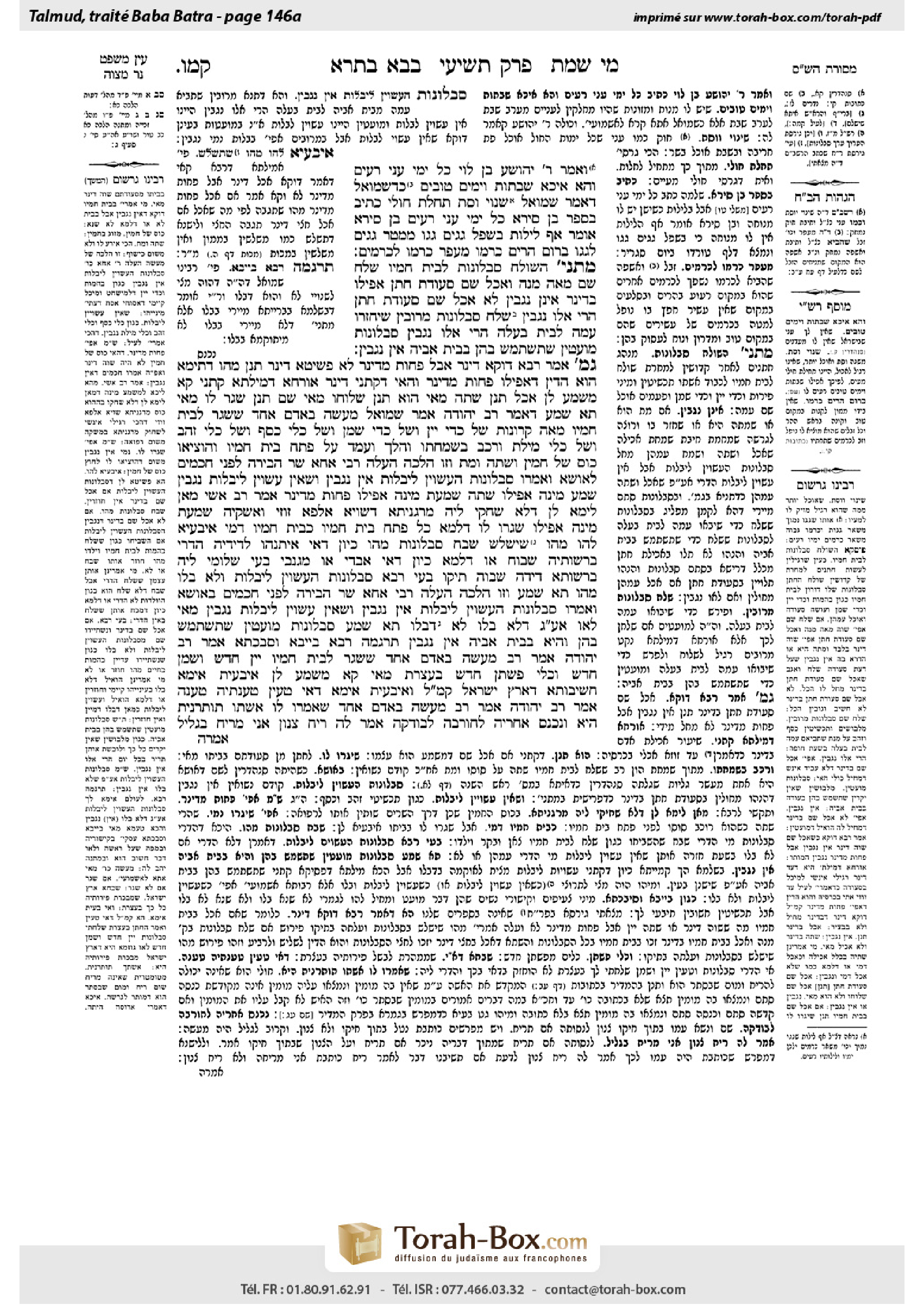
Bava Batra 146a: Talmud study for Daf Yomi
Study the Talmud for Daf Yomi with scanned pages, Hebrew text, English translations from Sefaria and AI-generated French translations.
Passage selection and English or AI-generated French translation are available where the scan has annotations. Daf Study is independent of Torah-Box and Sefaria.
Browse Bava Batra · בבא בתרא · All tractatesBava Batra 146a text and translations
This page of Bava Batra includes the Aramaic text, an English translation and an AI-generated French translation, alongside the scan above.
בבא בתרא קמ״ו א · Aramaic and Hebrew text
וְאָמַר רַבִּי יְהוֹשֻׁעַ בֶּן לֵוִי: ״כׇּל יְמֵי עָנִי רָעִים״?! וְהָא אִיכָּא שַׁבָּתוֹת וְיָמִים טוֹבִים! כְּדִשְׁמוּאֵל – דְּאָמַר שְׁמוּאֵל: שִׁנּוּי וֶסֶת – תְּחִלַּת חוֹלִי.
כְּתִיב בְּסֵפֶר בֶּן סִירָא: כׇּל יְמֵי עָנִי רָעִים. בֶּן סִירָא אוֹמֵר: אַף לֵילוֹת. בִּשְׁפַל גַּגִּים גַּגּוֹ, מִמְּטַר גַּגִּים לְגַגּוֹ. בְּרוּם הָרִים כַּרְמוֹ, מֵעֲפַר כַּרְמוֹ לִכְרָמִים.
מַתְנִי׳ הַשּׁוֹלֵחַ סִבְלוֹנוֹת לְבֵית חָמִיו; שָׁלַח שָׁם מֵאָה מָנֶה, וְאָכַל שָׁם סְעוּדַת חָתָן אֲפִילּוּ בְּדִינָר – אֵינָן נִגְבִּין. לֹא אָכַל שָׁם סְעוּדַת חָתָן – הֲרֵי אֵלּוּ נִגְבִּין. שָׁלַח סִבְלוֹנוֹת מְרוּבִּין שֶׁיַּחְזְרוּ עִמָּהּ לְבֵית בַּעְלָהּ – הֲרֵי אֵלּוּ נִגְבִּין. סִבְלוֹנוֹת מוּעָטִין שֶׁתִּשְׁתַּמֵּשׁ בָּהֶן בְּבֵית אָבִיהָ – אֵין נִגְבִּין.
גְּמָ׳ אָמַר רָבָא: דַּוְקָא דִּינָר, אֲבָל פָּחוֹת מִדִּינָר – לָא. פְּשִׁיטָא, דִּינָר תְּנַן! מַהוּ דְּתֵימָא: הוּא הַדִּין דַּאֲפִילּוּ פָּחוֹת מִדִּינָר, וְהַאי דְּקָתָנֵי דִּינָר – אוֹרְחָא דְּמִילְּתָא קָתָנֵי; קָא מַשְׁמַע לַן.
״אָכַל״ תְּנַן; שָׁתָה מַאי? ״הוּא״ תְּנַן; שְׁלוּחוֹ מַאי? ״שָׁם״ תְּנַן; שִׁגֵּר לוֹ, מַאי?
תָּא שְׁמַע, דְּאָמַר רַב יְהוּדָה אָמַר שְׁמוּאֵל: מַעֲשֶׂה בְּאָדָם אֶחָד שֶׁשִּׁגֵּר לְבֵית חָמִיו מֵאָה קְרוֹנוֹת שֶׁל כַּדֵּי יַיִן וְשֶׁל כַּדֵּי שֶׁמֶן וְשֶׁל כְּלֵי כֶסֶף וְשֶׁל כְּלֵי זָהָב וְשֶׁל כְּלִי מֵילָת; וְרָכַב בְּשִׂמְחָתוֹ, וְהָלַךְ וְעָמַד עַל פֶּתַח בֵּית חָמִיו; וְהוֹצִיאוּ כּוֹס שֶׁל חַמִּין וְשָׁתָה, וּמֵת.
וְזוֹ הֲלָכָה הֶעֱלָה רַבִּי אַחָא שַׂר הַבִּירָה לִפְנֵי חֲכָמִים לְאוּשָׁא, וְאָמְרוּ: סִבְלוֹנוֹת הָעֲשׂוּיִן לִיבְלוֹת – אֵין נִגְבִּין, וְשֶׁאֵין עֲשׂוּיִן לִיבְלוֹת – נִגְבִּין. שְׁמַע מִינַּהּ: אֲפִילּוּ שָׁתָה.
שָׁמְעַתְּ מִינַּהּ אֲפִילּוּ פָּחוֹת מִדִּינָר? אָמַר רַב אָשֵׁי: מַאן לֵימָא לַן דְּלָא שָׁחֲקִי לֵיהּ מַרְגָּנִיתָא דְּשָׁוְיָא אַלְפָּא זוּזֵי, וְאַשְׁקְיֻהּ. שָׁמְעַתְּ מִינַּהּ אֲפִילּוּ שִׁגְּרוּ לוֹ? דִּלְמָא כׇּל פֶּתַח בֵּית חָמִיו – כְּבֵית חָמִיו דָּמֵי.
אִיבַּעְיָא לְהוּ: מַהוּ שֶׁיְּשַׁלֵּשׁ? שֶׁבַח סִבְלוֹנוֹת, מַהוּ? כֵּיוָן דְּאִי אִיתַנְהוּ – לְדִידֵיהּ הָדְרִי, בִּרְשׁוּתֵיהּ שְׁבוּח; אוֹ דִלְמָא, כֵּיוָן דְּאִי אָבְדִי אוֹ מִגַּנְבִי – בָּעֵי שַׁלּוֹמֵי לֵיהּ, בִּרְשׁוּתָא דִּידַהּ שְׁבוּח? תֵּיקוּ.
בָּעֵי רָבָא: סִבְלוֹנוֹת הָעֲשׂוּיִן לִיבְלוֹת, וְלֹא בָּלוּ, מַהוּ? תָּא שְׁמַע: וְזוֹ הֲלָכָה הֶעֱלָה רַבִּי אַחָא שַׂר הַבִּירָה לִפְנֵי חֲכָמִים בְּאוּשָׁא, וְאָמְרוּ: סִבְלוֹנוֹת הָעֲשׂוּיִן לִיבְלוֹת – אֵין נִגְבִּין, וְשֶׁאֵין עֲשׂוּיִן לִיבְלוֹת – נִגְבִּין. מַאי, לָאו אַף עַל גַּב דְּלֹא בָּלוּ? לָא, דְּבָלוּ.
תָּא שְׁמַע: סִבְלוֹנוֹת מוּעָטִין שֶׁתִּשְׁתַּמֵּשׁ בָּהֶן, וְהִיא בְּבֵית אָבִיהָ – אֵין נִגְבִּין! תַּרְגְּמַהּ רָבָא: בְּיֵיבָא וּסְבַכְתָּא.
אָמַר רַב יְהוּדָה אָמַר רַב: מַעֲשֶׂה בְּאָדָם אֶחָד שֶׁשִּׁגֵּר לְבֵית חָמִיו יַיִן חָדָשׁ וְשֶׁמֶן חָדָשׁ וּכְלֵי פִּשְׁתָּן חָדָשׁ בַּעֲצֶרֶת. מַאי קָא מַשְׁמַע לַן? אִיבָּעֵית אֵימָא: חֲשִׁיבוּתָא דְּאֶרֶץ יִשְׂרָאֵל קָא מַשְׁמַע לַן, וְאִיבָּעֵית אֵימָא: דְּאִי טָעֵין, טַעַנְתֵּיהּ טַעֲנָה.
אָמַר רַב יְהוּדָה אָמַר רַב: מַעֲשֶׂה בְּאָדָם אֶחָד שֶׁאָמְרוּ לוֹ אִשְׁתּוֹ תּוֹתְרָנִית הִיא, וְנִכְנַס אַחֲרֶיהָ לְחוּרְבָּה לְבוֹדְקָהּ, אָמַר לָהּ: רֵיחַ צְנוֹן אֲנִי מֵרִיחַ בַּגָּלִיל.
Bava Batra 146a · English translation
And Rabbi Yehoshua ben Levi says: Is it so that all the days of the poor are terrible? But aren’t there Shabbatot and Festivals, when even the poor enjoy their meals and rest? Rather, explain this in accordance with the statement of Shmuel, as Shmuel says: A change of regimen [veset] causes the onset of intestinal disease, and as a result the poor suffer even from a change for the good.
It is written in the book of ben Sira: All the days of the poor are terrible. Ben Sira says: The nights as well. His roof is at the lowest point of the roofs; the rain of roofs go onto his roof. His vineyard is at the height of the mountains; the soil of his vineyard goes onto other vineyards.
MISHNA: With regard to one who sends presents [sivlonot] to his father-in-law’s house following his betrothal, even if he sent there the sum of ten thousand dinars and subsequently ate there a groom’s feast even worth the value of a single dinar, if for any reason the marriage is not effected, the presents are not collected in return by the formerly betrothed man. If he did not eat a groom’s feast there, the presents are collected, as they were not an unconditional gift. If he sent many presents with the stipulation that they return with her to her husband’s house, i.e., to his own house, after the wedding, these are collected if the marriage is not effected. If he sent a few presents for her to use while in her father’s house, they are not collected.
GEMARA: The mishna states that if the betrothed man ate food worth even a single dinar at his father-in-law’s house, the presents are not returned. Rava says: This applies specifically to the value of a dinar, but if he ate food worth less than the value of a dinar, it is not so. The Gemara asks: Isn’t that obvious, as we learned the halakha in the mishna with reference to the value of a dinar? The Gemara answers: It is stated lest you say that the same is true even in the case of less than a dinar, and the reason that the mishna teaches the halakha with reference to a dinar is that it teaches the matter in the manner in which it typically occurs, and one does not usually eat less than that. Rava therefore teaches us that the formulation of the mishna is precise; the mishna is not referring to the value of less than a dinar.
§ The Gemara asks: We learned the halakha in the mishna with regard to a betrothed man who ate at his father-in-law’s house. What is the halakha if he drank there? We learned the halakha in the mishna with regard to a case where he, the betrothed, ate there. What is the halakha if his agent ate there? We learned the halakha in the mishna with regard to a case where the betrothed man ate there, at his father-in-law’s house. What is the halakha if his father-in-law sent him a feast to his home?
The Gemara answers: Come and hear a proof concerning one these matters, as Rav Yehuda says that Shmuel says: There was an incident involving one man who sent to his father-in-law’s house one hundred wagons full of jars of wine and of jars of oil, and one hundred wagons full of silver vessels, and one hundred wagons full of gold vessels, and one hundred wagons full of garments of fine wool [milat]. And he rode over in his state of joy and went and stood by the entrance to his father-in-law’s house. And they brought out to him a cup of hot drink and he drank it, and he subsequently died.
The question arose as to whether the presents must be returned to the betrothed’s heirs. And Rabbi Aḥa Sar HaBira raised this halakha before the Sages in Usha, and they said: Presents that are typically consumed are not collected, and those that are not typically consumed are collected. One can conclude from this incident that even if the betrothed only drank, some of the presents cannot be reclaimed.
The Gemara asks: Can you learn from this incident that the presents cannot be claimed even if he ate or drank less than the value of a dinar, since a cup of hot drink is not worth a dinar? Rav Ashi said: Who shall say to us that they did not grind a pearl worth one thousand dinars and serve it to him to drink? The Gemara asks: Can you learn from this incident that even if they sent the feast to him the presents cannot be claimed, as he drank at the entrance and did not enter inside? The Gemara rejects this conclusion: Perhaps the entire entrance of his father-in-law’s house is considered as his father-in-law’s house.
A dilemma was raised before the Sages: Rava states that if the betrothed man ate less than the value of a dinar at his father-in-law’s house, and the marriage is not effected, he can collect the presents he sent. What is the halakha concerning whether he must divide the value of the presents, and claim only part of the value, in proportion to the amount he ate? And what is the halakha concerning the enhancement of the value of the presents? Does one say that since the halakha is that if they are extant they are returned to him, therefore they were enhanced under his ownership? Or perhaps, since the halakha is that if they are lost or stolen, the betrothed woman’s family is required to repay him, therefore they were enhanced under her ownership. The Gemara concludes: These dilemmas shall stand unresolved.
Rava raises a dilemma: What is the halakha with regard to presents that are typically consumed, but were not consumed? The Gemara replies: Come and hear a proof: And Rabbi Aḥa Sar HaBira raised this halakha before the Sages at Usha, and they said: Presents that are typically consumed are not collected, and those that are not typically consumed are collected. What, is it not referring to presents that are typically consumed even though they were not consumed? The Gemara rejects this: No, the mishna is referring to presents that were actually consumed.
The Gemara replies: Come and hear a proof from the mishna: If he sent a few presents for her to use while she is in her father’s house, they are not collected. This indicates that they cannot be collected in any event, irrespective of whether they were used or not. Rava interpreted the mishna as referring to a snood or hairnet, which are insignificant items that the betrothed man sends without any intention of later collecting them.
§ Rav Yehuda says that Rav says: There was an incident involving one man who sent new wine, and new oil, and new linen garments to his father-in-law’s house at the time of Shavuot. The Gemara asks: What is this incident teaching us? The Gemara answers: If you wish, say that it teaches us the importance, i.e., the greatness, of Eretz Yisrael, where there is new wine, oil, and linen already available at the time of Shavuot. And if you wish, say instead that it teaches that if the betrothed man claims that he sent these items at the time of Shavuot, his claim is a plausible claim, and there is no reason to question it.
Rav Yehuda says that Rav says: There was an incident involving one man who was told that his wife, i.e., his betrothed, was one whose sense of smell was impaired, and he followed her into a ruin, carrying a date with him, to check her to see if she could correctly identify the smell. He said to her: I smell the scent of radish in the Galilee.
Bava Batra 146a · Traduction française (IA)
Et le Rabbi Yéhoshua ben Levi dit : Est-ce que tous les jours du pauvre sont des jours terribles ? Mais ne sont-ce pas les sabbats et les fêtes, lors desquels même le pauvre peut manger et reposer ? Plutôt, expliquez cela conformément à la déclaration de Shmuel, car Shmuel dit : Un changement de régime [veset] provoque l'apparition d'une maladie intestinale, et en conséquence, le pauvre souffre même d'un changement favorable.
Il est écrit dans le livre de Ben Sira : Tous les jours du pauvre sont des jours terribles. Ben Sira dit : Les nuits aussi. Son toit est au point le plus bas des toits ; la pluie des toits tombe sur son toit. Son domaine viticole est au sommet des montagnes ; la terre de son domaine viticole tombe sur d'autres domaines viticoles.
MICHNA : Concernant celui qui envoie des présents [sivlonot] à la maison de son beau-père après son engagement, même s'il a envoyé là le montant de dix mille dinars et qu'il a ensuite mangé un festin de marié même d'une valeur égale à un seul dinar, si pour quelque raison le mariage n'est pas accompli, les présents ne sont pas récupérés par l'homme engagé. Si, en revanche, il n'a pas mangé un festin de marié là, les présents sont récupérés, car ils n'étaient pas un don conditionnel. Si, en revanche, il a envoyé des présents avec la stipulation qu'ils soient ramenés avec elle chez son mari, c'est-à-dire chez son propre domicile, après le mariage, ces présents sont récupérés si le mariage n'est pas accompli. Si, en revanche, il a envoyé des présents pour qu'elle les utilise pendant qu'elle est chez son père, ils ne sont pas récupérés.
GUEMARA : La mishna indique que si l'homme engagé a mangé un aliment même d'une valeur égale à un seul dinar à la maison de son beau-père, les présents ne sont pas récupérés. Rava dit : Cela s'applique spécifiquement à la valeur d'un dinar, mais si l'homme a mangé un aliment de valeur inférieure à celle d'un dinar, cela n'est pas ainsi. La Guemara demande : N'est-ce pas évident, puisque nous avons appris la halakha dans la mishna en référence à la valeur d'un dinar ? La Guemara répond : C'est dit afin que vous ne disiez pas que cela est vrai même dans le cas d'une valeur inférieure à un dinar, et la raison pour laquelle la mishna enseigne la halakha en référence à un dinar est qu'elle enseigne la matière dans la manière dont elle se produit habituellement, et on ne mange généralement pas moins que cela. Rava enseigne donc que la formulation de la mishna est précise ; la mishna ne fait pas référence à une valeur inférieure à un dinar.
§ La Guemara demande : Nous avons appris la halakha dans la mishna concernant un homme engagé qui a mangé à la maison de son beau-père. Quelle est la halakha si il a bu là ? Nous avons appris la halakha dans la mishna concernant un cas où l'homme engagé a mangé là. Quelle est la halakha si son agent a mangé là ? Nous avons appris la halakha dans la mishna concernant un cas où l'homme engagé a mangé là, à la maison de son beau-père. Quelle est la halakha si son beau-père a envoyé un festin chez lui ?
La Guemara répond : Approchez-vous d'une preuve concernant l'une de ces questions, car Rav Yéhuda dit que Shmuel dit : Il y avait un incident concernant un homme qui a envoyé à la maison de son beau-père cent chariots remplis de jarres de vin et de jarres d'huile, et cent chariots remplis d'objets en argent, et cent chariots remplis d'objets en or, et cent chariots remplis de vêtements de laine fine [milat]. Et il a monté en état de joie et est allé se tenir à l'entrée de la maison de son beau-père. Et ils ont sorti pour lui un verre de boisson chaude et il l'a bu, et il est ensuite mort.
La question s'est levée concernant si les présents doivent être rendus aux héritiers de l'homme engagé. Rabbi Acha Sar HaBira a soulevé cette halakha devant les Sages à Usha, et ils ont dit : Les présents qui sont généralement consommés ne sont pas récupérés, et ceux qui ne le sont pas sont récupérés. On peut conclure de cet incident que même si l'homme engagé n'a que bu, une partie des présents ne peut pas être récupérés.
La Guemara demande : Puis-je apprendre de cet incident que les présents ne peuvent pas être réclamés même si l'homme a mangé ou bu moins que la valeur d'un dinar, puisque un verre de boisson chaude n'est pas d'une valeur d'un dinar ? Rav Ashi a dit : Qui oserait dire qu'ils n'ont pas broyé une perle d'une valeur de mille dinars et l'ont servie à boire ? La Guemara demande : Puis-je apprendre de cet incident que même s'ils ont envoyé le festin à lui, les présents ne peuvent pas être réclamés, puisqu'il a bu à l'entrée et n'a pas entré à l'intérieur ? La Guemara rejette cette conclusion : Peut-être que toute l'entrée de la maison de son beau-père est considérée comme la maison de son beau-père.
Un dilemme a été soulevé devant les Sages : Rava dit que si l'homme engagé a mangé moins que la valeur d'un dinar à la maison de son beau-père, et que le mariage n'est pas accompli, il peut récupérer les présents qu'il a envoyés. Quelle est la halakha concernant le fait qu'il doive diviser la valeur des présents et réclamer seulement une partie de la valeur, en proportion de la quantité qu'il a mangé ? Et quelle est la halakha concernant l'augmentation de la valeur des présents ? Dit-on que puisque la halakha est que si ils sont présents ils sont rendus à lui, donc ils ont été améliorés sous sa propriété ? Ou peut-être, puisque la halakha est que si ils sont perdus ou volés, la famille de la fiancée est tenue de le réparer, donc ils ont été améliorés sous sa propriété. La Guemara conclut : Ces dilemmes resteront sans solution.
Rava soulève un dilemme : Quelle est la halakha concernant les présents qui sont généralement consommés mais qui n'ont pas été consommés ? La Guemara répond : Approchez-vous d'une preuve : Rabbi Acha Sar HaBira a soulevé cette halakha devant les Sages à Usha, et ils ont dit : Les présents qui sont généralement consommés ne sont pas récupérés, et ceux qui ne le sont pas sont récupérés. Qu'est-ce que cela ne fait pas référence aux présents qui sont généralement consommés même s'ils n'ont pas été consommés ? La Guemara rejette cela : Non, la mishna fait référence aux présents qui ont été effectivement consommés.
La Guemara répond : Viens entendre une preuve tirée de la Michna : Si un homme a envoyé quelques présents pour qu'elle les utilise pendant qu'elle est chez son père, ils ne sont pas récupérés. Cela montre qu'ils ne peuvent être récupérés en aucun cas, indépendamment du fait qu'ils aient été utilisés ou non. Rava a interprété la Michna comme se référant à un couvre-chef ou un bonnet, des objets insignifiants que l'homme fiancé envoie sans l'intention de les récupérer ultérieurement.
§ Rav Yehuda dit que Rav dit : Il y avait un cas concernant un homme qui avait envoyé du vin nouveau, de l'huile nouvelle et des vêtements en lin à la maison de son beau-père à la fête de Shavuot. La Guemara demande : Qu'est-ce que ce cas nous enseigne ? La Guemara répond : Si tu veux, dis que cela nous enseigne l'importance, c'est-à-dire la grandeur, d'Eretz Yisrael, où il y a du vin nouveau, de l'huile et des vêtements en lin disponibles à la fête de Shavuot. Et si tu veux, dis plutôt qu'il enseigne que si l'homme fiancé affirme avoir envoyé ces objets à la fête de Shavuot, son affirmation est une affirmation plausible et il n'y a pas de raison de la contester.
Rav Yehuda dit que Rav dit : Il y avait un cas concernant un homme qui avait été informé que sa femme, c'est-à-dire sa fiancée, avait une altération de l'odorat, et il l'a suivie dans un lieu abandonné, portant une date avec lui, pour l'examiner afin de vérifier si elle pouvait correctement identifier les odeurs. Il lui a dit : Je sens l'odeur de la racine de carotte du Galiléen.
Traduction française générée par IA à partir de l’édition anglaise de Sefaria. Vérifie toujours un passage avec le texte source.
Text from Sefaria: William Davidson Edition - Vocalized Aramaic (CC BY NC); William Davidson Edition - English (CC BY NC).