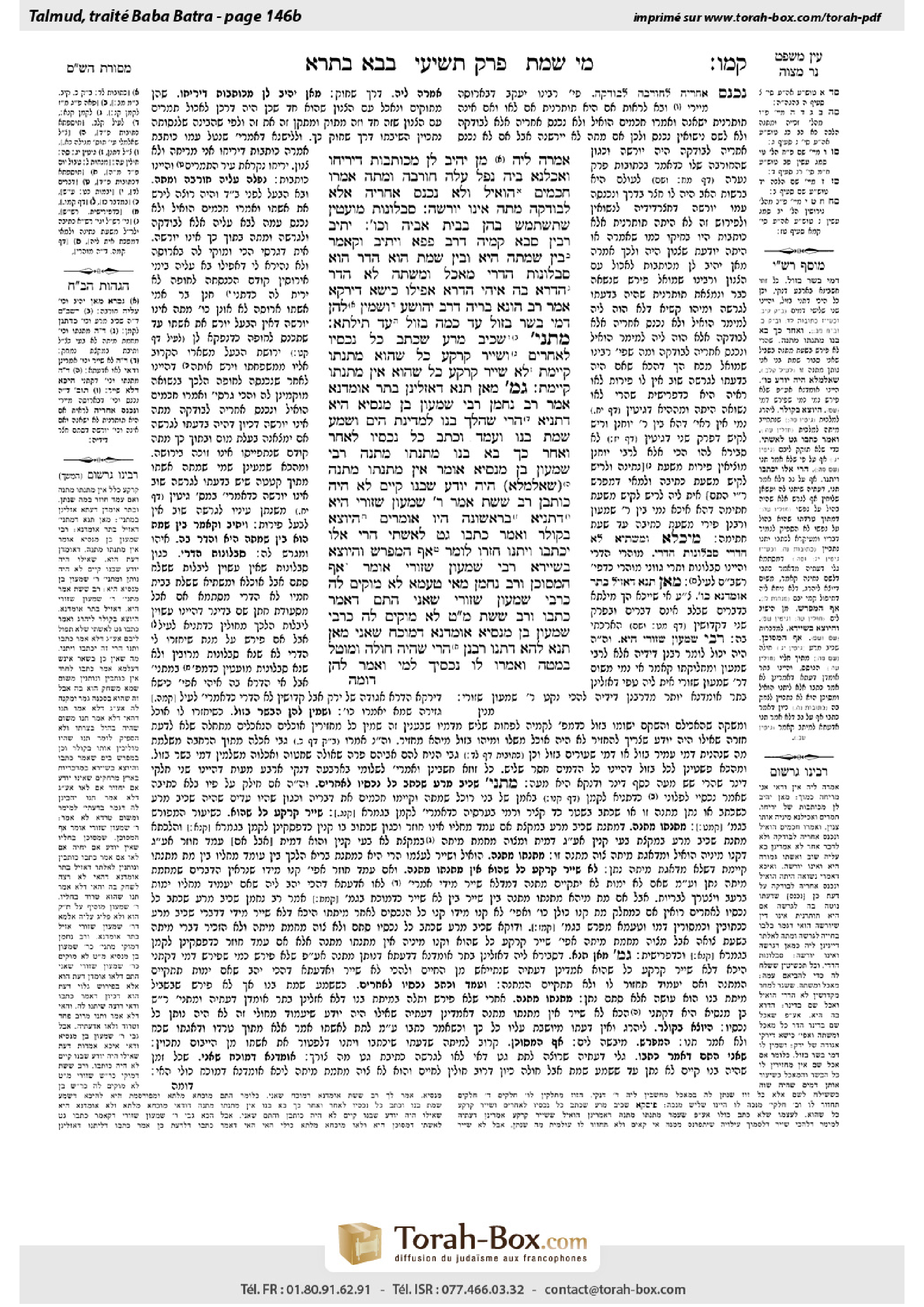
Bava Batra 146b: Talmud study for Daf Yomi
Study the Talmud for Daf Yomi with scanned pages, Hebrew text, English translations from Sefaria and AI-generated French translations.
Passage selection and English or AI-generated French translation are available where the scan has annotations. Daf Study is independent of Torah-Box and Sefaria.
Browse Bava Batra · בבא בתרא · All tractatesBava Batra 146b text and translations
This page of Bava Batra includes the Aramaic text, an English translation and an AI-generated French translation, alongside the scan above.
בבא בתרא קמ״ו ב · Aramaic and Hebrew text
אֲמַרָה לֵיהּ: מִן יָהֵיב לַן מִכּוֹתָבוֹת דִּירִיחוֹ וְאָכַלְנָא בֵּיהּ. נְפַל עֲלַהּ חוּרְבָּה, וּמֵתָה. אָמְרוּ חֲכָמִים: הוֹאִיל וְלֹא נִכְנַס אַחֲרֶיהָ אֶלָּא לְבוֹדְקָהּ, מֵתָה – אֵינוֹ יוֹרְשָׁהּ.
סִבְלוֹנוֹת מוּעָטִין שֶׁתִּשְׁתַּמֵּשׁ בָּהֶן בְּבֵית אָבִיהָ וְכוּ׳. יָתֵיב רָבִין סָבָא קַמֵּיהּ דְּרַב פָּפָּא, וְיָתֵיב וְקָאָמַר: בֵּין שֶׁמֵּתָה הִיא וּבֵין שֶׁמֵּת הוּא, הָדַר הוּא – סִבְלוֹנוֹת הָדְרִי, מַאֲכָל וּמִשְׁתֶּה לָא הָדַר. הָדְרָא בָּהּ אִיהִי – הָדְרָא אֲפִילּוּ כִּישָּׁא דְיַרְקָא. אָמַר רַב הוּנָא בְּרֵיהּ דְּרַב יְהוֹשֻׁעַ: וְשָׁמִין לָהֶן דְּמֵי בָשָׂר בְּזוֹל. עַד כַּמָּה ״בְּזוֹל״? עַד תִּילְתָּא.
מַתְנִי׳ שְׁכִיב מְרַע שֶׁכָּתַב כׇּל נְכָסָיו לַאֲחֵרִים, וְשִׁיֵּיר קַרְקַע כׇּל שֶׁהוּא – מַתְּנָתוֹ קַיֶּימֶת. לֹא שִׁיֵּיר קַרְקַע כָּל שֶׁהוּא – אֵין מַתְּנָתוֹ קַיֶּימֶת.
גְּמָ׳ מַאן תְּנָא דְּאָזְלִינַן בָּתַר אוּמְדָּנָא? אָמַר רַב נַחְמָן: רַבִּי שִׁמְעוֹן בֶּן מְנַסְיָא הִיא. דְּתַנְיָא: הֲרֵי שֶׁהָלַךְ בְּנוֹ לִמְדִינַת הַיָּם, וְשָׁמַע שֶׁמֵּת בְּנוֹ, וְעָמַד וְכָתַב כׇּל נְכָסָיו לְאַחֵר, וְאַחַר כָּךְ בָּא בְּנוֹ – מַתְּנָתוֹ מַתָּנָה. רַבִּי שִׁמְעוֹן בֶּן מְנַסְיָא אוֹמֵר: אֵין מַתְּנָתוֹ מַתָּנָה, שֶׁאִלְמָלֵא הָיָה יוֹדֵעַ שֶׁבְּנוֹ קַיָּים – לֹא הָיָה כּוֹתְבָן.
רַב שֵׁשֶׁת אָמַר: רַבִּי שִׁמְעוֹן שֵׁזוּרִי הִיא – דְּתַנְיָא, בָּרִאשׁוֹנָה הָיוּ אוֹמְרִים: הַיּוֹצֵא בְּקוֹלָר, וְאָמַר: ״כִּתְבוּ גֵּט לְאִשְׁתִּי״ – הֲרֵי אֵלּוּ יִכְתְּבוּ וְיִתְּנוּ. חָזְרוּ לוֹמַר: אַף הַמְפָרֵשׁ וְהַיּוֹצֵא בִּשְׁיָירָא. רַבִּי שִׁמְעוֹן שֵׁזוּרִי אוֹמֵר: אַף הַמְסוּכָּן.
וְרַב נַחְמָן – מַאי טַעְמָא לָא מוֹקֵים לַהּ כְּרַבִּי שִׁמְעוֹן שֵׁזוּרִי? שָׁאנֵי הָתָם, דְּאָמַר ״כִּתְבוּ״. וְרַב שֵׁשֶׁת – מַאי טַעְמָא לָא מוֹקֵים לַהּ כְּרַבִּי שִׁמְעוֹן בֶּן מְנַסְיָא? אוּמְדָּנָא דְּמוֹכַח שָׁאנֵי.
מַאן תְּנָא לְהָא דְּתָנוּ רַבָּנַן: הֲרֵי שֶׁהָיָה חוֹלֶה וּמוּטָל בַּמִּטָּה, וְאָמְרוּ לוֹ: נְכָסֶיךָ לְמִי? וְאָמַר לָהֶן:
Bava Batra 146b · English translation
She said to him: Who will give us of the dates of Jericho that I shall eat them, hinting that she smelled the date he had brought with him. The ruin collapsed upon her and she died. The Sages said: Since he went into the ruin after her only to check her sense of smell, and not for the purpose of consummating their marriage, if she dies, he does not inherit from her, as the marriage was not effected, and a man does not inherit from his betrothed.
§ The mishna teaches: If he sent a few presents for her to use while in her father’s house, they are not collected. Ravin the Elder was sitting before Rav Pappa and he was sitting and saying: Whether she died, or whether he died, or whether he retracted his agreement to the betrothal and divorced her, the presents return to the betrothed man or his heirs, but food and drink do not return. If she retracted her agreement to the betrothal and requested a divorce, even a bundle of vegetables returns to the betrothed man. Rav Huna, son of Rav Yehoshua, said: When the presents are returned, the court appraises for the betrothed woman’s family the sum that they must repay for any meat he gave her, according to a reduced assessment of the value of the meat and not according to the price the betrothed man paid. How much less is the reduced assessment? Up to one-third less than he paid.
MISHNA: With regard to a person on his death-bed who wrote a deed granting all of his property to others, and he reserved for himself any amount of land, his gift stands even if he subsequently recovers. If he did not reserve for himself any amount of land, and he recovered, his gift does not stand, as the gift was conditional upon his death, since is it evident that he did not intend to leave himself without means of support.
GEMARA: Who is the tanna who taught that we follow the principle of assessing a person’s intentions, even when he did not expressly state them? Rav Naḥman said: This is the opinion of Rabbi Shimon ben Menasya, as it is taught in a baraita (Tosefta, Ketubot 5:9): In a case where one’s son went overseas and he heard that his son died, and then he arose and wrote a document granting all of his property to another, and then his son came back, his gift to the other people is a valid gift. Rabbi Shimon ben Menasya says: His gift is not a valid gift, as had he known that his son was alive he would not have written a document granting them his property.
Rav Sheshet said: This is the opinion of Rabbi Shimon Shezuri, as it is taught in a mishna (Gittin 65b): Initially the Sages would say: With regard to one who was taken out in a collar to be executed and said: Write a bill of divorce for my wife, these people should write and give her the document. Although he did not explicitly say the word give, this is understood to have been his intention, to release her from the necessity to perform levirate marriage or ḥalitza. They then said that this halakha applies even to one who sets sail and one who departs with a caravan to a far-off place. A bill of divorce is given to his wife under these circumstances even if her husband said just: Write. Rabbi Shimon Shezuri says: Even in the case of one who is dangerously ill who gives that instruction, they write the bill of divorce and give it to his wife.
The Gemara asks: And what is the reason that Rav Naḥman does not interpret the mishna as being in accordance with the opinion of Rabbi Shimon Shezuri? The Gemara answers: Rav Naḥman holds that it is different there, as he said: Write a bill of divorce, thereby partially stating his intention to divorce her, whereas in the case of the mishna here, he did not express his intention at all. The Gemara asks: And what is the reason that Rav Sheshet does not interpret the mishna as being in accordance with the opinion of Rabbi Shimon ben Menasya? The Gemara answers: An assessment of a person’s intentions that is clearly proven is different, and it is possible that Rabbi Shimon ben Menasya does not apply this principle where the person’s intentions are less evident.
The Gemara asks: Who is the tanna who taught that which the Sages taught (Tosefta, Ketubot 4:15): If one was ill and bedridden, and those present said to him: To whom shall your property be given? And he said to them:
Bava Batra 146b · Traduction française (IA)
Elle lui dit : Qui nous donnera les dattes de Jéricho que je vais manger, suggérant qu'elle avait perçu l'odeur de la dattes qu'il avait apportées avec lui. La ruine s'effondra sur elle et elle mourut. Les Sages dirent : Puisqu'il est entré dans la ruine après elle uniquement pour vérifier son odorat, et non pour accomplir leur mariage, si elle meurt, il ne lui succède pas, car le mariage n'a pas été accompli, et un homme ne succède pas à son fiancée.
§ La mitsva enseigne : Si un homme a envoyé quelques présents pour qu'elle les utilise pendant qu'elle était chez son père, ils ne sont pas récupérés. Ravin le Vieux était assis devant Rav Pappa et il était assis et disait : Qu'elle meure, ou qu'il meure, ou qu'il révoque son accord de fiancement et divorce d'elle, les présents reviennent au fiancé ou à ses héritiers, mais les aliments et boissons ne reviennent pas. Si elle révoque son accord de fiancement et demande un divorce, même un faisceau de légumes revient au fiancé. Rav Huna, fils de Rav Yéhoshua, dit : Lorsque les présents sont rendus, la cour évalue pour la famille de la fiancée la somme qu'ils doivent rembourser pour tout la viande qu'il lui a donnée, selon une évaluation réduite de la valeur de la viande et non selon le prix que le fiancé avait payé. De combien est cette évaluation réduite ? Jusqu'à un tiers moins que ce qu'il avait payé.
MITSVA : Concernant une personne sur son lit de mort qui a écrit un acte transférant toute sa propriété à d'autres, et qui a réservé pour lui-même une quantité de terre, son don est valide même s'il récupère ensuite. Si il n'a pas réservé pour lui-même une quantité de terre, et s'il récupère, son don n'est pas valide, car le don était conditionnel à sa mort, puisque c'est évident qu'il ne voulait pas se laisser sans moyens de subsistance.
GUEMARA : Qui est le tanna qui a enseigné que nous suivons le principe d'évaluation des intentions d'une personne, même lorsqu'il ne les a pas exprimées explicitement ? Rav Naḥman dit : C'est l'opinion de Rabbi Shimon ben Menasya, comme il est enseigné dans une baraïta (Tosefta, Ketubot 5:9) : Dans un cas où son fils est parti à l'étranger et qu'il a entendu qu'il était mort, et qu'il s'est levé et a écrit un document transférant toute sa propriété à un autre, et que son fils est revenu, son don aux autres personnes n'est pas un don valide. Rabbi Shimon ben Menasya dit : Son don n'est pas un don valide, car s'il avait su que son fils était vivant, il n'aurait pas écrit un document transférant sa propriété à ces personnes.
Rav Sheshet dit : C'est l'opinion de Rabbi Shimon Shezuri, comme il est enseigné dans une mitsva (Gittin 65b) : Initialement les Sages disaient : Concernant celui qui a été sorti en collier pour être exécuté et qui a dit : Écrivez un divorce pour ma femme, ces gens devraient écrire et lui donner le document. Bien qu'il n'ait pas explicitement dit le mot donner, cela est compris comme son intention, de la libérer de la nécessité de pratiquer le levirate ou la ḥalitza. Ils ont ensuite dit que cette halakha s'applique même à celui qui part en mer et à celui qui part avec une caravane vers un lieu éloigné. Un divorce est donné à sa femme dans ces circonstances même si son mari a dit simplement : Écrivez. Rabbi Shimon Shezuri dit : Même dans le cas d'une personne gravement malade qui donne cet ordre, ils écrivent le divorce et le donnent à sa femme.
La Guemara demande : Et quelle est la raison pour laquelle Rav Naḥman ne considère pas la mitsna comme étant en accord avec l'opinion de Rabbi Shimon Shezuri ? La Guemara répond : Rav Naḥman considère que c'est différent là, car il a dit : Écrivez un divorce, ce qui exprime partiellement son intention de divorcer d'elle, alors que dans le cas de la mitsna ici, il n'a pas exprimé son intention du tout. La Guemara demande : Et quelle est la raison pour laquelle Rav Sheshet ne considère pas la mitsna comme étant en accord avec l'opinion de Rabbi Shimon ben Menasya ? La Guemara répond : L'évaluation des intentions d'une personne clairement prouvée est différente, et il est possible que Rabbi Shimon ben Menasya ne s'applique pas ce principe là où les intentions de la personne sont moins évidentes.
La Guemara demande : Qui est le tanna qui a enseigné ce qui est enseigné par les Sages (Tosefta, Ketubot 4:15) : Si l'on était malade et allongé, et que ceux présents dirent à lui : À qui devraient être donnés tes biens ? Et qu'il dit à eux :
Traduction française générée par IA à partir de l’édition anglaise de Sefaria. Vérifie toujours un passage avec le texte source.
Text from Sefaria: William Davidson Edition - Vocalized Aramaic (CC BY NC); William Davidson Edition - English (CC BY NC).