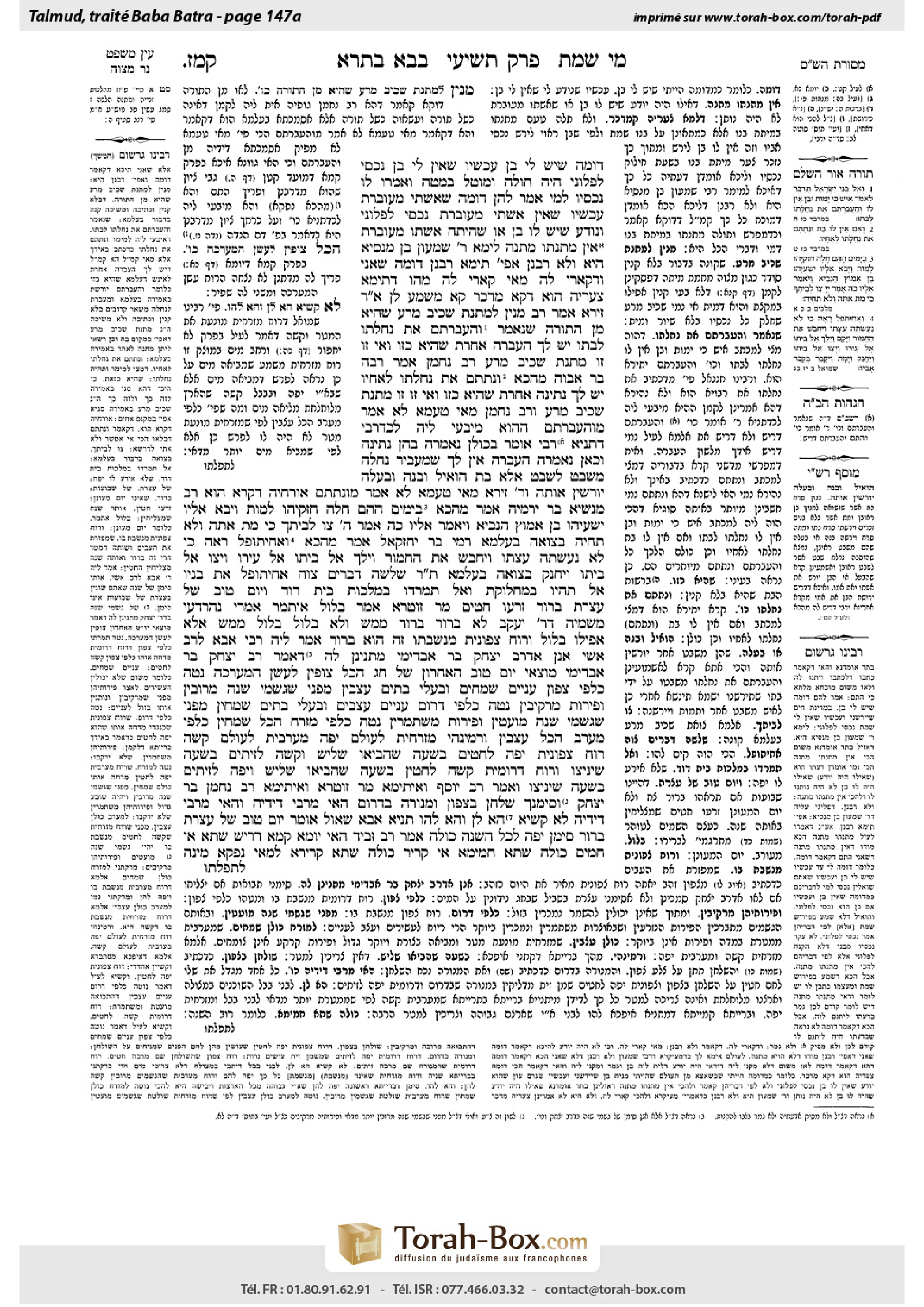
Bava Batra 147a: Talmud study for Daf Yomi
Study the Talmud for Daf Yomi with scanned pages, Hebrew text, English translations from Sefaria and AI-generated French translations.
Passage selection and English or AI-generated French translation are available where the scan has annotations. Daf Study is independent of Torah-Box and Sefaria.
Browse Bava Batra · בבא בתרא · All tractatesBava Batra 147a text and translations
This page of Bava Batra includes the Aramaic text, an English translation and an AI-generated French translation, alongside the scan above.
בבא בתרא קמ״ז א · Aramaic and Hebrew text
דּוֹמֶה שֶׁיֵּשׁ לִי בֵּן, עַכְשָׁיו שֶׁאֵין לִי בֵּן – נְכָסַי לִפְלוֹנִי; הָיָה חוֹלֶה וּמוּטָל בַּמִּטָּה, וְאָמְרוּ לוֹ: נְכָסָיו לְמִי? אָמַר לָהֶן: דּוֹמֶה שֶׁאִשְׁתִּי מְעוּבֶּרֶת, עַכְשָׁיו שֶׁאֵין אִשְׁתִּי מְעוּבֶּרֶת – נְכָסַי לִפְלוֹנִי; וְנוֹדַע שֶׁיֵּשׁ לוֹ בֵּן אוֹ שֶׁהָיְתָה אִשְׁתּוֹ מְעוּבֶּרֶת – אֵין מַתְּנָתוֹ מַתָּנָה.
לֵימָא רַבִּי שִׁמְעוֹן בֶּן מְנַסְיָא הִיא, וְלָא רַבָּנַן? אֲפִילּוּ תֵּימָא רַבָּנַן, ״דּוֹמֶה״ שָׁאנֵי.
וּדְקָאָרֵי לַהּ – מַאי קָאָרֵי לַהּ? מַהוּ דְּתֵימָא: צַעְרֵיהּ הוּא דְּקָא מַדְכַּר, קָא מַשְׁמַע לַן.
אָמַר רַבִּי זֵירָא אָמַר רַב: מִנַּיִן לְמַתְּנַת שְׁכִיב מְרַע שֶׁהִיא מִן הַתּוֹרָה? שֶׁנֶּאֱמַר: ״וְהַעֲבַרְתֶּם אֶת נַחֲלָתוֹ לְבִתּוֹ״ – יֵשׁ לְךָ הַעֲבָרָה אַחֶרֶת שֶׁהִיא כָּזוֹ. וְאֵי זוֹ? זוֹ מַתְּנַת שְׁכִיב מְרַע.
רַב נַחְמָן אָמַר רַבָּה בַּר אֲבוּהּ, מֵהָכָא: ״וּנְתַתֶּם אֶת נַחֲלָתוֹ לְאֶחָיו״ – יֵשׁ לְךָ נְתִינָה אַחֶרֶת שֶׁהִיא כָּזוֹ. וְאֵי זוֹ? זוֹ מַתְּנַת שְׁכִיב מְרַע.
וְרַב נַחְמָן – מַאי טַעְמָא לָא אָמַר מִ״וְהַעֲבַרְתֶּם״? הַהוּא מִיבְּעֵי לֵיהּ לְכִדְרַבִּי – דְּתַנְיָא, רַבִּי אוֹמֵר: בְּכוּלָּן נֶאֶמְרָה בָּהֶן ״נְתִינָה״, וְכָאן נֶאֶמְרָה ״הַעֲבָרָה״; אֵין לְךָ שֶׁמַּעֲבִיר נַחֲלָה מִשֵּׁבֶט לְשֵׁבֶט, אֶלָּא בַּת – הוֹאִיל וּבְנָהּ וּבַעְלָהּ יוֹרְשִׁין אוֹתָהּ.
וְרַבִּי זֵירָא – מַאי טַעְמָא לָא אָמַר מִ״וּנְתַתֶּם״? אוֹרְחֵיהּ דִּקְרָא הוּא.
רַב מְנַשְּׁיָא בַּר יִרְמְיָה אָמַר, מֵהָכָא: ״בַּיָּמִים הָהֵם חָלָה חִזְקִיָּהוּ לָמוּת, וַיָּבֹא אֵלָיו יְשַׁעְיָהוּ בֶן אָמוֹץ הַנָּבִיא, וַיֹּאמֶר אֵלָיו: כֹּה אָמַר ה׳, צַו לְבֵיתֶךָ, כִּי מֵת אַתָּה וְלֹא תִחְיֶה״ – בְּצַוָּאָה בְּעָלְמָא.
רָמֵי בַּר יְחֶזְקֵאל אָמַר, מֵהָכָא: ״וַאֲחִיתוֹפֶל רָאָה כִּי לֹא נֶעֶשְׂתָה עֲצָתוֹ וַיַּחֲבֹשׁ אֶת הַחֲמוֹר וַיֵּלֶךְ אֶל בֵּיתוֹ אֶל עִירוֹ וַיְצַו אֶל בֵּיתוֹ וַיֵּחָנַק״, בְּצַוָּאָה בְּעָלְמָא.
תָּנוּ רַבָּנַן: שְׁלֹשָׁה דְּבָרִים צִוָּה אֲחִיתוֹפֶל אֶת בָּנָיו – אַל תִּהְיוּ בְּמַחְלוֹקֶת, וְאַל תִּמְרְדוּ בְּמַלְכוּת בֵּית דָּוִד, וְיוֹם טוֹב שֶׁל עֲצֶרֶת בָּרוּר – זִרְעוּ חִטִּים. מָר זוּטְרָא אָמַר: ״בָּלוּל״ אִיתְּמַר. אָמְרִי נְהַרְדָּעֵי מִשְּׁמֵיהּ דְּרַבִּי יַעֲקֹב: לֹא ״בָּרוּר״ – בָּרוּר מַמָּשׁ, וְלֹא ״בָּלוּל״ – בָּלוּל מַמָּשׁ, אֶלָּא אֲפִילּוּ בָּלוּל וְרוּחַ צְפוֹנִית מְנַשַּׁבְתּוֹ – זֶה הוּא בָּרוּר.
אֲמַר לֵיהּ רַבִּי אַבָּא לְרַב אָשֵׁי: אֲנַן – אַדְּרַב יִצְחָק בַּר אַבְדִּימִי מַתְנֵינַן לַהּ, דְּאָמַר רַב יִצְחָק בַּר אַבְדִּימִי: מוֹצָאֵי יוֹם טוֹב הָאַחֲרוֹן שֶׁל חַג, הַכֹּל צוֹפִין לַעֲשַׁן הַמַּעֲרָכָה; נָטָה כְּלַפֵּי צָפוֹן – עֲנִיִּים שְׂמֵחִים וּבַעְלֵי בָתִּים עֲצֵבִין, מִפְּנֵי שֶׁגִּשְׁמֵי שָׁנָה מְרוּבִּין, וּפֵירוֹת מַרְקִיבִין.
נָטָה כְּלַפֵּי דָרוֹם – עֲנִיִּים עֲצֵבִים וּבַעְלֵי בָתִּים שְׂמֵחִין, מִפְּנֵי שֶׁגִּשְׁמֵי שָׁנָה מוּעָטִין, וּפֵירוֹת מִשְׁתַּמְּרִין. נָטָה כְּלַפֵּי מִזְרָח – הַכֹּל שְׂמֵחִין. כְּלַפֵּי מַעֲרָב – הַכֹּל עֲצֵבִין.
וּרְמִינְהִי: מִזְרָחִית – לְעוֹלָם יָפָה. מַעֲרָבִית – לְעוֹלָם קָשָׁה. רוּחַ צְפוֹנִית – יָפָה לְחִטִּים בְּשָׁעָה שֶׁהֵבִיאוּ שְׁלִישׁ, וְקָשָׁה לְזֵיתִים בְּשָׁעָה שֶׁיָּנֵיצוּ. וְרוּחַ דְּרוֹמִית – קָשָׁה לְחִטִּין בְּשָׁעָה שֶׁהֵבִיאוּ שְׁלִישׁ, וְיָפָה לְזֵיתִים בְּשָׁעָה שֶׁיָּנֵיצוּ.
וְאָמַר רַב יוֹסֵף, וְאִיתֵּימָא מָר זוּטְרָא, וְאִיתֵּימָא רַב נַחְמָן בַּר יִצְחָק: וְסִימָנָךְ – שֻׁלְחָן בַּצָּפוֹן, וּמְנוֹרָה בַּדָּרוֹם. הַאי מְרַבֵּי דִידֵיהּ וְהַאי מְרַבֵּי דִידֵיהּ!
לָא קַשְׁיָא; הָא לַן, וְהָא לְהוּ.
תַּנְיָא, אַבָּא שָׁאוּל אוֹמֵר: יוֹם טוֹב שֶׁל עֲצֶרֶת בָּרוּר – סִימָן יָפֶה לְכׇל הַשָּׁנָה כּוּלָּהּ. אָמַר רַב זְבִיד: הַאי יוֹמָא קַמָּא דְּרֵישׁ שַׁתָּא, אִי חַמִּים – כּוּלַּהּ שַׁתָּא חַמִּימָא, אִי קָרִיר – כּוּלַּהּ שַׁתָּא קָרִירָא. לְמַאי נָפְקָא מִינַּהּ?
Bava Batra 147a · English translation
Previously, I thought that I had a son. Now that I have been informed that I do not have a son, my property shall be given to so-and-so. Or if he was ill and bedridden, and those present said to him: To whom shall his property be given? And he said to them: Previously, I thought that my wife was pregnant. Now that I have been informed that my wife is not pregnant, my property shall be given to so-and-so. And if it then became known, in either of those cases, that he had a son or that his wife was pregnant, his gift is not a valid gift, since he clearly indicated that he bestowed the gift on that recipient only because he thought he had no heir.
The Gemara asks: Shall we say that this is the opinion of Rabbi Shimon ben Menasya and not the opinion of the Rabbis? The Gemara rejects this: You can even say that this is the opinion of the Rabbis, as the case where he said: I thought that I had a son, is different, since he stated the reason for his actions.
Since the difference between the cases is obvious, the Gemara asks: He who asked it, why did he ask it? The Gemara replies: Lest you say that when the bedridden man mentioned that he does not have a son, he is mentioning it only as an expression of his sorrow, since the matter of the disposal of his estate brings it to mind, but he is not mentioning this as the reason for the gift, the baraita therefore teaches us that the reference to his son indicates that had he known that he had a son, he would not have given his property to others.
§ Unlike the gifts of a healthy person, the gifts of a person on his deathbed do not require a formal act of acquisition. Rabbi Zeira says that Rav says: From where is it derived that this halakha with regard to the gift of a person on his deathbed is by Torah law? As it is stated in the passage delineating the laws of inheritance: “If a man dies, and he does not have a son, then you shall cause his inheritance to pass to his daughter” (Numbers 27:8). The term “you shall cause…to pass” is superfluous, as the verse could have stated: His inheritance shall go to his daughter. One can therefore derive from this term that you have another case of causing property to pass to another, which is comparable to this case of inheritance, which does not require an act of acquisition. And what is this case? This is the case of the gift of a person on his deathbed.
Rav Naḥman says that Rabba bar Avuh says: The halakha with regard to the gift of a person on his deathbed is derived from here: “And if he has no daughter, then you shall give his inheritance to his brothers” (Numbers 27:9). The verse could have stated: His inheritance shall go to his brothers, as inheritance is transferred by itself, without any intervention. One can therefore derive from the term “you shall give” that you have another case of giving that is comparable to this case. And what is this case? This is the case of the gift of a person on his deathbed.
The Gemara asks: And with regard to Rav Naḥman, what is the reason that he did not say that this halakha can be derived from the term “you shall cause…to pass”? The Gemara answers: He requires that verse for that which is taught by Rabbi Yehuda HaNasi, as it is taught in a baraita: Rabbi Yehuda HaNasi says: With regard to all of the heirs, the term giving was stated in the Torah, and here, with regard to the daughter, the term causing to pass was stated. One can derive from this that there is no heir who can cause one’s inheritance to pass from one tribe to another tribe except for the daughter, since her son and her husband inherit from her, and they may be of a different tribe.
The Gemara asks: And with regard to Rabbi Zeira, what is the reason that he did not say that this halakha can be derived from the term “Then you shall give”? The Gemara answers: Rabbi Zeira maintains that this usage is the usual manner of the verse, and one cannot derive anything from this term.
Rav Menashya bar Yirmeya says: The halakha with regard to the gift of a person on his deathbed is derived from here: “In those days Hezekiah became deathly ill, and Isaiah ben Amoz the prophet came to him, and said to him: So says the Lord: Instruct your household, for you will die, and you will not live” (II Kings 20:1). This indicates that merely by issuing an instruction, a person on his deathbed can transfer ownership of his property.
Rami bar Yeḥezkel says: The halakha with regard to the gift of a person on his deathbed is derived from here: “And when Ahithophel saw that his counsel was not followed, he saddled his ass, and he arose, and went to his home, to his city; and he instructed his household, and strangled himself” (II Samuel 17:23). This indicates that merely by issuing an instruction, a person on his deathbed can transfer ownership of his property.
The Sages taught: Before his death, when he saw that Absalom’s rebellion against King David had failed, Ahithophel instructed his sons with regard to three matters: Do not be participants in a dispute. And do not rebel against the kingship of the house of David. And if the festival of Shavuot is a clear day, sow wheat, as it is a sign that the wheat crop will thrive. Mar Zutra said: It was stated that the wheat crop will thrive if Shavuot is a cloudy day, not if it is a clear day. The Sages of Neharde’a say in the name of Rabbi Ya’akov: According to both opinions, a clear day does not literally mean a clear day, nor does a cloudy day literally mean a cloudy day. Rather, even if the day is cloudy but a north wind is blowing the clouds away, this is considered a clear day.
Rabbi Abba said to Rav Ashi: We teach this matter of signs concerning crops with regard to the statement of Rav Yitzḥak bar Avdimi, as Rav Yitzḥak bar Avdimi says: At the conclusion of the final day of the festival of Sukkot, everyone looked upon the smoke rising from the arrangement of wood on the altar. If the smoke inclined toward the north due to a south wind, the poor were glad and the homeowners were sad, because this was a sign that the year’s rainfall would be plentiful, and although the rain would produce an abundant crop, the produce would decay due to the humidity. The humidity would make it difficult to store the abundant harvest, forcing the homeowners to sell the produce quickly at a lower price.
If the smoke inclined toward the south due to a north wind, the poor were sad and the homeowners were glad, because this indicated that the year’s rainfall would be sparse and the produce would be meager and would store well. If the smoke inclined toward the east due to a west wind, everyone was glad, because this indicated that there would be sufficient rainfall to ensure a substantial crop, and at the same time, the produce would store well. If the smoke inclined toward the west due to an east wind, everyone was sad, because the east wind does not bring rain, and this indicated that there would be a drought.
The Gemara raises a contradiction from a baraita: An east wind is always beneficial, and a west wind is always harmful. A north wind is beneficial to the wheat when it has reached one-third of its growth and harmful to the olives when they are blossoming. And a south wind is harmful to the wheat when it has reached one-third of its growth and beneficial to the olives when they are blossoming.
And Rav Yosef says, and some say it is Mar Zutra who says this, and some say it is Rav Naḥman bar Yitzḥak who says this: The following is your mnemonic to remember which wind is beneficial to which crop: The Table is in the north of the Sanctuary, and the Candelabrum is in the south. This one increases its own, and that one increases its own, i.e., the Table, upon which the shewbread made from wheat is placed, is in the north, and the north wind is beneficial to the wheat. The Candelabrum, which is lit with olive oil, is in the south, and the south wind is beneficial to the olives. In any event, the baraita contradicts the statement of Rav Yitzḥak bar Avdimi with regard to the effect of the western and eastern winds.
The Gemara answers: This is not difficult. This, the east wind, is for us, in Babylonia, and that, the west wind, is for them, in Eretz Yisrael. In Babylonia the east wind is beneficial, because water is plentiful there, and the dry east wind does not harm the crops. In Eretz Yisrael the east wind is harmful, because water is scarce, and the east wind ruins the crops, whereas the west wind brings the necessary rain.
It is taught in a baraita: Abba Shaul says: If the festival of Shavuot is a clear day, this is a good sign for the entire year. Rav Zevid said: With regard to this first day of Rosh HaShana, if it is warm, the entire year will be warm, but if it is cold, the entire year will be cold. The Gemara asks: What difference is there whether one knows this or not?
Bava Batra 147a · Traduction française (IA)
Précédemment, je croyais avoir un fils. Maintenant que j'ai été informé que je n'ai pas de fils, ma propriété sera donnée à tel et tel. Ou s'il était malade et allongé, et que ceux qui étaient présents lui dirent : À qui doit être donnée sa propriété ? Et il leur répondit : Précédemment, je croyais que ma femme était enceinte. Maintenant que j'ai été informé que ma femme n'est pas enceinte, ma propriété sera donnée à tel et tel. Et si cela est ensuite devenu connu, dans l'une ou l'autre de ces situations, qu'il avait un fils ou que sa femme était enceinte, son don n'est pas un don valide, car il a clairement indiqué qu'il faisait ce don à ce destinataire uniquement parce qu'il croyait n'avoir pas d'héritier.
La Guemara demande : Doit-on dire que c'est l'opinion de Rabbi Shimon ben Menasya et non celle des Rabbins ? La Guemara rejette cette idée : On peut même dire que c'est l'opinion des Rabbins, car le cas où il dit : Je croyais avoir un fils, est différent, car il a indiqué la raison de ses actions.
Puisque la différence entre les cas est évidente, la Guemara demande : Celui qui a posé la question, pourquoi l'a-t-il posée ? La Guemara répond : Pour éviter que l'on dise que lorsque l'homme allongé mentionne qu'il n'a pas de fils, il le mentionne uniquement comme une expression de son chagrin, puisque la question de la distribution de son patrimoine y fait penser, mais il ne mentionne pas cela comme la raison du don, la baraïta nous apprend donc que la mention de son fils indique que s'il avait su qu'il avait un fils, il n'aurait pas donné sa propriété à d'autres.
Contrairement aux dons d'une personne en bonne santé, les dons d'une personne à son lit de mort n'exigent pas un acte formel d'acquisition. Rabbi Zeira dit que Rav dit : D'où cette halakha concernant le don d'une personne à son lit de mort est-elle dérivée ? Comme il est dit dans le passage décrivant les lois de l'héritage : « Si un homme meurt et qu'il n'a pas de fils, vous ferez passer son héritage à sa fille » (Nombres 27:8). Le terme « vous ferez passer » est superflu, car le verset aurait pu dire : Son héritage ira à sa fille. On peut donc en déduire de ce terme qu'il existe un autre cas de passage de propriété à un autre, comparable à ce cas d'héritage, qui n'exige pas un acte d'acquisition. Et quel est ce cas ? C'est le cas du don d'une personne à son lit de mort.
Rav Naḥman dit que Rabba bar Avuh dit : La halakha concernant le don d'une personne à son lit de mort est dérivée d'ici : « Et s'il n'a pas de fille, vous donnerez son héritage à ses frères » (Nombres 27:9). Le verset aurait pu dire : Son héritage ira à ses frères, car l'héritage est transmis d'office, sans intervention. On peut donc en déduire du terme « vous donnerez » qu'il existe un autre cas de don comparable à ce cas. Et quel est ce cas ? C'est le cas du don d'une personne à son lit de mort.
La Guemara demande : Et concernant Rav Naḥman, quelle est la raison qu'il n'a pas dit que cette halakha peut être dérivée du terme « vous ferez passer » ? La Guemara répond : Il exige ce verset pour ce qui est enseigné par Rabbi Yehuda HaNasi, comme il est enseigné dans une baraïta : Rabbi Yehuda HaNasi dit : Concernant tous les héritiers, le terme « donner » est utilisé dans la Torah, et ici, concernant la fille, le terme « faire passer » est utilisé. On peut en déduire que personne ne peut faire passer l'héritage d'une tribu à une autre tribu sauf la fille, car son fils et son mari héritent d'elle, et ils peuvent être de tribus différentes.
La Guemara demande : Et concernant Rabbi Zeira, quelle est la raison qu'il n'a pas dit que cette halakha peut être dérivée du terme « alors vous donnerez » ? La Guemara répond : Rabbi Zeira affirme que cette utilisation est la manière habituelle du verset, et on ne peut en déduire rien à partir de ce terme.
Rav Menashya bar Yirmeya dit : La halakha concernant le don d'une personne à son lit de mort est dérivée d'ici : « Dans ces jours-là, Hezékia tomba gravement malade, et le prophète Ézéchias ben Amoz vint à lui, et dit : Ainsi parle l'Éternel : Instruis ton maison, car tu mourras, et tu ne vivras pas » (II Rois 20:1). Cela indique que simplement en donnant une instruction, une personne à son lit de mort peut transférer la propriété de son patrimoine.
Rami bar Yeḥezkel dit : La halakha concernant le don d'une personne à son lit de mort est tirée de là : « Et quand Ahithophel vit que son conseil n'était pas suivi, il sella son âne, et il se leva, et alla chez lui, dans sa ville ; et il instruisit sa maison, et se tua » (II Samuel 17:23). Cela montre que simplement en donnant une instruction, une personne à son lit de mort peut transférer la propriété de son patrimoine.
Les Sages enseignèrent : Avant sa mort, lorsqu'il vit que la rébellion d'Absalom contre le roi David avait échoué, Ahithophel instruisit ses fils concernant trois choses : Ne soyez pas participants à un désaccord. Et ne révérez pas la royauté de la maison de David. Et si la fête de Shavuot est un jour clair, semez du blé, car c'est un signe que la récolte de blé sera bonne. Mar Zutra dit : On a dit que la récolte de blé sera bonne si Shavuot est un jour nuageux, pas si c'est un jour clair. Les Sages de Nehardea disent en nom de Rabbi Ya'akov : Selon les deux opinions, un jour clair ne signifie pas littéralement un jour clair, ni un jour nuageux ne signifie littéralement un jour nuageux. Plutôt, même si le jour est nuageux mais qu'un vent du nord éloigne les nuages, cela est considéré comme un jour clair.
Rabbi Abba dit à Rav Ashi : Nous enseignons cette question des signes concernant les récoltes en rapport avec la déclaration de Rav Yitzḥak bar Avdimi, comme Rav Yitzḥak bar Avdimi dit : À la fin du dernier jour du festival de la Sucque, tout le monde regardait la fumée montant de l'empilement de bois sur l'autel. Si la fumée penchait vers le nord en raison d'un vent du sud, les pauvres étaient heureux et les propriétaires tristes, car cela était un signe que la pluie de l'année serait abondante, et bien que la pluie produirait une récolte abondante, les produits se pourriraient en raison de l'humidité. L'humidité rendrait difficile le stockage de la récolte abondante, forçant les propriétaires à vendre les produits rapidement à un prix plus bas.
Si la fumée penchait vers le sud en raison d'un vent du nord, les pauvres étaient tristes et les propriétaires heureux, car cela indiquait que la pluie de l'année serait rare et la récolte serait maigre et se conserverait bien. Si la fumée penchait vers l'est en raison d'un vent du sud, tout le monde était heureux, car cela indiquait qu'il y aurait suffisamment de pluie pour assurer une récolte considérable, et en même temps, les produits se conserveraient bien. Si la fumée penchait vers l'ouest en raison d'un vent de l'est, tout le monde était triste, car le vent de l'est ne rapporte pas la pluie, et cela indiquait qu'il y aurait une sécheresse.
La Guemara soulève une contradiction à partir d'une baraïta : Le vent de l'est est toujours bénéfique, et le vent de l'ouest est toujours nuisible. Un vent du nord est bénéfique pour le blé lorsqu'il a atteint un tiers de sa croissance et nuisible pour les olives lorsqu'elles sont en fleur. Et un vent du sud est nuisible pour le blé lorsqu'il a atteint un tiers de sa croissance et bénéfique pour les olives lorsqu'elles sont en fleur.
Et Rav Yosef dit, et certains disent que c'est Mar Zutra qui dit cela, et certains disent que c'est Rav Naḥman bar Yitzḥak qui dit cela : Voici votre mnémonique pour se souvenir de quel vent est bénéfique pour quelle culture : La Table est au nord du Sanctuaire, et le Candelabrum est au sud. Celui-ci augmente le sien, et celui-là augmente le sien, c'est-à-dire la Table, sur laquelle on place le pain de proposition fait de blé, est au nord, et le vent du nord est bénéfique pour le blé. Le Candelabrum, qui est allumé avec l'huile d'olive, est au sud, et le vent du sud est bénéfique pour les olives. En tout cas, la baraïta contredit la déclaration de Rav Yitzḥak bar Avdimi concernant l'effet des vents de l'ouest et de l'est.
La Guemara répond : Ce n'est pas difficile. Celui-ci, le vent de l'est, est pour nous, en Babylone, et celui-là, le vent de l'ouest, est pour eux, en Eretz Yisrael. En Babylone, le vent de l'est est bénéfique, car l'eau est abondante là-bas, et le vent sec de l'est ne nuit pas aux cultures. En Eretz Yisrael, le vent de l'est est nuisible, car l'eau est rare, et le vent de l'est détruit les cultures, tandis que le vent de l'ouest apporte la pluie nécessaire.
Il est enseigné dans une baraïta : Abba Shaul dit : Si le festival de Shavuot est un jour clair, cela est un bon signe pour toute l'année. Rav Zevid dit : Concernant ce premier jour de Rosh HaShana, si c'est chaud, l'année entière sera chaude, mais si c'est froid, l'année entière sera froide. La Guemara demande : Quelle différence y a-t-il si l'on sait cela ou non ?
Traduction française générée par IA à partir de l’édition anglaise de Sefaria. Vérifie toujours un passage avec le texte source.
Text from Sefaria: William Davidson Edition - Vocalized Aramaic (CC BY NC); William Davidson Edition - English (CC BY NC).