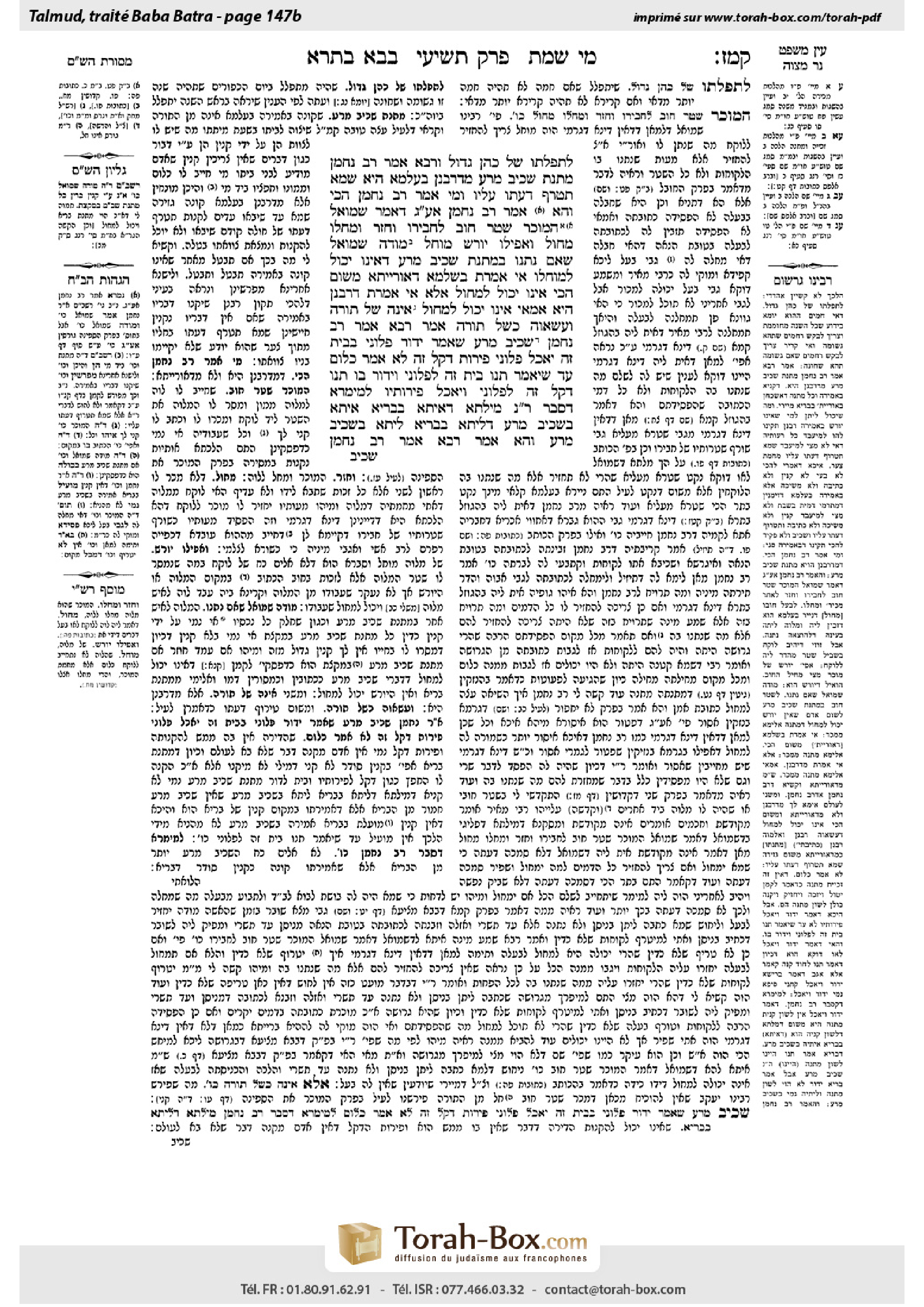
Bava Batra 147b: Talmud study for Daf Yomi
Study the Talmud for Daf Yomi with scanned pages, Hebrew text, English translations from Sefaria and AI-generated French translations.
Passage selection and English or AI-generated French translation are available where the scan has annotations. Daf Study is independent of Torah-Box and Sefaria.
Browse Bava Batra · בבא בתרא · All tractatesBava Batra 147b text and translations
This page of Bava Batra includes the Aramaic text, an English translation and an AI-generated French translation, alongside the scan above.
בבא בתרא קמ״ז ב · Aramaic and Hebrew text
לִתְפִלָּתוֹ שֶׁל כֹּהֵן גָּדוֹל.
וְרָבָא אָמַר רַב נַחְמָן: מַתְּנַת שְׁכִיב מְרַע מִדְּרַבָּנַן בְּעָלְמָא הִיא, שֶׁמָּא תִּטָּרֵף דַּעְתּוֹ עָלָיו.
וּמִי אָמַר רַב נַחְמָן הָכִי?! וְהָא אָמַר רַב נַחְמָן, אַף עַל גַּב דְּאָמַר שְׁמוּאֵל: הַמּוֹכֵר שְׁטַר חוֹב לַחֲבֵירוֹ, וְחָזַר וּמְחָלוֹ – מָחוּל; וַאֲפִילּוּ יוֹרֵשׁ מוֹחֵל; מוֹדֶה שְׁמוּאֵל שֶׁאִם נְתָנוֹ בְּמַתְּנַת שְׁכִיב מְרַע, דְּאֵינוֹ יָכוֹל לְמוֹחְלוֹ.
אִי אָמְרַתְּ בִּשְׁלָמָא דְּאוֹרָיְיתָא, מִשּׁוּם הָכִי אֵינוֹ יָכוֹל לִמְחוֹל. אֶלָּא אִי אָמְרַתְּ דְּרַבָּנַן הִיא, אַמַּאי אֵינוֹ יָכוֹל לִמְחוֹל? אֵינָהּ שֶׁל תּוֹרָה, וַעֲשָׂאוּהָ כְּשֶׁל תּוֹרָה.
אָמַר רָבָא אָמַר רַב נַחְמָן: שְׁכִיב מְרַע שֶׁאָמַר ״יָדוּר פְּלוֹנִי בְּבַיִת זֶה״; ״יֹאכַל פְּלוֹנִי פֵּירוֹת דֶּקֶל זֶה״ – לֹא אָמַר כְּלוּם, עַד שֶׁיֹּאמַר: ״תְּנוּ בַּיִת זֶה לִפְלוֹנִי וְיָדוּר בּוֹ״; ״תְּנוּ דֶּקֶל זֶה לִפְלוֹנִי וְיֹאכַל פֵּירוֹתָיו״.
לְמֵימְרָא דְּסָבַר רַב נַחְמָן מִילְּתָא דְּאִיתָא בְּבָרִיא – אִיתָא בִּשְׁכִיב מְרַע, דְלֵיתָא בְּבָרִיא – לֵיתָא בִּשְׁכִיב מְרַע? וְהָא אָמַר רָבָא אָמַר רַב נַחְמָן:
Bava Batra 147b · English translation
The Gemara answers: The difference is with regard to the prayer of the High Priest, who would pray on Yom Kippur for beneficial weather, and this knowledge enabled him to formulate his prayers accordingly.
The Gemara resumes the discussion with regard to the gifts of a person on his deathbed: And Rava says that Rav Naḥman says: The halakha that the gift of a person on his deathbed does not require an act of acquisition is merely by rabbinic law, and it is instituted lest he see that his will is not being carried out and he lose control of his mind due to his grief, exacerbating his physical state.
The Gemara asks: And did Rav Naḥman actually say this? But doesn’t Rav Naḥman say: Even though Shmuel says that with regard to one who sells a promissory note to another and then forgives the debt, the debt is forgiven and the note is nullified, and even the heir of the creditor can forgive the debt, Shmuel concedes that if the creditor gave the promissory note as the gift of a person on his deathbed, his heir cannot forgive the debt?
Granted, if you say that the gift of a person on his deathbed is valid by Torah law without an act of acquisition, due to that reason the heir cannot forgive the debt, as the debt was acquired by another. But if you say that it is valid by rabbinic law, why is the heir unable to forgive the debt? The Gemara replies: Rav Naḥman maintains that although this gift is not effective by Torah law, nevertheless, the Sages made it a halakha with the force of Torah law.
Rava says that Rav Naḥman says: With regard to a person on his deathbed who says: So-and-so shall reside in this house, or who says: So-and-so shall eat the fruit of this palm tree, he has not said anything, as one cannot give that which is not tangible, such as the right to use property, or the right to consume fruit that has not yet grown. His statement is ineffective until he says: Give this house to so-and-so and he shall reside there, or: Give this palm tree to so-and-so and he shall eat its fruit.
The Gemara asks: Is this to say that Rav Naḥman maintains that only a matter that can be conferred as a gift by a healthy person with an act of acquisition can be conferred as a gift by a person on his deathbed by means of verbal instruction, but a matter that cannot be conferred as a gift by a healthy person cannot be conferred as a gift by a person on his deathbed? Consequently, a person on his deathbed cannot transfer ownership of an intangible right, just as a healthy person cannot do so. But doesn’t Rava say that Rav Naḥman says:
Bava Batra 147b · Traduction française (IA)
La Guemara répond : La différence réside dans la prière du grand prêtre, qui priait le jour du Jour du Pardon afin d'obtenir un temps favorable, et cette connaissance lui permettait de formuler ses prières en conséquence.
La Guemara reprend la discussion concernant les dons d'une personne sur son lit de mort : Et Rava dit que Rav Naḥman dit : La halakha selon laquelle un don d'une personne sur son lit de mort n'exige pas un acte d'acquisition est uniquement rabbinique, et elle a été instituée afin qu'il ne voie pas que son testament n'est pas exécuté et qu'il perde le contrôle de son esprit à cause de sa douleur, aggravant ainsi son état physique.
La Guemara pose la question : Et Rava Naḥman a-t-il vraiment dit cela ? Mais ne dit-il pas Rav Naḥman : Même si Shmuel dit que concernant celui qui vend une note de remboursement à un autre et puis rembourse la dette, la dette est remboursée et la note est annulée, et même l'héritier du créancier peut rembourser la dette, Shmuel reconnaît que si le créancier donnait la note de remboursement comme don d'une personne sur son lit de mort, son héritier ne peut pas rembourser la dette ?
D'accord, si vous dites que le don d'une personne sur son lit de mort est valide selon la Loi juive sans acte d'acquisition, pour cette raison l'héritier ne peut pas rembourser la dette, car la dette a été acquise par un autre. Mais si vous dites qu'il est valide selon la loi rabbinique, pourquoi l'héritier ne peut-il pas rembourser la dette ? La Guemara répond : Rav Naḥman maintient que bien que ce don ne soit pas efficace selon la Loi juive, les Sages l'ont rendu une halakha avec la force de la Loi juive.
Rava dit que Rav Naḥman dit : Concernant une personne sur son lit de mort qui dit : Tel(le) habitera dans cette maison, ou qui dit : Tel(le) mangera les fruits de ce palmier, il n'a pas dit quelque chose, car on ne peut pas donner ce qui n'est pas tangible, comme le droit d'utiliser une propriété ou le droit de consommer des fruits qui n'ont pas encore mûri. Son déclaration est inefficace jusqu'à ce qu'il dise : Donne cette maison à tel(le) et il habitera là, ou : Donne ce palmier à tel(le) et il mangera ses fruits.
La Guemara pose la question : Est-ce dire que Rav Naḥman maintient que seul un objet qui peut être transmis comme don par une personne en bonne santé avec un acte d'acquisition peut être transmis comme don par une personne sur son lit de mort par simple déclaration, mais un objet qui ne peut pas être transmis comme don par une personne en bonne santé ne peut pas non plus être transmis comme don par une personne sur son lit de mort ? Ainsi, une personne sur son lit de mort ne peut pas transférer la propriété d'un droit intangible, tout comme une personne en bonne santé ne peut le faire. Mais ne dit-il pas Rava que Rav Naḥman dit :
Traduction française générée par IA à partir de l’édition anglaise de Sefaria. Vérifie toujours un passage avec le texte source.
Text from Sefaria: William Davidson Edition - Vocalized Aramaic (CC BY NC); William Davidson Edition - English (CC BY NC).