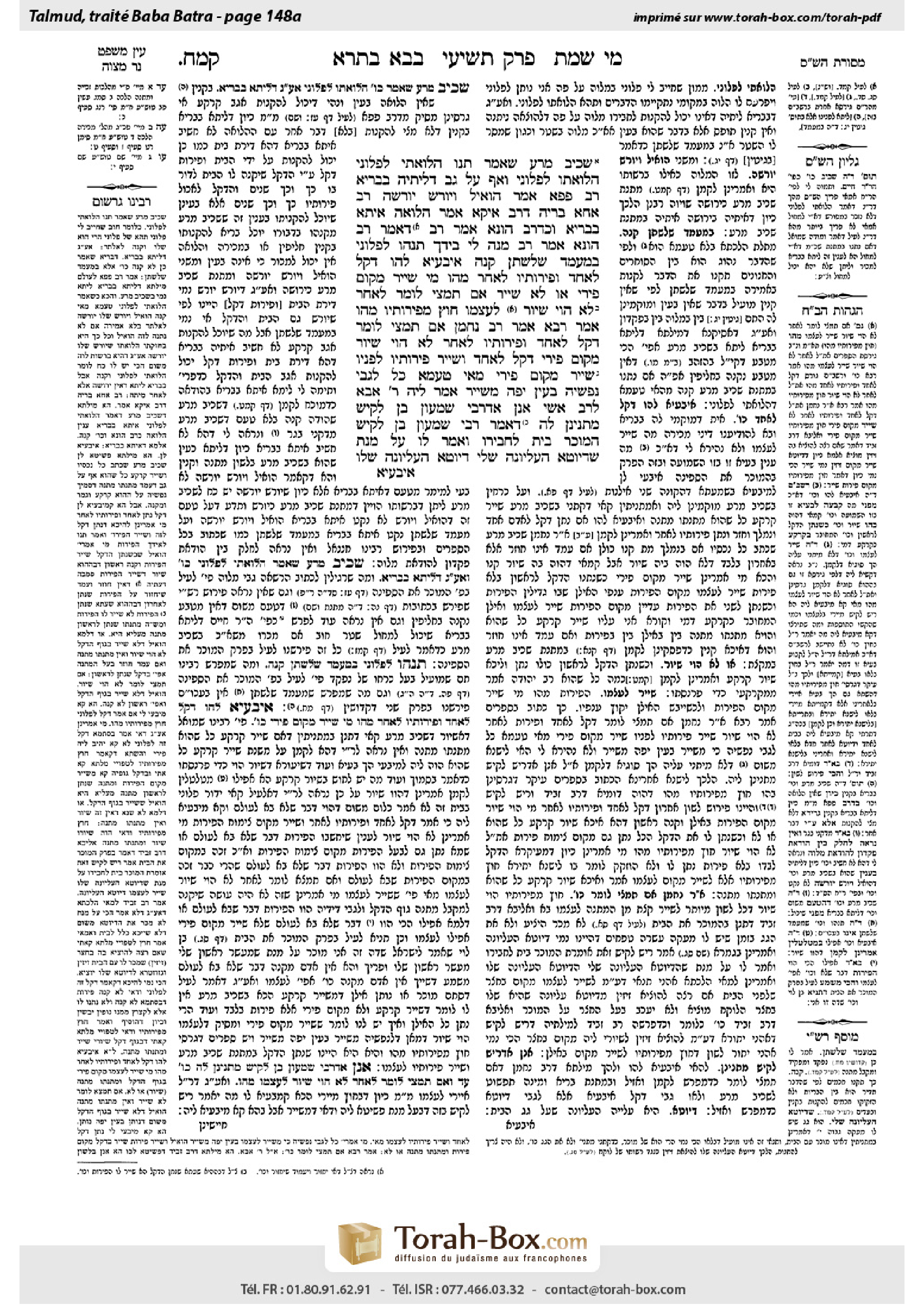
Bava Batra 148a: Talmud study for Daf Yomi
Study the Talmud for Daf Yomi with scanned pages, Hebrew text, English translations from Sefaria and AI-generated French translations.
Passage selection and English or AI-generated French translation are available where the scan has annotations. Daf Study is independent of Torah-Box and Sefaria.
Browse Bava Batra · בבא בתרא · All tractatesBava Batra 148a text and translations
This page of Bava Batra includes the Aramaic text, an English translation and an AI-generated French translation, alongside the scan above.
בבא בתרא קמ״ח א · Aramaic and Hebrew text
שְׁכִיב מְרַע שֶׁאָמַר ״תְּנוּ הַלְוָאָתִי לִפְלוֹנִי״ – הַלְוָאָתוֹ לִפְלוֹנִי, וְאַף עַל גַּב דְּלֵיתֵיהּ בְּבָרִיא! רַב פָּפָּא אָמַר: הוֹאִיל וְיוֹרֵשׁ יוֹרְשָׁהּ.
רַב אַחָא בְּרֵיהּ דְּרַב אִיקָא אָמַר: הַלְוָאָה אִיתָא בְּבָרִיא, וְכִדְרַב הוּנָא אָמַר רַב – דְּאָמַר רַב הוּנָא אָמַר רַב: ״מָנֶה לִי בְּיָדְךָ, תְּנֵהוּ לִפְלוֹנִי״; בְּמַעֲמַד שְׁלָשְׁתָּן – קָנָה.
אִיבַּעְיָא לְהוּ: דֶּקֶל לְאֶחָד וּפֵירוֹתָיו לְאַחֵר, מַהוּ? מִי שַׁיַּיר מְקוֹם פֵּירֵי, אוֹ לָא שַׁיַּיר? אִם תִּמְצֵי לוֹמַר: לְאַחֵר לָא הָוֵי שִׁיּוּר; לְעַצְמוֹ – ״חוּץ מִפֵּירוֹתָיו״, מַהוּ?
אָמַר רָבָא אָמַר רַב נַחְמָן, אִם תִּמְצֵי לוֹמַר: דֶּקֶל לְאֶחָד וּפֵירוֹתָיו לְאַחֵר לָא הָוֵי שִׁיּוּר מְקוֹם פֵּירֵי; דֶּקֶל לְאֶחָד וְשִׁיֵּיר פֵּירוֹתָיו לְפָנָיו – שַׁיַּיר מְקוֹם פֵּירֵי. מַאי טַעְמָא? כֹּל לְגַבֵּי נַפְשֵׁיהּ – בְּעַיִן יָפָה מְשַׁיֵּיר.
אֲמַר לֵיהּ רַבִּי אַבָּא לְרַב אָשֵׁי: אֲנַן אַדְּרַבִּי שִׁמְעוֹן בֶּן לָקִישׁ מַתְנֵינַן לַהּ. דְּאָמַר רַבִּי שִׁמְעוֹן בֶּן לָקִישׁ: הַמּוֹכֵר בַּיִת לַחֲבֵירוֹ, וְאָמַר לוֹ: ״עַל מְנָת שֶׁדְּיוֹטָא הָעֶלְיוֹנָה שֶׁלִּי״ – דְּיוֹטָא הָעֶלְיוֹנָה שֶׁלּוֹ.
Bava Batra 148a · English translation
With regard to a person on his deathbed who says: Give the loan owed to me to so-and-so as a gift, the loan owned to him is acquired by so-and-so. And this is the halakha despite the fact that this does not apply in the case of a healthy person, as one cannot transfer a loan to a third party without a promissory note. Rav Pappa says: In this case the halakha of transferring loans differs with regard to a person on his deathbed, since an heir inherits loans without a promissory note, and the Sages accorded the gift of a person on his deathbed the halakhic status of an inheritance.
Rav Aḥa, son of Rav Ika, said: A loan without a promissory note can be conferred as a gift by a healthy person. And this is in accordance with that which Rav Huna says that Rav says, as Rav Huna says that Rav says: With regard to one who said to another: I have one hundred dinars in your possession, give it to so-and-so, if this was stated in the presence of all three of the parties, the third party acquires the money without an act of acquisition and without the need for witnesses.
§ A dilemma was raised before the Sages: With regard to one who gave a palm tree to one person and its fruit to another, what is the halakha? Did he reserve the place of the fruit on the tree for the second person in order to give him a tangible object, and therefore the second person acquires the fruit, or did he not reserve it, and the second person does not acquire the fruit? Furthermore, if you say that giving the palm tree to one person and giving the fruit to another is not considered reserving the place of the fruit unless this is explicitly stipulated, then if he reserves the fruit for himself, stating that the tree is given to another except for its fruit, what is the halakha?
Rava said that Rav Naḥman said: Even if you say that giving the palm tree to one person and its fruit to another is not considered reserving the place of the fruit for the second person, if he gave the palm tree to one person and reserved the fruit for himself, he also reserved the place of the fruit for himself. What is the reason for this distinction? The reason is that anything that one reserves with regard to himself, he reserves generously, and therefore he reserves for himself not only the fruit itself, but also the place of the fruit.
Rabbi Abba said to Rav Ashi: We learned the aforementioned statement of Rav Naḥman with regard to the statement of Rabbi Shimon ben Lakish concerning a different matter, as Rabbi Shimon ben Lakish says: In the case of one who sells a house to another and says to him: I am selling the house on the condition that the upper story [deyota] remains mine, the upper story remains his.
Bava Batra 148a · Traduction française (IA)
Concerning a person on his deathbed who says: Give the loan owed to me to so-and-so as a gift, the loan owed to him is acquired by so-and-so. And this is the halakha, even though this does not apply in the case of a healthy person, as one cannot transfer a loan to a third party without a promissory note. Rav Pappa says: In this case, the halakha of transferring loans differs with regard to a person on his deathbed, since an heir inherits loans without a promissory note, and the Sages accorded the gift of a person on his deathbed the halakhic status of an inheritance.
Rav Aḥa, son of Rav Ika, said: A loan without a promissory note can be conferred as a gift by a healthy person. And this is in accordance with that which Rav Huna says that Rav says, as Rav Huna says that Rav says: With regard to one who said to another: I have one hundred dinars in your possession, give it to so-and-so, if this was stated in the presence of all three of the parties, the third party acquires the money without an act of acquisition and without the need for witnesses.
§ A dilemma was raised before the Sages: With regard to one who gave a palm tree to one person and its fruit to another, what is the halakha? Did he reserve the place of the fruit on the tree for the second person in order to give him a tangible object, and therefore the second person acquires the fruit, or did he not reserve it, and the second person does not acquire the fruit? Furthermore, if you say that giving the palm tree to one person and giving the fruit to another is not considered reserving the place of the fruit for the second person unless this is explicitly stipulated, then if he reserves the fruit for himself, stating that the tree is given to another except for its fruit, what is the halakha?
Rava dit que Rav Naḥman a dit : Même si l'on dit que donner le palmier à une personne et ses fruits à une autre n'est pas considéré comme réserver la place des fruits pour la deuxième personne, si l'on donne le palmier à une personne et qu'on réserve les fruits pour soi-même, on réserve aussi la place des fruits pour soi-même. Pourquoi cette distinction ? La raison est que tout ce que l'on réserve en ce qui concerne soi-même, on le réserve généreusement, et donc on réserve pour soi-même non seulement les fruits eux-mêmes, mais aussi la place des fruits.
Rabbi Abba dit à Rav Ashi : Nous avons appris la déclaration précédente de Rav Naḥman en rapport avec la déclaration de Rabbi Shimon ben Lakish concernant une autre question, car Rabbi Shimon ben Lakish dit : Dans le cas d'une personne qui vend une maison à une autre et lui dit : Je vends la maison sous la condition que l'étage supérieur [deyota] reste à moi, l'étage supérieur reste à lui.
Traduction française générée par IA à partir de l’édition anglaise de Sefaria. Vérifie toujours un passage avec le texte source.
Text from Sefaria: William Davidson Edition - Vocalized Aramaic (CC BY NC); William Davidson Edition - English (CC BY NC).