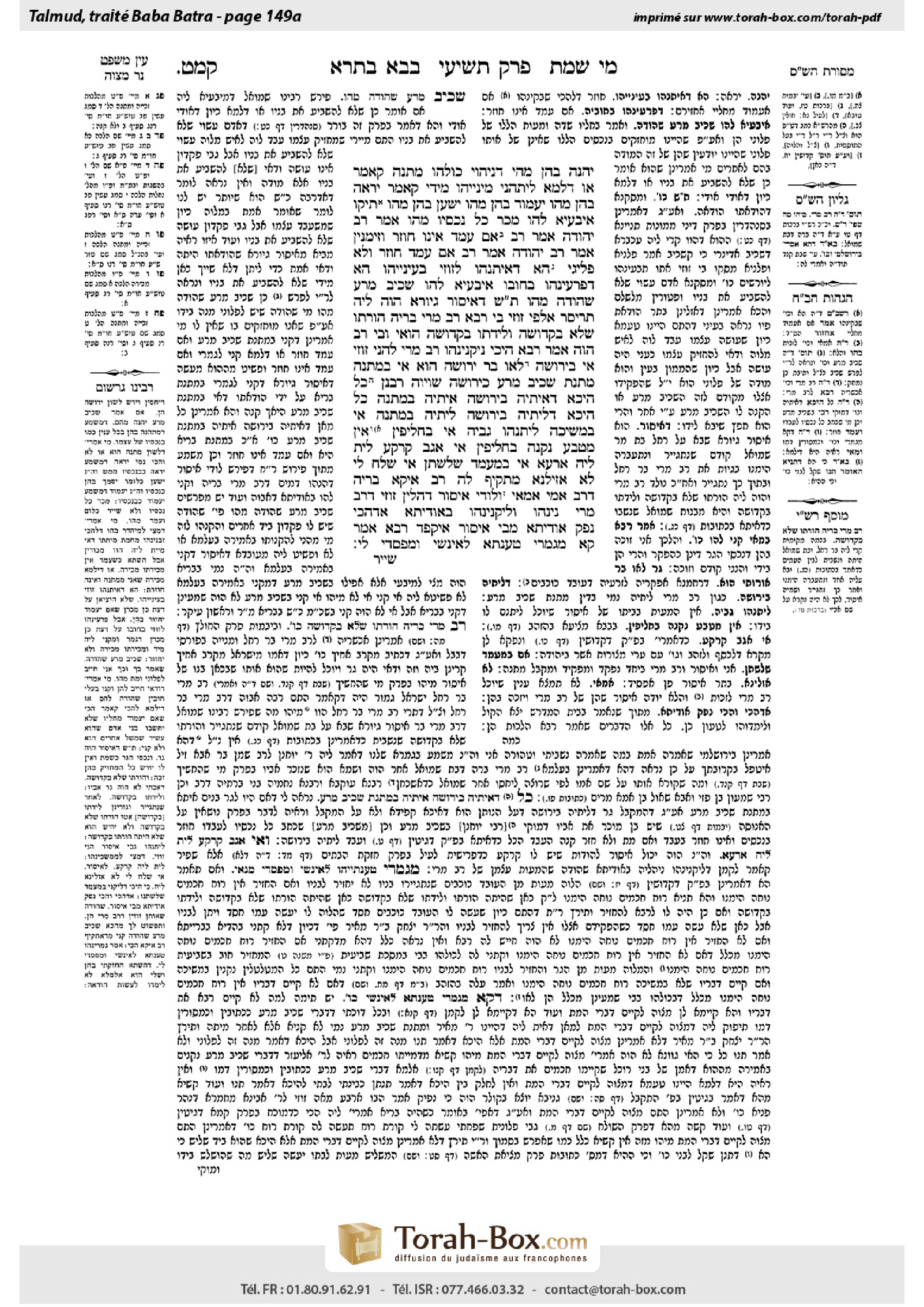
Bava Batra 149a: Talmud study for Daf Yomi
Study the Talmud for Daf Yomi with scanned pages, Hebrew text, English translations from Sefaria and AI-generated French translations.
Passage selection and English or AI-generated French translation are available where the scan has annotations. Daf Study is independent of Torah-Box and Sefaria.
Browse Bava Batra · בבא בתרא · All tractatesBava Batra 149a text and translations
This page of Bava Batra includes the Aramaic text, an English translation and an AI-generated French translation, alongside the scan above.
בבא בתרא קמ״ט א · Aramaic and Hebrew text
״יֵהָנֶה בָּהֶן״, מַהִי? דְּנֶיהְוֵי כּוּלְּהוּ מַתָּנָה קָאָמַר, אוֹ דִלְמָא לִיתְהֲנֵי מִינַּיְיהוּ מִידֵּי קָאָמַר? ״יֵרָאֶה בָּהֶן״, מַהוּ? ״יַעֲמוֹד בָּהֶן״, מַהוּ? ״יִשָּׁעֵן בָּהֶן״, מַהוּ? תֵּיקוּ.
אִיבַּעְיָא לְהוּ: מָכַר כׇּל נְכָסָיו, מַהוּ? אָמַר רַב יְהוּדָה אָמַר רַב: אִם עָמַד אֵינוֹ חוֹזֵר. וְזִימְנִין אָמַר רַב יְהוּדָה אָמַר רַב: אִם עָמַד חוֹזֵר. וְלָא פְּלִיגִי: הָא דְּאִיתַנְהוּ לְזוּזִי בְּעֵינַיְיהוּ, הָא דְּפַרְעִינְהוּ בְּחוֹבוֹ.
אִיבַּעְיָא לְהוּ: שְׁכִיב מְרַע שֶׁהוֹדָה, מַהוּ? תָּא שְׁמַע, דְּאִיסּוּר גִּיּוֹרָא הֲוָה לֵיהּ תְּרֵיסַר אַלְפֵי זוּזֵי בֵּי רָבָא. רַב מָרִי בְּרֵיהּ – הוֹרָתוֹ שֶׁלֹּא בִּקְדוּשָּׁה, וְלֵידָתוֹ בִּקְדוּשָּׁה הֲוַאי; וּבֵי רַב הֲוָה.
אָמַר רָבָא: הֵיכִי נִיקְנִינְהוּ רַב מָרִי לְהָנֵי זוּזֵי? אִי בִּירוּשָׁה – לָאו בַּר יְרוּשָּׁה הוּא. אִי בְּמַתָּנָה – מַתְּנַת שְׁכִיב מְרַע כִּירוּשָּׁה שַׁוְּיוּהָ רַבָּנַן; כׇּל הֵיכָא דְּאִיתֵיהּ בִּירוּשָׁה – אִיתֵיהּ בְּמַתָּנָה, כֹּל הֵיכָא דְּלֵיתֵיהּ בִּירוּשָׁה – לֵיתֵיהּ בְּמַתָּנָה.
אִי בִּמְשִׁיכָה – לֵיתַנְהוּ גַּבֵּיהּ. אִי בַּחֲלִיפִין – אֵין מַטְבֵּעַ נִקְנֶה בַּחֲלִיפִין. אִי אַגַּב קַרְקַע – לֵית לֵיהּ אַרְעָא. אִי בְּמַעֲמַד שְׁלָשְׁתָּן – אִי שָׁלַח לִי לָא אָזֵילְנָא.
מַתְקֵיף לַהּ רַב אִיקָא בְּרֵיהּ דְּרַב אַמֵּי: אַמַּאי? וְלוֹדֵי אִיסּוּר דְּהָלֵין זוּזֵי דְּרַב מָרִי נִינְהוּ, וְלִיקְנִינְהוּ בְּאוֹדִיתָא! אַדְּהָכִי, נְפַק אוֹדִיתָא מִבֵּי אִיסּוּר. אִיקְּפַד רָבָא, אָמַר: קָא מַגְמְרִי טַעֲנָתָא לְאִינָשֵׁי, וּמַפְסְדִי לִי.
Bava Batra 149a · English translation
If a person on his deathbed says: So-and-so shall benefit from my property, what is the halakha? Is he saying that all of the property shall be a gift? Or perhaps he is saying that the recipient shall derive some benefit from the property. If he says: So-and-so shall be seen in my property, what is the halakha? If he says: So-and-so shall stand in my property, what is the halakha? If he says: So-and-so shall rely on my property, what is the halakha? The Gemara concludes: All these dilemmas shall stand unresolved.
A dilemma was raised before the Sages: If a person on his deathbed sold all of his property, what is the halakha? Rav Yehuda says that Rav says: If he recovers, he cannot retract the sale. And at times, Rav Yehuda said that Rav said: If he recovers, he can retract the sale. And these statements do not disagree. This statement, that he can retract the sale, applies in a case where the dinars he received as payment are still extant, i.e., in his possession. That statement, that he cannot retract the sale, applies in a case where he paid his debt with those dinars.
§ A dilemma was raised before the Sages: In the case of a person on his deathbed who admitted that he owed money to a certain person, where it was possible that he did not actually owe him money, what is the halakha? Does his admission qualify as the gift of a person on his deathbed? The Gemara answers: Come and hear a proof, as Issur the convert had twelve thousand dinars deposited in the house of Rava. Rav Mari, Issur’s son, whose conception was not in the sanctity of the Jewish people, i.e., he was conceived before his father converted, but his birth was in the sanctity of the Jewish people, i.e., he was born after his father converted, was in a study hall elsewhere when his father was on his deathbed.
Rava reasoned that he would acquire possession of the deposit for himself, as he said: How can Rav Mari acquire these dinars? If he attempts to acquire the money as inheritance, he is not fit to inherit from Issur. Since he was conceived before his father converted, he is therefore not halakhically considered his son. If he attempts to acquire it as a gift, the Sages equated the halakhic status of the gift of a person on his deathbed with that of inheritance. Therefore, anywhere that the property can be acquired as inheritance, it can also be acquired as a gift, and anywhere that the property cannot be acquired as inheritance, it cannot be acquired as a gift.
If he attempts to acquire the dinars by pulling them, which is a formal act of acquisition, he will not be able to do this, as the dinars are not with him. If he attempts to acquire them by means of symbolic exchange, a pro forma act of acquisition effecting the transfer of ownership of an article, money cannot be acquired by means of symbolic exchange. If he attempts to acquire them by means of the acquisition of land, Issur does not have any land. If he attempts to acquire them by means of verbal instruction made by his father in the presence of all three parties, i.e., the giver, the recipient, and the bailee, if he sends for me, the bailee, I shall not go, as without the presence of the bailee he cannot transfer ownership of the money.
Rav Ika, son of Rav Ami, objected to this: Why is Rav Mari unable to acquire the money? But why not let Issur admit that these dinars are owned by Rav Mari, and he shall transfer ownership of them to Rav Mari by means of a document of admission? In the meantime, a document of admission stating that the dinars belonged to Rav Mari emerged from Issur’s house. Rava became angry, and said: They are teaching people legal claims and causing me loss. In any event, this incident proves that the admission of a person on his deathbed is a valid means of transferring ownership.
Bava Batra 149a · Traduction française (IA)
Si une personne, sur son lit de mort, dit : « Tel(le) bénéficiera de mes biens », quelle est la halakha ? Est-ce qu'il dit que tous les biens seront un don ? Ou bien est-ce qu'il dit que le bénéficiaire tirera un certain avantage de ses biens ? Si il dit : « Tel(le) sera vu(e) dans mes biens », quelle est la halakha ? Si il dit : « Tel(le) sera debout dans mes biens », quelle est la halakha ? Si il dit : « Tel(le) se reposera sur mes biens », quelle est la halakha ? La Guemara conclut : toutes ces questions restent sans réponse.
Une question a été soulevée devant les Sages : si une personne, sur son lit de mort, vend tous ses biens, quelle est la halakha ? Rav Yehuda dit que Rav dit : s'il se rétablit, il ne peut pas révoquer la vente. Et parfois, Rav Yehuda a dit que Rav a dit : s'il se rétablit, il peut révoquer la vente. Et ces déclarations ne s'opposent pas. Cette déclaration, selon laquelle il peut révoquer la vente, s'applique dans un cas où les dinars qu'il a reçus en paiement sont encore présents, c'est-à-dire en son possession. Cette déclaration, selon laquelle il ne peut pas révoquer la vente, s'applique dans un cas où il a payé sa dette avec ces dinars.
§ Une question a été soulevée devant les Sages : dans le cas d'une personne sur son lit de mort qui a admis qu'il devait de l'argent à une certaine personne, et où il était possible qu'il ne lui devînt pas en réalité de l'argent, quelle est la halakha ? Son admission constitue-t-elle un don d'une personne sur son lit de mort ? La Guemara répond : viens écouter une preuve, car Issur, le converti, avait douze mille dinars déposés chez Rava. Rav Mari, son fils, dont la conception n'était pas dans la sanctité du peuple d'Israël, c'est-à-dire qu'il avait été conçu avant que son père ne se convertisse, mais dont la naissance était dans la sanctité du peuple d'Israël, c'est-à-dire qu'il était né après que son père se fût converti, était dans une salle de study ailleurs lorsque son père était sur son lit de mort.
Rava raisonnait qu'il pourrait acquérir la possession des dinars pour lui-même, car il disait : comment Rav Mari pourrait-il acquérir ces dinars ? S'il tente d'acquérir l'argent en tant qu'héritage, il n'est pas digne d'hériter d'Issur. Puisqu'il avait été conçu avant que son père ne se convertisse, il n'est donc pas considéré halakhiquement comme son fils. S'il tente d'acquérir l'argent en tant que don, les Sages ont établi que le statut halakhique du don d'une personne sur son lit de mort est équivalent à celui de l'héritage. Ainsi, partout où la propriété peut être acquise en tant qu'héritage, elle peut aussi être acquise en tant que don, et partout où la propriété ne peut pas être acquise en tant qu'héritage, elle ne peut pas non plus être acquise en tant que don.
Si il tente d'acquérir les dinars par le fait d'attraction, qui est un acte formel d'acquisition, il ne pourra pas le faire, car les dinars ne sont pas avec lui. Si il tente d'acquérir les dinars par l'échange symbolique, un acte formel d'acquisition effectuant la transmission de propriété d'un objet, l'argent ne peut pas être acquis par l'échange symbolique. Si il tente d'acquérir les dinars par l'acquisition de terre, Issur n'a pas de terre. Si il tente d'acquérir les dinars par l'instruction verbale faite par son père en présence des trois parties, c'est-à-dire du donneur, du bénéficiaire et du gardien, s'il m'envoie, le gardien, je ne vais pas, car sans la présence du gardien, il ne peut pas transférer la propriété de l'argent.
Rav Ika, fils de Rav Ami, s'est opposé à cela : pourquoi Rav Mari ne peut-il pas acquérir l'argent ? Mais pourquoi ne pas laisser Issur admettre que ces dinars appartiennent à Rav Mari, et qu'il transfère la propriété à Rav Mari par un document d'admission ? Pendant ce temps, un document d'admission indiquant que les dinars appartenaient à Rav Mari est sorti de la maison d'Issur. Rava est devenu en colère et a dit : ils enseignent des revendications juridiques aux gens et me causent des pertes. En tout cas, cet incident prouve que l'admission d'une personne sur son lit de mort est un moyen valide de transférer la propriété.
Traduction française générée par IA à partir de l’édition anglaise de Sefaria. Vérifie toujours un passage avec le texte source.
Text from Sefaria: William Davidson Edition - Vocalized Aramaic (CC BY NC); William Davidson Edition - English (CC BY NC).