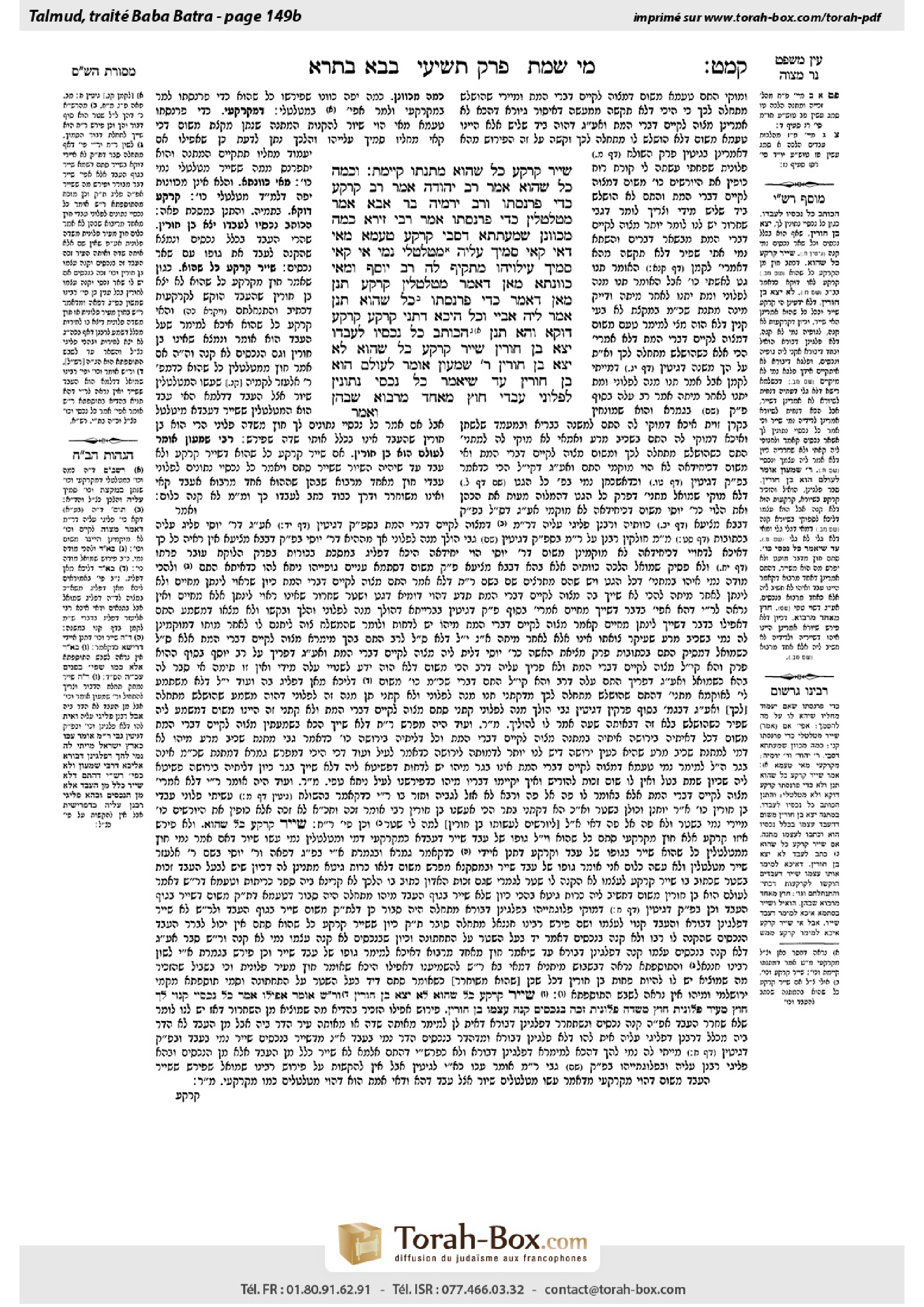
Bava Batra 149b: Talmud study for Daf Yomi
Study the Talmud for Daf Yomi with scanned pages, Hebrew text, English translations from Sefaria and AI-generated French translations.
Passage selection and English or AI-generated French translation are available where the scan has annotations. Daf Study is independent of Torah-Box and Sefaria.
Browse Bava Batra · בבא בתרא · All tractatesBava Batra 149b text and translations
This page of Bava Batra includes the Aramaic text, an English translation and an AI-generated French translation, alongside the scan above.
בבא בתרא קמ״ט ב · Aramaic and Hebrew text
שִׁיֵּיר קַרְקַע כׇּל שֶׁהוּא – מַתְּנָתוֹ קַיֶּימֶת. וְכַמָּה ״כׇּל שֶׁהוּא״? אָמַר רַב יְהוּדָה אָמַר רַב: קַרְקַע כְּדֵי פַרְנָסָתוֹ. וְרַב יִרְמְיָה בַּר אַבָּא אָמַר: מְטַלְטְלִין כְּדֵי פַרְנָסָתוֹ.
אָמַר רַבִּי זֵירָא: כַּמָּה מְכַוְּונָן שְׁמַעְתָּתָא דְסָבֵי; קַרְקַע טַעְמָא מַאי – דְּאִי קָאֵי סָמֵיךְ עֲלֵיהּ; מִטַּלְטְלִי נָמֵי – אִי קָאֵי סָמֵיךְ עִילָּוַיְהוּ.
מַתְקֵיף לַהּ רַב יוֹסֵף: וּמַאי כַּוּוֹנְתָּא? מַאן דְּאָמַר מְטַלְטְלִין – ״קַרְקַע״ תְּנַן! מַאן דְּאָמַר: כְּדֵי פַרְנָסָתוֹ – ״כׇּל שֶׁהוּא״ תְּנַן!
אֲמַר לֵיהּ אַבָּיֵי: וְכׇל הֵיכָא דְּתָנֵי ״קַרְקַע״ – קַרְקַע דַּוְקָא? וְהָא תְּנַן: הַכּוֹתֵב כׇּל נְכָסָיו לְעַבְדּוֹ – יָצָא בֶּן חוֹרִין. שִׁיֵּיר קַרְקַע כָּל שֶׁהוּא, לֹא יָצָא בֶּן חוֹרִין. רַבִּי שִׁמְעוֹן אוֹמֵר: לְעוֹלָם הוּא בֶּן חוֹרִין, עַד שֶׁיֹּאמַר: ״כׇּל נְכָסַי נְתוּנִין לִפְלוֹנִי עַבְדִּי, חוּץ מֵאֶחָד מֵרִבּוֹא שֶׁבָּהֶן״.
Bava Batra 149b · English translation
§ The mishna teaches (146b): If a person on his deathbed reserved for himself any amount of land, his gift stands even if he subsequently recovers. The Gemara asks: And how much is meant by the term: Any amount? Rav Yehuda says that Rav says: This means land that is sufficient to provide for his livelihood. Since he reserved this land for himself, one can assume that he wished to transfer the rest of his property in any event. And Rav Yirmeya bar Abba says: Even if he reserved for himself movable property that is sufficient to provide for his livelihood, his gift is valid.
Rabbi Zeira said: How meticulous are the halakhic statements of the elders Rav Yehuda and Rav Yirmeya. With regard to land, what is the reason that he must have reserved enough for his livelihood? The reason is that if he recovers he will rely on that land for his livelihood. With regard to movable property as well, if he recovers he will rely on it for his livelihood.
Rav Yosef objects to Rabbi Zeira’s statement: What is meticulous about these statements? The statement of the one who says the gift is valid even if he reserved for himself movable property is difficult, as we learn in the mishna that he must leave himself land. The statement of the one who says that he must leave himself an amount sufficient to provide for his livelihood is difficult, as we learn in the mishna that his gift is valid if he reserved for himself any amount.
Abaye said to Rav Yosef: And anywhere that the term land is taught, does it mean specifically land? But didn’t we learn in a mishna (Pe’a 3:8): With regard to one who writes, i.e., gives via a document, all of his property to his Canaanite slave, the slave has been emancipated, but if he reserved for himself any amount of land, then he has not been emancipated, as perhaps he reserved the slave for himself as well. Rabbi Shimon says: He always becomes a freeman regardless of the wording of the document, even if the owner reserved land for himself, unless it says in the document: All of my property is given to so-and-so my slave, except for one ten-thousandth of it, as in that case it is possible that the master meant to include the slave in the portion that he is not giving away. Consequently, the slave is not emancipated.
Bava Batra 149b · Traduction française (IA)
§ La Michna enseigne (146b) : Si une personne, sur son lit de mort, réserve pour lui-même une quantité quelconque de terre, son don subsiste même s'il recouvre ensuite sa santé. La Guemara pose la question : De quelle quantité s'agit-il exactement par la mention : une quantité quelconque ? Rav Yehuda dit que Rav dit : cela signifie une terre suffisante pour subvenir à ses besoins. Puisqu'il a réservé cette terre pour lui-même, on peut supposer qu'il voulait transférer le reste de ses biens de toute façon. Et Rav Yirmeya bar Abba dit : même s'il a réservé pour lui-même des biens mobiliers suffisants pour subvenir à ses besoins, son don est valide.
Rabbi Zeira dit : Quel soin les déclarations halakhiques des anciens, Rav Yehuda et Rav Yirmeya, prennent. En ce qui concerne la terre, pourquoi doit-il avoir réservé suffisamment pour subvenir à ses besoins ? La raison est que s'il recouvre sa santé, il comptera sur cette terre pour subvenir à ses besoins. En ce qui concerne les biens mobiliers également, s'il recouvre sa santé, il comptera sur eux pour subvenir à ses besoins.
Rav Yosef s'oppose à la déclaration de Rabbi Zeira : De quel soin s'agit-il dans ces déclarations ? La déclaration de celui qui dit que le don est valide même s'il a réservé pour lui-même des biens mobiliers est difficile, car nous apprenons dans la Michna qu'il doit laisser pour lui-même une terre. La déclaration de celui qui dit qu'il doit laisser pour lui-même une quantité suffisante pour subvenir à ses besoins est difficile, car nous apprenons dans la Michna que son don est valide s'il a réservé pour lui-même une quantité quelconque.
Abaye dit à Rav Yosef : Et partout où le terme terre est enseigné, cela signifie-t-il spécifiquement la terre ? Mais n'avons-nous pas appris dans une Michna (Pe’a 3:8) : En ce qui concerne celui qui écrit, c'est-à-dire qui donne par un document, tous ses biens à son esclave cananéen, l'esclave est emancipé, mais s'il réserve pour lui-même une quantité quelconque de terre, alors il n'est pas emancipé, car peut-être a-t-il réservé l'esclave pour lui-même également. Rabbi Shimon dit : Il devient toujours libre, indépendamment du contenu du document, même s'il a réservé de la terre pour lui-même, à moins que le document ne dise : Tous mes biens sont donnés à tel ou tel mon esclave, sauf un dixième de celui-ci, comme dans ce cas il est possible que le maître ait voulu inclure l'esclave dans la part qu'il ne donne pas. Ainsi, l'esclave n'est pas emancipé.
Traduction française générée par IA à partir de l’édition anglaise de Sefaria. Vérifie toujours un passage avec le texte source.
Text from Sefaria: William Davidson Edition - Vocalized Aramaic (CC BY NC); William Davidson Edition - English (CC BY NC).