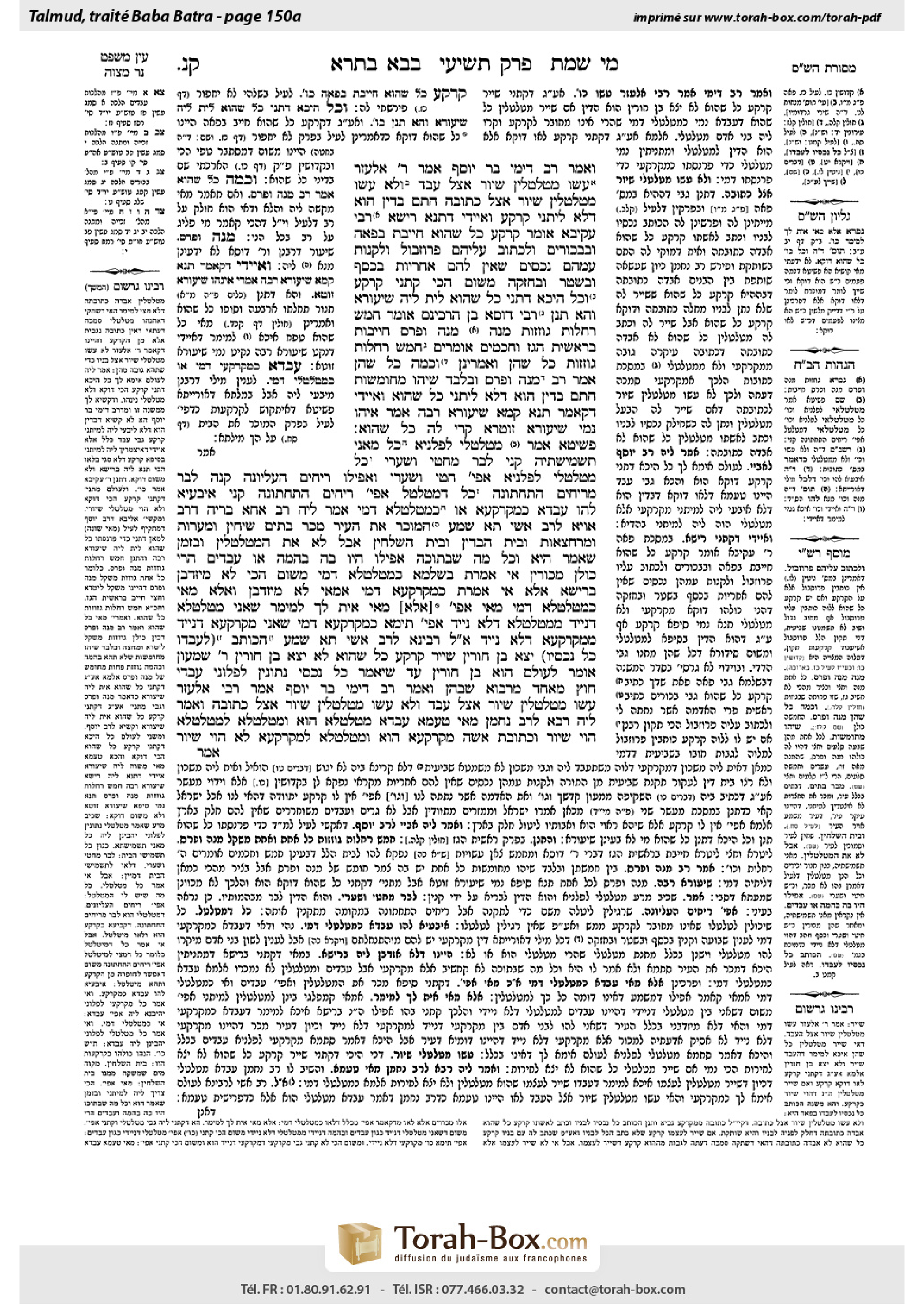
Bava Batra 150a: Talmud study for Daf Yomi
Study the Talmud for Daf Yomi with scanned pages, Hebrew text, English translations from Sefaria and AI-generated French translations.
Passage selection and English or AI-generated French translation are available where the scan has annotations. Daf Study is independent of Torah-Box and Sefaria.
Browse Bava Batra · בבא בתרא · All tractatesBava Batra 150a text and translations
This page of Bava Batra includes the Aramaic text, an English translation and an AI-generated French translation, alongside the scan above.
בבא בתרא ק״נ א · Aramaic and Hebrew text
וְאָמַר רַב דִּימִי בַּר יוֹסֵף אָמַר רַבִּי אֶלְעָזָר: עָשׂוּ מְטַלְטְלִין שִׁיּוּר אֵצֶל עֶבֶד, וְלֹא עָשׂוּ מְטַלְטְלִין שִׁיּוּר אֵצֶל כְּתוּבָּה!
הָתָם בְּדִין הוּא דְּלָא לִיתְנֵי קַרְקַע; וְאַיְּידִי דִּתְנָא רֵישָׁא, רַבִּי עֲקִיבָא אוֹמֵר: קַרְקַע כׇּל שֶׁהוּא חַיֶּיבֶת בַּפֵּאָה וּבַבִּכּוּרִים, וְלִכְתּוֹב עֲלֵיהֶם פְּרוֹזְבּוּל, וְלִקְנוֹת עִמָּהֶם נְכָסִים שֶׁאֵין לָהֶם אַחְרָיוּת בְּכֶסֶף וּבִשְׁטָר וּבַחֲזָקָה – מִשּׁוּם הָכִי קָתָנֵי קַרְקַע.
וְכׇל הֵיכָא דְּתָנֵי ״כׇּל שֶׁהוּא״ – לֵית לֵיהּ שִׁיעוּרָא? וְהָא תְנַן, רַבִּי דּוֹסָא בֶּן הַרְכִּינָס אוֹמֵר: חָמֵשׁ רְחֵלוֹת גּוֹזְזוֹת מָנֶה מָנֶה וּפְרָס – חַיָּיבוֹת בְּרֵאשִׁית הַגֵּז. וַחֲכָמִים אוֹמְרִים: חָמֵשׁ רְחֵלוֹת גּוֹזְזוֹת כׇּל שֶׁהֵן. וְאָמְרִינַן: וְכַמָּה ״כׇּל שֶׁהֵן״? אָמַר רַב: מָנֶה וּפְרָס, וּבִלְבַד שֶׁיְּהוּ מְחוּמָּשׁוֹת!
הָתָם, בְּדִין הוּא דְּלָא לִיתְנֵי ״כׇּל שֶׁהוּא״; וְאַיְּידֵי דְּקָאָמַר תַּנָּא קַמָּא שִׁיעוּרָא רַבָּה, אָמַר אִיהוּ נָמֵי שִׁיעוּרָא זוּטְרָא – קָרֵי לַהּ ״כׇּל שֶׁהוּא״.
פְּשִׁיטָא – אָמַר: ״מִטַּלְטְלַי לִפְלָנְיָא״ – כֹּל מָאנֵי תַּשְׁמִישְׁתֵּיהּ קָנֵי, לְבַר מֵחִטִּי וּשְׂעָרֵי. ״כֹּל מִטַּלְטְלַי לִפְלָנְיָא״ – אֲפִילּוּ חִטֵּי וּשְׂעָרֵי. וַאֲפִילּוּ רֵיחַיִם הָעֶלְיוֹנָה קָנָה, לְבַר מֵרֵיחַיִם הַתַּחְתּוֹנָה. ״כֹּל דְּמִטַּלְטַל״ – אֲפִילּוּ רֵיחַיִם הַתַּחְתּוֹנָה קָנֵי.
אִיבַּעְיָא לְהוּ: עַבְדָּא – כִּמְקַרְקְעָא אוֹ כְּמִטַּלְטְלָא דָּמֵי? אֲמַר לֵיהּ רַב אַחָא בְּרֵיהּ דְּרַב אַוְיָא לְרַב אָשֵׁי, תָּא שְׁמַע: הַמּוֹכֵר אֶת הָעִיר – מָכַר בָּתִּים, שִׁיחִין, וּמְעָרוֹת, וּמֶרְחֲצָאוֹת, וּבֵית הַבַּדִּין, וּבֵית הַשְּׁלָחִין; אֲבָל לֹא אֶת הַמִּטַּלְטְלִין. וּבִזְמַן שֶׁאָמַר: ״הִיא וְכֹל מַה שֶּׁבְּתוֹכָהּ״, אֲפִילּוּ הָיוּ בָּהּ בְּהֵמָה אוֹ עֲבָדִים – הֲרֵי כּוּלָּן מְכוּרִין. אִי אָמְרַתְּ בִּשְׁלָמָא כְּמִטַּלְטְלָא דָּמֵי, מִשּׁוּם הָכִי לָא מִיזְדַּבַּן בְּרֵישָׁא; אֶלָּא אִי אָמְרַתְּ כִּמְקַרְקְעָא דָּמֵי, אַמַּאי לָא מִיזְדַּבַּן?
וְאֶלָּא מַאי? כְּמִטַּלְטְלָא דָּמֵי?! מַאי ״אֲפִילּוּ״? [אֶלָּא] מַאי אִית לָךְ לְמֵימַר – שָׁאנֵי מִטַּלְטְלָא דְּנָיֵיד מִמִּטַּלְטְלָא דְּלָא נָיֵיד; אֲפִילּוּ תֵּימָא כִּמְקַרְקְעָא דָּמֵי, שָׁאנֵי מְקַרְקְעָא דְּנָיֵיד מִמְּקַרְקְעָא דְּלָא נָיֵיד.
אֲמַר לֵיהּ רָבִינָא לְרַב אָשֵׁי: תָּא שְׁמַע, הַכּוֹתֵב לְעַבְדּוֹ כׇּל נְכָסָיו – יָצָא בֶּן חוֹרִין. שִׁיֵּיר קַרְקַע כָּל שֶׁהוּא – לֹא יָצָא בֶּן חוֹרִין. רַבִּי שִׁמְעוֹן אוֹמֵר: לְעוֹלָם הוּא בֶּן חוֹרִין, עַד שֶׁיֹּאמַר: ״כׇּל נְכָסַי נְתוּנִין לִפְלוֹנִי עַבְדִּי, חוּץ מֵאֶחָד מֵרִבּוֹא שֶׁבָּהֶן״.
וְאָמַר רַב דִּימִי בַּר יוֹסֵף אָמַר רַבִּי אֶלְעָזָר: עָשׂוּ מִטַּלְטְלִין שִׁיּוּר אֵצֶל עֶבֶד, וְלֹא עָשׂוּ מִטַּלְטְלִין שִׁיּוּר אֵצֶל כְּתוּבָּה. וַאֲמַר לֵיהּ רָבָא לְרַב נַחְמָן: מַאי טַעְמָא? עַבְדָּא מִטַּלְטְלָא הוּא, וּמִטַּלְטְלָא לְמִטַּלְטְלָא הָוֵי שִׁיּוּר; וּכְתוּבַּת אִשָּׁה מְקַרְקְעָא הוּא, וּמִטַּלְטְלָא לִמְקַרְקְעָא לָא הָוֵי שִׁיּוּר.
Bava Batra 150a · English translation
And Rav Dimi bar Yosef says that Rabbi Elazar says: The Sages deemed movable property to be considered a significant reserving of property for oneself with regard to the emancipation of a slave, so that a slave is not emancipated when his owner gives him all of his other property. But they did not deem movable property that one withheld from his sons and earmarked for his wife to be considered a significant reserving of property with regard to her marriage contract. If one granted all of his property to his sons but reserved any amount of land for his wife, she forfeits her marriage contract. By not protesting the gift, she has conceded that she will collect her marriage contract only from the land he reserved for her. Nevertheless, if he reserved only movable property for his wife, she does not forfeit her marriage contract. Rabbi Elazar’s ruling with regard to a slave indicates that the expression: Reserves any amount of land, does not necessarily exclude movable property.
Rav Yosef replies: There, with regard to the slave, by right the mishna should not have taught the halakha with regard to land, but it should have taught the halakha with regard to all property. But since the former clause of the mishna teaches a halakha with regard to land, the mishna mentions land in the subsequent clause as well. The Gemara cites the former clause (Pe’a 3:6): Rabbi Akiva says: The owner of any amount of land is obligated in pe’a and in first fruits; and if the debtor possesses any amount of land the creditor can write a document that prevents the Sabbatical Year from abrogating an outstanding debt [prosbol] for it so that his loans will not be canceled in the seventh year; and he can acquire property that does not serve as a guarantee along with it by means of money, by a deed, or by taking possession of it. Rav Yosef concludes: Due to this reason, the mishna teaches the halakha with regard to land.
Abaye raises an objection to Rav Yosef’s statement that the term any amount should be understood literally: And anywhere that the term: Any amount, is taught, does the amount not have a measure? But didn’t we learn in a mishna (Ḥullin 135a): Rabbi Dosa ben Harkinas says: When shearing five sheep, the sheared wool of each sheep, with the wool weighing one hundred dinars and half of one hundred dinars, i.e., one hundred and fifty dinars, renders the owner obligated in the mitzva to give the first sheared wool to the priests. And the Rabbis say: Five sheep, each of whose sheared wool yields wool weighing any amount. And we say: And how much is signified by the term: Any amount? Rav says: A total weight of one hundred dinars and half of one hundred dinars, provided that the one hundred and fifty dinars are divided equally between the five sheep. This indicates that the term any amount can denote a certain minimal amount.
Rav Yosef replies: There, with regard to the first sheared wool, by right the mishna should not have taught the halakha with regard to any amount. But since the first tanna, Rabbi Dosa ben Harkinas, states a large measure, the Rabbis also state that they require a small measure, and therefore they call this measure any amount. But with regard to the gift of a person on his deathbed, the term any amount should be understood literally.
§ It is obvious that if one said: I give my movable property to so-and-so, then that person acquires all of his utensils, excluding his wheat and barley. If one said: I give all my movable property to so-and-so, then that person acquires even the wheat and barley, and he acquires even the upper millstone, since it is occasionally removed from its place. He acquires all the property that is not land or houses, except for the lower millstone, which is never moved. If he said: I give everything that can be moved to so-and-so, that person acquires even the lower millstone, as it is possible to move it.
A dilemma was raised before the Sages: Is the legal status of a Canaanite slave like that of land, or is his status like that of movable property? Rav Aḥa, son of Rav Avya, said to Rav Ashi: Come and hear a proof from a mishna (68a): A landowner who sells the city has sold with it the houses, and the ditches and caves, and the bathhouses, and the olive presses and the irrigated fields, but not the movable property. But when the seller said to the buyer: I am selling it and everything that is in it, then even if there were animals or Canaanite slaves in the city, they are all sold. Rav Aḥa, son of Rav Avya, explains the proof: Granted, if you say that the legal status of a Canaanite slave is like that of movable property, due to that reason he is not sold in the first case. But if you say that the legal status of a Canaanite slave is like that of land, why is he not sold with the city?
Rav Ashi replied: Rather, what do you say? Do you maintain that his legal status is like that of movable property? If there is no difference in legal status between Canaanite slaves and movable property, what is the reason that the mishna emphasizes in the second case that even the Canaanite slaves are sold? Rather, what have you to say to explain this? One must explain that movable property that moves by itself is different from movable property that does not move by itself, and therefore one might have thought that although the sale includes movable property, Canaanite slaves are not included in the sale. In the same manner, even if you say that the legal status of a Canaanite slave is like that of land, land that moves is different from land that does not move. Therefore, the legal status of Canaanite slaves cannot be proved from this mishna.
Ravina said to Rav Ashi: Come and hear a proof from a mishna (Pe’a 3:8): With regard to one who writes, i.e., gives via a document, all of his property to his Canaanite slave, the slave has been emancipated, but if he reserved for himself any amount of land, then he has not been emancipated, as perhaps he reserved the slave for himself as well. Rabbi Shimon says: He always becomes a freeman regardless of the wording of the document, even if the owner reserved land for himself, unless it says in the document: All of my property is given to so-and-so my slave, except for one ten-thousandth of it.
And Rav Dimi bar Yosef says that Rabbi Elazar says: The Sages deemed movable property to be considered a significant reserving of property for oneself with regard to a slave, so that the slave is not emancipated when the owner gives him all of his other property. But they did not deem movable property that one withheld from his sons and earmarked for his wife to be considered a significant reserving of property with regard to her marriage contract. And Rava said to Rav Naḥman: What is the reason for this? Rav Naḥman explained: A Canaanite slave is considered movable property, and reserving movable property is considered a significant reserving with regard to movable property. But a woman’s marriage contract is a document concerning land, since the payment of the marriage contract is collected from land, and reserving movable property is not considered a significant reserving with regard to land. Rav Naḥman states that a Canaanite slave is considered movable property.
Bava Batra 150a · Traduction française (IA)
Et Rav Dimi bar Yosef dit que Rabbi Eléazar dit : Les Sages considéraient les biens mobiliers comme un important réservement de propriété pour soi-même en ce qui concerne l’émancipation d’un esclave, de sorte qu’un esclave n’est pas émancipé lorsque son maître lui donne tous ses autres biens. Mais ils ne considéraient pas les biens mobiliers que l’on avait retenus de ses fils et réservés à sa femme comme un important réservement de propriété en ce qui concerne son contrat de mariage. Si l’on donnait tous ses biens à ses fils mais réservait une quantité quelconque de terre à sa femme, elle perd son contrat de mariage. En ne protestant pas contre le don, elle a accepté de ne recevoir son contrat de mariage que de la terre qu’il a réservée pour elle. Cependant, si l’on réservait seulement des biens mobiliers pour sa femme, elle ne perd pas son contrat de mariage. La décision de Rabbi Eléazar concernant un esclave indique que l’expression : réserve une quantité quelconque de terre, ne signifie pas nécessairement qu’il s’agit exclusivement de terre.
Rav Yosef répond : Là, concernant l’esclave, par droit la mitsna ne devrait pas avoir enseigné la halakha concernant la terre, mais elle devrait avoir enseigné la halakha concernant tous les biens. Mais puisque la première partie de la mitsna enseigne une halakha concernant la terre, la mitsna mentionne la terre dans la seconde partie également. La Guemara cite la première partie (Pe’a 3:6) : Rabbi Akiva dit : L’propriétaire de toute quantité de terre est tenu des premières fruits et de la pe’a ; et si le débiteur possède toute quantité de terre, le créancier peut écrire un document qui empêche l’année sabatique de révoquer une dette en suspens [prosbul] pour cela, de sorte que ses prêts ne soient pas annulés en septième année ; et il peut acquérir un bien qui ne sert pas de garantie avec cela par l’argent, par un acte ou par la possession. Rav Yosef conclut : À cause de cela, la mitsna enseigne la halakha concernant la terre.
Abaye soulève une objection contre l'affirmation de Rav Yosef que le terme toute quantité doit être compris littéralement : Et partout où le terme : toute quantité, est enseigné, la quantité n’a-t-elle pas une mesure ? Mais n’avons-nous pas appris dans une mitsna (Ḥullin 135a) : Rabbi Dosa ben Harkinas dit : Lors de la toile de cinq brebis, la laine de chaque brebis, avec la laine pesant un dinar et demi d’un dinar, c’est-à-dire 150 dinars, rend l’propriétaire tenu de la première laine donnée aux prêtres. Et les Rabbins disent : Cinq brebis, dont la laine de chaque brebis pèse toute quantité. Et nous disons : Et combien signifie le terme : toute quantité ? Rav dit : Un poids total de 100 dinars et demi d’un dinar, à condition que les 150 dinars soient divisés également entre les cinq brebis. Cela indique que le terme toute quantité peut désigner une certaine quantité minimale.
Rav Yosef répond : Là, concernant la première laine, par droit la mitsna ne devrait pas avoir enseigné la halakha concernant toute quantité. Mais puisque le premier tanna, Rabbi Dosa ben Harkinas, énonce une mesure importante, les Rabbins disent aussi qu’ils exigent une mesure petite, et par conséquent ils appellent cette mesure toute quantité. Mais concernant le don d’une personne sur son lit de mort, le terme toute quantité doit être compris littéralement.
§ Il est évident que si l’on dit : Je donne mes biens mobiliers à tel et tel, alors cette personne acquiert tous ses ustensiles, à l’exception de ses blés et de ses céréales. Si l’on dit : Je donne tous mes biens mobiliers à tel et tel, alors cette personne acquiert même les blés et les céréales, et il acquiert même la meule supérieure, car elle est parfois retirée de son lieu. Il acquiert tous les biens qui ne sont pas de la terre ou des maisons, à l’exception de la meule inférieure, qui n’est jamais déplacée. Si l’on dit : Je donne tout ce qui peut être déplacé à tel et tel, cette personne acquiert même la meule inférieure, car il est possible de la déplacer.
Un dilemme a été soulevé devant les Sages : Le statut juridique d’un esclave cananéen est-il comme celui de la terre, ou comme celui des biens mobiliers ? Rav Acha, fils de Rav Avya, dit à Rav Ashi : Viens et écoute une preuve dans une mitsna (68a) : Un propriétaire de ville qui vend la ville a vendu avec elle les maisons, les fossés et les grottes, les bains et les presses d’olive, et les champs irrigués, mais pas les biens mobiliers. Mais lorsque le vendeur dit au acheteur : Je vends cela et tout ce qui est dedans, alors même s’il y avait des esclaves cananéens ou des animaux dans la ville, ils sont tous vendus. Rav Acha, fils de Rav Avya, explique la preuve : Admettons, si tu dis que le statut juridique d’un esclave cananéen est comme celui des biens mobiliers, à cause de cela il n’est pas vendu dans le premier cas. Mais si tu dis que le statut juridique d’un esclave cananéen est comme celui de la terre, pourquoi n’est-il pas vendu avec la ville ?
Rav Ashi répondit : Plutôt, que dis-tu ? Maintiens-tu que son statut juridique est comme celui des biens mobiliers ? Si aucun différence de statut juridique n’existe entre les esclaves cananéens et les biens mobiliers, quelle est la raison pour laquelle la mitsna insiste dans le second cas que même les esclaves cananéens sont vendus ? Plutôt, que veux-tu dire pour expliquer cela ? On doit expliquer que les biens mobiliers qui se déplacent tout seuls sont différents des biens mobiliers qui ne se déplacent pas tout seuls, et par conséquent on pouvait penser que bien que la vente inclut les biens mobiliers, les esclaves cananéens ne sont pas inclus dans la vente. De la même manière, même si tu dis que le statut juridique d’un esclave cananéen est comme celui de la terre, la terre qui se déplace est différente de la terre qui ne se déplace pas. Par conséquent, le statut juridique des esclaves cananéens ne peut pas être prouvé à partir de cette mitsna.
Ravina dit à Rav Ashi : Viens et écoute une preuve dans une mitsna (Pe’a 3:8) : Concernant celui qui écrit, c’est-à-dire donne par un document, tous ses biens à son esclave cananéen, l’esclave est émancipé, mais si il réserve pour lui-même toute quantité de terre, alors il n’est pas émancipé, car peut-être il a réservé l’esclave pour lui-même. Rabbi Shimon dit : Il devient toujours libre indépendamment du contenu du document, même si l’propriétaire réserve une terre pour lui-même, à moins que le document ne dise : Tous mes biens sont donnés à tel et tel mon esclave, sauf un dixième de dixième de cela.
Et Rav Dimi bar Yosef dit que Rabbi Eléazar dit : Les Sages considéraient les biens mobiliers comme constituant une réserve importante pour soi-même concernant un esclave, de sorte que l’esclave ne soit pas emancipé lorsque l’owner lui donne tous ses autres biens. Mais ils ne considéraient pas les biens mobiliers que l’on avait cachés de ses fils et réservés pour sa femme comme constituant une réserve importante concernant son contrat de mariage. Et Rava dit à Rav Naḥman : Quelle est la raison de cela ? Rav Naḥman explique : Un esclave cananéen est considéré comme un bien mobilier, et la réserve de biens mobiliers est considérée comme une réserve importante concernant les biens mobiliers. Mais le contrat de mariage d’une femme est un document concernant la terre, car le paiement du contrat de mariage est récolté à partir de la terre, et la réserve de biens mobiliers n’est pas considérée comme une réserve importante concernant la terre. Rav Naḥman affirme que l’esclave cananéen est considéré comme un bien mobilier.
Traduction française générée par IA à partir de l’édition anglaise de Sefaria. Vérifie toujours un passage avec le texte source.
Text from Sefaria: William Davidson Edition - Vocalized Aramaic (CC BY NC); William Davidson Edition - English (CC BY NC).