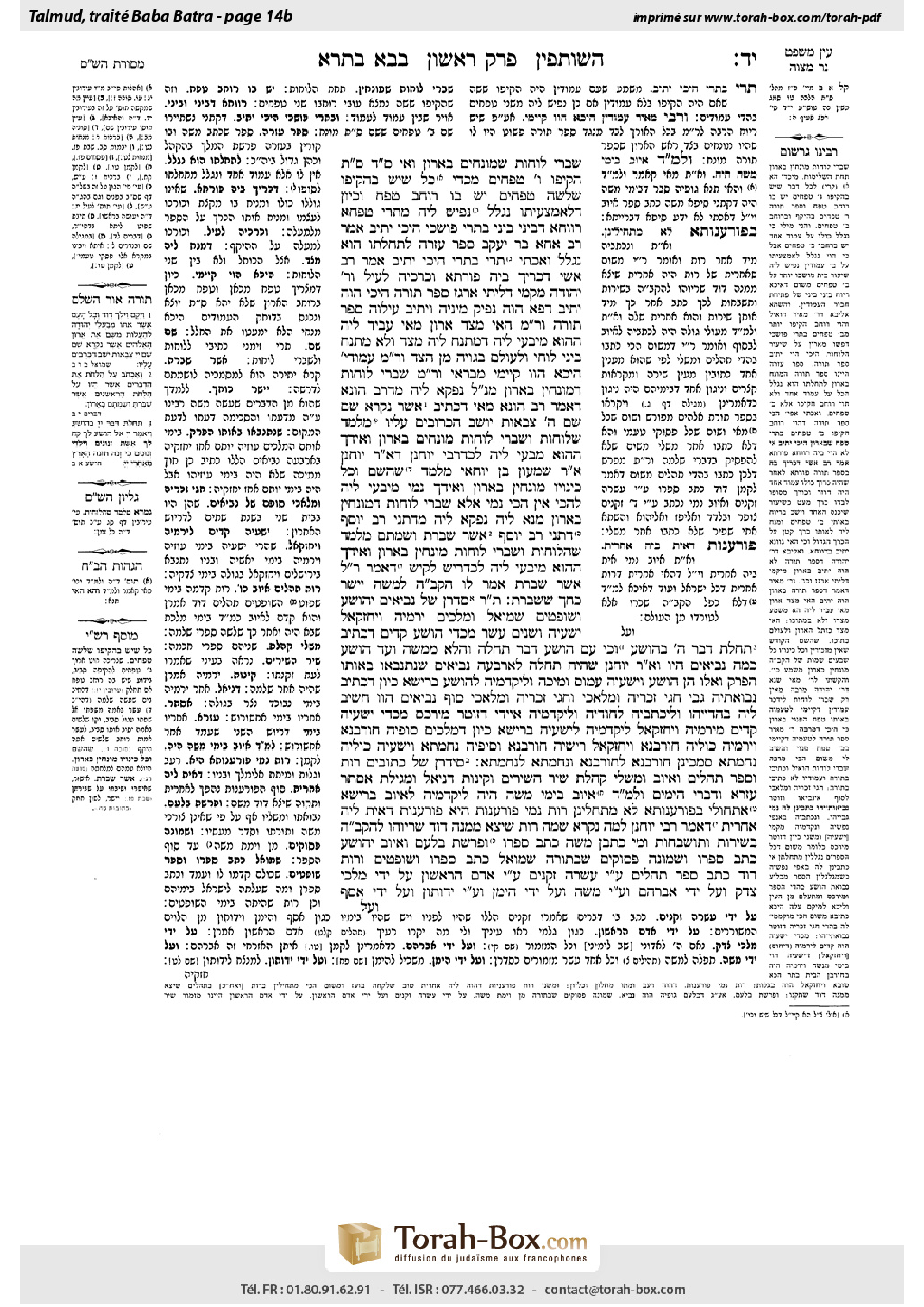
Bava Batra 14b: Talmud study for Daf Yomi
Study the Talmud for Daf Yomi with scanned pages, Hebrew text, English translations from Sefaria and AI-generated French translations.
Passage selection and English or AI-generated French translation are available where the scan has annotations. Daf Study is independent of Torah-Box and Sefaria.
Browse Bava Batra · בבא בתרא · All tractatesBava Batra 14b text and translations
This page of Bava Batra includes the Aramaic text, an English translation and an AI-generated French translation, alongside the scan above.
בבא בתרא י״ד ב · Aramaic and Hebrew text
שִׁבְרֵי לוּחוֹת שֶׁמּוּנָּחִים בָּאָרוֹן. וְאִי סָלְקָא דַעְתָּךְ סֵפֶר תּוֹרָה הֶקֵּיפוֹ שִׁשָּׁה טְפָחִים; מִכְּדֵי כֹּל שֶׁיֵּשׁ בְּהֶקֵּיפוֹ שְׁלֹשָׁה טְפָחִים – יֵשׁ בּוֹ רוֹחַב טֶפַח, וְכֵיוָן דִּלְאֶמְצָעִיתוֹ נִגְלָל – נְפִישׁ לֵיהּ מִתְּרֵי טִפְחָא רַוְוחָא דְּבֵינֵי בֵּינֵי; בִּתְרֵי פּוּשְׁכֵי הֵיכִי יָתֵיב?
אָמַר רַב אַחָא בַּר יַעֲקֹב: סֵפֶר עֲזָרָה לִתְחִלָּתוֹ הוּא נִגְלָל. וְאַכַּתִּי, תְּרֵי בִּתְרֵי הֵיכִי יָתֵיב? אָמַר רַב אָשֵׁי: דְּכָרֵיךְ בֵּיהּ פּוּרְתָּא, וְכַרְכֵיהּ לְעֵיל.
וְרַבִּי יְהוּדָה – מִקַּמֵּי דְּלַיְתֵי אַרְגַּז, סֵפֶר תּוֹרָה הֵיכִי הֲוָה יָתֵיב? דַּפָּא הֲוָה נָפֵיק מִינֵּיהּ, וְיָתֵיב עִילָּוֵהּ סֵפֶר תּוֹרָה. וְרַבִּי מֵאִיר – הַאי ״מִצַּד אֲרוֹן״, מַאי עָבֵיד לֵיהּ? הַהוּא מִיבְּעֵי לֵיהּ דְּמִתְּנַח לֵיהּ מִצַּד וְלָא מִתְּנַח בֵּינֵי לוּחֵי; וּלְעוֹלָם בְּגַוֵּיהּ – מִן הַצַּד.
וְרַבִּי מֵאִיר, עַמּוּדִין הֵיכָא הֲווֹ קָיְימִי? מִבָּרַאי. וְרַבִּי מֵאִיר, שִׁבְרֵי לוּחוֹת דְּמוּנָּחִין בָּאָרוֹן – מְנָא לֵיהּ? נָפְקָא לֵיהּ מִדְּרַב הוּנָא – דְּאָמַר רַב הוּנָא, מַאי דִּכְתִיב: ״אֲשֶׁר נִקְרָא שֵׁם שֵׁם ה׳ צְבָאוֹת יֹשֵׁב הַכְּרֻבִים עָלָיו״? מְלַמֵּד שֶׁלּוּחוֹת וְשִׁבְרֵי לוּחוֹת מוּנָּחִים בָּאָרוֹן.
וְאִידַּךְ – הַהוּא מִבְּעֵי לֵיהּ לְכִדְרַבִּי יוֹחָנָן, דְּאָמַר רַבִּי יוֹחָנָן אָמַר רַבִּי שִׁמְעוֹן בֶּן יוֹחַאי: מְלַמֵּד, שֶׁהַשֵּׁם וְכׇל כִּינּוּיָו מוּנָּחִין בָּאָרוֹן.
וְאִידַּךְ נָמֵי מִיבְּעֵי לֵיהּ לְהָכִי! אֵין הָכִי נָמֵי. אֶלָּא שִׁבְרֵי לוּחוֹת דְּמוּנָּחִין בָּאָרוֹן מְנָא לֵיהּ? נָפְקָא לֵיהּ מִדְּתָנֵי רַב יוֹסֵף – דְּתָנֵי רַב יוֹסֵף: ״אֲשֶׁר שִׁבַּרְתָּ וְשַׂמְתָּם״ – מְלַמֵּד שֶׁהַלּוּחוֹת וְשִׁבְרֵי לוּחוֹת מוּנָּחִין בָּאָרוֹן.
וְאִידַּךְ – הַהוּא מִיבְּעֵי לֵיהּ לְכִדְרֵישׁ לָקִישׁ, דְּאָמַר רֵישׁ לָקִישׁ: ״אֲשֶׁר שִׁבַּרְתָּ״ – אָמַר לוֹ הַקָּדוֹשׁ בָּרוּךְ הוּא לְמֹשֶׁה: יִישַׁר כֹּחֲךָ שֶׁשִּׁבַּרְתָּ.
תָּנוּ רַבָּנַן, סִדְרָן שֶׁל נְבִיאִים: יְהוֹשֻׁעַ וְשׁוֹפְטִים, שְׁמוּאֵל וּמְלָכִים, יִרְמְיָה וִיחֶזְקֵאל, יְשַׁעְיָה וּשְׁנֵים עָשָׂר. מִכְּדֵי הוֹשֵׁעַ קָדֵים; דִּכְתִיב: ״תְּחִלַּת דִּבֶּר ה׳ בְּהוֹשֵׁעַ״ – וְכִי עִם הוֹשֵׁעַ דִּבֵּר תְּחִלָּה? וַהֲלֹא מִמֹּשֶׁה וְעַד הוֹשֵׁעַ כַּמָּה נְבִיאִים הָיוּ! וְאָמַר רַבִּי יוֹחָנָן: שֶׁהָיָה תְּחִלָּה לְאַרְבָּעָה נְבִיאִים שֶׁנִּתְנַבְּאוּ בְּאוֹתוֹ הַפֶּרֶק – וְאֵלּוּ הֵן: הוֹשֵׁעַ וִישַׁעְיָה, עָמוֹס וּמִיכָה; וְלַיקְדְּמֵיהּ לְהוֹשֵׁעַ בְּרֵישָׁא!
כֵּיוָן דִּכְתִיב נְבוּאֲתֵיהּ גַּבֵּי חַגַּי זְכַרְיָה וּמַלְאָכִי, וְחַגַּי זְכַרְיָה וּמַלְאָכִי סוֹף נְבִיאִים הֲווֹ – חָשֵׁיב לֵיהּ בַּהֲדַיְיהוּ. וְלִיכְתְּבֵיהּ לְחוֹדֵיהּ, וְלַיקְדְּמֵיהּ! אַיְּידֵי דְּזוּטַר מִירְכַס.
מִכְּדִי יְשַׁעְיָה קָדֵים מִיִּרְמְיָה וִיחֶזְקֵאל, לַיקְדְּמֵיהּ לִישַׁעְיָה בְּרֵישָׁא! כֵּיוָן דִּמְלָכִים סוֹפֵיהּ חוּרְבָּנָא; וְיִרְמְיָה כּוּלֵּיהּ חוּרְבָּנָא; וִיחֶזְקֵאל רֵישֵׁיהּ חוּרְבָּנָא וְסֵיפֵיהּ נֶחָמְתָּא; וִישַׁעְיָה כּוּלֵּיהּ נֶחָמְתָּא – סָמְכִינַן חוּרְבָּנָא לְחוּרְבָּנָא, וְנֶחָמְתָּא לְנֶחָמְתָּא.
סִידְרָן שֶׁל כְּתוּבִים: רוּת וְסֵפֶר תְּהִלִּים וְאִיּוֹב וּמִשְׁלֵי, קֹהֶלֶת, שִׁיר הַשִּׁירִים וְקִינוֹת, דָּנִיאֵל וּמְגִילַת אֶסְתֵּר, עֶזְרָא וְדִבְרֵי הַיָּמִים. וּלְמַאן דְּאָמַר: אִיּוֹב בִּימֵי מֹשֶׁה הָיָה, לַיקְדְּמֵיהּ לְאִיּוֹב בְּרֵישָׁא! אַתְחוֹלֵי בְּפוּרְעֲנוּתָא לָא מַתְחֲלִינַן. רוּת נָמֵי פּוּרְעָנוּת הִיא! פּוּרְעָנוּת דְּאִית לֵיהּ אַחֲרִית – דְּאָמַר רַבִּי יוֹחָנָן: לָמָּה נִקְרָא שְׁמָהּ רוּת? שֶׁיָּצָא מִמֶּנָּה דָּוִד, שֶׁרִיוָּהוּ לְהַקָּדוֹשׁ בָּרוּךְ הוּא בְּשִׁירוֹת וְתוּשְׁבָּחוֹת.
וּמִי כְּתָבָן? מֹשֶׁה כָּתַב סִפְרוֹ וּפָרָשַׁת בִּלְעָם וְאִיּוֹב. יְהוֹשֻׁעַ כָּתַב סִפְרוֹ וּשְׁמוֹנָה פְּסוּקִים שֶׁבַּתּוֹרָה. שְׁמוּאֵל כָּתַב סִפְרוֹ וְשׁוֹפְטִים וְרוּת. דָּוִד כָּתַב סֵפֶר תְּהִלִּים – עַל יְדֵי עֲשָׂרָה זְקֵנִים: עַל יְדֵי אָדָם הָרִאשׁוֹן, עַל יְדֵי מַלְכִּי צֶדֶק, וְעַל יְדֵי אַבְרָהָם, וְעַל יְדֵי מֹשֶׁה, וְעַל יְדֵי הֵימָן, וְעַל יְדֵי יְדוּתוּן, וְעַל יְדֵי אָסָף,
Bava Batra 14b · English translation
the broken pieces of the first set of tablets, which were placed in the Ark. Having cited the baraita, the Gemara now presents its objection to what was taught earlier with regard to the dimensions of a Torah scroll: And if it should enter your mind to say, as Rabbi Yehuda HaNasi held, that the circumference of a Torah scroll is six handbreadths, now since any cylindrical object having a circumference of three handbreadths has a diameter of one handbreadth, a Torah scroll with a circumference of six handbreadths has a diameter of two handbreadths. And since a Torah scroll is wound to the middle, since it is rolled from both sides, it must take up more than two handbreadths due to the space between the sheets of parchment and the double rolling. According to Rabbi Meir, who says that the Torah scroll was placed inside the ark, how did the scroll fit in the remaining two handbreadths [pushkei] of space in the Ark?
Rav Aḥa bar Ya’akov said: The scroll of the Temple courtyard, which was kept in the Ark, was wound to its beginning, i.e., it had only a single pole, so that its circumference was only two handbreadths. The Gemara asks: But still, how does an item that is two handbreadths wide fit into a space that is precisely two handbreadths? It would be impossible to fit it in. Rav Ashi said: A small section of the scroll was wound separately and then placed on top of the scroll.
Having concluded its current discussion, the Gemara now addresses the details of the aforementioned baraita and asks: And according to Rabbi Yehuda, who says that the Torah scroll rested on the chest that came from the Philistines, where was the Torah scroll placed before the chest arrived? The Gemara answers: A shelf protruded from the Ark and the Torah scroll rested on it. The Gemara asks: And according to Rabbi Meir, who says that the Torah scroll rested inside the Ark, what does he do with this verse: “Take this Torah scroll and put it at the side of the Ark” (Deuteronomy 31:26)? The Gemara answers: He requires that verse to teach that the Torah scroll was placed at the side of the tablets, and that it was not placed between the two tablets, but it was actually placed inside the Ark at the side of the tablets.
The Gemara asks: And according to Rabbi Meir, where were the silver columns placed? The Gemara answers: Outside the Ark. The Gemara further asks: And from where does Rabbi Meir derive that the broken pieces of the first set of tablets were placed in the Ark, as the verse from which Rabbi Yehuda learns this: “There was nothing in the Ark except” (I Kings 8:9), is needed by Rabbi Meir to teach that the Torah scroll was placed there? The Gemara answers: He derives this point from what Rav Huna expounded, as Rav Huna says: What is the meaning of that which is written: “The Ark of God, whereupon is called the Name, the name of the Lord of hosts that sits upon the cherubs” (II Samuel 6:2)? The phrase “the name, the name of the Lord” teaches that both the second tablets and the broken pieces of the first set of tablets were placed in the Ark.
The Gemara asks: And what does the other Sage, i.e., Rabbi Yehuda, derive from this verse? The Gemara responds: He requires that text for that which Rabbi Yoḥanan says, as Rabbi Yoḥanan says that Rabbi Shimon ben Yoḥai says: This teaches that the ineffable name of God and all of His appellations were placed in the Ark.
The Gemara inquires: And doesn’t the other Sage, Rabbi Meir, also require it for that? The Gemara answers: Yes, it is indeed so. Rather, from where does he derive that the broken pieces of the first set of tablets were placed in the Ark? The Gemara expounds: He derives this from that which Rav Yosef taught, as Rav Yosef taught a baraita: The verses state: “At that time the Lord said to me: Hew for yourself two tablets of stone like the first…and I will write on the tablets the words that were on the first tablets, which you broke, and you shall put them in the Ark” (Deuteronomy 10:1–2). This teaches that both the second set of tablets and the broken pieces of the first set of tablets were placed in the Ark.
The Gemara asks: And what does the other one, Rabbi Yehuda, learn from this verse? The Gemara answers: He requires it for that which Reish Lakish teaches, as Reish Lakish says: What is the meaning of that which is stated: “The first tablets, which you broke [asher shibbarta]”? These words allude to the fact that God approved of Moses’ action, as if the Holy One, Blessed be He, said to Moses: May your strength be straight [yishar koḥakha] because you broke them.
§ The Sages taught: The order of the books of the Prophets when they are attached together is as follows: Joshua and Judges, Samuel and Kings, Jeremiah and Ezekiel, and Isaiah and the Twelve Prophets. The Gemara asks: Consider: Hosea preceded some of the other prophets whose books are included in the Bible, as it is written: “The Lord spoke first to Hosea” (Hosea 1:2). At first glance this verse is difficult: But did God speak first with Hosea, and not with any other prophet before him? Weren’t there many prophets between Moses and Hosea? And Rabbi Yoḥanan says: He was the first of four prophets who prophesied in that period, and they were: Hosea and Isaiah, Amos and Micah. Accordingly, Hosea preceded those three prophets; and the book of Hosea as well should precede the books of those prophets.
The Gemara answers: Since his prophecy is written together with those of Haggai, Zechariah, and Malachi in one book of the Twelve Prophets, and Haggai, Zechariah, and Malachi were the last of the prophets, he is counted with them. The Gemara inquires: But let the book of Hosea be written separately and let it precede the others. The Gemara answers: Were it written separately, since it is small it would be lost.
The Gemara further asks: Consider: Isaiah preceded Jeremiah and Ezekiel; let the book of Isaiah precede the books of those other prophets. The Gemara answers: Since the book of Kings ends with the destruction of the Temple, and the book of Jeremiah deals entirely with prophecies of the destruction, and the book of Ezekiel begins with the destruction of the Temple but ends with consolation and the rebuilding of the Temple, and Isaiah deals entirely with consolation, as most of his prophecies refer to the redemption, we juxtapose destruction to destruction and consolation to consolation. This accounts for the order: Jeremiah, Ezekiel, and Isaiah.
The baraita continues: The order of the Writings is: Ruth and the book of Psalms, and Job and Proverbs; Ecclesiastes, Song of Songs, and Lamentations; Daniel and the Scroll of Esther; and Ezra and Chronicles. The Gemara asks: And according to the one who says that Job lived in the time of Moses, let the book of Job precede the others. The Gemara answers: We do not begin with suffering, i.e., it is inappropriate to start the Writings with a book that deals so extensively with suffering. The Gemara asks: But the book of Ruth, with which the Writings opens, is also about suffering, since it describes the tragedies that befell the family of Elimelech. The Gemara answers: This is suffering which has a future of hope and redemption. As Rabbi Yoḥanan says: Why was she named Ruth, spelled reish, vav, tav? Because there descended from her David who sated, a word with the root reish, vav, heh, the Holy One, Blessed be He, with songs and praises.
The baraita now considers the authors of the biblical books: And who wrote the books of the Bible? Moses wrote his own book, i.e., the Torah, and the portion of Balaam in the Torah, and the book of Job. Joshua wrote his own book and eight verses in the Torah, which describe the death of Moses. Samuel wrote his own book, the book of Judges, and the book of Ruth. David wrote the book of Psalms by means of ten elders of previous generations, assembling a collection that included compositions of others along with his own. He included psalms authored by Adam the first man, by Melchizedek king of Salem, and by Abraham, and by Moses, and by Heman, and by Jeduthun, and by Asaph,
Bava Batra 14b · Traduction française (IA)
les morceaux brisés des premières tables, qui étaient placés dans l’Arca. Ayant cité la baraïta, le Guemara présente maintenant son objection concernant ce qui avait été enseigné précédemment concernant les dimensions d’un rouleau de Torah : Et si cela vous vient à l’esprit de dire, selon Rabbi Yehuda HaNasi, que la circonférence d’un rouleau de Torah est de six paumes, maintenant, puisque tout objet cylindrique ayant une circonférence de trois paumes a un diamètre d’une paume, un rouleau de Torah ayant une circonférence de six paumes a un diamètre de deux paumes. Et puisque le rouleau de Torah est enroulé au milieu, puisqu’il est enroulé des deux côtés, il doit occuper plus de deux paumes en raison de l’espace entre les feuilles de parchemin et du double enroulement. Selon Rabbi Meir, qui dit que le rouleau de Torah était placé à l’intérieur de l’Arca, comment ce rouleau a-t-il pu entrer dans les deux paumes restantes [pushkei] d’espace dans l’Arca ?
Rav Aḥa bar Ya’akov a dit : Le rouleau du cour de l’Temple, qui était conservé dans l’Arca, était enroulé à son début, c’est-à-dire qu’il avait un seul bâton, de sorte que sa circonférence était de deux paumes seulement. Le Guemara demande : Mais alors, comment un objet de deux paumes de large peut-il entrer dans un espace précisément de deux paumes ? Cela serait impossible. Rav Ashi a dit : Une petite partie du rouleau était enroulée séparément et placée sur le dessus du rouleau.
Ayant conclu sa discussion actuelle, le Guemara aborde maintenant les détails de la baraïta mentionnée plus haut et demande : Et selon Rabbi Yehuda, qui dit que le rouleau de Torah reposait sur la poitrine venue des Philistins, où était-il placé avant l’arrivée de la poitrine ? Le Guemara répond : Une étagère sortait de l’Arca et le rouleau de Torah reposait dessus. Le Guemara demande : Et selon Rabbi Meir, qui dit que le rouleau de Torah était placé à l’intérieur de l’Arca, comment interprète-t-il cette versette : « Prends ce rouleau de Torah et mets-le à côté de l’Arca » (Deutéronome 31:26) ? Le Guemara répond : Il exige ce verset pour enseigner que le rouleau de Torah était placé à côté des tables, et qu’il n’était pas placé entre les deux tables, mais qu’il était effectivement placé à l’intérieur de l’Arca à côté des tables.
Le Guemara demande : Et selon Rabbi Meir, où étaient placés les colonnes d’argent ? Le Guemara répond : À l’extérieur de l’Arca. Le Guemara ajoute encore : Et d’où Rabbi Meir dérive-t-il que les morceaux brisés des premières tables étaient placés dans l’Arca, puisque le verset d’où Rabbi Yehuda tire cela : « Il n’y avait rien dans l’Arca à l’exception de » (I Rois 8:9), est nécessaire pour Rabbi Meir afin d’enseigner que le rouleau de Torah était placé là ? Le Guemara répond : Il dérive de ce que Rav Huna a expliqué, car Rav Huna dit : Quelle est la signification de ce qui est écrit : « L’Arca de Dieu, sur laquelle est appelé le Nom, le nom du Seigneur des armées qui siège sur les chérubins » (II Samuel 6:2) ? La phrase « le nom, le nom du Seigneur » enseigne que les secondes tables et les morceaux brisés des premières tables étaient placés dans l’Arca.
Le Guemara demande : Et qu’entend le Sage autre, c’est-à-dire Rabbi Yehuda, par ce verset ? Le Guemara répond : Il exige ce texte pour ce que Rabbi Yoḥanan dit, car Rabbi Yoḥanan dit que Rabbi Shimon ben Yoḥai dit : Cela enseigne que le nom ineffable de Dieu et toutes ses appellations étaient placés dans l’Arca.
Le Guemara interroge : Et ne demande-t-il pas aussi le Sage autre, Rabbi Meir, à ce sujet ? Le Guemara répond : Oui, c’est effectivement ainsi. Cependant, d’où dérive-t-il que les morceaux brisés des premières tables étaient placés dans l’Arca ? Le Guemara explique : Il dérive de ce que Rav Yosef a enseigné, car Rav Yosef a enseigné une baraïta : Les versets disent : « À ce moment-là, le Seigneur dit à moi : Fais-toi deux tables de pierre comme la première… et je t’écrirai sur les tables les paroles qui étaient sur les premières tables, que tu as brisées, et tu les placeras dans l’Arca » (Deutéronome 10:1–2). Cela enseigne que les secondes tables et les morceaux brisés des premières tables étaient placés dans l’Arca.
Le Guemara demande : Et qu’entend l’autre, Rabbi Yehuda, par ce verset ? Le Guemara répond : Il exige cela pour ce que Reish Lakish enseigne, car Reish Lakish dit : Quelle est la signification de ce qui est dit : « Les premières tables, que tu as brisées [asher shibbarta] » ? Ces mots indiquent que Dieu approuvait l’action de Moïse, comme si le Saint, le Bienheureux, disait à Moïse : Que ta force soit droite [yishar koḥakha] parce que tu les as brisées.
§ Les Sages ont enseigné : L’ordre des livres des Prophètes lorsqu’ils sont joints ensemble est le suivant : Josué et les Juges, Samuel et les Rois, Jérémie et Ézéchiel, et Isaïe et les Douze Prophètes. Le Guemara demande : Considérons : Oseia a précédé certains des autres prophètes dont les livres sont inclus dans la Bible, car il est écrit : « Le Seigneur parla d’abord à Oseia » (Oseia 1:2). À première vue, ce verset est difficile : Mais Dieu a-t-il parlé d’abord à Oseia, et pas à aucun autre prophète avant lui ? N’y avait-il pas beaucoup de prophètes entre Moïse et Oseia ? Et Rabbi Yoḥanan dit : Il était le premier des quatre prophètes qui ont prophétisé durant cette période, et ils étaient : Oseia et Isaïe, Amos et Michée. Ainsi, Oseia a précédé ces trois prophètes ; et le livre d’Oseia devrait aussi précéder les livres de ces prophètes.
Le Guemara répond : Puisque sa prophétie est écrite ensemble avec celles de Haggai, Zacharie et Malachie dans un seul livre des Douze Prophètes, et Haggai, Zacharie et Malachie étant les derniers des prophètes, il est compté parmi eux. Le Guemara interroge : Mais laissez le livre d’Oseia être écrit séparément et qu’il précède les autres. Le Guemara répond : Si cela était écrit séparément, puisque c’est petit, il serait perdu.
La Guemara pose une question supplémentaire : Considérons : l'Isaïe a précédé Jérémie et Ézéchiel ; la livre d'Isaïe devrait donc précéder les livres de ces autres prophètes. La Guemara répond : Puisque le livre des Rois se termine par la destruction du Temple, et que le livre de Jérémie traite entièrement des prophéties de la destruction, et que le livre d'Ézéchiel commence par la destruction du Temple mais se termine par la consolation et la reconstruction du Temple, et que l'Isaïe traite entièrement de la consolation, puisque la plupart de ses prophéties concernent la rédemption, nous juxtaposons destruction à destruction et consolation à consolation. Cela explique l'ordre : Jérémie, Ézéchiel et Isaïe.
La baraïta continue : L'ordre des Ecritures est : Ruth et le livre des Psaumes, et Job et les Proverbes ; l'Ecclesiaste, le Cantique des Cantiques et les Lamentations ; Daniel et le Livre d'Esther ; et Esdras et les Chroniques. La Guemara pose une question : Et selon celui qui dit que Job vécut à l'époque de Moïse, le livre de Job devrait précéder les autres. La Guemara répond : Nous ne commençons pas par la souffrance, c'est-à-dire il est inapproprié de commencer les Ecritures avec un livre qui traite si intensément de la souffrance. La Guemara pose une question : Mais le livre de Ruth, avec lequel les Ecritures commencent, est aussi sur la souffrance, puisqu'il décrit les tragédies qui frappèrent la famille d'Elimelech. La Guemara répond : C'est une souffrance qui a un avenir d'espoir et de rédemption. Comme Rabbi Yoḥanan dit : Pourquoi a-t-elle été nommée Ruth, écrite reish, vav, tav ? Parce que descendit de là David qui satura, un mot dont la racine est reish, vav, heh, le Saint, béni soit-Il, avec des chants et des louanges.
La baraïta considère maintenant les auteurs des livres bibliques : Et qui a écrit les livres de la Bible ? Moïse a écrit son propre livre, c'est-à-dire la Torah, et la portion de Balaam dans la Torah, et le livre de Job. Josué a écrit son propre livre et huit versets dans la Torah, qui décrivent la mort de Moïse. Samuel a écrit son propre livre, le livre des Juges, et le livre de Ruth. David a écrit le livre des Psaumes grâce à dix anciens de générations précédentes, assemblant une collection qui comprenait des compositions d'autres personnes ainsi que les siennes. Il a inclus des psaumes écrits par Adam, le premier homme, par Melchisédek roi de Salem, et par Abraham, et par Moïse, et par Heman, et par Jeduthun, et par Asaph,
Traduction française générée par IA à partir de l’édition anglaise de Sefaria. Vérifie toujours un passage avec le texte source.
Text from Sefaria: William Davidson Edition - Vocalized Aramaic (CC BY NC); William Davidson Edition - English (CC BY NC).