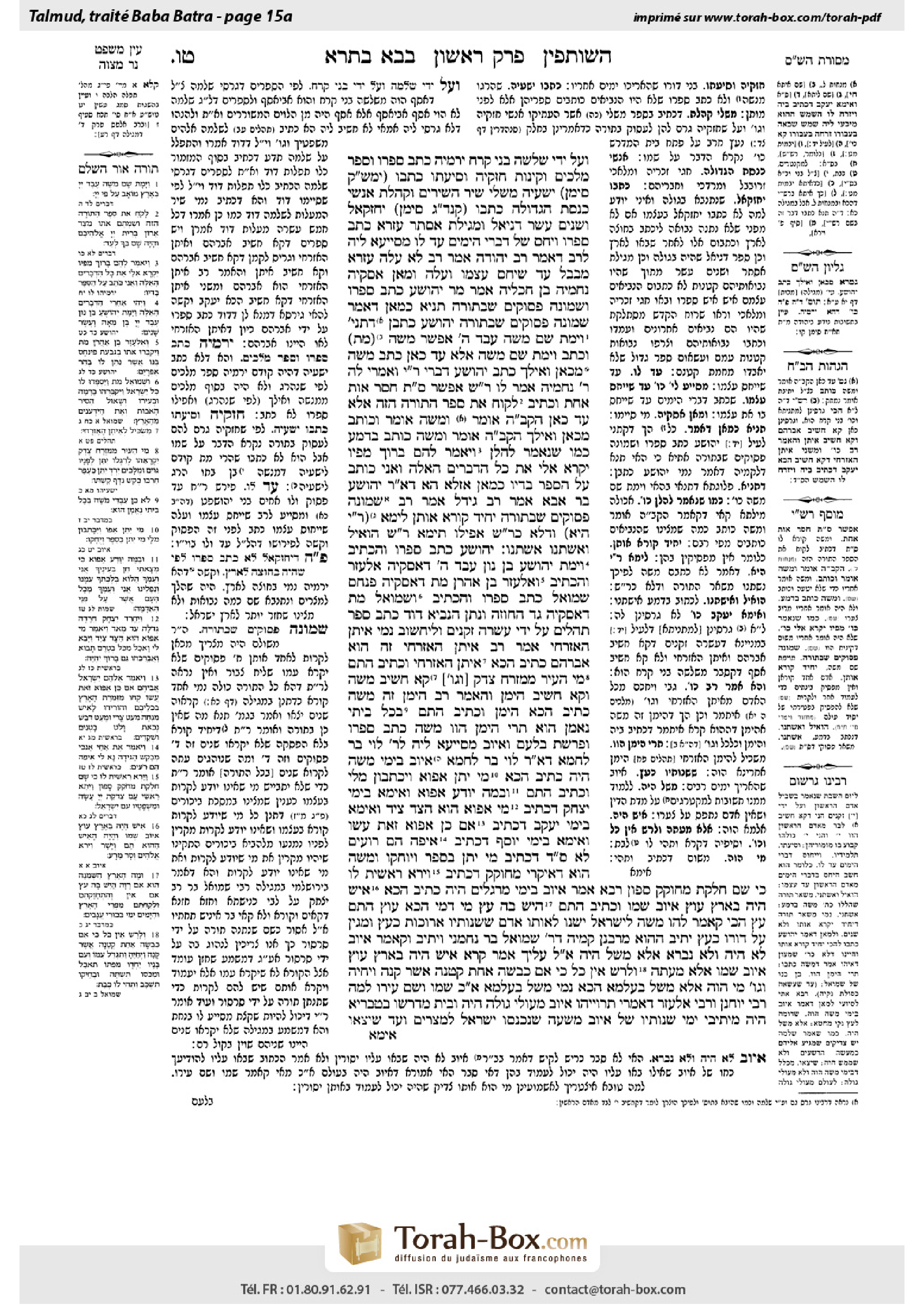
Bava Batra 15a: Talmud study for Daf Yomi
Study the Talmud for Daf Yomi with scanned pages, Hebrew text, English translations from Sefaria and AI-generated French translations.
Passage selection and English or AI-generated French translation are available where the scan has annotations. Daf Study is independent of Torah-Box and Sefaria.
Browse Bava Batra · בבא בתרא · All tractatesBava Batra 15a text and translations
This page of Bava Batra includes the Aramaic text, an English translation and an AI-generated French translation, alongside the scan above.
בבא בתרא י״ה א · Aramaic and Hebrew text
וְעַל יְדֵי שְׁלֹשָׁה בְּנֵי קֹרַח.
יִרְמְיָה כָּתַב סִפְרוֹ וְסֵפֶר מְלָכִים וְקִינוֹת. חִזְקִיָּה וְסִיעָתוֹ כָּתְבוּ (יִמְשָׁק סִימָן:) יְשַׁעְיָה, מִשְׁלֵי, שִׁיר הַשִּׁירִים וְקֹהֶלֶת. אַנְשֵׁי כְּנֶסֶת הַגְּדוֹלָה כָּתְבוּ (קַנְדָּג סִימָן:) יְחֶזְקֵאל וּשְׁנֵים עָשָׂר, דָּנִיֵּאל וּמְגִילַת אֶסְתֵּר. עֶזְרָא כָּתַב סִפְרוֹ, וְיַחַס שֶׁל דִּבְרֵי הַיָּמִים עַד לוֹ.
מְסַיְּיעָא לֵיהּ לְרַב, דְּאָמַר רַב יְהוּדָה אָמַר רַב: לֹא עָלָה עֶזְרָא מִבָּבֶל, עַד שֶׁיִּחֵס עַצְמוֹ וְעָלָה. וּמַאן אַסְּקֵיהּ? נְחֶמְיָה בֶּן חֲכַלְיָה.
אָמַר מָר: יְהוֹשֻׁעַ כָּתַב סִפְרוֹ וּשְׁמוֹנָה פְּסוּקִים שֶׁבַּתּוֹרָה. תַּנְיָא כְּמַאן דְּאָמַר: שְׁמוֹנָה פְּסוּקִים שֶׁבַּתּוֹרָה יְהוֹשֻׁעַ כְּתָבָן. דְּתַנְיָא ״וַיָּמׇת שָׁם מֹשֶׁה עֶבֶד ה׳״ – אֶפְשָׁר מֹשֶׁה מֵת, וְכָתַב: ״וַיָּמׇת שָׁם מֹשֶׁה״?! אֶלָּא עַד כָּאן כָּתַב מֹשֶׁה, מִכָּאן וְאֵילָךְ כָּתַב יְהוֹשֻׁעַ; דִּבְרֵי רַבִּי יְהוּדָה, וְאָמְרִי לַהּ רַבִּי נְחֶמְיָה.
אָמַר לוֹ רַבִּי שִׁמְעוֹן: אֶפְשָׁר סֵפֶר תּוֹרָה חָסֵר אוֹת אַחַת, וּכְתִיב: ״לָקֹחַ אֵת סֵפֶר הַתּוֹרָה הַזֶּה״?! אֶלָּא עַד כָּאן הַקָּדוֹשׁ בָּרוּךְ הוּא אוֹמֵר – וּמֹשֶׁה אוֹמֵר וְכוֹתֵב; מִכָּאן וְאֵילָךְ הַקָּדוֹשׁ בָּרוּךְ הוּא אוֹמֵר – וּמֹשֶׁה כּוֹתֵב בְּדֶמַע, כְּמוֹ שֶׁנֶּאֱמַר לְהַלָּן: ״וַיֹּאמֶר לָהֶם בָּרוּךְ: מִפִּיו יִקְרָא אֵלַי אֵת כׇּל הַדְּבָרִים הָאֵלֶּה, וַאֲנִי כּוֹתֵב עַל הַסֵּפֶר בַּדְּיוֹ״.
כְּמַאן אָזְלָא הָא דְּאָמַר רַבִּי יְהוֹשֻׁעַ בַּר אַבָּא אָמַר רַב גִּידֵּל אָמַר רַב: שְׁמוֹנָה פְּסוּקִים שֶׁבַּתּוֹרָה יָחִיד קוֹרֵא אוֹתָן? לֵימָא רַבִּי יְהוּדָה הִיא – וּדְלָא כְּרַבִּי שִׁמְעוֹן? אֲפִילּוּ תֵּימָא רַבִּי שִׁמְעוֹן, הוֹאִיל וְאִשְׁתַּנּוֹ – אִשְׁתַּנּוֹ.
יְהוֹשֻׁעַ כָּתַב סִפְרוֹ. וְהָכְתִיב: ״וַיָּמׇת יְהוֹשֻׁעַ בִּן נוּן עֶבֶד ה׳״! דְּאַסְּקֵיהּ אֶלְעָזָר. וְהָכְתִיב: ״וְאֶלְעָזָר בֶּן אַהֲרֹן מֵת״! דְּאַסְּקֵיהּ פִּנְחָס.
שְׁמוּאֵל כָּתַב סִפְרוֹ. וְהָכְתִיב: ״וּשְׁמוּאֵל מֵת״! דְּאַסְּקֵיהּ גָּד הַחוֹזֶה וְנָתָן הַנָּבִיא.
דָּוִד כָּתַב סֵפֶר תְּהִלִּים – עַל יְדֵי עֲשָׂרָה זְקֵנִים. וְלִיחְשׁוֹב נָמֵי אֵיתָן הָאֶזְרָחִי! אָמַר רַב: אֵיתָן הָאֶזְרָחִי זֶה הוּא אַבְרָהָם – כְּתִיב הָכָא: ״אֵיתָן הָאֶזְרָחִי״, וּכְתִיב הָתָם: ״מִי הֵעִיר מִמִּזְרָח צֶדֶק [וְגוֹ׳]״.
קָא חָשֵׁיב מֹשֶׁה וְקָא חָשֵׁיב הֵימָן, וְהָאָמַר רַב: הֵימָן זֶה מֹשֶׁה – כְּתִיב הָכָא: ״הֵימָן״, וּכְתִיב הָתָם: ״בְּכׇל בֵּיתִי נֶאֱמָן הוּא״! תְּרֵי הֵימָן הֲווֹ.
מֹשֶׁה כָּתַב סִפְרוֹ וּפָרָשַׁת בִּלְעָם וְאִיּוֹב. מְסַיְּיעָא לֵיהּ לְרַבִּי לֵוִי בַּר לַחְמָא – דְּאָמַר רַבִּי לֵוִי בַּר לַחְמָא: אִיּוֹב בִּימֵי מֹשֶׁה הָיָה – כְּתִיב הָכָא: ״מִי יִתֵּן אֵפוֹא וְיִכָּתְבוּן מִלָּי״, וּכְתִיב הָתָם: ״וּבַמֶּה יִוָּדַע אֵפוֹא״.
וְאֵימָא בִּימֵי יִצְחָק, דִּכְתִיב: ״מִי אֵפוֹא הוּא הַצָּד צַיִד״! וְאֵימָא בִּימֵי יַעֲקֹב, דִּכְתִיב: ״אִם כֵּן אֵפוֹא זֹאת עֲשׂוּ״! וְאֵימָא בִּימֵי יוֹסֵף, דִּכְתִיב: ״אֵיפֹה הֵם רוֹעִים״!
לָא סָלְקָא דַּעְתָּךְ, דִּכְתִיב: ״מִי יִתֵּן בַּסֵּפֶר וְיֻחָקוּ״ – וּמֹשֶׁה הוּא דְּאִיקְּרִי ״מְחוֹקֵק״, דִּכְתִיב: ״וַיַּרְא רֵאשִׁית לוֹ כִּי שָׁם חֶלְקַת מְחֹקֵק סָפוּן״.
רָבָא אָמַר: אִיּוֹב בִּימֵי מְרַגְּלִים הָיָה – כְּתִיב הָכָא: ״אִישׁ הָיָה בְאֶרֶץ עוּץ, אִיּוֹב שְׁמוֹ״, וּכְתִיב הָתָם: ״הֲיֵשׁ בָּהּ עֵץ״. מִי דָּמֵי?! הָכָא ״עוּץ״, הָתָם ״עֵץ״! הָכִי קָאָמַר לְהוּ מֹשֶׁה לְיִשְׂרָאֵל: יֶשְׁנוֹ לְאוֹתוֹ אָדָם שֶׁשְּׁנוֹתָיו אֲרוּכּוֹת כְּעֵץ, וּמֵגֵין עַל דּוֹרוֹ כְּעֵץ?
יָתֵיב הָהוּא מֵרַבָּנַן קַמֵּיהּ דְּרַבִּי שְׁמוּאֵל בַּר נַחְמָנִי, וְיָתֵיב וְקָאָמַר: אִיּוֹב לֹא הָיָה וְלֹא נִבְרָא, אֶלָּא מָשָׁל הָיָה. אֲמַר לֵיהּ: עָלֶיךָ אָמַר קְרָא: ״אִישׁ הָיָה בְאֶרֶץ עוּץ, אִיּוֹב שְׁמוֹ״.
אֶלָּא מֵעַתָּה, ״וְלָרָשׁ אֵין כֹּל כִּי אִם כִּבְשָׂה אַחַת קְטַנָּה, אֲשֶׁר קָנָה וַיְחַיֶּהָ וְגוֹ׳״, מִי הֲוָה? אֶלָּא מָשָׁל בְּעָלְמָא, הָכָא נָמֵי מָשָׁל בְּעָלְמָא. אִם כֵּן, שְׁמוֹ וְשֵׁם עִירוֹ לָמָּה?
רַבִּי יוֹחָנָן וְרַבִּי אֶלְעָזָר דְאָמְרִי תַּרְוַיְיהוּ: אִיּוֹב מֵעוֹלֵי גוֹלָה הָיָה, וּבֵית מִדְרָשׁוֹ בִּטְבֶרְיָא הָיָה. מֵיתִיבִי: יְמֵי שְׁנוֹתָיו שֶׁל אִיּוֹב – מִשָּׁעָה שֶׁנִּכְנְסוּ יִשְׂרָאֵל לְמִצְרַיִם, וְעַד שֶׁיָּצְאוּ!
Bava Batra 15a · English translation
and by the three sons of Korah.
Jeremiah wrote his own book, and the book of Kings, and Lamentations. Hezekiah and his colleagues wrote the following, and a mnemonic to remember which books they wrote is yod, mem, shin, kuf: Isaiah [Yeshaya], Proverbs [Mishlei], Song of Songs [Shir HaShirim], and Ecclesiastes [Kohelet]. The members of the Great Assembly wrote the following, and a mnemonic to remember these books is kuf, nun, dalet, gimmel: Ezekiel [Yeḥezkel ], and the Twelve Prophets [Sheneim Asar], Daniel [Daniel ], and the Scroll of Esther [Megillat Ester]. Ezra wrote his own book and the genealogy of the book of Chronicles until his period.
The Gemara comments: This supports Rav, as Rav Yehuda says that Rav says: Ezra did not ascend from Babylonia to Eretz Yisrael until he established his own genealogy, and after that he ascended. This genealogy is what is written in the book of Chronicles. And who completed the book of Chronicles for the generations following Ezra? Nehemiah, son of Hacaliah.
The Gemara elaborates on the particulars of this baraita: The Master said above that Joshua wrote his own book and eight verses of the Torah. The Gemara comments: This baraita is taught in accordance with the one who says that it was Joshua who wrote the last eight verses in the Torah. This point is subject to a tannaitic dispute, as it is taught in another baraita: “And Moses the servant of the Lord died there” (Deuteronomy 34:5); is it possible that after Moses died, he himself wrote “And Moses died there”? Rather, Moses wrote the entire Torah until this point, and Joshua wrote from this point forward; this is the statement of Rabbi Yehuda. And some say that Rabbi Neḥemya stated this opinion.
Rabbi Shimon said to him: Is it possible that the Torah scroll was missing a single letter? But it is written: “Take this Torah scroll” (Deuteronomy 31:26), indicating that the Torah was complete as is and that nothing further would be added to it. Rather, until this point the Holy One, Blessed be He, dictated and Moses repeated after Him and wrote the text. From this point forward, with respect to Moses’ death, the Holy One, Blessed be He, dictated and Moses wrote with tears. The fact that the Torah was written by way of dictation can be seen later, as it is stated concerning the writing of the Prophets: “And Baruch said to them: He dictated all these words to me, and I wrote them with ink in the scroll” (Jeremiah 36:18).
The Gemara asks: In accordance with whose opinion is that which Rabbi Yehoshua bar Abba says that Rav Giddel says that Rav says: When the Torah is read publicly in the synagogue, one person reads the last eight verses in the Torah, and that section may not be divided between two readers? Shall we say that this is in accordance with the opinion of Rabbi Yehuda and not in accordance with the opinion of Rabbi Shimon, as according to Rabbi Shimon these verses are an integral part of the Torah, written by Moses just like the rest? The Gemara answers: Even if you say that this was said in accordance with the opinion of Rabbi Shimon, since they differ from the rest of the Torah in one way, as Moses wrote them with tears, they differ from the rest of the Torah in this way as well, i.e., they may not be divided between two readers.
It is stated in the baraita that Joshua wrote his own book. The Gemara asks: But isn’t it written toward the end of the book: “And Joshua, son of Nun, the servant of the Lord, died” (Joshua 24:29)? Is it possible that Joshua wrote this? The Gemara answers: Aaron’s son Eleazar completed it. The Gemara asks: But isn’t it also written: “And Eleazar, son of Aaron, died” (Joshua 24:33)? The Gemara answers: Pinehas completed it.
It is also stated in the baraita that Samuel wrote his own book. The Gemara asks: But isn’t it written: “And Samuel died” (I Samuel 28:3)? The Gemara answers: Gad the seer and Nathan the prophet finished it.
It is further stated that David wrote the book of Psalms by means of ten elders, whom the baraita proceeds to list. The Gemara asks: But then let it also count Ethan the Ezrahite among the contributors to the book of Psalms, as it is he who is credited with Psalms, chapter 89. Rav says: Ethan the Ezrahite is the same person as Abraham. Proof for this is the fact that it is written here: “A Maskil of Ethan the Ezrahite” (Psalms 89:1), and it is written there: “Who raised up one from the east [mizraḥ], whom righteousness met wherever he set his foot” (Isaiah 41:2). The latter verse is understood as referring to Abraham, who came from the east, and for that reason he is called Ethan the Ezrahite in the former verse.
The Gemara asks: The baraita counts Moses among the ten elders whose works are included in the book of Psalms, and it also counts Heman. But doesn’t Rav say: The Heman mentioned in the Bible (I Kings 5:11) is the same person as Moses? This is proven by the fact that it is written here: “Heman” (Psalms 88:1), which is Aramaic for trusted, and it is written there about Moses: “For he is the trusted one in all My house” (Numbers 12:7). The Gemara answers: There were two Hemans, one of whom was Moses, and the other a Temple singer from among the descendants of Samuel.
The baraita further states that Moses wrote his own book, i.e., the Torah, the portion of Balaam, and the book of Job. This supports Rabbi Levi bar Laḥma, as Rabbi Levi bar Laḥma says: Job lived in the time of Moses. It is written here with regard to Job: “Oh, that my words were written now [eifo]” (Job 19:23), and it is written there in Moses’ words to God: “For in what shall it be known here [eifo]” (Exodus 33:16). The unusual use of the word eifo in these two places indicates that Job and Moses lived in the same generation.
The Gemara comments: But if that is the proof, say that Job lived in the time of Isaac, as it is written in connection with Isaac: “Who then [eifo] is he that has taken venison” (Genesis 27:33). Or say that he lived in the time of Jacob, as it is written with respect to Jacob: “If it must be so now [eifo], do this” (Genesis 43:11). Or say that he lived in the time of Joseph, as it is written with respect to Joseph: “Tell me, I pray you, where [eifo] are they feeding their flocks?” (Genesis 37:16).
The Gemara answers: It could not enter your mind to say this, as it is written in the continuation of the previously mentioned verse: “Oh, that my words were inscribed [veyuḥaku] in a book” (Job 19:23), and it is Moses who is called the inscriber, as it is written with regard to him: “And he provided the first part for himself, for there was the inscriber’s [meḥokek] portion reserved” (Deuteronomy 33:21).
Rava says: Job lived at the time of the spies whom Moses sent to scout the land of Canaan. This is proven by the fact that it is written here: “There was a man in the land of Utz, whose name was Job” (Job 1:1), and it is written there in the account of the spies: “Whether there are trees [eitz] in it” (Numbers 13:20). The Gemara asks: Is it comparable? Here the word that is used is Utz, whereas there the word is eitz. The Gemara answers: This is what Moses said to Israel, i.e., to the spies: Is that man named Job still alive, he whose years are as long as the years of a tree and who protects his generation like a tree? This is why the allusion to him here is through the word eitz, rather than Utz.
The Gemara relates that one of the Sages sat before Rabbi Shmuel bar Naḥmani and he sat and said: Job never existed and was never created; there was never such a person as Job. Rather, his story was a parable. Rabbi Shmuel bar Naḥmani said to him: In rebuttal to you, the verse states: “There was a man in the Land of Utz whose name was Job” (Job 1:1), which indicates that such a man did indeed exist.
The Gemara asks: But if that is so, that the words “there was” prove that Job existed, what shall we say about the parable that Natan the prophet presented to David: “There were two men in one city; the one rich and the other poor. The rich man had very many flocks and herds, but the poor man had nothing except one little lamb, which he had bought and reared” (II Samuel 12:3)? Was there really such a person? Rather, it was merely a parable; here too it is merely a parable. The Gemara answers: If so, that it is a parable, why state his name and the name of his city? Rather, Job was clearly a real person.
The Gemara cites another opinion with regard to the time when Job lived. Rabbi Yoḥanan and Rabbi Elazar both say: Job was among those who ascended from the exile to Eretz Yisrael at the start of the Second Temple period, and his house of study was in Tiberias. The Gemara raises an objection from what is taught in a baraita: The days of Job’s life extended from when Israel entered Egypt until they left, indicating that this is the period during which he lived and not, as suggested, in the early days of the Second Temple.
Bava Batra 15a · Traduction française (IA)
et par les trois fils de Korah.
Jérémie a écrit son propre livre, le livre des Rois et les Lamentations. Hachiaque et ses collègues ont écrit les suivants, et un moyen mnémotechnique pour se souvenir des livres qu'ils ont écrits est yod, mem, shin, kuf : Yeshaya, Mishlei, Shir HaShirim et Kohelet. Les membres de la Grande Assemblée ont écrit les suivants, et un moyen mnémotechnique pour se souvenir de ces livres est kuf, nun, dalet, gimmel : Yéhézkel et les Douze Prophètes, Daniel et le Livre d'Esther. Ezra a écrit son propre livre et la généalogie du livre des Chroniques jusqu'à son époque.
La Guemara commente : cela soutient Rav, car Rav Yéhuda dit que Rav dit : Ezra n'est monté d' Babylone vers la Terre d'Israël qu'après avoir établi sa propre généalogie, et après cela il est monté. Cette généalogie est ce qui est écrit dans le livre des Chroniques. Et qui a achevé le livre des Chroniques pour les générations suivantes d'Ezra ? Némié, fils de Hacaliah.
La Guemara développe les détails de ce baraïta : Le Maître a dit ci-dessus que Josué a écrit son propre livre et huit versets de la Torah. La Guemara commente : ce baraïta est enseigné selon celui qui dit que c'est Josué qui a écrit les derniers huit versets de la Torah. Ce point est sujet à un débat tannaitique, car il est enseigné dans un autre baraïta : « Et Moïse, le serviteur du Seigneur, mourut là » (Deutéronome 34:5) ; est-il possible que, après la mort de Moïse, il ait lui-même écrit « Et Moïse mourut là » ? Plutôt, Moïse a écrit toute la Torah jusqu'à ce point, et Josué a écrit à partir de ce point ; c'est l'opinion de Rabbi Yéhuda. Et certains disent que Rabbi Néchemyah a exprimé cette opinion.
Rabbi Shimon a dit à lui : Est-il possible que le rouleau de la Torah manque une seule lettre ? Mais il est écrit : « Prends ce rouleau de la Torah » (Deutéronome 31:26), indiquant que la Torah était complète telle quelle et que rien ne serait ajouté à elle. Plutôt, jusqu'à ce point, le Saint, le Bienheureux, a dicté et Moïse a répété après Lui et a écrit le texte. À partir de ce point, concernant la mort de Moïse, le Saint, le Bienheureux, a dicté et Moïse a écrit avec des larmes. Le fait que la Torah ait été écrite par dictée peut être vu plus tard, car il est dit concernant l'écriture des Prophètes : « Et Baruch a dit à eux : Il a dicté toutes ces paroles à moi, et j'ai écrit celles-ci avec de l'encre sur le rouleau » (Jérémie 36:18).
La Guemara pose une question : selon l'opinion de qui est-ce que Rabbi Yéhoshua bar Abba dit que Rav Giddel dit que Rav dit : lorsqu'on lit la Torah publiquement dans la synagogue, une seule personne lit les derniers huit versets de la Torah, et cette section ne peut pas être divisée entre deux lecteurs ? Devons-nous dire que cela est selon l'opinion de Rabbi Yéhuda et non selon celle de Rabbi Shimon, car selon Rabbi Shimon ces versets font partie intégrante de la Torah, écrits par Moïse comme le reste ? La Guemara répond : même si vous dites que cela a été dit selon l'opinion de Rabbi Shimon, puisque ces versets diffèrent du reste de la Torah d'une seule manière, à savoir qu'ils ont été écrits avec des larmes par Moïse, ils diffèrent du reste de la Torah de cette manière également, c'est-à-dire qu'ils ne peuvent pas être divisés entre deux lecteurs.
Il est dit dans le baraïta que Josué a écrit son propre livre. La Guemara pose une question : mais n'est-il pas écrit à la fin du livre : « Et Josué, fils de Nun, le serviteur du Seigneur, mourut » (Josué 24:29) ? Est-il possible que Josué ait écrit cela ? La Guemara répond : c'est Éléazar fils d'Aaron qui l'a achevé. La Guemara pose une autre question : mais n'est-il pas aussi écrit : « Et Éléazar, fils d'Aaron, mourut » (Josué 24:33) ? La Guemara répond : c'est Pinhas qui l'a achevé.
Il est également dit dans le baraïta que Samuel a écrit son propre livre. La Guemara pose une question : mais n'est-il pas écrit : « Et Samuel mourut » (I Samuel 28:3) ? La Guemara répond : Gad le prophète et Nathan le prophète l'ont achevé.
Il est également dit que David a écrit le livre des Psaumes grâce à dix anciens, dont le baraïta liste ensuite les noms. La Guemara pose une question : mais alors devrait-on aussi compter Ethan l'Ézraïte parmi les contributeurs au livre des Psaumes, car c'est lui qui est crédité du chapitre 89 des Psaumes ? Rav dit : Ethan l'Ézraïte est la même personne qu'Abraham. La preuve en est le fait qu'il est écrit ici : « Un Maskil d'Ethan l'Ézraïte » (Psaumes 89:1), et il est écrit là : « Qui a levé un homme du levant [mizraḥ], dont la justice l'a rencontré partout où il a posé ses pieds » (Isaïe 41:2). La dernière verset est comprise comme faisant référence à Abraham, qui est venu du levant, et pour cette raison il est appelé Ethan l'Ézraïte dans le premier verset.
La Guemara pose une question : le baraïta compte Moïse parmi les dix anciens dont les œuvres sont incluses dans le livre des Psaumes, et il compte également Heman. Mais n'est-ce pas que Rav dit : le Heman mentionné dans la Bible (I Rois 5:11) est la même personne que Moïse ? Cela est prouvé par le fait qu'il est écrit ici : « Heman » (Psaumes 88:1), qui signifie en araméen « confiant », et il est écrit là concernant Moïse : « Car il est le confiant dans toute ma maison » (Nombres 12:7). La Guemara répond : il y avait deux Hemans, l'un étant Moïse, et l'autre un chanteur du Temple parmi les descendants de Samuel.
Le baraïta précise également que Moïse a écrit son propre livre, c'est-à-dire la Torah, la portion de Balaam et le livre de Job. Cela soutient Rabbi Levi bar Laḥma, car Rabbi Levi bar Laḥma dit : Job a vécu à l'époque de Moïse. Il est écrit ici concernant Job : « Oh, que mes paroles fussent écrites maintenant [eifo] » (Job 19:23), et il est écrit là dans les paroles de Moïse à Dieu : « Pour en quoi sera-t-il connu ici [eifo] » (Exode 33:16). L'usage inhabituel du mot eifo dans ces deux endroits indique que Job et Moïse vivaient dans la même génération.
La Guemara commente : Mais si c’est une preuve, disons que Job vivait à l’époque d’Isaac, car il est écrit à propos d’Isaac : « Qui donc [eifo] a pris de la viande de bête » (Genèse 27:33). Ou disons qu’il vivait à l’époque de Jacob, car il est écrit à propos de Jacob : « Si c’est ainsi maintenant [eifo], fais cela » (Genèse 43:11). Ou disons qu’il vivait à l’époque de Joseph, car il est écrit à propos de Joseph : « Dis-moi, s’il te plaît, où [eifo] sont-ils nourris leurs troupeaux ? » (Genèse 37:16).
La Guemara répond : Il ne t’est pas venu à l’esprit de dire cela, car il est écrit dans la continuation du verset mentionné précédemment : « Oh, que mes paroles fussent inscrites [veyuḥaku] dans un livre » (Job 19:23), et c’est Moïse qui est appelé l’inscripteur, car il est écrit à son sujet : « Et il réserva la part de l’inscripteur [meḥokek] pour lui-même » (Deutéronome 33:21).
Rava dit : Job vivait à l’époque des espions que Moïse envoya explorer la terre de Canaan. Cela est prouvé par le fait qu’il est écrit ici : « Il y avait un homme dans la terre d’Utz, dont le nom était Job » (Job 1:1), et il est écrit là, dans le récit des espions : « Y a-t-il des arbres [eitz] là-bas ? » (Nombres 13:20). La Guemara demande : Est-ce comparable ? Ici, le mot utilisé est Utz, tandis que là, c’est eitz. La Guemara répond : C’est ce que Moïse a dit aux Israélites, c’est-à-dire aux espions : Ce homme nommé Job est-il encore vivant, celui dont les années sont aussi longues que celles d’un arbre et qui protège sa génération comme un arbre ? C’est pourquoi l’allusion à lui ici est faite par le mot eitz, et non pas Utz.
La Guemara rapporte que l’un des Sages était assis devant Rabbi Shmuel bar Naḥmani, et il dit : Job n’a jamais existé et n’a jamais été créé ; il n’y a jamais eu un tel homme que Job. Plutôt, son histoire était une parabole. Rabbi Shmuel bar Naḥmani répondit à lui : En réponse à cela, le verset dit : « Il y avait un homme dans la terre d’Utz, dont le nom était Job » (Job 1:1), ce qui indique que cet homme existait effectivement.
La Guemara demande : Mais si c’est ainsi, que les mots « il y avait » prouvent que Job existait, que dire de la parabole que Natan le prophète présenta à David : « Il y avait deux hommes dans une ville ; l’un riche et l’autre pauvre. Le riche avait beaucoup de troupeaux et de bétail, mais le pauvre n’avait rien à part une petite agnelle, qu’il avait achetée et élevée » (II Rois 12:3) ? Y avait-il vraiment un tel homme ? Plutôt, c’était simplement une parabole ; ici aussi, c’est simplement une parabole. La Guemara répond : Si c’est ainsi, que c’est une parabole, pourquoi mentionner son nom et le nom de sa ville ? Plutôt, Job était clairement un homme réel.
La Guemara cite une autre opinion concernant l’époque où Job vivait. Rabbi Yoḥanan et Rabbi Elazar disent tous les deux : Job était parmi ceux qui sont montés d’exil en Terre d’Israël à l’origine de la période du Temple Second, et sa maison de study était à Tibériade. La Guemara soulève une objection à partir de ce qui est enseigné dans une baraïta : Les jours de la vie de Job s’étendaient du moment où Israël entraîna en Égypte jusqu’au moment où ils en sortirent, indiquant que c’est cette période-là où il vivait et non, comme suggéré, aux débuts de la période du Temple Second.
Traduction française générée par IA à partir de l’édition anglaise de Sefaria. Vérifie toujours un passage avec le texte source.
Text from Sefaria: William Davidson Edition - Vocalized Aramaic (CC BY NC); William Davidson Edition - English (CC BY NC).