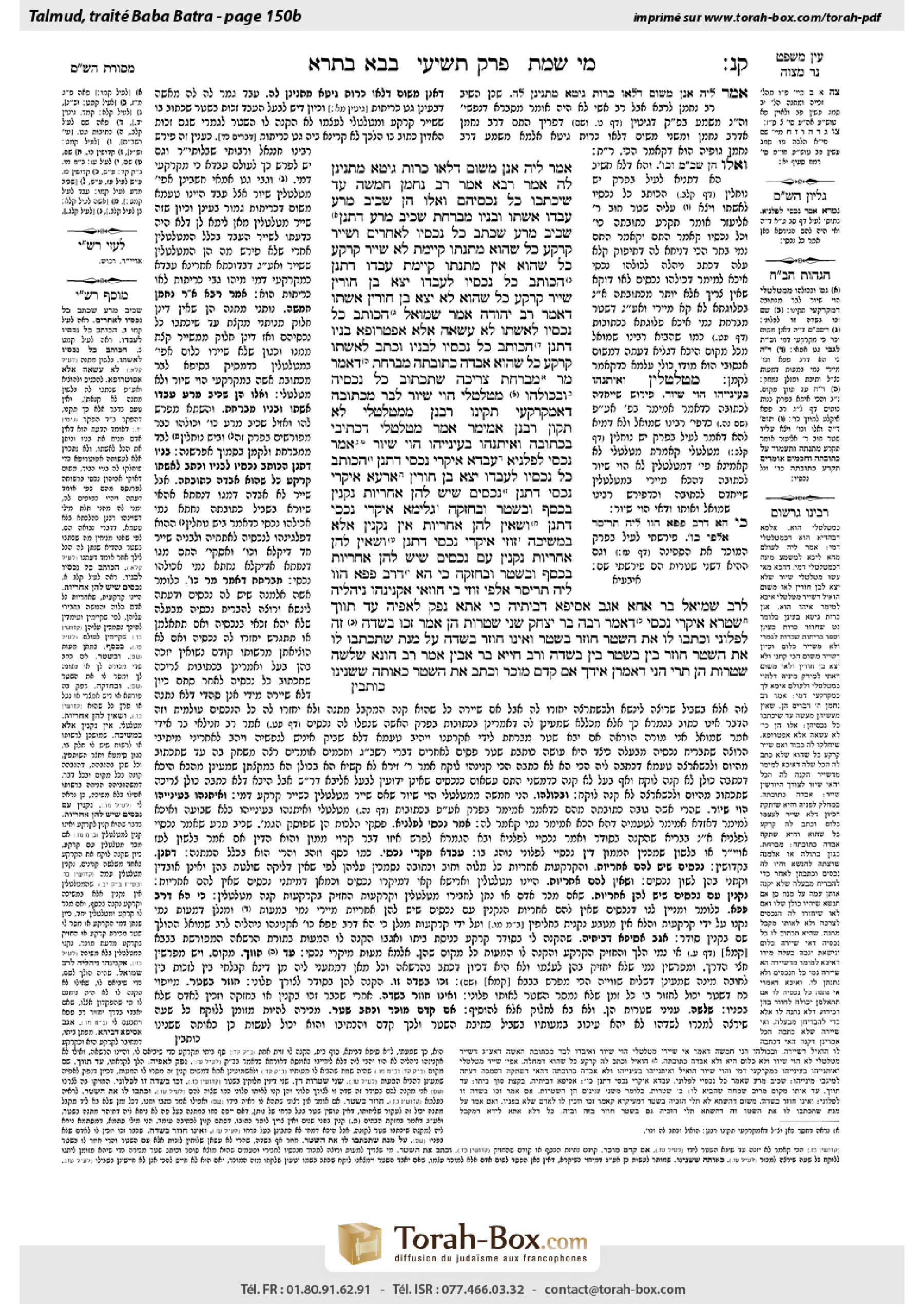
Bava Batra 150b: Talmud study for Daf Yomi
Study the Talmud for Daf Yomi with scanned pages, Hebrew text, English translations from Sefaria and AI-generated French translations.
Passage selection and English or AI-generated French translation are available where the scan has annotations. Daf Study is independent of Torah-Box and Sefaria.
Browse Bava Batra · בבא בתרא · All tractatesBava Batra 150b text and translations
This page of Bava Batra includes the Aramaic text, an English translation and an AI-generated French translation, alongside the scan above.
בבא בתרא ק״נ ב · Aramaic and Hebrew text
אֲמַר לֵיהּ: אֲנַן – מִשּׁוּם דְּלָאו כְּרוֹת גִּיטָּא מַתְנֵינַן לַהּ.
אָמַר רָבָא אָמַר רַב נַחְמָן: חֲמִשָּׁה עַד שֶׁיִּכְתְּבוּ כָּל נִכְסֵיהֶם; וְאֵלּוּ הֵן: שְׁכִיב מְרַע, עַבְדּוֹ, אִשְׁתּוֹ, וּבָנָיו, מַבְרַחַת.
שְׁכִיב מְרַע – דִּתְנַן: שְׁכִיב מְרַע שֶׁכָּתַב כׇּל נְכָסָיו לַאֲחֵרִים, וְשִׁיֵּיר קַרְקַע כׇּל שֶׁהוּא – מַתְּנָתוֹ קַיֶּימֶת; לֹא שִׁיֵּיר קַרְקַע כָּל שֶׁהוּא – אֵין מַתְּנָתוֹ קַיֶּימֶת.
עַבְדּוֹ – דִּתְנַן: הַכּוֹתֵב כׇּל נְכָסָיו לְעַבְדּוֹ – יָצָא בֶּן חוֹרִין, שִׁיֵּיר קַרְקַע כָּל שֶׁהוּא – לֹא יָצָא בֶּן חוֹרִין.
אִשְׁתּוֹ – דְּאָמַר רַב יְהוּדָה אָמַר שְׁמוּאֵל: הַכּוֹתֵב כׇּל נְכָסָיו לְאִשְׁתּוֹ – לֹא עֲשָׂאָהּ אֶלָּא אַפֹּטְרוֹפָּא.
בָּנָיו – דִּתְנַן: הַכּוֹתֵב כׇּל נְכָסָיו לְבָנָיו, וְכָתַב לְאִשְׁתּוֹ קַרְקַע כׇּל שֶׁהוּא – אִבְּדָה כְּתוּבָּתָהּ.
מַבְרַחַת – דְּאָמַר מָר: מַבְרַחַת צְרִיכָה שֶׁתִּכְתּוֹב כׇּל נְכָסֶיהָ.
וּבְכוּלְּהוּ מִטַּלְטְלֵי הָוֵי שִׁיּוּר, לְבַר מִכְּתוּבָה – דְּאַמְּקַרְקְעֵי תַּקִּינוּ רַבָּנַן, מִמִּטַּלְטְלֵי לָא תַּקּוּן רַבָּנַן.
אַמֵּימָר אָמַר: מִטַּלְטְלֵי דִּכְתִיבִי בִּכְתוּבָּה, וְאִיתַנְהוּ בְּעֵינַיְיהוּ – הָוֵי שִׁיּוּר.
אָמַר ״נִכְסַי לִפְלָנְיָא״ – עַבְדָּא אִיקְּרִי ״נִכְסֵי״, דִּתְנַן: הַכּוֹתֵב כׇּל נְכָסָיו לְעַבְדּוֹ – יָצָא בֶּן חוֹרִין. אַרְעָא אִיקְּרִי ״נִכְסֵי״, דִּתְנַן: נְכָסִים שֶׁיֵּשׁ לָהֶן אַחְרָיוּת, נִקְנִין בְּכֶסֶף וּבִשְׁטָר וּבַחֲזָקָה. גְּלִימָא אִיקְּרִי ״נִכְסֵי״, דִּתְנַן: וְשֶׁאֵין לָהֶן אַחְרָיוּת – אֵין נִקְנִין אֶלָּא בִּמְשִׁיכָה.
זוּזֵי אִיקְּרִי ״נִכְסֵי״, דִּתְנַן: וְשֶׁאֵין לָהֶן אַחְרָיוּת נִקְנִין עִם נְכָסִים שֶׁיֵּשׁ לָהֶן אַחְרָיוּת – בְּכֶסֶף וּבִשְׁטָר וּבַחֲזָקָה. כִּי הָא דְּרַב פָּפָּא הֲווֹ לֵיהּ תְּרֵיסַר אַלְפֵי זוּזֵי בֵּי חוֹזָאֵי, אַקְנִינְהוּ נִיהֲלֵיהּ לְרַב שְׁמוּאֵל בַּר אַחָא אַגַּב אַסִּיפָּא דְבֵיתֵיהּ. כִּי אֲתָא, נְפַק לְאַפֵּיהּ עַד ״תְּווֹךְ״.
שְׁטָרָא אִיקְּרִי ״נִכְסֵי״, דְּאָמַר רַבָּה בַּר יִצְחָק: שְׁנֵי שְׁטָרוֹת הֵן; אָמַר ״זְכוּ בְּשָׂדֶה זֶה לִפְלוֹנִי, וְכִתְבוּ לוֹ אֶת הַשְּׁטָר״ – חוֹזֵר בַּשְּׁטָר, וְאֵינוֹ חוֹזֵר בַּשָּׂדֶה. ״עַל מְנָת שֶׁתִּכְתְּבוּ לוֹ אֶת הַשְּׁטָר״ – חוֹזֵר בֵּין בַּשְּׁטָר בֵּין בַּשָּׂדֶה.
וְרַב חִיָּיא בַּר אָבִין אָמַר רַב הוּנָא: שְׁלֹשָׁה שְׁטָרוֹת הֵן; תְּרֵי – הָנֵי דַּאֲמַרַן, אִידַּךְ – אִם קָדַם מוֹכֵר וְכָתַב אֶת הַשְּׁטָר, כְּאוֹתָהּ שֶׁשָּׁנִינוּ:
Bava Batra 150b · English translation
Rav Ashi said to Ravina: The reason the slave is not emancipated if the master reserved part of the property for himself is not that the slave is included in the property that the owner reserved for himself. Rather, we teach this halakha as being due to the fact that the document is not a bill of manumission that completely severs the bond between the slave and the master.
§ Rava says that Rav Naḥman says: There are five types of gifts to which specific halakhot apply, but the halakhot do not apply until the owners write a deed granting all of their property to another without reserving anything for themselves, and they are as follows: The gift of a person on his deathbed, a gift to one’s Canaanite slave, a gift to one’s wife, a gift to one’s sons, and the gift of a woman who shelters her property from her prospective husband by transferring her property to another before her marriage. In this latter case the Sages instituted that if her husband dies or divorces her she can reclaim the property.
The Gemara explains each of these cases: In the case of a gift of a person on his deathbed, this is as we learned in the mishna (146b): With regard to a person on his deathbed who wrote a deed granting all of his property to others, and he reserved for himself any amount of land, his gift stands even if he subsequently recovers. If he did not reserve for himself any amount of land, and he recovered, his gift does not stand, as the gift was conditional upon his death, since evidently he did not intend to leave himself without means of support if he survived.
In the case of a gift to one’s slave, this is as we learned in a mishna (Pe’a 3:8): With regard to one who writes a deed granting all of his property to his Canaanite slave, the slave has been emancipated, but if he reserved for himself any amount of land, then he has not been emancipated, as perhaps he reserved the slave for himself as well.
In the case of a gift to one’s wife, this is as Rav Yehuda says that Shmuel says: One who writes a deed granting all of his property to his wife renders her only a steward of his property, i.e., he intends only to place her in charge of the property and she does not acquire it. According to Rav Naḥman, this applies only if he did not reserve any part of the property for himself.
In the case of a gift to one’s sons, this is as we learned in a mishna (Pe’a 3:7): With regard to one who writes a deed granting all of his property to his sons, and he writes in the deed that he grants any amount of land to his wife, she forfeits payment of her marriage contract. If he reserves any amount of land for himself, his wife does not forfeit payment of her marriage contract.
In the case of a gift of a woman who shelters her property from her intended husband, this is as the Master says: In the case of a woman who wishes to shelter her property from her prospective husband, she must write a deed granting all of her property to another. If she reserves for herself any amount of property, she cannot reclaim the property if she is widowed or divorced.
The Gemara concludes: With regard to all of these cases, reserving movable property is considered a significant reserving of property, except with regard to a woman’s marriage contract. If one grants all of his property to his sons except for any amount of land, which he gives to his wife, and he reserves for himself only movable property, his wife forfeits payment of her marriage contract, as nothing remains in the husband’s possession from which she is entitled to collect payment. This is because the Sages instituted that the lien on the marriage contract is placed on land, and the Sages did not institute that the marriage contract can be collected from movable property.
Ameimar said: With regard to movable property that is explicitly written in the marriage contract as property from which the debt may be collected and is still extant, if the husband reserves this property for himself, this is considered a significant reserving of property, and his wife does not forfeit payment of her marriage contract.
§ If one said: My property shall go to so-and-so, anything that is referred to as property is included in the gift. A Canaanite slave is called property, as we learned in a mishna (Pe’a 3:8): With regard to one who writes, i.e., gives via a document, all of his property to his Canaanite slave, the slave has been emancipated. Land is called property, as we learned in a mishna (Kiddushin 26a): Property that serves as a guarantee, i.e., land, can be acquired by means of money, by means of a deed, or by taking possession of it. A cloak, as well as other garments and movable property, is called property, as we learned in that same mishna: And property that does not serve as a guarantee, i.e., movable property, can be acquired only by pulling.
Money [zuzei] is called property, as we learned in that same mishna: And property that does not serve as a guarantee can be acquired together with property that serves as a guarantee by means of money, by means of a deed, or by taking possession of it. Money is among the types of property that can be acquired by means of the acquisition of land, as is evident from this incident involving Rav Pappa, who had twelve thousand dinars loaned to the people of Bei Ḥozai. Rav Pappa transferred ownership of the money to Rav Shmuel bar Aḥa, who was traveling to Bei Ḥozai, by means of transferring ownership of the threshold of his house, so that Rav Shmuel bar Aḥa could collect the money. When Rav Shmuel bar Aḥa came back with the money, Rav Pappa was so pleased that he went out as far as Tavakh to meet him.
A deed is called property, as Rabba bar Yitzḥak says: There are two types of deeds with regard to the acquisition of land. If one said to the witnesses: Acquire this field on behalf of so-and-so and write the deed for him as proof of the sale, the giver can retract the deed but he cannot retract the transfer of ownership of the field once the other party has taken possession of it. If one said: Acquire this field on behalf of so-and-so on the condition that you write the deed for him, the giver can retract both the deed and the transfer of the field, as he stipulated that the acquisition of the field is dependent on the writing of the deed.
And Rav Ḥiyya bar Avin says that Rav Huna says: There are three types of deeds. Two are those that we stated above, and the other is as follows: If the seller wrote the deed in advance and kept it until the buyer would come and pay him. The Gemara adds parenthetically: This is like that halakha that we learned in a mishna (167b):
Bava Batra 150b · Traduction française (IA)
Rav Ashi a dit à Ravina : La raison pour laquelle un esclave n'est pas emancipé si le maître a réservé une partie de la propriété pour lui-même n'est pas que l'esclave soit inclus dans la propriété que l'owner a réservé pour lui-même. Plutôt, nous enseignons cette halakha en raison du fait que le document n'est pas un acte de manumission qui coupe entièrement le lien entre l'esclave et son maître.
§ Rava dit que Rav Naḥman dit : Il existe cinq types de dons auxquels s'appliquent des halakhot spécifiques, mais ces halakhot ne s'appliquent que lorsque les propriétaires écrivent un acte transférant toute leur propriété à un autre sans réservation pour eux-mêmes, et ils sont les suivants : Le don d'une personne sur son lit de mort, un don à un esclave cananéen, un don à sa femme, un don à ses fils, et le don d'une femme qui protège sa propriété de son futur mari en transférant sa propriété à un autre avant son mariage. Dans ce dernier cas, les Sages ont institué que si son mari meurt ou divorce d'elle, elle peut récupérer la propriété.
La Guemara explique chacun de ces cas : Dans le cas d'un don d'une personne sur son lit de mort, cela correspond à ce que nous avons appris dans la mishna (146b) : Concernant une personne sur son lit de mort qui a écrit un acte transférant toute sa propriété à d'autres, et qui a réservé pour lui-même une quantité de terre, son don est valide même s'il récupère ensuite. Si il n'a réservé pour lui-même aucune quantité de terre, et qu'il récupère, son don n'est pas valide, car le don était conditionnel à sa mort, puisque manifestement il ne voulait pas le laisser sans moyens de subsistance s'il survivait.
Dans le cas d'un don à un esclave, cela correspond à ce que nous avons appris dans une mishna (Pe’a 3:8) : Concernant celui qui écrit un acte transférant toute sa propriété à son esclave cananéen, l'esclave est emancipé, mais si celui-ci réservait pour lui-même une quantité de terre, alors il n'est pas emancipé, car peut-être il a réservé l'esclave pour lui-même également.
Dans le cas d'un don à sa femme, cela correspond à ce que Rav Yehuda dit que Shmuel dit : Celui qui écrit un acte transférant toute sa propriété à sa femme lui donne seulement la charge de sa propriété, c'est-à-dire qu'il veut simplement la placer en charge de la propriété et qu'elle ne l'acquiert pas. Selon Rav Naḥman, cela s'applique uniquement si celui-ci n'a réservé aucune partie de la propriété pour lui-même.
Dans le cas d'un don à ses fils, cela correspond à ce que nous avons appris dans une mishna (Pe’a 3:7) : Concernant celui qui écrit un acte transférant toute sa propriété à ses fils, et qui écrit dans l'acte qu'il donne une quantité de terre à sa femme, elle perd le paiement de son mariage. Si celui-ci réservait une quantité de terre pour lui-même, sa femme ne perd pas le paiement de son mariage.
Dans le cas d'une femme qui donne un don et qui protège sa propriété contre son mari prévu, cela correspond à ce que le Maître dit : Dans le cas d'une femme qui veut protéger sa propriété contre son futur mari, elle doit écrire un acte transférant toute sa propriété à un autre. Si elle réserve pour elle-même une quantité de propriété, elle ne peut récupérer la propriété si elle est veuve ou divorcée.
La Guemara conclut : Concernant tous ces cas, la réservation de biens mobiliers est considérée comme une réservation significative, sauf concernant le contrat de mariage d'une femme. Si l'on donne toute sa propriété à ses fils, sauf une quantité de terre qu'il donne à sa femme, et qu'il réserve pour lui-même seulement des biens mobiliers, sa femme perd le paiement de son mariage, car il ne reste plus rien dans la possession du mari dont elle peut récupérer le paiement. Cela est dû au fait que les Sages ont institué que le droit de réclamation sur le contrat de mariage est placé sur la terre, et les Sages n'ont pas institué que le contrat de mariage puisse être récupéré à partir des biens mobiliers.
Ameimar a dit : Concernant les biens mobiliers qui sont explicitement mentionnés dans le contrat de mariage comme des biens à partir desquels la dette peut être récupérée et qui sont encore présents, si le mari réserve ces biens pour lui-même, cela est considéré comme une réservation significative, et sa femme ne perd pas le paiement de son mariage.
§ Si l'on dit : Ma propriété ira à tel ou tel, tout ce qui est appelé propriété est inclus dans le don. Un esclave cananéen est appelé propriété, comme nous l'avons appris dans une mishna (Pe’a 3:8) : Concernant celui qui écrit, c'est-à-dire donne par un document, toute sa propriété à son esclave cananéen, l'esclave est emancipé. La terre est appelée propriété, comme nous l'avons appris dans une mishna (Kiddushin 26a) : La propriété qui sert de garantie, c'est-à-dire la terre, peut être acquise par l'argent, par un acte ou par la possession. Une cape, ainsi que d'autres vêtements et biens mobiliers, est appelée propriété, comme nous l'avons appris dans la même mishna : Et la propriété qui ne sert pas de garantie, c'est-à-dire les biens mobiliers, peut être acquise uniquement par la saisie.
L'argent [zuzei] est appelé propriété, comme nous l'avons appris dans la même mishna : Et la propriété qui ne sert pas de garantie peut être acquise ensemble avec la propriété qui sert de garantie par l'argent, par un acte ou par la possession. L'argent est parmi les types de propriété qui peuvent être acquis par l'acquisition de la terre, comme on le voit à partir de cet incident concernant Rav Pappa, qui avait douze mille dinars prêtés aux habitants de Bei Ḥozai. Rav Pappa a transféré la propriété de l'argent à Rav Shmuel bar Aḥa, qui voyageait vers Bei Ḥozai, en transférant la propriété du seuil de sa maison, afin que Rav Shmuel bar Aḥa puisse récupérer l'argent. Lorsque Rav Shmuel bar Aḥa est revenu avec l'argent, Rav Pappa était si content qu'il est allé jusqu'à Tavakh pour le rencontrer.
Un acte est appelé propriété, comme le dit Rabba bar Yitzḥak : Il y a deux types d'actes en ce qui concerne l'acquisition de terrain. Si l'on dit aux témoins : Acquérir ce champ au nom de tel et écrire l'acte à son intention comme preuve de la vente, le donneur peut récuser l'acte mais il ne peut pas récuser la transmission de propriété du champ une fois que l'autre partie a pris possession de celui-ci. Si l'on dit : Acquérir ce champ au nom de tel sous condition que vous écriviez l'acte à son intention, le donneur peut récuser à la fois l'acte et la transmission du champ, car il a stipulé que l'acquisition du champ dépend de l'écriture de l'acte.
Et Rav Ḥiyya bar Avin dit que Rav Huna dit : Il y a trois types d'actes. Deux sont ceux que nous avons évoqués ci-dessus, et le troisième est le suivant : Si le vendeur a écrit l'acte à l'avance et l'a gardé jusqu'à ce que l'acheteur vienne payer. La Guemara ajoute en parenthèse : Cela ressemble à cette halakha que nous avons apprise dans une mitsva (167b) :
Traduction française générée par IA à partir de l’édition anglaise de Sefaria. Vérifie toujours un passage avec le texte source.
Text from Sefaria: William Davidson Edition - Vocalized Aramaic (CC BY NC); William Davidson Edition - English (CC BY NC).