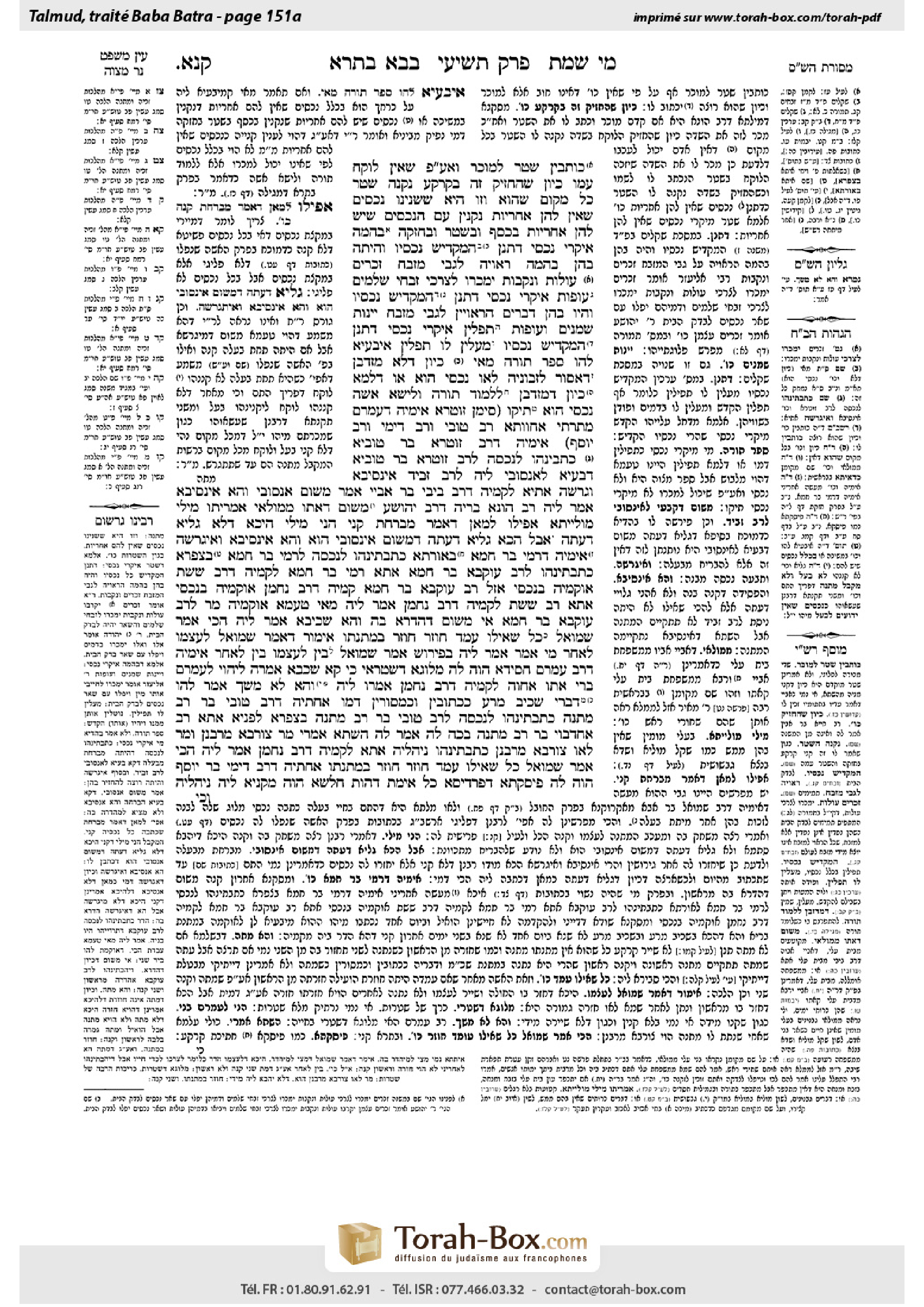
Bava Batra 151a: Talmud study for Daf Yomi
Study the Talmud for Daf Yomi with scanned pages, Hebrew text, English translations from Sefaria and AI-generated French translations.
Passage selection and English or AI-generated French translation are available where the scan has annotations. Daf Study is independent of Torah-Box and Sefaria.
Browse Bava Batra · בבא בתרא · All tractatesBava Batra 151a text and translations
This page of Bava Batra includes the Aramaic text, an English translation and an AI-generated French translation, alongside the scan above.
בבא בתרא קנ״א א · Aramaic and Hebrew text
כּוֹתְבִין שְׁטָר לַמּוֹכֵר וְאַף עַל פִּי שֶׁאֵין לוֹקֵחַ עִמּוֹ; כֵּיוָן שֶׁהֶחְזִיק זֶה בַּקַּרְקַע – נִקְנָה שְׁטָר כׇּל מָקוֹם שֶׁהוּא. וְזוֹ הִיא שֶׁשָּׁנִינוּ: נְכָסִים שֶׁאֵין לָהֶן אַחְרָיוּת, נִקְנִין עִם הַנְּכָסִים שֶׁיֵּשׁ לָהֶן אַחְרָיוּת – בְּכֶסֶף וּבִשְׁטָר וּבַחֲזָקָה.
בְּהֵמָה אִיקְּרִי ״נִכְסֵי״, דִּתְנַן: הַמַּקְדִּישׁ נְכָסָיו וְהָיְתָה בָּהֶן בְּהֵמָה רְאוּיָה לְגַבֵּי מִזְבֵּחַ; זְכָרִים – עוֹלוֹת, וּנְקֵבוֹת – יִמָּכְרוּ לְצׇרְכֵי זִבְחֵי שְׁלָמִים. עוֹפוֹת אִיקְּרִי ״נִכְסֵי״, דִּתְנַן: הַמַּקְדִּישׁ נְכָסָיו וְהָיוּ בָּהֶן דְּבָרִים הָרְאוּיִין לְגַבֵּי מִזְבֵּחַ – יֵינוֹת, שְׁמָנִים וְעוֹפוֹת.
תְּפִלִּין אִיקְּרִי ״נִכְסֵי״, דִּתְנַן: הַמַּקְדִּישׁ נְכָסָיו, מַעֲלִין לוֹ תְּפִלִּין. אִיבַּעְיָא לְהוּ: סֵפֶר תּוֹרָה מַאי? כֵּיוָן דְּלָא מִזְדַּבַּן – דְּאָסוּר לְזַבּוֹנֵיהּ – לָאו נִכְסֵי הוּא; אוֹ דִלְמָא, כֵּיוָן דְּמִזְדַּבַּן לִלְמוֹד תּוֹרָה וְלִישָּׂא אִשָּׁה – נִכְסֵי הוּא? תֵּיקוּ.
(סִימָן: זוּטְרָא, אִימֵּיהּ דְּעַמְרָם, מִתַּרְתֵּי אַחְווֹתָא, רַב טוֹבִי וְרַב דִּימִי וְרַב יוֹסֵף.)
אִימֵּיהּ דְּרַב זוּטְרָא בַּר טוֹבִיָּא כַּתְבִינְהוּ לְנִכְסַהּ לְרַב זוּטְרָא בַּר טוֹבִיָּא, דְּבָעֲיָא לְאִנְּסוֹבֵי לֵיהּ לְרַב זְבִיד. אִינְּסִיבָא וְגָרְשַׁהּ. אָתְיָא לְקַמֵּיהּ דְּרַב בִּיבִי בַּר אַבָּיֵי, אֲמַר: מִשּׁוּם אִנְּסוֹבֵי – וְהָא אִינְּסִיבָא.
אֲמַר לֵיהּ רַב הוּנָא בְּרֵיהּ דְּרַב יְהוֹשֻׁעַ: מִשּׁוּם דְּאַתּוּ מִמּוּלָאֵי, אָמְרִיתוּ מִילֵּי מוּלְיָיתָא? אֲפִילּוּ לְמַאן דְּאָמַר מַבְרַחַת קָנֵי, הָנֵי מִילֵּי הֵיכָא דְּלָא גַלְּיָא דַּעְתַּהּ, אֲבָל הָכָא – גַלְּיָא דַּעְתַּהּ דְּמִשּׁוּם אִינְּסוֹבֵי הוּא, וְהָא אִינְּסִיבָא וְאִיגָּרְשָׁה.
אִימֵּיהּ דְּרָמֵי בַּר חָמָא, בְּאוּרְתָּא כְּתַבְתִּינְהוּ לְנִכְסַהּ לְרָמִי בַּר חָמָא, בְּצַפְרָא כְּתַבְתִּינְהוּ לְרַב עוּקְבָא בַּר חָמָא. אֲתָא רָמֵי בַּר חָמָא לְקַמֵּיהּ דְּרַב שֵׁשֶׁת, אוֹקְמֵיהּ בְּנִכְסֵי. אֲזַל רַב עוּקְבָא בַּר חָמָא קַמֵּיהּ דְּרַב נַחְמָן, אוֹקְמֵיהּ בְּנִכְסֵי.
אֲתָא רַב שֵׁשֶׁת לְקַמֵּיהּ דְּרַב נַחְמָן, אֲמַר לֵיהּ: מַאי טַעְמָא אוֹקְמֵיהּ מָר לְרַב עוּקְבָא בַּר חָמָא? אִי מִשּׁוּם דַּהֲדַרָא בַּהּ – וְהָא שְׁכִיבָא! אֲמַר לֵיהּ, הָכִי אָמַר שְׁמוּאֵל: כֹּל שֶׁאִילּוּ עָמַד – חוֹזֵר, חוֹזֵר בְּמַתְּנָתוֹ.
אֵימוֹר דְּאָמַר שְׁמוּאֵל – לְעַצְמוֹ; לְאַחֵר מִי אָמַר? אֲמַר לֵיהּ, בְּפֵירוּשׁ אָמַר שְׁמוּאֵל: בֵּין לְעַצְמוֹ בֵּין לְאַחֵר.
אִימֵּיהּ דְּרַב עַמְרָם חֲסִידָא הֲוָה לַהּ מְלוּגָא דִּשְׁטָרֵאי. כִּי קָא שָׁכְבָא, אָמְרָה: לֶיהֱוֵי לְעַמְרָם בְּרִי. אֲתוֹ אֲחוֹהָ לְקַמֵּיהּ דְּרַב נַחְמָן, אֲמַרוּ לֵיהּ: וְהָא לָא מְשַׁךְ! אֲמַר לְהוּ: דִּבְרֵי שְׁכִיב מְרַע כִּכְתוּבִין וְכִמְסוּרִין דָּמוּ.
אֲחָתֵיהּ דְּרַב טוֹבִי בַּר רַב מַתְנָה כְּתַבְתִּינְהוּ לְנִכְסַהּ לְרַב טוֹבִי בַּר רַב מַתְנָה – בְּצַפְרָא. לְפַנְיָא, אֲתָא רַב אַחָדְבוּי בַּר רַב מַתְנָה בְּכָה לַהּ – אֲמַר לַהּ, הַשְׁתָּא אָמְרִי: מָר צוּרְבָּא מֵרַבָּנַן, וּמָר לָאו צוּרְבָּא מֵרַבָּנַן! כְּתַבְתִּינְהוּ נִיהֲלֵיהּ. אֲתָא לְקַמֵּיהּ דְּרַב נַחְמָן, אֲמַר לֵיהּ, הָכִי אָמַר שְׁמוּאֵל: כׇּל שֶׁאִילּוּ עָמַד חוֹזֵר, חוֹזֵר בְּמַתְּנָתוֹ.
אֲחָתֵיהּ דְּרַב דִּימִי בַּר יוֹסֵף הֲוָה לַהּ פִּיסְקְתָא דְפַרְדֵּיסָא, כׇּל אֵימַת דַּהֲוָת חָלְשָׁא הֲוָה מַקְנְיָא לֵיהּ נִיהֲלֵיהּ,
Bava Batra 151a · English translation
A scribe may write a deed of sale for the seller of property at the seller’s request, even if the buyer is not with him when he presents his request, as the deed obligates only the seller. In this case, once this one, the buyer, has taken possession of the land, the deed is acquired, wherever it is. And this is as it is stated in the mishna that we learned (Kiddushin 26a): Property that does not serve as a guarantee can be acquired together with the property that serves as a guarantee by means of money, by means of a deed, or by taking possession of it. One can learn from this that a deed is included in the term: Property that does not serve as a guarantee.
An animal is called property, as we learned in a mishna (Shekalim 12a): In a case of one who consecrated his property, and on the property there were animals fit to be sacrificed upon the altar, male animals are sacrificed as burnt-offerings, and female animals are sold for the purpose of being sacrificed as peace-offerings. Birds are called property, as we learned in a mishna (Shekalim 12a): In a case of one who consecrated his property, and on the property there were items that were fit to be sacrificed upon the altar, e.g., wines, oils, and birds, Rabbi Eliezer says: They are sold for the needs of that kind of item, i.e., to individuals who will use them as such.
Phylacteries are called property, as we learned in a mishna (Arakhin 23b): With regard to one who consecrates his property, the value of his phylacteries is assessed for him and he redeems them by paying their value to the Temple treasury. A dilemma was raised before the Sages: With regard to a Torah scroll, what is the halakha? Is it considered property or not? Does one say that since it is not sold, as it is prohibited to sell a Torah scroll, it is therefore not considered property? Or perhaps one says that since it may be sold in order to enable one to study Torah or to marry a woman, it is considered property. The Gemara concludes: The dilemma shall stand unresolved.
§ The Gemara presents a mnemonic for the series of incidents stated below: Zutra, the mother, of Amram, from two sisters, Rav Tovi, and Rav Dimi and Rav Yosef.
The mother of Rav Zutra bar Toviyya wrote a deed granting her property to Rav Zutra bar Toviyya, explaining that she was doing so because she wanted to get married to Rav Zevid, and she did not want him to acquire her property. She married Rav Zevid, and he divorced her. She came before Rav Beivai bar Abaye to claim her property from her son. Rav Beivai said: She transferred her property because she wanted to get married, and she married. Since her intentions were fulfilled, even though she subsequently was divorced, the gift is a valid gift.
Rav Huna, son of Rav Yehoshua, said to Rav Beivai: Is it because you come from a line of truncated [mula’ei] people, from the house of the High Priest Eli, whose descendants were condemned to premature death (see I Samuel 2:31), that you say truncated [mulyata] and unsound matters? Even according to the one who says that the deed of a woman who shelters her property from her intended husband effects acquisition, and the woman cannot reclaim the property, this matter applies where she did not reveal her intentions in transferring ownership of her property. But here, she revealed her intentions that she transferred the property because she wanted to marry; and she married, but was divorced. Therefore, since she is no longer married, she can reclaim the property.
The mother of Rami bar Ḥama wrote a deed in the evening granting her property to Rami bar Ḥama. In the morning of the following day, she wrote a deed granting her property to his brother, Rav Ukva bar Ḥama. Rami bar Ḥama came before Rav Sheshet, who established him as the owner of the property, as the deed transferring the property to him preceded the gift to his brother. Rav Ukva bar Ḥama came before Rav Naḥman, who established him as the owner of the property.
Rav Sheshet came before Rav Naḥman and said to him: What is the reason that the Master established Rav Ukva bar Ḥama as the owner of the property? If it is because she retracted her gift, but didn’t she die? Since the gift of a person on his deathbed is considered valid, Rami bar Ḥama already acquired the property in the evening. Rav Naḥman said to Rav Sheshet: This is what Shmuel says: With regard to the gift of a person on his deathbed, in any case where he could retract his gift if he were to recover, i.e., if he transferred ownership of all of his property, even if he does not recover, he can retract his gift.
Rav Sheshet responded: Say that Shmuel said that he can retract his gift if he wants to retain the property for himself, but if he wants to retract his gift in order to give it to another, did he also say that he can do so? Rav Naḥman said to Rav Sheshet: Shmuel explicitly said that he can retract his gift both in order to retain the property for himself and to grant it to another.
The mother of Rav Amram the Pious had a bundle [meloga] of promissory notes. When she was dying, she said: Let these promissory notes be for Amram, my son. His brothers came before Rav Naḥman. They said to Rav Naḥman: But Rav Amram did not pull the bundle of documents, and since an act of acquisition was not performed he did not acquire them. Rav Naḥman said to them: An act of acquisition was not required, because the statement of a person on his deathbed is considered as written and as though the documents were delivered to the recipient.
The sister of Rav Tovi bar Rav Mattana wrote a deed in the morning granting her property to Rav Tovi bar Rav Mattana. In the evening another brother, Rav Aḥadvoi bar Rav Mattana, came and cried to her. Rav Aḥadvoi said to her: Now people will say that you gave your property to Rav Tovi because this Master, Rav Tovi, is a Torah scholar, and that Master, Rav Aḥadvoi, is not a Torah scholar. She wrote a deed granting the property to him. Rav Tovi came before Rav Naḥman. Rav Naḥman said to Rav Tovi: This is what Shmuel says: With regard to the gift of a person on his deathbed, in any case where he could retract his gift if he were to recover, even if he does not recover, he can retract his gift, and therefore the property belongs to Rav Aḥadvoi.
The sister of Rav Dimi bar Yosef had a tract of land in an orchard. Whenever she was sick and thought that she was dying, she would transfer ownership of the orchard to Rav Dimi,
Bava Batra 151a · Traduction française (IA)
Un scribe peut rédiger un acte de vente pour le vendeur d'une propriété à la demande du vendeur, même si l'acheteur n'est pas présent lorsqu'il formule sa demande, car l'acte engage uniquement le vendeur. Dans ce cas, une fois que cet acheteur a pris possession de la terre, l'acte est acquis, où qu'il soit. Et c'est ainsi qu'il est dit dans la mitsna que nous avons appris (Kiddushin 26a) : Une propriété qui ne sert pas de garantie peut être acquise ensemble avec la propriété qui sert de garantie par l'intermédiaire de l'argent, par l'intermédiaire d'un acte, ou par la prise de possession. On peut en tirer la conclusion que l'acte est inclus dans le terme : Une propriété qui ne sert pas de garantie.
Un animal est appelé propriété, comme nous l'avons appris dans une mitsna (Shekalim 12a) : Dans le cas d'une personne qui a consacré sa propriété, et sur cette propriété il y avait des animaux aptes à être sacrifiés sur l'autel, les mâles sont sacrifiés comme offrandes brûlées, et les femelles sont vendus à des fins de sacrifice comme offrandes de paix. Les oiseaux sont appelés propriété, comme nous l'avons appris dans une mitsna (Shekalim 12a) : Dans le cas d'une personne qui a consacré sa propriété, et sur cette propriété il y avait des objets aptes à être sacrifiés sur l'autel, par exemple, des vins, des huiles et des oiseaux, Rabbi Eliezer dit : Ils sont vendus pour les besoins de ce type d'objet, c'est-à-dire pour des individus qui les utiliseront ainsi.
Les phylactères sont appelés propriété, comme nous l'avons appris dans une mitsna (Arakhin 23b) : En ce qui concerne une personne qui consacre sa propriété, la valeur de ses phylactères est évaluée pour lui et il les rachète en payant leur valeur au trésor du Temple. Un dilemme a été soulevé devant les Sages : En ce qui concerne un rouleau de Torah, quelle est la halakha ? Est-il considéré comme propriété ou non ? Dit-on que puisqu'il n'est pas vendu, puisqu'il est interdit de vendre un rouleau de Torah, il n'est donc pas considéré comme propriété ? Ou bien dit-on que puisqu'il peut être vendu afin de permettre à quelqu'un d'étudier la Torah ou de se marier, il est considéré comme propriété. La Guemara conclut : Ce dilemme restera sans solution.
§ La Guemara présente un mnémonique pour la série d'incidents évoqués ci-dessous : Zutra, la mère, d'Amram, de deux sœurs, Rav Tovi, et Rav Dimi et Rav Yosef.
La mère de Rav Zutra bar Toviyya a rédigé un acte de donation de sa propriété à Rav Zutra bar Toviyya, expliquant qu'elle le faisait parce qu'elle voulait se marier avec Rav Zevid et qu'elle ne voulait pas qu'il acquière sa propriété. Elle s'est mariée avec Rav Zevid, et il l'a divorcée. Elle est venue devant Rav Beivai bar Abaye pour réclamer sa propriété à son fils. Rav Beivai a dit : Elle a transféré sa propriété parce qu'elle voulait se marier, et elle s'est mariée. Puisque ses intentions ont été accomplies, même si elle a ensuite été divorcée, la donation est une donation valide.
Rav Huna, fils de Rav Yehoshua, a dit à Rav Beivai : Est-ce à cause de ton origine provenant d'une lignée de personnes tronquées [mula’ei], de la maison du grand prêtre Eli, dont les descendants étaient condamnés à la mort prématurée (voir I Samuel 2:31), que tu dis des choses tronquées [mulyata] et incohérentes ? Même selon celui qui dit que le don d'une femme qui cache sa propriété de son mari prévu effectue l'acquisition, et la femme ne peut pas récupérer la propriété, cette affaire s'applique là où elle n'a pas dévoilé ses intentions dans le transfert de propriété. Mais ici, elle a dévoilé ses intentions qu'elle transférait la propriété parce qu'elle voulait se marier ; et elle s'est mariée, mais a été divorcée. Par conséquent, puisqu'elle n'est plus mariée, elle peut récupérer la propriété.
La mère de Rami bar Ḥama a rédigé un acte de donation de sa propriété à Rami bar Ḥama. Le lendemain matin, elle a rédigé un autre acte de donation de sa propriété à son frère, Rav Ukva bar Ḥama. Rami bar Ḥama est venu devant Rav Sheshet, qui l'a établi comme propriétaire de la propriété, car l'acte transférant la propriété à lui avait précédé la donation à son frère. Rav Ukva bar Ḥama est venu devant Rav Naḥman, qui l'a établi comme propriétaire de la propriété.
Rav Sheshet est venu devant Rav Naḥman et lui a dit : Quel est le motif pour lequel le Maître a établi Rav Ukva bar Ḥama comme propriétaire de la propriété ? Si c'est parce qu'elle a rétracté sa donation, mais ne l'a-t-elle pas morte ? Puisque la donation d'une personne sur son lit de mort est considérée comme valide, Rami bar Ḥama a déjà acquis la propriété en fin de journée. Rav Naḥman a dit à Rav Sheshet : C'est ce que Shmuel dit : En ce qui concerne la donation d'une personne sur son lit de mort, dans tout cas où il pourrait rétracter sa donation s'il récupérait, c'est-à-dire si il transférait la propriété de toute sa propriété, même s'il ne récupère pas, il peut rétracter sa donation.
Rav Sheshet répondit : Dis que Shmuel a dit qu'il peut rétracter sa donation s'il veut conserver la propriété pour lui-même, mais si il veut rétracter sa donation afin de la donner à un autre, a-t-il aussi dit qu'il peut le faire ? Rav Naḥman dit à Rav Sheshet : Shmuel a explicitement dit qu'il peut rétracter sa donation à la fois pour conserver la propriété pour lui-même et pour la donner à un autre.
La mère de Rav Amram le Juste avait un paquet [meloga] de billets de créance. Lorsqu'elle était mourante, elle dit : Faites ces billets de créance appartenir à Amram, mon fils. Ses frères sont venus devant Rav Naḥman. Ils lui dirent : Mais Rav Amram n'a pas tiré le paquet de documents, et puisque l'acte d'acquisition n'a pas été effectué, il n'a pas acquis ces documents. Rav Naḥman dit à eux : L'acte d'acquisition n'était pas requis, car la déclaration d'une personne sur son lit de mort est considérée comme écrite et comme si les documents avaient été remis au destinataire.
La sœur de Rav Tovi bar Rav Mattana a rédigé un acte le matin lui confiant sa propriété à Rav Tovi bar Rav Mattana. Le soir, un autre frère, Rav Aḥadvoi bar Rav Mattana, est venu la supplier. Rav Aḥadvoi lui a dit : Maintenant les gens diront que vous avez donné votre propriété à Rav Tovi parce que ce maître, Rav Tovi, est un savant en Torah, et que ce maître, Rav Aḥadvoi, n'est pas un savant en Torah. Elle a rédigé un acte lui confiant la propriété à lui. Rav Tovi est venu devant Rav Naḥman. Rav Naḥman a dit à Rav Tovi : C'est ce que dit Shmuel : En ce qui concerne le don d'une personne sur son lit de mort, dans tout cas où il pourrait récuser son don s'il recouvre la santé, même s'il ne recouvre pas la santé, il peut récuser son don, et donc la propriété appartient à Rav Aḥadvoi.
La sœur de Rav Dimi bar Yosef possédait un terrain dans un verger. Quand elle était malade et croyait qu'elle allait mourir, elle transférait la propriété du verger à Rav Dimi.
Traduction française générée par IA à partir de l’édition anglaise de Sefaria. Vérifie toujours un passage avec le texte source.
Text from Sefaria: William Davidson Edition - Vocalized Aramaic (CC BY NC); William Davidson Edition - English (CC BY NC).