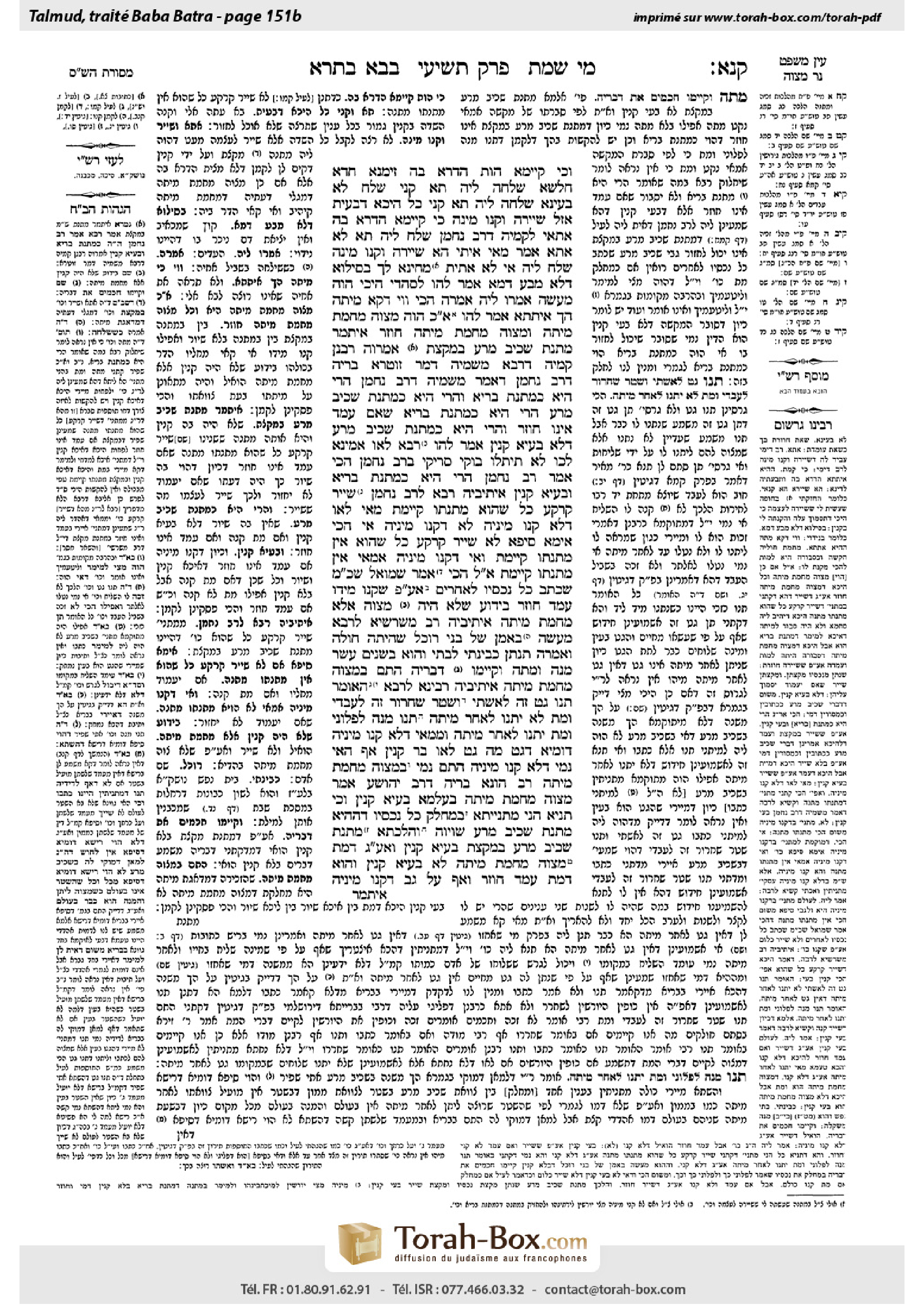
Bava Batra 151b: Talmud study for Daf Yomi
Study the Talmud for Daf Yomi with scanned pages, Hebrew text, English translations from Sefaria and AI-generated French translations.
Passage selection and English or AI-generated French translation are available where the scan has annotations. Daf Study is independent of Torah-Box and Sefaria.
Browse Bava Batra · בבא בתרא · All tractatesBava Batra 151b text and translations
This page of Bava Batra includes the Aramaic text, an English translation and an AI-generated French translation, alongside the scan above.
בבא בתרא קנ״א ב · Aramaic and Hebrew text
וְכִי קָיְימָא הֲוָת הָדְרָא בָּהּ. זִימְנָא חֲדָא חֲלַשָׁא, שְׁלַחָה לֵיהּ: תָּא קְנִי. שְׁלַח: לָא בָּעֵינָא. שְׁלַחָה לֵיהּ: תָּא קְנִי כֹּל הֵיכָא דְּבָעֵית. אֲזַל שַׁיַּירה וּקְנוֹ מִינַּהּ. כִּי קָיְימָא, הָדְרָא בָּהּ.
אֲתַאי לְקַמֵּיהּ דְּרַב נַחְמָן, שְׁלַח לֵיהּ: תָּא. לָא אֲתָא. אָמַר: מַאי אֵיתֵי? הָא שַׁיַּירִה וּקְנוֹ מִינַּהּ! שְׁלַח לֵיהּ: אִי לָא אָתֵית, מָחֵינָא לָךְ בְּסִילְוָא דְּלָא מַבַּע דְּמָא.
אֲמַר לְהוּ לְסָהֲדִי: הֵיכִי הֲוָה מַעֲשֶׂה? אֲמַרוּ לֵיהּ, אֲמַרָה הָכִי: ״וַוי דְּקָא מָיְתָה הָךְ אִיתְּתָא!״ אֲמַר לְהוּ: אִם כֵּן, הֲוָה מְצַוֶּה מֵחֲמַת מִיתָה, וּמְצַוֶּה מֵחֲמַת מִיתָה – חוֹזֵר.
אִיתְּמַר: מַתְּנַת שְׁכִיב מְרַע בְּמִקְצָת; אַמְרוּהָ רַבָּנַן קַמֵּיהּ דְּרָבָא מִשְּׁמֵיהּ דְּמָר זוּטְרָא בְּרֵיהּ דְּרַב נַחְמָן דְּאָמַר מִשְּׁמֵיהּ דְּרַב נַחְמָן: הֲרֵי הִיא כְּמַתְּנַת בָּרִיא, וַהֲרֵי הִיא כְּמַתְּנַת שְׁכִיב מְרַע. הֲרֵי הִיא כְּמַתְּנַת בָּרִיא – שֶׁאִם עָמַד אֵינוֹ חוֹזֵר, וַהֲרֵי הִיא כְּמַתְּנַת שְׁכִיב מְרַע – דְּלָא בָּעֲיָא קִנְיָן.
אֲמַר לְהוּ רָבָא, לָאו אָמֵינָא לְכוּ: לָא תִּיתְלוֹ בּוּקֵי סְרִיקֵי בְּרַב נַחְמָן? הָכִי אָמַר רַב נַחְמָן: הֲרֵי הִיא כְּמַתְּנַת בָּרִיא, וּבָעֲיָא קִנְיַן.
אֵיתִיבֵיהּ רָבָא לְרַב נַחְמָן: שִׁיֵּיר קַרְקַע כׇּל שֶׁהוּא – מַתְּנָתוֹ קַיֶּימֶת. מַאי, לָאו דְּלָא קְנוֹ מִינֵּיהּ? לָא, דִּקְנוֹ מִינֵּיהּ. אִי הָכִי, אֵימָא סֵיפָא: לֹא שִׁיֵּיר קַרְקַע כָּל שֶׁהוּא – אֵין מַתְּנָתוֹ קַיֶּימֶת. וְאִי דִּקְנוֹ מִינֵּיהּ, אַמַּאי אֵין מַתְּנָתוֹ קַיֶּימֶת?
אֲמַר לֵיהּ, הָכִי אָמַר שְׁמוּאֵל: שְׁכִיב מְרַע שֶׁכָּתַב כׇּל נְכָסָיו לַאֲחֵרִים, אַף עַל פִּי שֶׁקָּנוּ מִיָּדוֹ – עָמַד חוֹזֵר; בְּיָדוּעַ שֶׁלֹּא הָיָה מְצַוֶּה אֶלָּא מֵחֲמַת מִיתָה.
אֵיתִיבֵיהּ רַב מְשַׁרְשְׁיָא לְרָבָא: מַעֲשֶׂה בְּאִמָּן שֶׁל בְּנֵי רוֹכֵל שֶׁהָיְתָה חוֹלָה, וְאָמְרָה: ״תִּנָּתֵן כְּבִינְתִּי לְבִתִּי״ – וְהִוא בִּשְׁנֵים עָשָׂר מָנֶה, וּמֵתָה – וְקִיְּימוּ דְּבָרֶיהָ. הָתָם בִּמְצַוָּה מֵחֲמַת מִיתָה.
אֵיתִיבֵיהּ רָבִינָא לְרָבָא: הָאוֹמֵר ״תְּנוּ גֵּט זֶה לְאִשְׁתִּי, וּשְׁטַר שִׁחְרוּר זֶה לְעַבְדִּי״, וּמֵת – לֹא יִתְּנוּ לְאַחַר מִיתָה. ״תְּנוּ מָנֶה לִפְלוֹנִי״, וּמֵת – יִתְּנוּ לְאַחַר מִיתָה.
וּמִמַּאי דְּלָא קְנוֹ מִינֵּיהּ? דּוּמְיָא דְּגֵט – מָה גֵּט לָאו בַּר קִנְיָן, אַף הַאי נָמֵי דְּלָא קְנוֹ מִינֵּיהּ! הָתָם נָמֵי, בִּמְצַוֶּה מֵחֲמַת מִיתָה.
רַב הוּנָא בְּרֵיהּ דְּרַב יְהוֹשֻׁעַ אָמַר: מְצַוֶּה מֵחֲמַת מִיתָה בְּעָלְמָא – בָּעֲיָא קִנְיָן, וְכִי תַּנְיָא הָנֵי מַתְנְיָיתָא – בִּמְחַלֵּק כׇּל נְכָסָיו, דְּהַהִיא – מַתְּנַת שְׁכִיב מְרַע שַׁוְּיוּהָ.
וְהִלְכְתָא: מַתְּנַת שְׁכִיב מְרַע בְּמִקְצָת – בָּעֲיָא קִנְיָן, וְאַף עַל גַּב דְּמֵת. מְצַוֶּה מֵחֲמַת מִיתָה לָא בָּעֲיָא קִנְיָן, וְהוּא דְּמֵת; עָמַד – חוֹזֵר, וְאַף עַל גַּב דִּקְנוֹ מִינֵּיהּ.
Bava Batra 151b · English translation
and when she recovered she would retract her gift. On one occasion she was sick. She sent a message to Rav Dimi: Come and acquire my property. He sent a message back to her: I do not want to come. She sent a message to him: Come and acquire my property in any manner that you want. He went and reserved for her part of the orchard, and he acquired the rest of the property from her with an act of acquisition. When she recovered she retracted the gift.
She came before Rav Naḥman to reclaim it. Rav Naḥman sent a message to Rav Dimi: Come to court. Rav Dimi did not come. He said: What reason is there for me to come? Didn’t I reserve part of the property for her, and I acquired the rest of the property from her with an act of acquisition? Therefore, the acquisition is complete. Rav Naḥman sent a message to Rav Dimi: If you do not come, I will strike you with a thorn [besileva] that does not draw blood, i.e., I will excommunicate you.
Inquiring into the matter, Rav Naḥman said to the witnesses: How did the act of transferring the property take place? The witnesses said to Rav Naḥman: This is what she said: Woe, that woman is dying! Rav Naḥman said to them: If so, this is a case of one who issues directives with regard to his property due to his expectation of his imminent death. And one who issues directives due to his expectation of his imminent death can retract his gift even if he did not transfer all of his property, as he evidently granted the gift only because he expected to die.
§ It was stated that the amora’im disagreed with regard to a gift of a person on his deathbed that includes only a part of his property. The Sages said the following before Rava in the name of Mar Zutra, son of Rav Naḥman, who said it in the name of Rav Naḥman: This type of gift is in some respects like the gift of a healthy person, and in other respects it is like the gift of a person on his deathbed. It is like the gift of a healthy person, as, if he recovers he cannot retract it, as stated in the mishna. And it is like the gift of a person on his deathbed, as it does not require an act of acquisition. Rather, it is acquired by means of verbal instruction alone.
Rava said to the Sages: Did I not say to you: Do not hang empty pitchers [bukei] upon Rav Naḥman, i.e., do not attribute incorrect statements to him? This is what Rav Naḥman says: A gift of a person on his deathbed that includes only a part of his property is like the gift of a healthy person and requires an act of acquisition. If an act of acquisition is not performed, the acquisition of the gift is not effective even if the owner dies.
Rava raised an objection to Rav Naḥman from the mishna (146b): If he reserved for himself any amount of land, his gift stands. What, is it not referring even to a case where the gift was not acquired from him by means of an act of acquisition? No, it is referring to a case where the gift was acquired from him by means of an act of acquisition. Rava asks: If that is so, say the last clause of the mishna: If he did not reserve for himself any amount of land, and he recovered, his gift does not stand. And if the mishna is referring to a case where the gift was acquired from him by means of an act of acquisition, why does his gift not stand?
Rav Naḥman said to Rava: This is what Shmuel says: With regard to a person on his deathbed who wrote a deed granting all of his property to others without reserving anything for himself, even though the gift was acquired from his possession by means of an act of acquisition, if he recovers, he can retract his gift. The reason for this is that it is known that he was issuing directives with regard to his property only due to his expectation of his imminent death.
Rav Mesharshiyya raised an objection to Rava: There was an incident involving the mother of the sons of Rokhel, who was sick, and she said: My brooch [keveinati] shall be given to my daughter, and it is valued at twelve hundred dinars. And this woman subsequently died, and the Sages upheld her statement even though the gift included only a part of her property and an act of acquisition was not performed. Rava replied: That incident is different, as the case there is referring to one who issues directives due to his expectation of his imminent death.
Ravina raised an objection to Rava from a mishna (Gittin 13a): In the case of one who says: Give this bill of divorce to my wife, or: Give this bill of manumission to my slave, and then he dies, one should not give it after his death. But if one says: Give one hundred dinars to so-and-so, and then he died, one does give the recipient the money after his death. This indicates that a gift of a person on his deathbed that includes only a part of his property does not require an act of acquisition.
And from where can one learn that the money was not acquired from him by means of an act of acquisition? This is learned from the fact that this halakha was juxtaposed to the halakha with regard to a bill of divorce, indicating that this case is similar to a bill of divorce. Just as a bill of divorce is not subject to the standard halakhot of an act of acquisition, so too, in this case of the gift of one hundred dinars, the mishna is referring to a case where the money was not acquired from him by means of an act of acquisition. Rava replied: There, too, the mishna is referring to one who issues directives with regard to his property due to his imminent death.
Rav Huna, son of Rav Yehoshua, said: The gift of one who issues directives with regard to his property due to his expectation of his imminent death generally requires an act of acquisition. And when it is taught in these baraitot that an act of acquisition is not required, the baraitot are referring to one who divides all of his property between different recipients, as in that case, the Sages accorded the gift the legal status of a gift of a person on his deathbed.
The Gemara concludes: And the halakha is that a gift of a person on his deathbed that includes only a part of his property requires an act of acquisition; otherwise it is invalid even though he subsequently died, and the gift is inherited by his heirs instead. The gift of one who issues directives with regard to his property due to his expectation of his imminent death does not require an act of acquisition. And this applies only when he subsequently died. If he recovered, he can retract his gift even though it was acquired from him by means of an act of acquisition.
Bava Batra 151b · Traduction française (IA)
et lorsqu'elle se rétablit, elle rétractait son don. Un jour, elle fut malade. Elle envoya un message à Rav Dimi : Viens et achète ma propriété. Il envoya un message en retour : Je n'ai pas envie de venir. Elle envoya un message à lui : Viens et achète ma propriété selon la manière que tu veux. Il alla et réserva une partie des vergers pour elle, et il acquit le reste de la propriété d'elle par un acte d'acquisition. Lorsqu'elle se rétablit, elle rétracta le don.
Elle vint devant Rav Naḥman pour réclamer cela. Rav Naḥman envoya un message à Rav Dimi : Viens devant le tribunal. Rav Dimi ne vint pas. Il dit : Quel est le motif pour que je vienne ? N'ai-je pas réservé une partie de la propriété pour elle, et j'ai acquis le reste de la propriété d'elle par un acte d'acquisition ? Donc, l'acquisition est accomplie. Rav Naḥman envoya un message à Rav Dimi : Si tu n'oses pas venir, je te frapperai avec un épine [besileva] qui ne saigne pas, c'est-à-dire je t'excommunierai.
Enquêtant sur la question, Rav Naḥman dit aux témoins : Comment l'acte de transfert de la propriété s'est-il produit ? Les témoins dirent à Rav Naḥman : C'est ce qu'elle a dit : Malheur à cette femme, elle meurt ! Rav Naḥman dit à eux : Si c'est ainsi, c'est un cas d'une personne qui donne des ordres concernant sa propriété en raison de son attente de sa mort prochaine. Et une personne qui donne des ordres en raison de son attente de sa mort prochaine peut rétracter son don même s'il n'a pas transféré toute sa propriété, car il a évidemment donné le don uniquement en raison de son attente de mourir.
§ Il a été dit que les amora’im s'entendaient sur un don d'une personne sur son lit de mort qui inclut seulement une partie de sa propriété. Les Sages dirent ce qui suit devant Rava au nom de Mar Zutra, fils de Rav Naḥman, qui dit cela au nom de Rav Naḥman : Ce type de don est en quelque sorte comme le don d'une personne saine, et en d'autres aspects comme le don d'une personne sur son lit de mort. Il est comme le don d'une personne saine, car, s'il se rétablit, il ne peut pas rétracter le don, comme dit la mitsna. Et il est comme le don d'une personne sur son lit de mort, car il ne nécessite pas un acte d'acquisition. Plutôt, il est acquis par l'intermédiaire d'une instruction verbale seule.
Rava dit aux Sages : N'ai-je pas dit à vous : Ne suspendez pas des seaux vides [bukei] sur Rav Naḥman, c'est-à-dire ne ne pas attribuer des déclarations incorrectes à lui ? C'est ce que Rav Naḥman dit : Un don d'une personne sur son lit de mort qui inclut seulement une partie de sa propriété est comme le don d'une personne saine et nécessite un acte d'acquisition. Si un acte d'acquisition n'est pas accompli, l'acquisition du don n'est pas efficace même si le propriétaire meurt.
Rava souleva une objection contre Rav Naḥman à partir de la mitsna (146b) : Si il a réservé pour lui-même une quantité de terre, son don tient. Qu'est-ce que cela ne signifie pas même dans un cas où le don n'a pas été acquis d'elle par un acte d'acquisition ? Non, cela signifie dans un cas où le don a été acquis d'elle par un acte d'acquisition. Rava demande : Si c'est ainsi, dites la dernière clause de la mitsna : Si il n'a pas réservé pour lui-même une quantité de terre, et s'il se rétablit, son don ne tient pas. Et si la mitsna signifie dans un cas où le don a été acquis d'elle par un acte d'acquisition, pourquoi son don ne tient-il pas ?
Rav Naḥman dit à Rava : C'est ce que Shmuel dit : Concernant une personne sur son lit de mort qui a écrit un acte de donation donnant toute sa propriété à d'autres sans réservant rien pour lui-même, même si le don a été acquis de ses possessions par un acte d'acquisition, s'il se rétablit, il peut rétracter son don. La raison de cela est que c'est connu qu'il donnait des ordres concernant sa propriété uniquement en raison de son attente de sa mort prochaine.
Rav Mesharshiyya souleva une objection contre Rava : Il y avait un incident concernant la mère des fils de Rokhel, qui était malade, et elle a dit : Mon broche [keveinati] sera donnée à ma fille, et elle vaut mille deux cents dinars. Et cette femme est morte ensuite, et les Sages ont soutenu sa déclaration même si le don incluait seulement une partie de sa propriété et un acte d'acquisition n'avait pas été accompli. Rava répondit : Ce cas est différent, car il s'agit d'une personne qui donnait des ordres en raison de son attente de sa mort prochaine.
Ravina souleva une objection contre Rava à partir d'une mitsna (Gittin 13a) : Dans le cas d'une personne qui dit : Donne ce divorce à ma femme, ou : Donne cette manumission à mon esclave, et ensuite il meurt, on ne doit pas le donner après sa mort. Mais si une personne dit : Donne mille dinars à tel et tel, et ensuite il meurt, on donne à l'heureux récepteur l'argent après sa mort. Cela indique qu'un don d'une personne sur son lit de mort qui inclut seulement une partie de sa propriété ne nécessite pas un acte d'acquisition.
Et d'où peut-on apprendre que l'argent n'a pas été acquis de lui par un acte d'acquisition ? C'est appris du fait que cette halakha a été placée à côté de la halakha concernant un divorce, indiquant que ce cas est semblable à un divorce. Tout comme un divorce n'est pas soumis aux halakhot standards d'un acte d'acquisition, de même, dans ce cas de don de cent dinars, la mitsva fait référence à un cas où l'argent n'a pas été acquis de lui par un acte d'acquisition. Rava répondit : Là aussi, la mitsva fait référence à une personne qui donne des ordres concernant sa propriété en raison de sa mort prochaine.
Rav Huna, fils de Rav Yehoshua, dit : Le don d'une personne qui donne des ordres concernant sa propriété en raison de son attente de sa mort prochaine nécessite généralement un acte d'acquisition. Et quand il est enseigné dans ces baraitot que l'acte d'acquisition n'est pas requis, les baraitot font référence à une personne qui divise toute sa propriété entre différents récepteurs, comme dans ce cas, les Sages ont accordé au don le statut juridique d'un don d'une personne sur son lit de mort.
La Guemara conclut : Et la halakha est que le don d'une personne sur son lit de mort, qui comprend seulement une partie de ses biens, nécessite un acte d'acquisition ; autrement, il est invalide même s'il meurt ensuite, et le don est hérité par ses héritiers au lieu de cela. Le don d'une personne qui donne des directives concernant ses biens en raison de son attente de sa mort imminente ne nécessite pas un acte d'acquisition. Et cela s'applique uniquement lorsqu'il meurt ensuite. Si il récupère, il peut rétracter son don même s'il a été acquis de lui par un acte d'acquisition.
Traduction française générée par IA à partir de l’édition anglaise de Sefaria. Vérifie toujours un passage avec le texte source.
Text from Sefaria: William Davidson Edition - Vocalized Aramaic (CC BY NC); William Davidson Edition - English (CC BY NC).